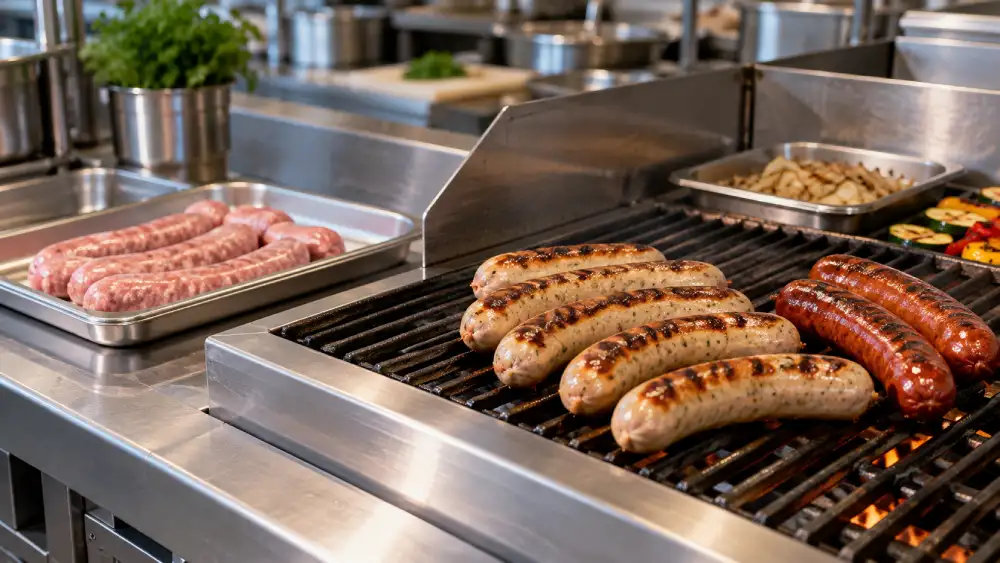
Smoke is one of those sausage characteristics customers often recognise before they can describe it. The aroma arrives first, followed by a savoury depth that makes the product taste more complete, even before mustard, sauce or toppings enter the picture.
Beechwood smoking has a particularly strong connection with German sausage making. Bockwurst, frankfurters and several other German sausage styles are traditionally smoked, as this guide to German sausages and smoked meats1 illustrates.
However, “smoky” does not always mean that a sausage has spent time in a smokehouse. Smoke flavouring can be mixed into the meat, applied to the surface or used as part of a shortened industrial process. It may produce an obvious smoky note, but that is not necessarily the same as the aroma, colour and casing character created by real wood smoke.
For UK caterers and foodservice buyers, the distinction is commercially useful. A genuinely beechwood-smoked sausage can give a menu a clearer product story, stronger aroma during service and a point of difference from a generic hot dog. The important part is understanding what the smoking process actually contributes and how to judge whether the difference is worth paying for.
Why Beechwood Became the Classic Smoke for German Sausages
Beech is a hardwood that produces a relatively clean, controlled smoke when properly dried and burned under suitable conditions. Its flavour is generally milder than heavy barbecue woods such as mesquite or strongly resinous alternatives. That suits finely seasoned sausages because the smoke can support the meat and spices without overwhelming them.
This balance is particularly useful for bockwurst, frankfurters, Vienna-style sausages and other finely textured German products. White pepper, paprika, coriander, mace and garlic can remain noticeable rather than disappearing beneath a dominant layer of smoke.
Not every bratwurst is smoked. Many fresh bratwurst styles are intended to develop their colour and roasted flavour entirely on the grill. Beechwood smoking is more commonly associated with cooked, scalded or cured sausage styles, although individual recipes and regional methods vary.
Wood choice is only one part of the result. Moisture, airflow, combustion temperature and smoking time all change what reaches the sausage. Research into the effects of wood type, smoking time and temperature on sausages2 shows why “wood-smoked” should not be treated as one standard flavour. A carefully controlled beechwood process can create a gentle, repeatable character. Poorly controlled smoking can produce bitterness, uneven colour or a harsh aftertaste.
For an operator, the practical advantage is balance. A mild smoked sausage remains flexible enough for a breakfast plate, premium hot dog, currywurst, loaded roll or simple mustard serve. The smoke gives it identity without dictating the entire menu.
What Real Wood Smoke Adds Beyond a Smoky Taste
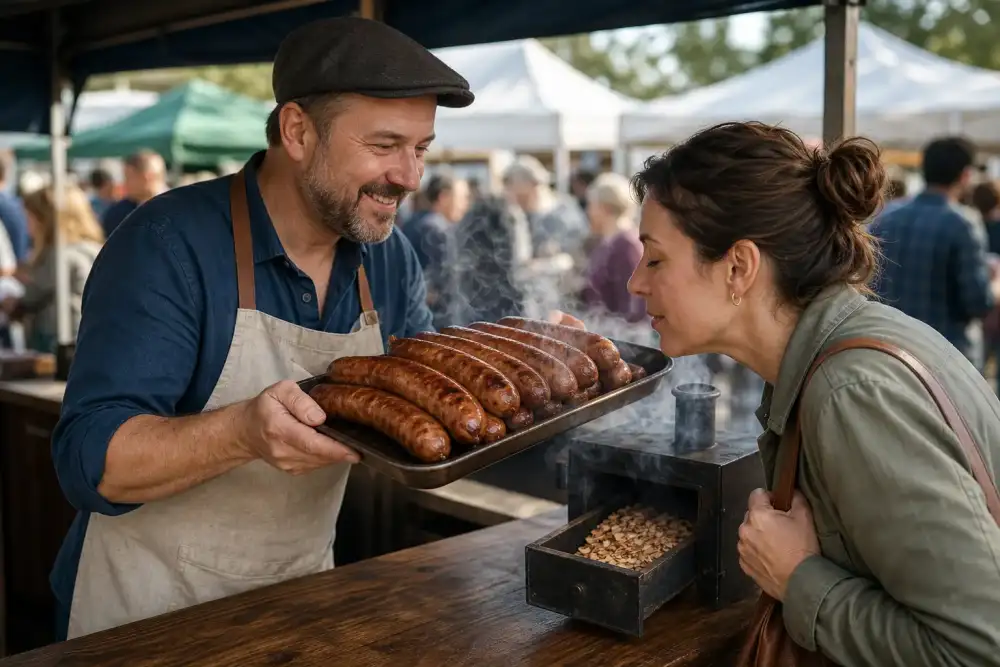
Real smoking is not simply a way of applying one flavour compound. When wood is heated, it releases a complex mixture of volatile substances. These settle on the slightly moist surface of the sausage and interact with its casing, fat, proteins and seasonings.
Phenolic compounds contribute much of the recognisable smoky aroma. Carbonyl compounds are involved in colour development, while organic acids can add sharpness and influence the surface environment. The exact mixture changes with the wood, temperature, oxygen supply and design of the smokehouse.
The technical overview of wood-smoke components and their functions3 explains why smoke affects aroma, colour and the food’s surface rather than acting as a single added seasoning.
Time in the smokehouse also changes the physical product. Controlled warmth and airflow remove some surface moisture, help set the casing and build a more integrated aroma. The smoke is deposited gradually, so the first bite does not taste like a separate flavouring has been placed on top.
That difference can become noticeable during service. As a genuinely smoked sausage warms, its aroma is released into the serving area. On a market stall or festival pitch, that smell has commercial value because customers can encounter the product before they reach the menu board.
The smoke should still remain in proportion. A well-smoked sausage does not need to taste like a bonfire. Its value lies in giving the meat, casing and seasoning a more complete character.
How Smoke Builds Colour Without Simply Dyeing the Casing
Beechwood smoke can help produce the warm golden, amber or reddish-brown exterior associated with many smoked sausages. This happens gradually as smoke compounds settle on the surface and react with components in the casing and meat.
Surface moisture matters. If a sausage enters the smokehouse too wet, smoke may settle unevenly and create patchy or streaked colour. If the surface is too dry, smoke deposition may be limited. Producers therefore control drying, humidity, airflow and temperature rather than simply exposing the sausages to as much smoke as possible.
The outside colour should not be confused with the pink interior of a cured sausage. Internal colour can be influenced by the meat recipe, curing ingredients, paprika and heat treatment. Likewise, the darker marks created later on a grill or plancha come largely from browning and direct heat, not from additional beechwood smoke.
Studies of how different woods affect smoked sausage quality4 also show that wood choice can influence colour, aroma, flavour and the formation of unwanted smoke-related compounds. More smoke or darker colour is therefore not automatically a sign of better quality. Controlled smoking is more important than maximum intensity.
For buyers, appearance is useful but not conclusive. A uniform amber casing may suggest a well-managed smoking process, but similar colour can also be produced through smoke flavouring, colouring ingredients or processing adjustments. The product specification and ingredients list provide better evidence than colour alone.
What Liquid Smoke Can Copy and What It Cannot
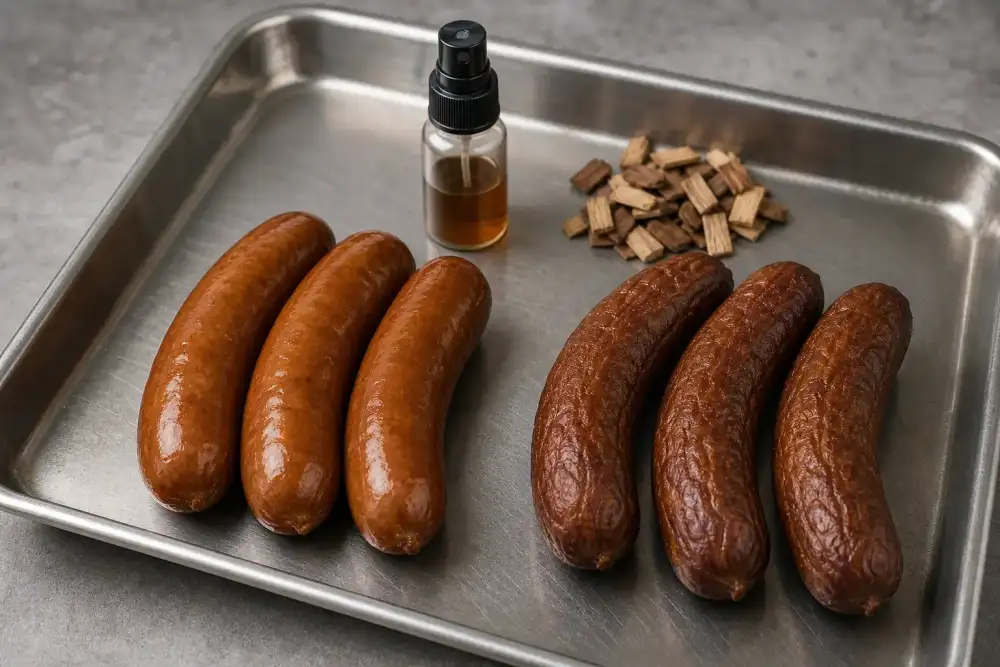
Liquid smoke is not necessarily an artificial laboratory imitation. It is commonly made by producing wood smoke, condensing it and separating or filtering parts of the resulting liquid. The finished smoke flavouring can then be incorporated into a sausage mixture or applied to its surface by spraying, dipping or atomisation.
This has clear production advantages. The amount can be measured precisely, batch variation is easier to control and the producer does not need the same smokehouse time or equipment. It can also create a recognisable smoky flavour at relatively low cost.
A published comparison of traditional and liquid smoking methods5 found measurable differences between the resulting pork sausages, although results from one product and process should not be treated as universal. Other studies have found that liquid smoke can perform well for particular colour, moisture or sensory measurements.
The main limitation is that adding smoke flavour does not automatically reproduce the complete smokehouse process. If the flavouring is mixed into the meat, the sausage may taste smoky throughout but lack the layered surface aroma and slight casing development created by gradual smoke exposure.
Externally applied smoke condensate followed by controlled drying can come closer. Even then, the result depends on concentration, application method, casing, recipe and subsequent cooking.
This is why it is too simple to say that all liquid smoke is bad. It can copy important parts of the flavour and may deliver excellent consistency. What it cannot guarantee on its own is the same interaction between smoke, time, temperature, surface moisture and casing.
When Smoke Flavouring Still Makes Commercial Sense
Smoke flavouring solves genuine manufacturing problems. It reduces processing time, makes dosing easier and can help maintain a consistent profile across large production runs. For price-sensitive products where “smoky” is more important than “traditionally smoked”, that may be a reasonable compromise.
It can also work well when smoke is only one element of a stronger recipe. A heavily sauced chilli dog, for example, may leave little room for customers to appreciate subtle differences between smoking methods. Paying extra for a more nuanced sausage does not automatically create value if the menu covers it with cheese sauce, barbecue sauce and several powerful toppings.
UK food businesses should nevertheless expect smoke flavourings to be properly authorised and used for permitted purposes. The Food Standards Agency maintains a register of smoke flavouring products permitted in Great Britain6, which provides a more reliable reference than assumptions based on the word “natural”.
The sensible buying decision depends on the menu. A genuine beechwood-smoked sausage has greater value when the sausage remains the centre of the dish, the menu makes something of its German character or the aroma contributes to attracting passing trade.
Smoke flavouring may be perfectly adequate for value-led offers, strongly flavoured recipes or products where production consistency carries more weight than a traditional process story. The mistake is not using smoke flavouring. The mistake is paying for one type of product while assuming that it is another.
What Buyers Should Check on the Specification and Label
Product descriptions can make almost any sausage sound reassuringly rustic. Buyers need more concrete information.
Start by asking how the smoke character is created. “Beechwood flavour”, “smoke flavour” and “smoked over beechwood” do not necessarily describe the same process. A useful supplier should be able to explain whether the sausage is exposed to real wood smoke, treated with smoke condensate or made with flavouring incorporated into the recipe.
Other practical questions include:
- Is the sausage genuinely smoked, smoke-flavoured or both?
- Which wood is used?
- Is the product raw, cooked or ready to reheat?
- Does it have a natural, collagen or cellulose casing?
- What cooking or reheating method does the producer recommend?
- How well does it hold during a realistic service period?
- What are the case size, unit weight and expected cooked yield?
- Are the product description and menu claims supported by the specification?
Trading Standards-backed guidance on labelling meat and products containing meat7 says smoked products should be distinguished from products that have not been smoked but contain smoke flavouring. Operators should therefore avoid upgrading “smoke flavour” to “traditionally smoked” when writing menus.
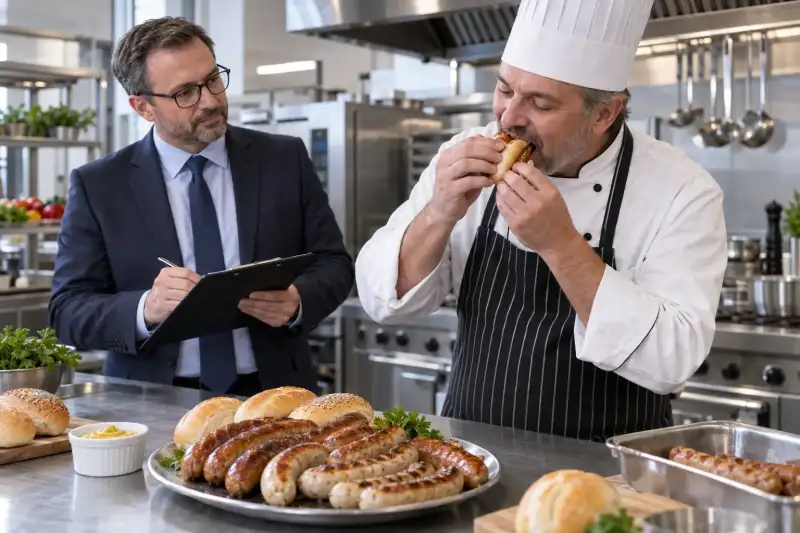
A side-by-side cooking test is still essential. Compare aroma, casing, colour, saltiness, juiciness and flavour after the sausages have been held for the period your service actually demands. The winner at the first bite may not be the winner after 30 minutes on a busy counter.
How to Protect Smoke Character During Service
A good smoked sausage can lose much of its advantage through aggressive reheating. Fierce heat may split the casing, release fat and replace a balanced smoke aroma with scorched notes. It does not create more beechwood character. It simply adds a different form of browning.
For suitable pre-cooked bockwurst and frankfurters, gentle heating in hot water can bring the product to serving temperature without damaging the casing. A brief grill or plancha finish can then add colour where appropriate. Always follow the producer’s instructions because cooking requirements differ between raw, cooked and ready-to-heat products.
Long holding can also flatten the product. Casings wrinkle, surfaces dry and the aroma released during the first part of service gradually disappears. Smaller batches may require slightly more staff attention, but they can preserve appearance and eating quality while reducing the risk of tired sausages sitting on display.
Cooking, cooling, reheating and holding procedures should form part of the operator’s documented food safety system. The Food Standards Agency’s Safer Food, Better Business guidance for caterers8 provides a useful framework, but businesses should also check the product instructions and any requirements applying to their particular site.
Menu design matters too. A genuinely beechwood-smoked sausage usually benefits from toppings that leave room for the product. Mustard, curry sauce, sauerkraut, pickles, crisp onions or a well-chosen relish can provide contrast without burying the smoke beneath several competing flavours.
Frequently Asked Questions
Not necessarily. Beechwood usually produces a relatively mild, balanced smoke character, but the final intensity depends on smoking time, temperature, casing and recipe. Ask for a sample rather than judging from the description alone. A good product should still allow the meat and seasoning to come through clearly.
It can be, but calculate the difference per serving rather than comparing case prices alone. A small increase per sausage may be justified if the product supports a higher menu price, improves a simple serve or gives customers a reason to choose your stand.
The premium is harder to recover when the sausage is buried under several powerful sauces and toppings. Test it in the menu format you actually intend to sell.
That depends on the build. Mustard, sauerkraut, pickles and a balanced curry sauce can complement the smoke. Heavy barbecue sauce, smoked cheese, chilli and multiple rich toppings may cover most of the difference.
useful test is to serve two sausages in identical rolls with your normal toppings and compare them blind. Include staff who regularly serve the product, but also ask people who resemble your typical customer.
Usually, because the smoking has already taken place during production. Reheating a smoked sausage is not the same as operating a smoker on site.
However, grilling can still create heat, grease, cooking smells and vapour. Check the ventilation, fire precautions, equipment restrictions and food handling setup for the premises. A hot-water reheating method may suit sites where a grill or plancha would be impractical, provided it matches the producer’s instructions.
Yes. The casing influences the initial bite, surface texture and how the sausage releases its juices and aroma. A natural casing may provide a more pronounced snap, while collagen casings often offer greater uniformity. Skinless products deliver a different eating experience again.
Casing choice also affects service. A delicate casing may split under fierce heat, while a thicker one may need more careful warming. Compare products using your actual equipment rather than assuming one casing type is always superior.
Only when the supplier can support that description. Ask for the specification or written product information confirming that beechwood is used in the smoking process. Do not upgrade phrases such as “smoke flavour”, “smoky” or “beechwood flavour” into a traditional smoking claim.
This matters particularly when beechwood smoking is being used to justify a premium price. Your menu wording should accurately describe the product customers receive.
Do not assume so. Smoking historically contributed to preservation, but the shelf life of a modern sausage depends on its full production process, packaging, formulation and storage conditions.
Once a pack is opened, follow the producer’s refrigerated storage and use-by instructions. Label opened packs clearly and keep them within your documented stock-rotation system. A smoky smell can also make early signs of deterioration harder to judge, so aroma should never replace proper date and temperature controls.
Some can, but check the supplier’s instructions first. Freezing may affect casing texture, moisture and appearance, particularly if the product is poorly wrapped or repeatedly temperature-cycled.
Where freezing is permitted, freeze within the recommended period, protect the product from freezer damage and thaw it under refrigerated conditions. Run a small test before committing valuable stock, then compare the thawed product with an unfrozen sausage after cooking and holding.
Start with a simple build that allows the sausage to remain the main flavour. A quality roll with mustard and one contrasting topping makes it easier to judge aroma, seasoning, casing and juiciness.
Once the product has passed that test, try it in your busier menu formats such as currywurst or a loaded hot dog. This reveals whether the extra product cost still produces a noticeable benefit after sauces, toppings and service holding are introduced.
Conclusion
Beechwood smoke contributes more to a sausage than a generic smoky taste. When the process is controlled well, it helps develop aroma, surface colour and casing character while supporting the meat and seasoning rather than overwhelming them.
Liquid smoke can reproduce part of that effect. It offers consistency, speed and measurable production control, and it can be entirely suitable for some products. What it does not automatically reproduce is the combined effect of real smoke exposure, gradual deposition, surface drying and time in the smokehouse.
For caterers and foodservice buyers, the right choice depends on how the sausage will be sold. A genuinely beechwood-smoked product is most valuable when its flavour and German character remain visible on the menu. It can strengthen a simple premium hot dog, currywurst or sausage roll without requiring an overloaded list of toppings.
The best way to judge the difference is practical. Check the specification, confirm how the smoke character is produced and cook competing sausages under real service conditions. Then assess them after holding, not only straight from the grill.
If beechwood smoking gives the menu a clearer product story, better aroma and a more complete eating experience, it is doing commercially useful work rather than merely adding another phrase to the description.
The Sausage Haüs
The Sausage Haus brings authentic German-style sausages to the UK market through a partnership between Hardy Remagen and Baird Foods.
Hardy Remagen is a long-established German producer with deep experience in traditional sausage making, continental meat products and modern food manufacturing. The range reflects the kind of products German shoppers already understand and enjoy: Bratwurst, Frankfurters, smoked hotdogs, cheese-filled sausages, Bockwurst, Weisswurst and other classic German-style lines.
In the UK, the range is represented and distributed by Baird Foods, giving retailers, wholesalers, caterers and foodservice operators access to German sausage products with a practical UK supply route. This combination is important: German manufacturing knowledge on one side, UK market understanding and distribution on the other.
For retail buyers, The Sausage Haus range offers a clear way to add something different to both chilled and frozen sausage fixtures. The products are built around real eating occasions: BBQs, premium hotdog nights, family meals, German street food, Oktoberfest promotions, Christmas market food and quick comfort meals at home.
The result is a range that gives shoppers something more distinctive than ordinary sausages and standard hotdogs, while giving buyers a compact, commercially useful product story with strong fresh and frozen potential.
References
Guide to German sausages and smoked meats.
Technical overview of wood-smoke components and their functions.
How different woods affect smoked sausage quality.
UK Government. Authorised Regulated Food and Feed Products for Great Britain.
Labelling meat and products containing meat.
UK Government. Safer food, better business for caterers. GOV.UK. Updated January 29, 2020.