Bockwurst is a straightforward, high-utility German sausage for UK trade: mild flavour, reliable portioning, and easy service across hot holding, plated lunches, and hotdog builds. This spotlight focuses on buyer priorities—spec, yield, food safety controls, and menu execution—so you can select and run Bockwurst with confidence in 2026.
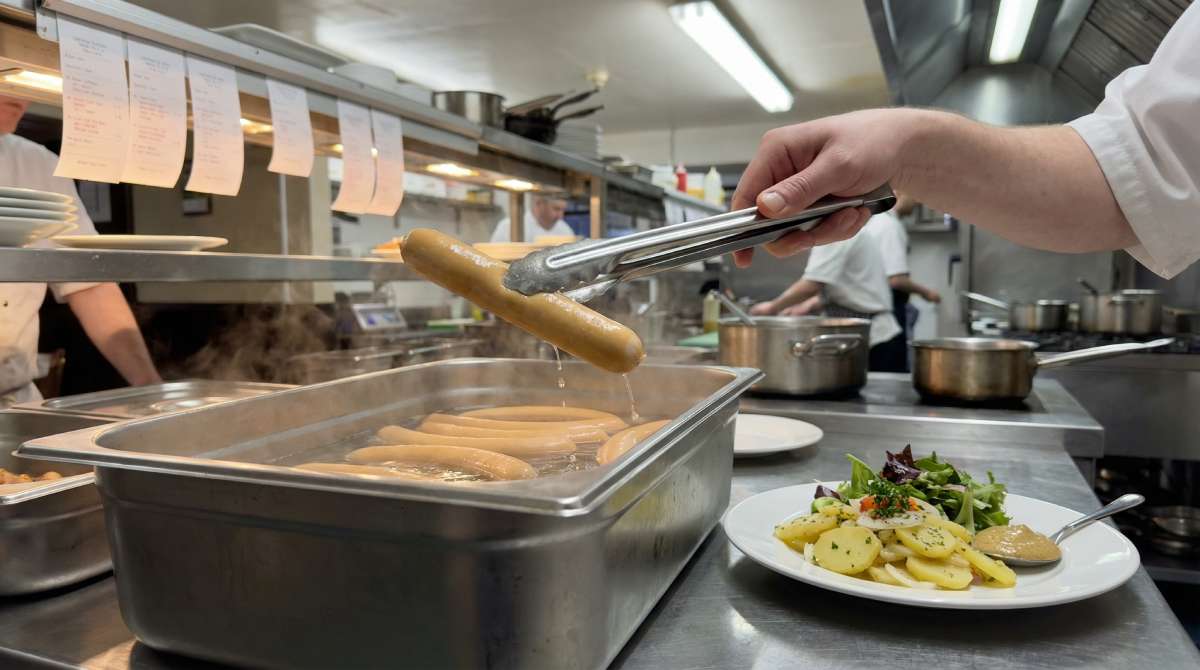
Service-ready Bockwurst: held hot in a bain marie and plated with potato salad, mustard and salad.
Introduction
In UK foodservice, “sausage” is not a category—it is a workflow. Buyers are not only choosing flavour; they are choosing prep time, holding behaviour, yield, waste risk, and how reliably a product performs under the pressure of peak service. A sausage that tastes excellent in a calm test kitchen can still be a poor trade choice if it splits in holding, slows the pass, or creates inconsistent portion costs across shifts.
That is exactly where Bockwurst tends to fit well. Done properly, it is a high-utility sausage: typically mild, broadly acceptable to mainstream customers, and operationally forgiving when you run it with a sensible temperature-control routine. It can serve as a simple, legible menu line that does not require a complicated story. Customers understand “German sausage with mustard” quickly, and the kitchen can produce the same result repeatedly, even when the team is mixed-experience and the tickets are stacking.
For pubs, caterers, stadia kiosks, event operators, and retailers with hot food counters, Bockwurst can be a practical tool because it supports the things trade teams care about most:
- Predictable portion discipline: one sausage, one carrier, one condiment spec, one side spec.
- Fast execution: heat-through and serve, with optional finishing if you want colour.
- Holding potential: it can perform well in controlled hot holding, which matters when demand is spiky and service windows are short.
- Broad menu compatibility: hotdog builds, plated lunches, grab-and-go rolls, or simple counter service.
This is also why the “buyer lens” matters. The right way to assess Bockwurst is not only “does it taste good?” but “does it stay good in our system?” That means asking practical questions: What does the spec say about meat content, allergens, and casing? What is the recommended heating method? How does it behave after 30–60 minutes in hot holding? What does the portion cost look like when you include the bun/plate spec and condiments? Where are the waste points, and can we control them?
This article is written for UK pub kitchens, chefs, buyers, caterers, wholesalers, and retail trade teams. It is evidence-aware in the sense that it prioritises verifiable controls—temperature management, probe discipline, documented holding procedures—and it avoids claims that should be proven via a supplier spec sheet or your own site HACCP. The goal is simple: help you decide whether Bockwurst belongs in your offer for 2026, and if it does, how to run it as a dependable, low-drama profit line.
Key Takeaways
- Bockwurst is a throughput sausage. Mild flavour and simple serving formats make it easy to sell quickly in UK trade settings (pub lunch, events, hot counters).
- Buy it like a buyer: start with the spec sheet. Meat content, casing type, allergen status, and heating instructions matter more than marketing descriptors.
- Yield and waste are usually controlled by process, not product. Overheating, boiling, and poor hot holding practice create split casings, dryness, and shrink.
- Hot holding is a compliance item, not an afterthought. FSA guidance centres on holding hot food at 63°C or above, with a limited time allowance when that is not possible.
- Portion cost is predictable if you standardise the build. One sausage (e.g., 120g), one bun/plate spec, one condiment portion, and one side structure.
- Menu success comes from “simple + repeatable”. One base build and two named variants typically beat five complicated options.
- Common failure modes are preventable. Most problems come from boiling, under-filled holding kit, and inconsistent probe discipline.
What is Bockwurst?
Where it sits in German sausage culture

Classic Rasthof break: Bockwurst with mustard, a bread roll, and hot black coffee.
Bockwurst is one of Germany’s most recognisable everyday sausages: a hot-eating, counter-friendly product that is commonly served with mustard and bread. You see it in places built for speed—canteens, service stations, and quick-service counters—which is exactly why it translates well into UK trade. The product is culturally designed to be simple, fast, and consistent, rather than dependent on garnish, long cook cycles, or niche flavour positioning.
For UK customers, the cleanest framing is “the mild German classic”. It is typically gentler than strongly smoked or heavily spiced sausages, but it still feels distinct from a standard UK banger in bite and serving style. The commercial upside is clarity: the customer understands the offer quickly (“German sausage, served hot, with mustard”), and the kitchen can execute it without adding training burden.
Typical flavour profile and texture
Across reputable German providers, Bockwurst usually sits in a mild-to-medium seasoning range with a smooth, cohesive bite. It is often a fine, well-bound sausage (commonly emulsified), which is one reason it can perform well in hot holding—provided the process is controlled.
For buyers and menu engineers, the most helpful way to describe Bockwurst is not in tasting notes, but in how it behaves in service. In well-run operations it tends to:
- heat through quickly and evenly using gentle heat,
- hold acceptably in a bain marie or cabinet when temperature control is tight, and
- pair naturally with mustard, pickles, and potato salad without needing “chef theatre” to sell.
Why Bockwurst matters in UK trade in 2026
Demand drivers: familiarity without being boring
Most trade operators are looking for the same result: a menu line that feels a touch more premium or distinctive, but still sells to mainstream customers without a lengthy explanation. Bockwurst often fits that brief because it is easy to understand and broadly acceptable in flavour, which reduces the “will this sell?” anxiety that comes with more niche sausages.
In UK terms, it earns its keep because you can deploy it in several commercially useful ways without changing your kitchen model. It can work as:
- a hotdog-style offer with a German angle, without committing the whole menu to a theme,
- a plated lunch special that looks generous while remaining controlled on portion cost, and
- a fast hot counter item that does not require fryer capacity or constant chef attention.
The mild profile can also reduce customer hesitation in mixed audiences (family pubs, motorway-adjacent trade, events). That does not guarantee sales—but it can lower the friction point compared with more assertive, more polarising products.
Operational fit: counters, events, pubs, catering
Bockwurst becomes particularly attractive when your operation has familiar constraints. If you need speed at peak, consistent outcomes across mixed skill levels, and a product that behaves well under hot holding, it can be a practical choice.
It tends to fit well when you are dealing with:
- limited cooking capacity at peak (you need reliable “heat and serve” items),
- mixed skill levels on shift (you need a repeatable method that does not rely on one person),
- hot holding requirements (you want something that can hold safely and still eat well), and
- portion control priorities (consistent plate/bun value is essential).
For wholesalers and retailers there is also a merchandising advantage. Bockwurst is easy to name and explain, and it naturally supports add-ons—mustard, rolls, pickles, sauerkraut, potato salad—which lifts basket value without making the core item complicated.
Spec and quality indicators buyers should check
The non-negotiables on a spec sheet
If you are buying Bockwurst for trade use, the spec sheet is your anchor. Marketing copy helps with positioning, but it is not technical assurance. The practical approach is to treat Bockwurst like any other high-throughput item: confirm the data that affects food safety, yield, and service performance before you commit to listing it.
At a minimum, you want clarity on:
- meat content and declared meat types (pork-only vs mixed),
- allergens (MILK and/or EGG may appear in classic recipes—verify per supplier),
- casing type (natural vs collagen and expected behaviour under heat),
- portion weight (e.g., 120g) plus length/diameter consistency,
- recommended heating method (hot water, steam, combi, etc.),
- storage format (fresh/chilled/frozen) and shelf life assumptions, and
- intended use guidance (some products are optimised for hot holding; others for grill finishing).
If any of this is missing, request it. In foodservice procurement, gaps tend to reappear later as kitchen risk, training time, or avoidable waste.
Casing, smoke, and split risk
In real service, casing is where many sausages “win or lose”. With Bockwurst, you are typically aiming for a casing that stays intact during heating and holding, with minimal splitting under normal conditions and a bite that feels clean rather than rubbery or papery.
When Bockwurst splits, it is usually process-driven rather than mysterious. The common causes are:
- boiling instead of gentle heating,
- overheating in hot holding equipment, and
- dry exposure (insufficient humidity/medium, depending on method).
Smoke profile is another useful indicator—but it is a menu-fit decision, not an automatic “better/worse”. Some Bockwurst is lightly smoked; some is not. Subtle smoke can lift perceived quality, but it can also narrow pairing options if your wider menu is very neutral. Treat smoke level as a deliberate choice rather than an incidental detail.
Allergens and dietary flags (what to verify)
If you are writing menus, supplying retail, or supporting public-sector catering, allergen discipline is non-negotiable. With Bockwurst, verify rather than assume:
- whether MILK is present,
- whether EGG is present,
- whether mustard appears within seasoning (less common, but possible), and
- whether gluten is present (for example via certain binders—varies by producer).
If you do not have a confirmed allergen statement from the producer or distributor, treat the allergen status as unknown and request documentation. Being “evidence-aware” simply means you avoid claims you cannot verify and you make buying decisions on the documents that matter.
Yield, portion cost, and margin logic
Portion discipline for predictable GP
Bockwurst becomes easy to run profitably once the build is standardised. The point is not culinary creativity; it is predictable portion cost and stable gross margin.
A simple portion structure does most of the work:
- one Bockwurst (fixed weight/size, e.g., 120g),
- one carrier (defined bun spec or a plated format spec),
- one condiment spec (a pot or measured stripe), and
- one side spec (pickles and/or a defined potato salad portion).
If you want the item to feel premium, you usually do not need to add more moving parts. Premium in trade often comes from better components and tighter control:
- a bun that holds structure and stays fresh,
- a mustard choice that feels intentional,
- disciplined side portioning, and
- cleaner presentation on the pass.
Waste points and how to eliminate them
Waste on Bockwurst is typically created by process failure rather than the product itself. The usual waste points are holding too long, overheating and splitting, drying out in service, and poor rotation that leads to end-of-shift discard.
The controls are not complicated, but they must be consistent:
- hold smaller batches and rotate faster,
- probe-check at set intervals and record simply,
- use a clear “two-hour” plan where holding cannot be maintained, and
- enforce a staff rule that hot holding kit is for holding, not for cooking or reheating.
This is where many operations quietly win margin: less waste, fewer complaints, and less “fixing” on the fly.
Cooking, reheating, and hot holding without problems
Best-practice heating methods for Bockwurst
Most kitchens get the best eating quality from Bockwurst by using gentle heat rather than aggressive boiling. The goal is to heat through evenly, preserve juiciness, and protect casing integrity—so the sausage looks and eats well on the plate or in the bun.
In practice, that usually means:
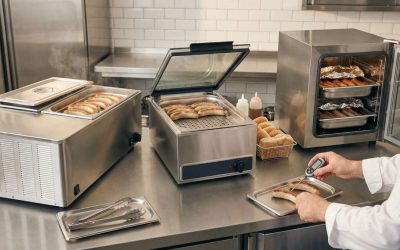
- hot water heating (not boiling) for stable, even heating and lower split risk,
- steam or combi-steam for scalable consistency when settings are correct, and
- an optional light grill/pan finish if you want a touch of colour and aroma.
The key is to keep Bockwurst low-maintenance. It performs best when it is quick, consistent, and juicy—rather than treated like a product that needs constant attention.
Hot holding: what UK guidance expects
Temperature control is a compliance requirement for UK food businesses. FSA guidance indicates hot food should be held at 63°C or above, with a limited allowance to keep food below 63°C for up to two hours when necessary, provided it is managed correctly.
Operationally, the takeaway for a Bockwurst offer is simple:
- If you sell from hot holding, design your method so you reliably stay at or above 63°C.
- If you cannot guarantee that, use a time-based control (one period up to two hours) and follow a documented end-of-period action (use, reheat, chill, or discard) aligned to your site procedures.
Bockwurst can be commercially attractive here because it is well-suited to controlled hot holding when the process is set up properly.
Simple probe and record routine
You do not need an elaborate system to run Bockwurst safely; you need a consistent one that staff can follow under pressure.
A practical routine is:
- preheat hot holding equipment before loading,
- load a manageable batch (avoid overfilling and avoid loading cold product into marginal kit),
- probe-check the thickest part at set intervals,
- record time/temperature/initials in the site log, and
- trigger corrective action immediately if the temperature is below target.
When training staff, two points prevent most issues: probe discipline is about evidence and consistency, and overheating “to be safe” can increase split casings and waste. Follow the method rather than improvising.
Menu and usage ideas that work in pub kitchens
The base build (one workflow, multiple variants)
If you want Bockwurst to be a dependable profit line, build it around one workflow and then offer variants that share most prep. This protects speed and consistency while still giving customers choice.
A strong base build is the simplest hotdog format: Bockwurst in a quality roll, portion-controlled mustard, and pickles. From there, you can create two or three named variants without changing the station:
- Classic German: mustard, pickles, crispy onions
- Curry-style: curry ketchup (or curry sauce) plus a light curry spice dusting (one bottle, one shaker)
- Deli-style: mustard, sauerkraut, and one premium topping (for example fried onions)
The commercial benefit is that you create range perception and upsell potential, but execution remains stable.
Plated lunch formats that hold margin
Plated Bockwurst works best when the plate looks generous but the build is tightly specified. Two formats tend to land well in pubs:
Bockwurst with Southern German-style potato salad: one sausage, one defined potato salad portion, mustard pot, and a simple garnish. It reads premium and “proper” without adding complexity.
Bockwurst with fries and salad: familiar pub logic that sells easily. The margin protection comes from defining salad size and dressing portion so “free extras” do not creep.
For caterers, a tray-service version can also work: sliced Bockwurst over warm potato salad, mustard on the side, and clear labelling with consistent serving utensils.
Counter and event formats for speed
For events and hot counters, the winning conditions are speed and consistency. The simplest way to protect both is to reduce decision points:
- pre-portion buns and condiments,
- run a single service flow that minimises hand movements, and
- keep toppings tight (two options rather than seven).
Bockwurst often performs well here because the offer is legible. Customers do not need persuading: hot sausage, mustard, bread—done.
Common mistakes (and how to avoid them)
Boiling, splitting, and “grey water” holding
The most common quality failure with Bockwurst is boiling. It increases split risk, drives out moisture, and can create an unappealing surface and mouthfeel. The second issue is poor bain marie practice: water not preheated, kit overloaded, holding medium not maintained, and product left too long, leading to dull colour and tired texture.
The fix is practical and repeatable:
- heat gently; do not boil,
- stabilise equipment before service,
- hold in small, fast-rotating batches, and
- keep the method visible on a one-page station card.
Over-complication and slow service
Bockwurst loses its commercial advantage when it becomes complicated. Too many variants, toppings, and side choices typically translate to slower service and inconsistent margin.
A more reliable operating model is:
- one base build and two variants,
- one plated format and one counter format, and
- one clearly defined upsell (extra sausage, premium bun, or a loaded topping).
Misaligned menu pricing
If you price Bockwurst like a budget item, it will often be executed like one: cheaper bun, uncontrolled condiments, inconsistent portioning. That undermines both margin and customer perception.
If you position it as premium-but-simple, you can justify the elements that customers actually notice:
- a better carrier (bun/roll),
- intentional mustard portioning (brand choice matters), and
- cleaner presentation with defined sides.
Pricing should match the operating strategy rather than fighting it.
Buyer checklist for Bockwurst
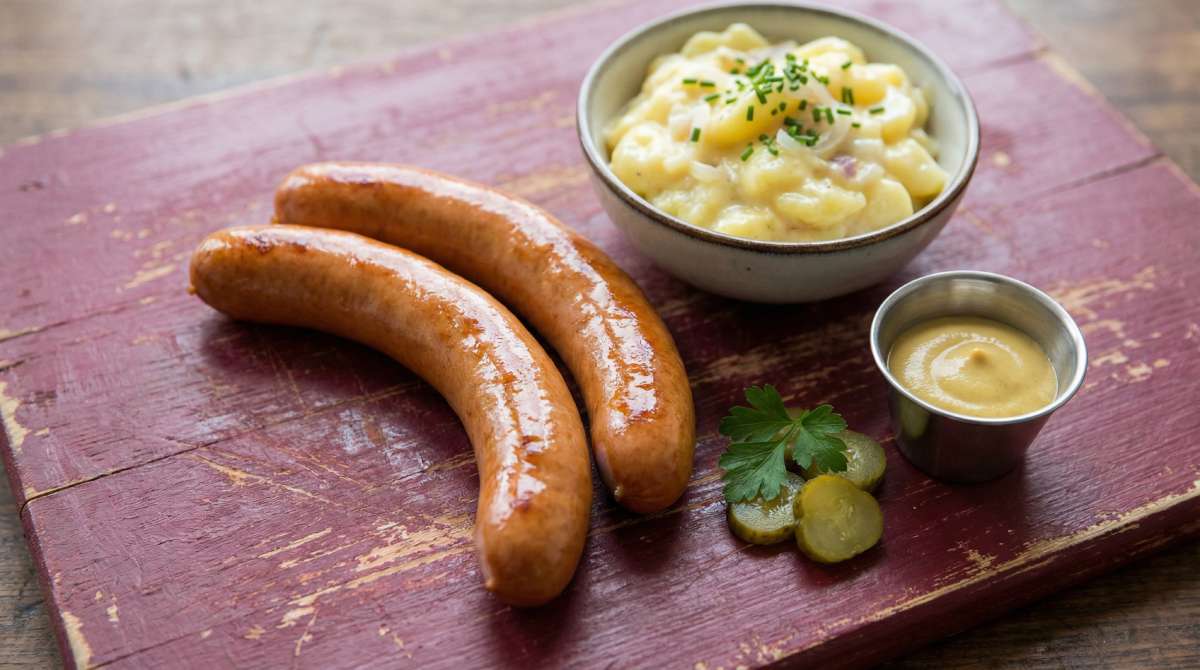
Bockwurst the classic way: warm sausage, mild mustard, pickles and Southern German potato salad.
Pre-purchase checks
Before listing Bockwurst, confirm the fundamentals: spec sheet reviewed (meat content/type, allergens, casing, portion weight), storage format aligned to your operation (frozen vs chilled), heating method compatible with your kit and throughput, portion size suitable for your menu price point, allergen statement current, and lead times/MOQs aligned to forecast.
For The Sausage Haüs range, note the supply chain positioning: produced by Remagen (Germany) and distributed in the UK by Baird Foods.
First-delivery acceptance checks
On first delivery, validate that the product matches the buying intent. You are looking for weight/size consistency across units, intact casing, correct packaging and labelling, compliant receipt temperatures per site procedure, and a trial cook that confirms eating quality and holding behaviour (including split risk).
In-service controls
Once live, keep controls simple and repeatable: defined batch size and rotation frequency, hot holding target and probe schedule, written corrective actions, portion specs for bun/plate/condiment/side, and staff training supported by one station card and one method.
That is what turns Bockwurst from “another sausage” into a dependable profit line that performs under real UK service conditions.
Frequently Asked Questions
Yes, provided you run a proper hot holding routine and keep within your site food safety procedures. UK guidance focuses on holding hot food at 63°C or above, with a limited time allowance when that is not possible—so the key is process control rather than guesswork.
Bockwurst is usually milder and often has a finer, more uniform texture than many Bratwürste. Compared with a Frankfurter, Bockwurst is commonly thicker and served as a more substantial “hot sausage” portion. Exact differences vary by producer, so check the spec for meat type, seasoning and casing.
It can be, because it is easy to explain to customers, quick to serve, and can perform well under controlled hot holding. It also lends itself to simple plated lunches (e.g., potato salad and mustard) with predictable portion cost.
Some classic recipes can include MILK and/or EGG, and some may include other ingredients depending on the producer. Do not assume—confirm from the supplier’s allergen statement and keep your menu allergen info aligned.
The most reliable formats are:
- Hotdog-style roll with mustard and pickles (plus one or two optional toppings)
- Plated lunch with potato salad and mustard
- Counter/event service with a tight topping set and fast rotation
At minimum: portion weight (e.g., 120g), meat type/content, allergens, casing type, recommended heating method, storage format (frozen/chilled), shelf life, and whether the product is intended for hot holding versus grill finish.
The most common causes are boiling (instead of gentle heating), overheating in hot holding equipment, and holding too long without tight rotation. In most cases, split risk and dryness are process issues that can be reduced with a consistent method.
Bockwurst is a classic German hot-eating sausage, typically mild in seasoning with a smooth, cohesive bite. It is commonly served hot with mustard and bread, and it is well suited to quick-service formats.
Confirm the spec and allergen statement, run a short kitchen trial under your real hot holding conditions, set portion specs (sausage, bun/plate, condiments, sides), and agree probe/record routines and corrective actions. This turns Bockwurst into a repeatable profit line rather than a “nice idea” item.
Most kitchens get consistent results by heating it gently (for example in hot water that is not boiling, or with steam/combi-steam). A brief pan or grill finish can be used for colour, but it is not essential for a strong offer. Always follow the producer’s instructions.
Conclusion
Bockwurst can be a commercially sensible sausage line for UK trade in 2026 when you treat it as a system: a clear spec, controlled heating, compliant hot holding, and a simple serving format that staff can execute under pressure. The product’s strength is not novelty; it is repeatability—mild flavour, legible menu language, and portion discipline that supports predictable margin.
If you are considering adding Bockwurst to a pub menu, event offer, or wholesale set, start with the buyer basics: confirm the spec sheet, run a short kitchen trial under real holding conditions, and build one base format with two variants. If you want support selecting the right format for your service model, The Sausage Haüs team can advise on pack formats, usage ideas, and trade-friendly execution.
About Sausage Haüs
The Sausage Haüs supplies authentic German sausages for UK foodservice and trade customers, designed for consistent handling, clear portion control, and strong customer appeal. Our range is produced by Remagen (Germany) and distributed in the UK by Baird Foods, supporting reliable supply for pubs, caterers, wholesalers, and retailers.
Our current core range includes Bratwurst, Bacon Frankfurter, Chilli Beef Frankfurter, Cheese Frankfurter, Beef Hotdog, Jumbo Pork Hotdog and Munich Weisswurst – products engineered for dependable service performance and commercially strong menu applications, from hot counters and events to pub kitchens and retail freezer or chilled cabinets.