Choosing sausages for foodservice involves far more than comparing case prices.
A quotation might tell you that Product A costs a few pence less per sausage than Product B. It does not tell you how consistently those sausages fit your buns, how they behave during reheating, whether they still look good after hot holding, how convenient the inner packs are, or whether every delivery performs like the sample you originally approved.
For a small café, pub or farm shop, those details affect day-to-day service. For a multi-site operator, wholesaler, event caterer or large foodservice buyer, small differences can become significant when multiplied across thousands of portions.
That is why a useful sausage buying guide should look beyond price per case and even beyond taste alone.
For pre-cooked German sausages such as Bratwurst, Frankfurters, Bockwurst and other foodservice lines, the buying decision should include formulation, eating quality, casing, physical consistency, regeneration, holding performance, packaging, shelf life, allergen information and batch consistency.
The cheapest sausage on the quotation may still be the right product. But it should win because the complete commercial proposition works, not simply because one number is lower.
Start with the operation, not the case price
Before comparing sausages, define what the sausage actually has to do.
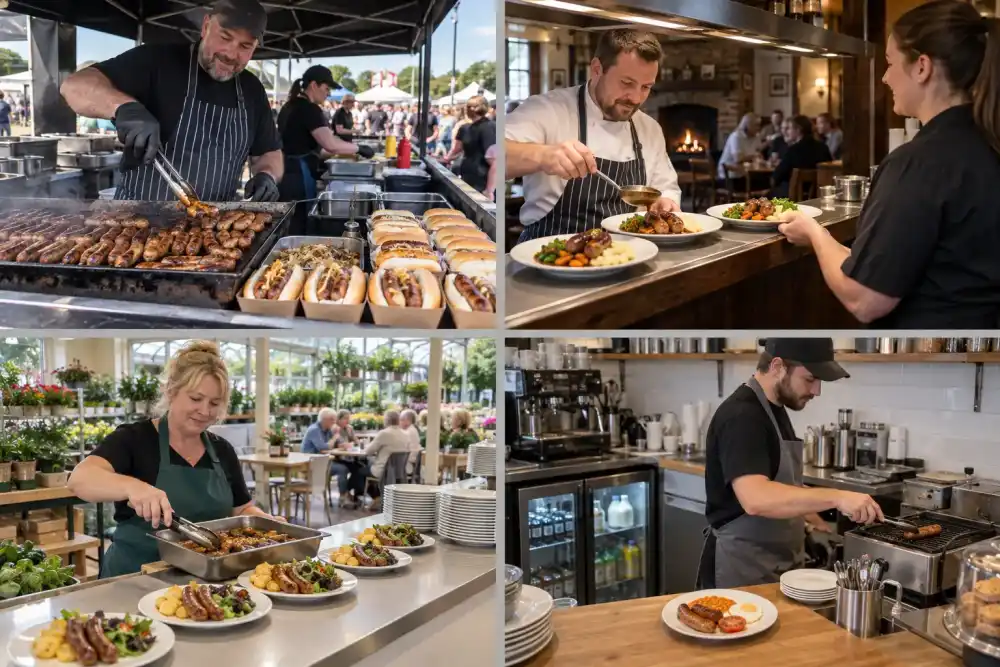
A festival trader serving hundreds of sausage rolls in a short lunchtime rush has different requirements from a country pub offering a premium sausage plate. A garden centre café may prioritise simple preparation and predictable portions, while a wholesaler needs products that work for several different customer types.
Start with practical questions.
How will the sausage be served? Will it go into a standard bun, onto a plated meal, through a buffet or into a loaded street-food dish? Will it be reheated to order, cooked in batches or held ready for service? Will staff use a grill, pan, oven, hotplate or another approved method?
Storage matters too. A frozen product may offer useful stock flexibility, but only when there is adequate freezer capacity and a workable defrosting or cook-from-frozen procedure where the manufacturer permits it. A chilled line may suit a high-throughput operation differently.
Then consider service volume, selling price and staff capability.
A product intended for a 50-cover pub does not necessarily need the same operational characteristics as one going through a stadium kiosk or busy outdoor event.
Once that brief is clear, comparing quotations becomes much more meaningful.
The 10-point sausage buyer’s scorecard
1. Meat content and formulation
Meat content is an obvious place to start, but it should not become the entire quality assessment.
UK rules set composition requirements for certain meat products using reserved descriptions such as sausage. Buyers who want the regulatory background can refer to the government's guidance on meat products and reserved descriptions1. (GOV.UK1)
For a commercial buyer, however, the full formulation matters more than one percentage in isolation.
Look at the type of meat, fat level, seasoning, salt, added ingredients and overall formulation. These influence flavour, juiciness, texture and how the sausage performs when reheated.
A sausage with an impressive headline meat percentage is not automatically the best product for every operation. Equally, a low purchase price should not distract from a formulation that produces a noticeably weaker eating experience.
The question is whether the specification matches the quality level you intend to sell.
2. Flavour and eating quality
A sausage can look excellent on a specification sheet and still be wrong for the menu.
Taste the product in the way the customer will actually receive it.
That means not only sampling a piece of sausage on its own at a supplier meeting. Try it in the intended bun, with the relevant sauce, as part of the planned plated dish, or with whatever sides normally accompany it.
Pay attention to seasoning, saltiness, smoke, richness and aftertaste.
Also consider what happens after the third or fourth bite. An intensely flavoured sausage can be impressive in a small sample but overpowering when served as a full portion. Conversely, something that initially seems restrained may work very well once mustard, onions, curry sauce or other toppings are added.
The right level of flavour depends on the job.
A classic Bratwurst, a smoky Frankfurter and a cheese-filled sausage are solving different menu problems. They should not all be judged against exactly the same sensory brief.
3. Casing, bite and texture
Casing affects more than appearance.
Natural casing, collagen casing and skinless products can deliver different levels of snap, tenderness and resistance when bitten. They can also behave differently on equipment and during service.
There is no universal rule that one casing is always better.
For a premium sausage served relatively simply, a pronounced snap may be part of the desired eating experience. Another operation may prefer a softer bite because the product is being served to a broader customer base or incorporated into a more complex dish.
The filling texture matters alongside the casing. German-style sausages often have a finer texture than traditional coarse British sausages, and that difference may be exactly what the menu requires.
Assess the complete bite rather than judging the skin separately from the filling.
4. Size and portion consistency
A nominal 100 g sausage tells only part of the story.
Weight, length and diameter all matter commercially.
If the sausage is intended for a particular roll, excessive variation in length can make one portion look generous and another look disappointing. Diameter influences visual impact, reheating time and how comfortably the finished product sits in the bun.
Consistency is particularly important for multi-site operations because specifications are normally designed around repeatable portions.
The pack itself also needs to contain what the buyer expects. Packaged goods sold by declared weight are subject to separate UK quantity rules, explained in the government's guidance on weights and measures for packaged goods2. (GOV.UK2)
For procurement purposes, go further and ask the supplier about the expected unit weight, physical dimensions and normal production tolerances.
The goal is not laboratory-level uniformity. Food products naturally vary. The question is whether that variation is controlled tightly enough for the intended operation.
5. Reheat performance
For a pre-cooked sausage, "cooked yield" is often less useful as a buying criterion than reheat performance.
The buyer needs to know what happens when the product moves from the pack to the customer.
Does it heat evenly? Does the skin split easily? Does it lose noticeable moisture? Does the surface colour attractively? Can staff achieve a good result without unusually careful handling?
Test the sausage using the equipment your sites actually have.
A product that performs beautifully on a development kitchen grill may behave differently on a flat-top, in an oven or during high-volume batch preparation.
Always follow the manufacturer's cooking or reheating instructions and your own food-safety procedures.
The commercial question is simple: can ordinary trained staff produce the intended result repeatedly during real service?
6. Hot-hold performance
This can be one of the most important characteristics for event catering, food-to-go, buffets and high-volume hospitality.
A sausage may be excellent immediately after reheating but deteriorate quickly once held.
Look for changes in skin texture, wrinkling, splitting, moisture, colour and overall appearance. Then taste it again. A product can remain visually acceptable while becoming noticeably drier or tougher.
Food safety comes first. The Food Standards Agency states that food being hot held should normally be kept at 63°C or above and gives further practical detail in its hot-holding guidance for food businesses3. (GOV.UK3)
If quality deteriorates during safe hot holding, the answer is not to reduce the holding temperature. It is to adjust batch size, holding duration, equipment or workflow.
That makes hot-hold testing a useful part of procurement rather than something the kitchen discovers after the product has already been listed.
7. Pack and case configuration
Case price attracts attention. Case configuration often determines how easy the product is to use.
Suppose two suppliers offer similar sausages in similar total case weights. One case contains several manageable inner packs, while the other contains a format that requires considerably more product to be opened or defrosted at once.
For a very high-volume site, that difference may be irrelevant.
For a smaller café, pub or mobile trader, it could affect waste, freezer space, stock rotation and preparation.
Check:
- sausages per inner pack
- inner packs per case
- whether packs are resealable or individually separated where relevant
- chilled or frozen format
- case dimensions and storage requirements
- whether partial-case use fits normal service volume
The "best" configuration therefore depends partly on throughput.
Large packs can be efficient when turnover is high. Smaller inner packs can provide more control where demand fluctuates.
Packaging is not glamorous, but neither is throwing away food because the pack format did not suit the operation.
8. Shelf life and storage requirements
Shelf life should be examined alongside the way stock actually moves through the business.
A theoretically generous shelf life provides little benefit if the case format, storage requirement or defrosting process does not match normal usage.
Likewise, frozen products can offer useful stock flexibility, particularly for businesses with seasonal or uneven demand. That advantage depends on having appropriate freezer capacity and disciplined stock rotation.
The Food Standards Agency provides current guidance on chilling, freezing and defrosting food safely4. (GOV.UK4)
Buyers should establish the manufacturer's storage instructions and relevant date information for the exact product being considered.
It is also worth asking what applies once an inner pack is opened or, where relevant, once frozen product has been defrosted.
This is where a specification can have a direct operational effect.
A product with a slightly higher unit cost but a format that fits normal turnover may create less avoidable waste than a theoretically cheaper case that is awkward to manage.
9. Allergens and specification documentation
For serious foodservice procurement, good documentation is part of the product.
The buyer needs accurate ingredient and allergen information that can move reliably from supplier to menu planning, kitchen procedures and customer communication.
The Food Standards Agency's allergen guidance for food businesses5 explains current requirements and emphasises keeping allergen information accurate and available. (GOV.UK5)
Do not simply ask whether a sausage "contains allergens".
Look at which allergens are present, how they are declared, whether precautionary statements apply, and how specification changes are communicated.
This becomes increasingly important as an operation grows.
At one independent site, the owner may personally know every product. Across dozens of locations, accurate specifications have to pass through purchasing systems, training materials, recipes, menus and front-of-house communication.
The more sites involved, the less room there is for informal knowledge.
10. Batch-to-batch consistency
The sample is not the business.
The business begins when the second, fifth and fiftieth delivery perform like the sample.
Consistency covers flavour, seasoning, appearance, unit dimensions, casing, texture and cooking behaviour. Some natural variation is inevitable, but large variations make an otherwise good product difficult to operate.
This matters especially where a product is rolled out across several locations.
Customers should not receive noticeably different portions because they happened to visit a different site or because a new batch arrived that week.
Kitchen procedures also become more difficult when products behave unpredictably.
A premium sausage should therefore be assessed not simply on how good the best sample can be, but on how reliably the agreed specification is delivered.
For large accounts, that reliability may ultimately be more valuable than a small difference in headline price.
Why unit price can hide the real cost of service
There is nothing wrong with negotiating hard on price.
Food businesses have to control costs, and a few pence multiplied across substantial volumes can become meaningful money.
The mistake is treating purchase price as though it were the same thing as cost in service.
A more useful commercial calculation considers the whole portion.
That might include the sausage itself, expected waste, the bun or accompaniment, sauces, preparation requirements, staff time, holding losses and the risk of stock expiring before it can be used.
Not all of those costs can be neatly attributed to one sausage. The point is to identify differences that are genuinely large enough to affect the operation.
A product that costs slightly more but arrives in a better pack format, works consistently with existing equipment and reduces avoidable waste may be commercially competitive with a cheaper alternative.
The opposite is equally true.
Do not pay extra for characteristics your business does not need.
A tightly specified premium product designed for long hot-hold periods provides little additional value to a restaurant that cooks every sausage directly to order.
The useful question is therefore not:
Which sausage has the lowest price?
It is:
Which sausage gives us the right customer experience at the most sensible total cost for this operation?
Test the sausage the way your team will actually use it
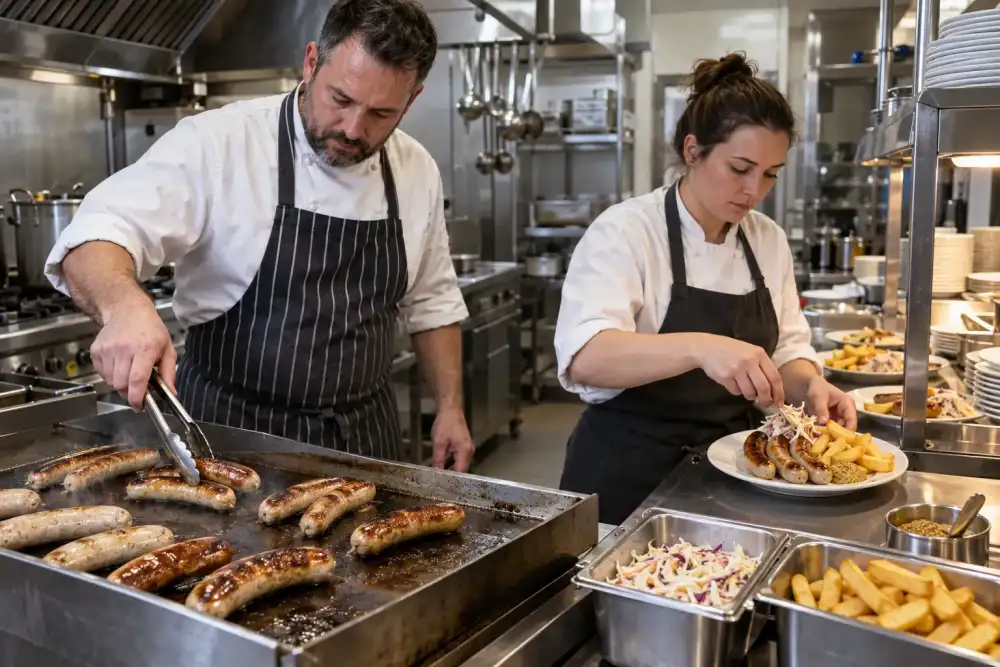
Supplier samples should be treated as the beginning of an evaluation, not the end.
Run a simple service trial.
Use the same equipment, batch sizes and staff procedures that would be used in normal trading. If the product is destined for several types of site, test the important variations.
A practical trial might record:
| Test | What to look for |
|---|---|
| Straight reheating | Time, even heating, moisture and appearance |
| Grill or flat-top finish | Browning, splitting and handling |
| Bun test | Length, diameter, stability and presentation |
| Full build | Balance with sauces, toppings and sides |
| Batch service | Ease of handling at realistic volume |
| Hot holding | Appearance, texture and moisture over the intended service period |
| Portion check | Weight, length and visual consistency |
| Staff feedback | Ease, speed and obvious failure points |
Testing should reproduce realistic service rather than create ideal conditions.
If an event trader expects staff to serve continuously during a two-hour rush, evaluate the product under something resembling that pressure. If a pub will cook to order during quieter periods but batch during football fixtures, test both methods.
Do not overlook the simplest question either.
Ask the people preparing it.
A chef, kiosk worker or street-food trader may spot an operational problem immediately that is barely visible from the purchasing office.
Compare suppliers on a genuinely like-for-like basis
Buyer comparisons become unreliable when Supplier A quotes one format and Supplier B quotes another.
Before comparing price, normalise the information.
Make sure you understand the nominal unit size, units per case, total case weight, inner-pack configuration, storage format, shelf life, ingredients, allergens and preparation requirements.
Then separate product factors from supplier factors.
The sausage itself may be excellent, but the commercial relationship also depends on availability, ordering arrangements, minimum quantities, lead times, delivery pattern and communication.
Those should be evaluated separately rather than allowing one attractive headline price to blur everything together.
Traceability is another basic part of professional food procurement. UK government guidance states that food businesses must keep appropriate supplier and transaction records, with more detail available in its guidance on food suppliers and traceability6. (GOV.UK6)
For buyers, good supplier information therefore has value beyond administration.
Clear product codes, batch information and specification control make it easier to operate confidently and respond efficiently if a problem ever needs investigating.
A strong comparison should eventually let you explain not only which product you selected, but why.
Build the specification before asking for the quote
One of the simplest ways to improve purchasing is to define the requirement before asking suppliers what they have.
Otherwise, the process can become supplier-led.
One company offers a 90 g product, another quotes 100 g, another offers 120 g. Pack sizes differ. Some are frozen, some chilled. Different casing types and formulations appear.
Soon the buyer is comparing prices that do not describe equivalent solutions.
Instead, start with a short buying brief.
For example:
- intended menu use
- target unit weight and acceptable range
- preferred length and diameter
- required eating style and flavour profile
- casing preference, if important
- chilled or frozen requirement
- expected preparation method
- realistic hot-holding requirement
- preferred inner-pack size
- allergen constraints
- required documentation
- estimated volumes and delivery pattern
Retail products may require additional packaging and labelling considerations. Government guidance summarises the information that food labels may need to display7. (GOV.UK7)
Not every specification should be rigid.
Sometimes a supplier has a better solution than the one originally imagined. The purpose of the brief is not to prevent alternatives. It is to make clear what commercial problem the product is supposed to solve.
That produces a much better supplier conversation.
Turn the scorecard into a better buying decision
Not every buyer should give all ten criteria the same importance.
A Christmas market trader might place exceptional weight on hot-hold performance, portion consistency and speed of preparation.
A premium farm shop may care more about flavour, formulation, provenance, pack presentation and customer differentiation.
A national foodservice operation is likely to place particularly high value on specification control, allergens, consistency, logistics and reliable execution across multiple locations.
That is why the scorecard should be weighted around the operation.
A simple approach is to mark each factor as essential, important or desirable before supplier samples arrive.
Then score each serious candidate against the same brief.
This prevents one particularly good characteristic from dominating the decision. A fantastic flavour sample should not hide an unsuitable case format. Likewise, an attractive unit price should not disguise inconsistent dimensions or poor hot-hold performance.
It also gives procurement, operations and food development a common language.
Instead of arguing that one sausage "seems better", teams can discuss where each product performs well, where compromises exist and which differences actually matter to the customer.
That is what a useful buyer's scorecard should do.
Frequently Asked Questions
One tasting session is rarely enough for an important foodservice listing. Ideally, test the product more than once and under realistic service conditions, particularly if volumes will be significant.
For a larger rollout, it can also be useful to evaluate sausages from more than one production batch. That helps distinguish genuine consistency from an unusually good sample. The larger the account, the more important it becomes to know that normal deliveries will perform like the product originally approved.
Not necessarily. A higher price may reflect a different formulation, casing, pack format or positioning, but none of those automatically makes the product better for your operation.
The better question is whether the additional cost produces something commercially useful. Better flavour, easier preparation, stronger presentation or a more suitable pack format may justify a premium. Paying extra for characteristics your customers will not notice or your kitchen does not need usually will not.
Often, yes. One well-chosen sausage can simplify purchasing, stock control and staff training while appearing in several different menu formats.
For example, the same sausage might work in a roll, a plated dish and a loaded street-food style serve. The important limitation is that the product must genuinely suit each application. Stretching one SKU across dishes where it does not fit simply to reduce stock lines can weaken the menu.
More important than it sounds. A good sausage in the wrong bun can make the finished portion look poorly judged.
sausage that is noticeably shorter than the roll may appear ungenerous, while one that is too long or thick can be awkward to eat and difficult to dress consistently. Buyers planning a hotdog offer should ideally test sausage and bun together rather than sourcing them independently and hoping the dimensions work.
That depends mainly on throughput, storage capacity and how predictable demand is.
Chilled products can work particularly well where stock turns quickly and regularly. Frozen sausages can offer useful flexibility for seasonal businesses, event operators or sites with uneven demand because stock can be held for longer before it is needed.
Neither format is automatically better. Compare the complete operating process, including delivery frequency, available storage, defrosting requirements where applicable and how much product is normally needed at one time.
Treat any meaningful formulation or specification change as something that should be reviewed rather than assumed to be equivalent.
Changes in ingredients, allergens, casing, dimensions, unit weight or preparation instructions could affect menus, operational procedures or customer information. Larger buyers may therefore want clear processes for receiving and reviewing updated product specifications before changed stock enters normal service.
They are the correct starting point, but they do not replace an operational trial.
Manufacturer instructions tell you how the product should be prepared safely and correctly. They do not necessarily tell you how easily 40 portions can be produced during a lunch rush, how the sausage works with your equipment or whether your intended holding system maintains the quality you want.
Test the approved preparation method within your actual workflow before committing to substantial volumes.
Usually when there is a clear commercial reason for doing so.
particular weight, length, flavour profile or format may make sense for a large-volume customer with a defined menu concept. Bespoke development is much harder to justify when an existing product already performs the required job well.
Before requesting a custom specification, establish what problem the change is intended to solve and whether expected volumes make the additional complexity realistic.
Yes, particularly once the shortlist becomes serious.
Procurement can compare price, specifications and commercial terms, while chefs and operational staff can identify practical issues such as awkward handling, slow preparation, poor bun fit or deterioration during service.
The strongest decisions usually combine both perspectives. A product has to make commercial sense on paper and still work when somebody has to serve it during a busy shift.
There is no universal timetable, but it makes sense to review it when something important changes rather than waiting for a problem.
Triggers might include a new menu, different equipment, higher volumes, supplier changes, repeated site feedback, unusual waste levels or a noticeable change in customer response.
periodic comparison can also be worthwhile for large-volume accounts, but changing suppliers simply because another quotation is marginally cheaper can create more disruption than value if the existing product performs reliably.
Conclusion
A commercial sausage purchase should never become unnecessarily complicated. Equally, reducing the entire decision to price per unit leaves out many of the things that determine whether the product works once it reaches a real kitchen, counter or event stall.
For pre-cooked German sausages, a practical buying assessment should consider formulation, flavour, casing and texture, size consistency, reheating, hot holding, pack format, shelf life, allergens and batch-to-batch reliability.
The relative importance of those factors will change from one operation to another.
A festival trader, pub group, café, wholesaler and retailer are not buying exactly the same solution even when the sausage itself appears similar.
The sensible approach is to define the operational requirement first, test realistic samples against it and only then compare the complete commercial proposition.
Unit price still matters. It simply belongs inside a bigger calculation.
At The Sausage Haus, we work with German sausage products for different UK retail, catering and foodservice applications. If you are assessing a range or trying to identify the right format for a particular operation, a clear service brief is usually the best place to start the conversation.
I deliberately kept the article centred on buyer decision-making rather than turning it into a thinly disguised Sausage Haus sales page. That should also give us much stronger material for the LinkedIn post afterwards.
The Sausage Haüs
The Sausage Haus brings authentic German-style sausages to the UK market through a partnership between Hardy Remagen and Baird Foods.
Hardy Remagen is a long-established German producer with deep experience in traditional sausage making, continental meat products and modern food manufacturing. The range reflects the kind of products German shoppers already understand and enjoy: Bratwurst, Frankfurters, smoked hotdogs, cheese-filled sausages, Bockwurst, Weisswurst and other classic German-style lines.
In the UK, the range is represented and distributed by Baird Foods, giving retailers, wholesalers, caterers and foodservice operators access to German sausage products with a practical UK supply route. This combination is important: German manufacturing knowledge on one side, UK market understanding and distribution on the other.
For retail buyers, The Sausage Haus range offers a clear way to add something different to both chilled and frozen sausage fixtures. The products are built around real eating occasions: BBQs, premium hotdog nights, family meals, German street food, Oktoberfest promotions, Christmas market food and quick comfort meals at home.
The result is a range that gives shoppers something more distinctive than ordinary sausages and standard hotdogs, while giving buyers a compact, commercially useful product story with strong fresh and frozen potential.
References
UK Government. Meat products: sell them legally in England. GOV.UK. Updated January 3, 2017.
UK Government. Weights and measures: the law. GOV.UK. Updated December 15, 2014.
UK Government. Sfbb Caterer Cooking 06 Hot Holding 0. GOV.UK.
Guidance on chilling, freezing and defrosting food safely.
UK Government. food businesses. GOV.UK. Updated July 17, 2026.
UK Government. Running a food business. GOV.UK. Updated January 30, 2025.
UK Government. Food labelling and packaging. GOV.UK. Updated December 4, 2014.