
Built for busy events
Chips lift sausage sales

Best fit for winter crowds
Overview
The UK’s favourite event foods are not always the same as the takeaway meals people order at home. At festivals, markets, Christmas markets, air shows and sports events, customers choose food differently. They want something hot, fast, filling, easy to carry and tempting enough to eat while walking, watching or queuing.
That is where German hot dogs, bratwurst, currywurst and premium frankfurters have a clear role. They combine the familiar appeal of sausage in a bun with a stronger event-food identity: smoky grills, generous portions, bold toppings, curry sauce, chips and the natural connection with Christmas markets and continental street food.
German hot dogs may not be one of the UK’s biggest everyday takeaway categories yet, but in the right event setting they can perform like a major crowd-pleaser. From small market days to large food festivals and air shows, German sausages can offer caterers a focused, fast-moving and highly flexible menu format that competes with burgers, fried chicken, loaded fries and other popular event foods.
Key Takeaways
- Event food is different from takeaway food. At festivals, markets and sports venues, customers choose with their eyes, nose and appetite in the moment. Speed, smell, visibility and portability matter.
- German hot dogs fit the event environment extremely well. They are hot, handheld, filling, easy to understand and quick to serve, which makes them practical for high-footfall catering.
- Bratwurst, currywurst and frankfurters offer more identity than a basic hot dog. They feel more premium, more distinctive and more connected to street-food and Christmas-market culture.
- Chips are a major part of the opportunity. In real event catering, sausage-and-chips meals can turn a simple snack into a full meal, with currywurst and chips especially strong.
- German sausages can sell serious volume. Strong town food festivals, air shows and large multi-day events can produce hundreds or even thousands of sausage sales when the pitch, menu and service speed are right.
- Christmas markets are the most natural setting. British customers already associate German sausages with winter markets, wooden stalls, mulled wine, beer, mustard, sauerkraut and hot food.
- The best menus stay focused. A simple range of bratwurst, currywurst, jumbo smoked hot dogs, cheese frankfurters, chilli bacon frankfurters, chips and sauces can feel varied without slowing service.
- German hot dogs do not need to replace burgers or fried chicken. Their strength is that they sit alongside them as a practical, premium and memorable event-food option.
At home, the UK’s favourite fast foods are easy to guess. People order Chinese, Indian, pizza, burgers, fried chicken, kebabs and fish and chips. But event food is different.
At a festival, Christmas market, air show, food market or sports venue, people are not sitting on the sofa scrolling through a delivery app. They are walking, queuing, drinking, managing children, watching a performance, looking for warmth, or trying to grab something filling before the next part of the day begins.
That changes the food decision completely.
Event food has to work harder. It must be fast to serve, easy to hold, satisfying enough to feel like a meal, and tempting enough to win attention in a crowded field of other stalls. It must smell good, look good, survive bad weather, work with chips, and still taste good when eaten standing up with a wooden fork.
That is where German hot dogs, bratwurst, currywurst
They may not yet be one of the UK’s biggest everyday takeaway categories in the same way as pizza or burgers. But in the world of event catering, German sausages make immediate sense. They combine the familiarity of sausage in a bun with the stronger identity of continental street food, Christmas-market tradition and premium hot dog culture.
And in the right setting, they can sell in serious volume.
The UK event-food opportunity is huge
The UK events industry is not a small niche. The UK Events Report 2024 estimated that the UK events industry generates £61.653 billion annually, with leisure and outdoor events, including music festivals, sporting events and cultural festivals, contributing £28.053 billion.
Outdoor events are especially relevant for food traders and foodservice operators. Research reported by Access All Areas estimated the UK outdoor-events sector at more than £25 billion, with around 200 million outdoor event attendance occasions each year across festivals, sport, cultural gatherings and community events. The same report referred to 592 active music festivals, around 70,000 charities running at least one outdoor event each year, and agricultural shows attracting about 7 million attendees annually.
Music alone is a major part of this picture. UK Music reported that 23.5 million music tourists attended UK concerts and festivals in 2024, spending a record £10 billion in total. That spending includes more than just tickets. It also includes travel, accommodation, food, drink and other event-related purchases.
Sport adds another large market. Two Circles reported that ticketed professional sport in the UK reached a record 79.4 million attendances in 2025, above both 2024 and the pre-pandemic benchmark of 2019.
For foodservice, the conclusion is simple: the UK has a huge culture of outdoor events, live entertainment, markets and sport. The question is not whether people eat at these events. They do. The real question is which foods can handle the combination of footfall, speed, appetite, weather and queue pressure.
Event food is not the same as takeaway food
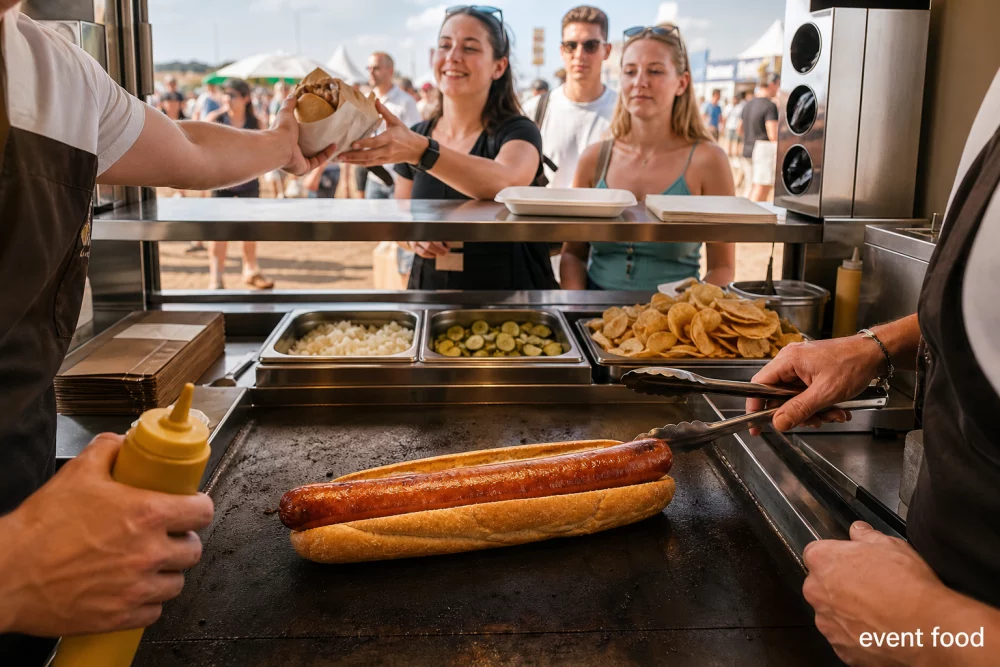
A takeaway is chosen with time. Event food is chosen in the moment.
That matters. At home, people may compare menus, read reviews, wait 40 minutes and accept that the food arrives in bags and boxes. At an event, the customer makes a much faster decision. They look around, smell the grills, judge the queue, check the price board, and decide what feels worth eating now.
The strongest event foods usually have a few things in common:
- They are visible. A burger on a griddle, chicken in a fryer, chips in a tray or sausages on a grill can sell themselves before the customer even reads the menu.
- They are fast. Nobody wants to miss the next band, display, match, race or market moment because lunch took half an hour.
- They are portable. Event food must be easy to eat standing up, walking, sitting on grass, leaning against a barrier or holding a drink in the other hand.
- They are filling. At events, customers are often there for hours. A small snack may not be enough. Food needs to feel like value.
- They are emotionally right for the setting. A hot sausage at a Christmas market, currywurst with chips at a winter event, or a jumbo hot dog at a sports venue does not need much explanation. It feels natural.
That is why the normal takeaway ranking does not fully explain the event-food market. Chinese and Indian food may dominate many home-delivery decisions, but at outdoor events the practical winners are often burgers, , fried chicken, wraps, pizza slices, loaded fries and hot dogs.
The UK’s favourite event foods
There is no single official ranking of “the most eaten event foods in Britain”. Event organisers, caterers and venues all operate differently. A music festival is not the same as a Christmas market. A town food festival is not the same as a football fan zone. A family air show is not the same as a late-night beer festival.
But across UK events, several categories repeatedly appear because they match the basic demands of event eating.
1. Burgers
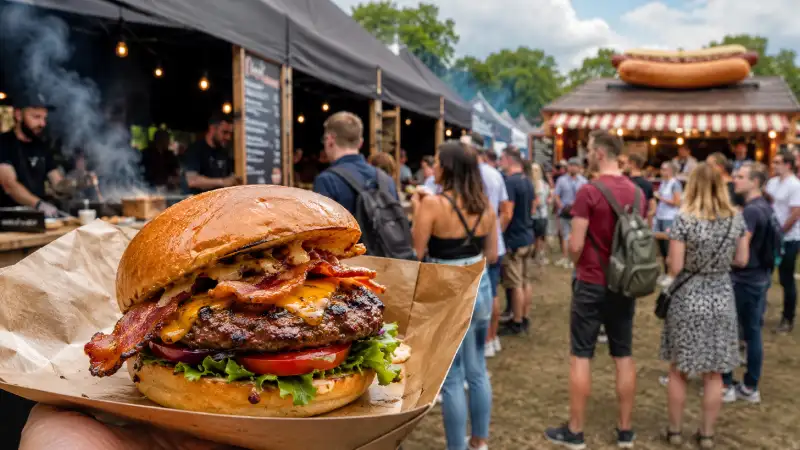
Burgers are one of the most obvious event foods. They are familiar, filling, easy to customise and easy to understand. A customer can choose a classic cheeseburger, a bacon burger, a smashed burger, a premium beef burger or a plant-based option without needing much explanation.
The challenge is that burgers are also a crowded category. At many festivals and outdoor events, there may be several burger traders competing for the same customer. This means a burger offer needs either a very strong brand, a strong visual setup, a standout price point, or a genuinely better product to stand apart.
German hot dogs are interesting here because they can offer similar handheld convenience without sitting in exactly the same category.
2. Fish and chips
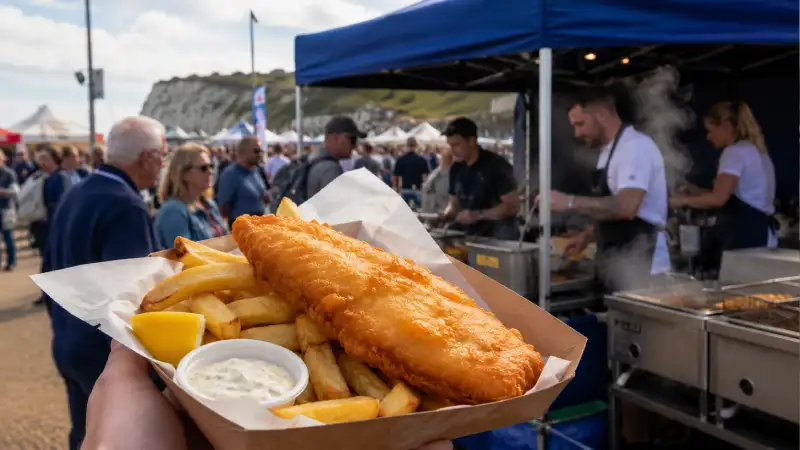
Fish and chips remains one of the great British outdoor-food formats. It has heritage, comfort value and broad appeal. At coastal events, family festivals, seaside towns and traditional markets, it still feels completely right.
But fish and chips is operationally different from sausages. It usually depends on frying, batter, oil management, waste control and a slightly more involved preparation process. Done well, it is fantastic. But it is not always the simplest high-speed event format.
German sausages with chips can borrow part of the same meal logic: hot protein, chips, sauce, tray, fork, satisfying portion. Currywurst with chips, in particular, can function as a continental cousin of British chip-shop comfort food.
3. Fried chicken
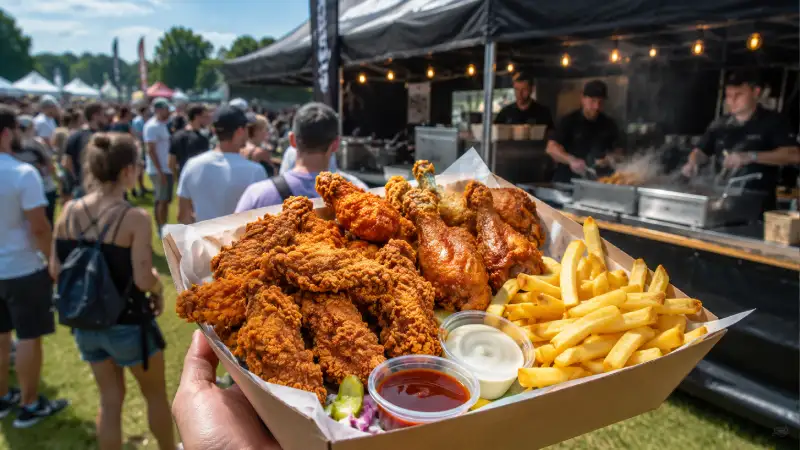
Fried chicken has become a major fast-food force in the UK. It works especially well with younger customers, families and casual event crowds. Chicken strips, wings, burgers and loaded boxes are easy to sell because customers already understand the format.
At events, fried chicken benefits from strong aroma, crunch, sauce options and meal-box flexibility. But it can also involve fryers, oil, holding quality and more complicated service depending on the menu.
German hot dogs can compete by offering a simpler line: grill, bun, sausage, toppings, chips, sauce. Less menu complexity can be a serious advantage when queues build quickly.
4. Pizza and flatbreads
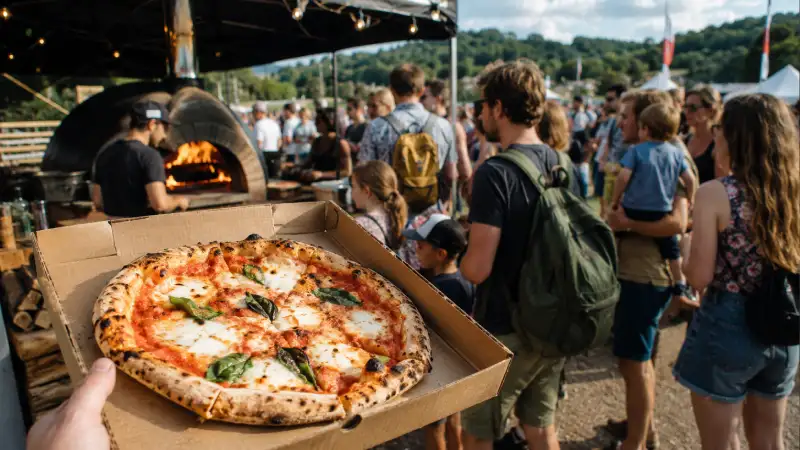
Pizza has obvious event appeal. It is visual, familiar, family-friendly and flexible. Wood-fired pizza also adds theatre, which can be powerful at food festivals.
The downside is portability. Pizza is easy enough to eat from a box or slice, but it is not always as convenient as a hot dog, wrap or tray meal when customers are moving through a busy site. Service speed can also vary depending on the oven setup and queue.
German hot dogs have less theatre than a pizza oven, but they win on speed and one-handed eating.
5. Kebabs, gyros and wraps
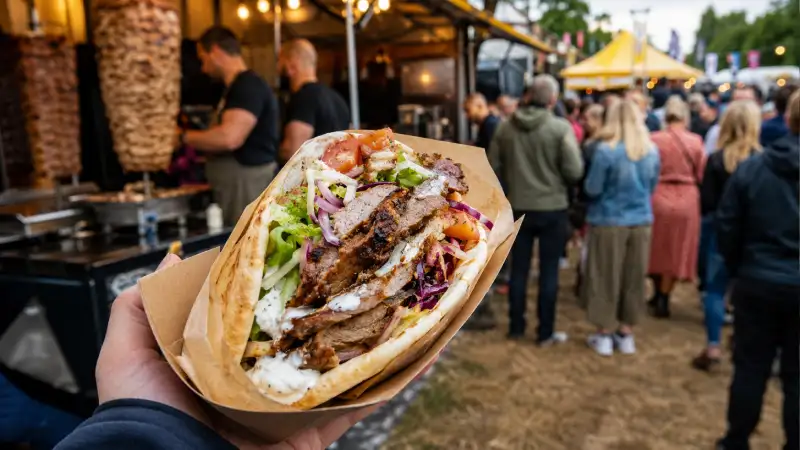
Kebabs, gyros and wraps are very strong event foods because they are handheld, filling and full of flavour. They work especially well at beer events, music events, late-night markets and high-energy crowd settings.
This is one of the categories German sausages should learn from. The best kebab and gyros traders understand vertical theatre, visible cooking, generous portions and sauce-led appeal. A German sausage stand can use a similar logic with bratwurst, onions, curry sauce, mustard, sauerkraut, chips and loaded toppings
6. Loaded chips and loaded fries
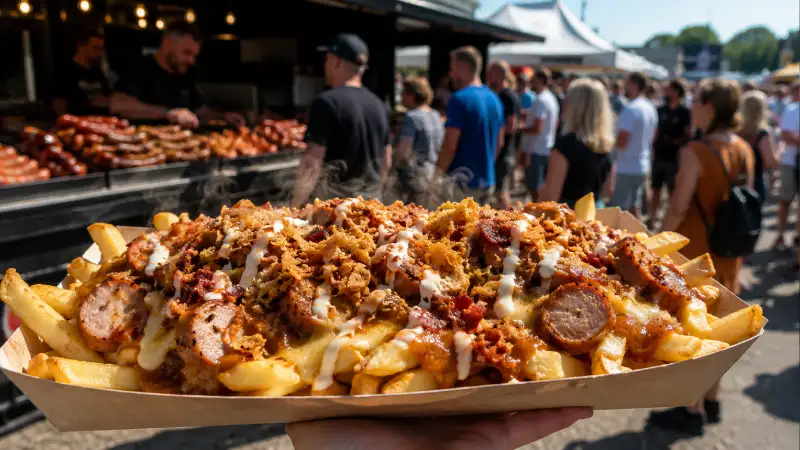
Chips are often treated as a side, but at events they can be the real engine of the food offer.
Loaded chips turn a simple product into a meal. Add curry sauce, cheese, onions, bacon, chilli, pulled meat, garlic sauce or sausage slices, and the customer suddenly sees a tray that feels like value.
This matters enormously for German sausages. A bratwurst in a roll is a strong snack. Currywurst with chips is a full event meal. A sliced frankfurter over chips with sauce can be a fast, hot, high-margin tray. A jumbo smoked hot dog with chips can satisfy families, sports crowds and hungry festival visitors.
From direct event catering experience, chips are not a minor add-on. At one large four-day food festival, around 70% of sausage customers also chose chips. That changes the commercial picture completely.
7. Hot dogs, bratwurst and German sausages
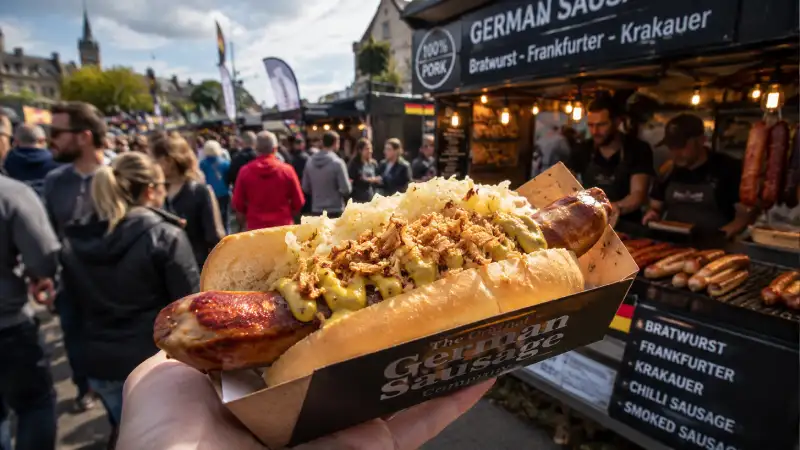
This is where German hot dogs fit.
A standard hot dog is already a familiar event food in Britain. People understand it instantly. But German hot dogs and bratwurst add something extra: better sausage identity, stronger continental appeal, bigger flavour, better visual presence and a more premium story.
That is important because many basic hot dogs in the UK have trained customers to expect something cheap and forgettable. A proper German-style sausage can move the category upwards. It can be sold as bratwurst, currywurst, smoked pork hot dog, cheese frankfurter, chilli bacon frankfurter or a loaded German hot dog meal.
The customer still understands the format. But the product feels more special.
British customers already understand sausages
German hot dogs do not have to start from zero in the UK. British customers already understand sausages, sausage rolls, hot dogs, BBQ sausages, breakfast sausages and sausage-and-chips meals.
AHDB reported that 80% of households bought pork sausages in the year ending 3 September 2023, showing how familiar the category remains in Britain. More recent AHDB retail reporting also showed sausages contributing to processed pig-meat volume growth in 2025, with sausages up in both the October and November 2025 red-meat retail performance updates.
That familiarity is commercially important. German hot dogs do not ask British consumers to learn a completely new food. They take something people already understand and give it a stronger event identity.
A bratwurst in a roll is not a difficult sell. A currywurst tray with chips is not a difficult sell. A with fried onions and mustard is not a difficult sell. These are familiar enough to be safe, but different enough to stand out.
That balance is one of the main reasons German sausages work so well at events.
Real-world event numbers: what German sausages can actually do
The public statistics show the size of the events market. But the more interesting question for caterers and buyers is practical: what can a German sausage offer actually sell?
Real-world trading experience gives a much clearer picture.
- At a small market day, around 100 sausages per day can be a realistic target when the pitch is right.
- At a local food festival, the number may be closer to 200 to 300 sausages per day, depending on footfall, weather, competition and whether the event is genuinely food-led.
- At a strong town food festival, German sausages can reach around 1,000 sausages per day.
- At a large air show or outdoor family event, around 2,500 sausages over two days is realistic from direct trading experience.
- At a major four-day food festival, German sausages can become a serious volume product, with around 10,000 sausages sold over four days. And when around 70% of those customers add chips, the offer is no longer just a snack. It becomes a full event meal.
A useful way to look at the numbers is this:
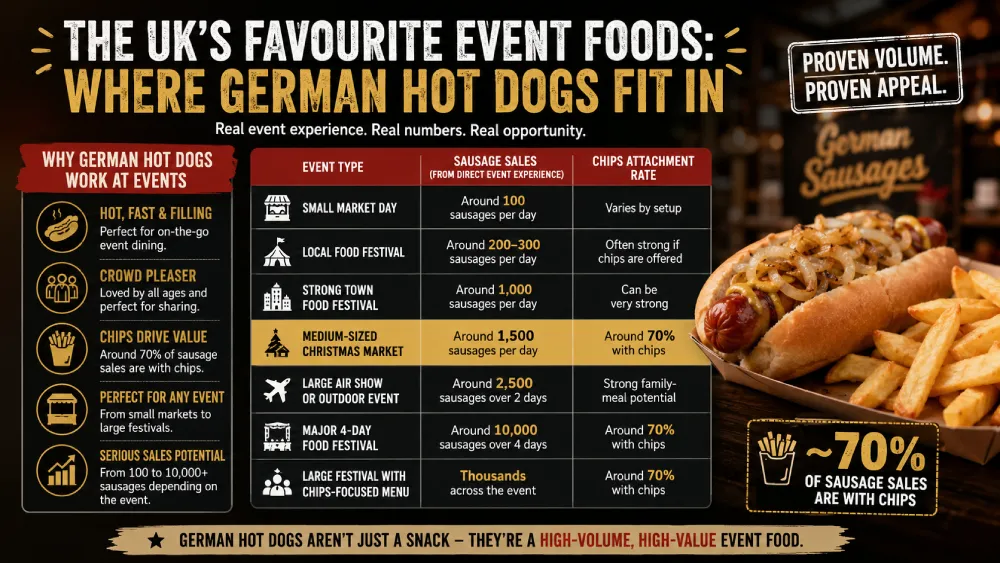
These numbers should not be treated as a guarantee. Every event is different. Weather, location, pitch position, pricing, queue speed, signage, nearby competition and stock planning all matter.
But they show something important: German sausages are not just a novelty product. In the right environment, they can behave like a major event-food category.
Why German hot dogs work so well at events
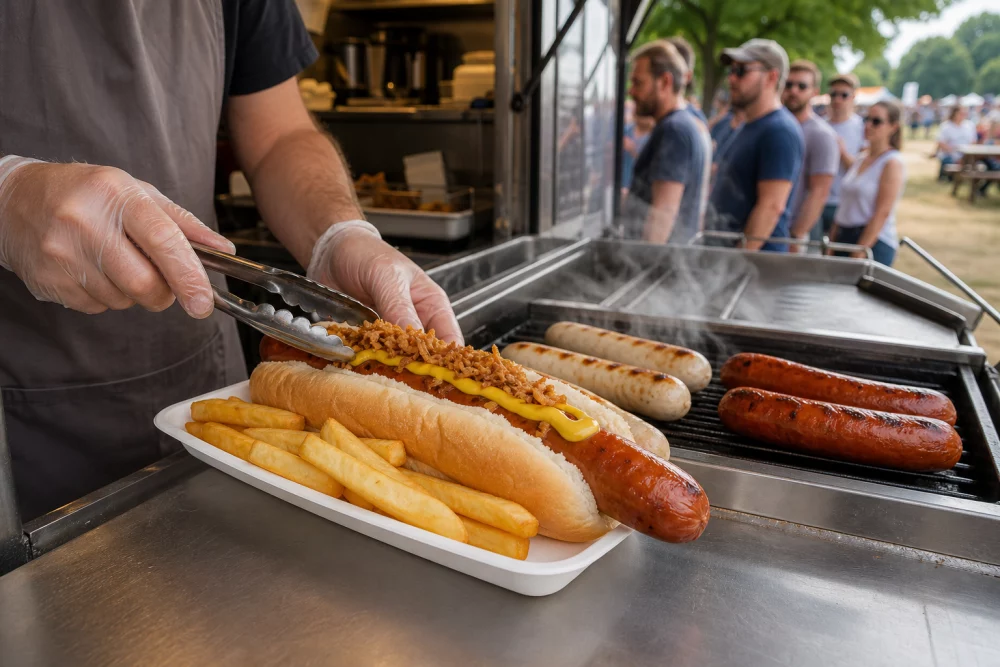
German hot dogs sit in a useful middle ground.
- They are familiar, because British customers know sausages and hot dogs.
- They are distinctive, because bratwurst, currywurst and German-style frankfurters feel more special than a basic hot dog.
- They are fast, because the menu can be simple and service can be streamlined.
- They are flexible, because the same core products can become snacks, hot dogs, loaded rolls, currywurst trays or sausage-and-chips meals.
- They are visual, because sausages on a grill create movement, steam, colour and smell.
- They are scalable, because a trader can build a compact menu around a few strong products rather than trying to cook twenty different dishes.
That combination is rare.
A burger may be familiar but highly competitive. A wood-fired pizza may be premium but slower. Fried chicken may be popular but operationally more complex. A kebab may be filling but more ingredient-heavy.
A German sausage menu can be comparatively simple:
- One classic bratwurst
- One smoky hot dog
- One cheese or chilli sausage
- Chips
- Fried onions
- Mustard
- Curry ketchup or curry sauce
- Sauerkraut
- One or two loaded specials
That is enough variety for customers without making the operation slow.
The Christmas market advantage
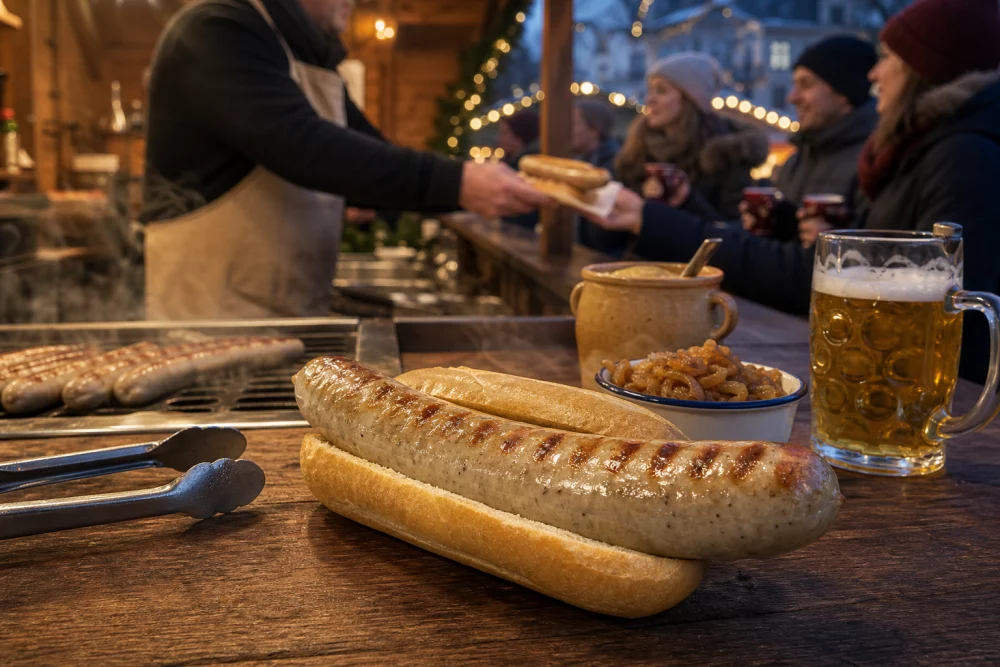
Christmas markets are probably the easiest place for British customers to understand German sausages
This tourism-style event page from the Bratwurstmuseum highlights how bratwurst fits into the atmosphere and food culture of German Christmas markets.
The setting already does half the work. Wooden stalls, cold weather, lights, music, mulled wine, beer, hot food and winter crowds all make bratwurst and currywurst feel natural.
Manchester Christmas Markets 2024 operated across the city centre, with food and drink stalls trading daily from 11am to 9pm. Bath Christmas Market 2024 reported average visitor spend of £31.31 per person per day at the market, plus additional spending elsewhere in the city, including eating and drinking. Hyde Park Winter Wonderland is described by PMY Group as the UK’s largest outdoor Christmas market, attracting about 2.5 million visitors and including themed zones such as a Bavarian village and shopping village.
That is exactly the environment where German sausages make sense.
A bratwurst at a Christmas market does not need a complicated explanation. It fits the customer’s expectation. The same is true for currywurst with chips, smoked frankfurters, sauerkraut, mustard, fried onions and German-style loaded hot dogs.
For Christmas events, German sausages also solve a practical problem: they are hot, fast and warming. In cold weather, that matters. Customers are more likely to want something substantial and savoury. A hot sausage in a roll or a tray of currywurst and chips feels like part of the event experience.
Sport events and air shows need robust food
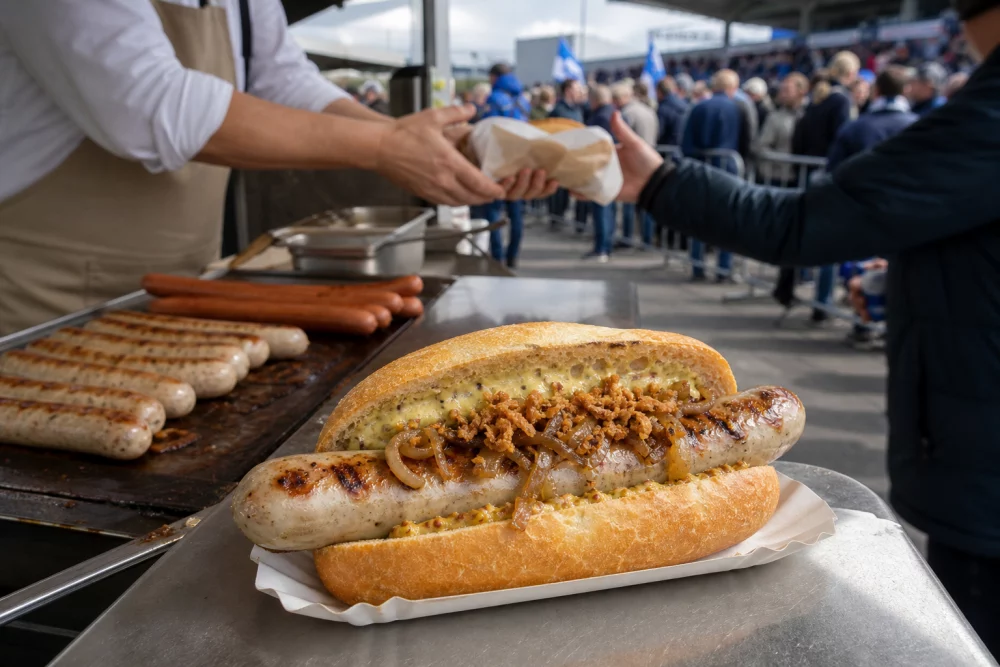
Sport events, air shows, motorsport days, rugby clubs, football fan zones and outdoor family events create a slightly different food challenge.
This industry body advice explains outdoor hospitality health and safety checks worth reviewing before serving high-volume sausage menus at festivals, fan zones, and outdoor family events.
The customer may be there all day. They may be with children. They may be moving between viewing areas. They may want food between fixtures, displays or races. They may not want anything too complicated. They want something hot, filling and easy.
This is a natural environment for hot dogs, but a German-style offer can lift the category.
A feels more substantial than a basic stadium hot dog. A bratwurst in a roll feels more authentic. A chilli bacon frankfurter or cheese frankfurter gives customers an upgrade. A sausage-and-chips tray becomes an easy family meal.
Direct event experience supports this. A large air show can produce thousands of sausage sales over a weekend. Around 2,500 sausages over two days is a realistic example from actual trading.
The operational point is just as important as the sales number. At busy sports and outdoor events, service speed can decide whether a stall succeeds. A compact German sausage menu can move quickly because the customer choice is clear and the cooking process can be organised around volume.
Food festivals need something familiar but different
Food festivals are a particularly interesting setting for German hot dogs.
Unlike a normal market, many visitors arrive expecting to try food. That can be good and bad. It means people are more open to spending, but it also means the competition is strong. A food festival may include burgers, pizzas, Thai food, paella, barbecue, noodles, bao buns, cakes, coffee, loaded fries, artisan pies and many other options.
A German sausage offer has to stand out without becoming too niche.
That is why the best positioning is not simply “hot dogs”. It is better to build the menu around recognisable event-food hooks:
- German bratwurst in a roll
- Berlin-style currywurst with chips
- Jumbo smoked pork hot dogs
- Cheese frankfurter loaded hot dogs
- Chilli bacon frankfurters
- Bacon frankfurters with onions and mustard
- German sausage and chips trays
This gives the customer several ways in. Someone who wants a simple lunch can choose a bratwurst roll. Someone who wants a proper meal can choose currywurst with chips. Someone who wants indulgence can choose a cheese or chilli frankfurter. Someone who wants something familiar can choose a smoky hot dog.
That range is broad enough to work, but still focused enough to serve quickly.
Chips are not just a side dish
One of the biggest commercial lessons in event catering is that chips are not an afterthought.
This hospitality trade article looks at why chips matter commercially in catering, especially when you are building high-volume event food offers around sausages and sides.
For many customers, chips turn the purchase from a snack into a meal. That matters because customers at events often make a value judgement quickly. A sausage in a roll may be enough for some. But sausage with chips looks like lunch or dinner.
This is why currywurst with chips is such a strong event format. It is simple, hot, filling and easy to eat from a tray. It has sauce, protein and chips. It feels generous without needing a complicated kitchen.
The same principle applies to other German sausage formats:
- A bratwurst roll is quick and classic.
- A bratwurst with chips is more substantial.
- A sliced smoked frankfurter over chips becomes a loaded tray.
- A cheese frankfurter with chips becomes indulgent.
- A chilli bacon frankfurter with chips becomes a festival-style upgrade.
- A currywurst box becomes a complete street-food meal.
For operators, this is valuable because chips improve menu flexibility. They allow one core sausage product to appear in several formats, from fast handheld snack to full tray meal.
Which German sausage formats work best?
Different events need different sausage formats. A Christmas market is not the same as a sports ground, and a family air show is not the same as a beer festival.
Bratwurst in a roll
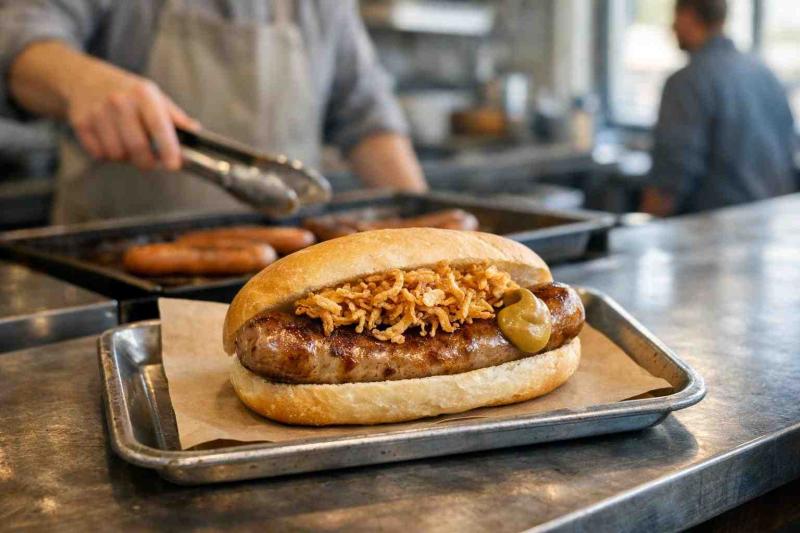
This is the classic German market option. It works especially well at Christmas markets, beer festivals, food festivals and continental-style markets.
This cultural overview from DW highlights the festive food staples of German Christmas markets, including bratwurst, which helps explain why the format works so well for winter event catering.
Its strength is simplicity. Bratwurst, roll, mustard, onions, maybe sauerkraut. Customers understand it immediately.
Currywurst with chips
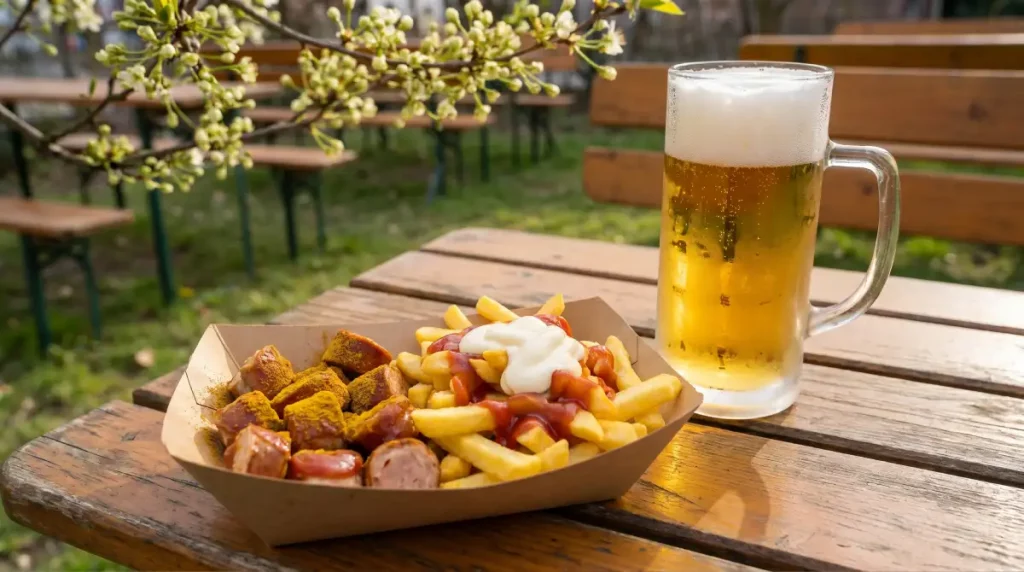
This may be one of the strongest event-food formats of all. It is warming, filling, saucy and easy to sell as a tray meal.
Currywurst works especially well at winter events, food festivals, student areas, beer events, Christmas markets and high-volume outdoor catering.
Jumbo smoked hot dog
This is a strong sports and family-event product. It has the familiarity of a hot dog but feels bigger and more satisfying.
It works well at air shows, sports venues, outdoor screenings, motorsport events, rugby clubs and American-style menu settings.
Cheese frankfurter
Cheese frankfurters are ideal for premium hot dog menus and loaded offers. The melted-cheese element gives customers an indulgent reason to upgrade.
They work especially well with younger festival audiences, family events and menus where standard hot dogs need a more exciting alternative.
Chilli bacon frankfurter
This is a stronger-flavoured option for customers who want heat, smoke and richness. It can work well as a loaded hot dog, with chips, or as a premium festival sausage.
Bacon frankfurter
A bacon frankfurter is a useful bridge between the familiar and the premium. Smoky bacon flavour is easy for British customers to understand, but the German-style frankfurter format makes it more distinctive than a standard sausage.
A simple menu can still feel exciting
One mistake in event catering is trying to offer too much.
A long menu can slow service, confuse customers and create stock problems. German sausages work best when the menu is focused but not boring.
A strong event menu might look like this:
Classic Bratwurst
German bratwurst in a roll with mustard and fried onions.
Currywurst & Chips
Sliced bratwurst with curry sauce and chips.
Jumbo Smoked Hot Dog
Large smoked pork hot dog in a roll with onions and sauce.
Cheese Frankfurter Loaded Hot Dog
Cheese frankfurter with crispy onions, mustard and optional chips.
Chilli Bacon Frankfurter
A smoky, spicy premium hot dog option.
That is only five core items, but it covers several customer moods: classic, meal, family, indulgent and spicy. Add chips and two or three sauces, and the menu feels much bigger than it actually is.
For event operators, that is the sweet spot: enough choice to attract customers, but not so much choice that the queue stops moving.
So, are German hot dogs one of the UK’s favourite event foods?
In the broad national sense, burgers, chips, fried chicken, pizza, wraps and traditional fish and chips are still more established.
But that is not the full story.
German hot dogs do not need to beat every category everywhere. Their strength is that they fit many high-footfall settings unusually well. They are familiar enough for British customers, distinctive enough to stand out, fast enough for queues, and flexible enough to sell as a snack, a premium hot dog or a full sausage-and-chips meal.
That makes them a strong event-food format rather than just a hot dog alternative.
At a small market, they can provide a simple, reliable hot-food offer. At a town food festival, they can sell serious daily volume. At an air show, they can serve families quickly. At a Christmas market, they feel completely at home. At a music festival or sports event, they give customers something hot, filling and easy to eat on the move.
That is where German hot dogs fit in.
They are not just competing with other hot dogs. They are competing in the wider event-food arena, alongside burgers, chips, fried chicken, pizza, wraps and loaded fries.
And in the right setting, they can hold their own.
Frequently Asked Questions
No. Christmas markets are the most obvious fit because customers already associate bratwurst, currywurst and frankfurters with German winter food. But German hot dogs can also work very well at food festivals, air shows, beer festivals, sports venues, town markets, pub gardens and outdoor events.
The setting matters more than the season. If customers want hot, fast, filling food that is easy to eat while standing or walking, a German sausage offer can work. The menu may simply need adjusting. A Christmas market might favour bratwurst, currywurst and mustard, while a summer festival may suit smoky hot dogs, cheese frankfurters, chilli bacon frankfurters and loaded chips.
standard hot dog is often seen as a quick, basic snack. A German-style hot dog can feel more substantial and more premium because the sausage itself has a stronger identity.
Bratwurst, frankfurters, smoked hot dogs and currywurst-style dishes all give the operator more to work with. The product can be sold as a simple sausage in a roll, but it can also become a proper meal with chips, onions, curry sauce, mustard, sauerkraut or loaded toppings. That gives customers a familiar format, but with more flavour, more theatre and a stronger reason to buy.
Usually both, if the setup allows it. A sausage in a roll is fast, simple and easy for customers who want to eat on the move. Sausage with chips creates a fuller meal and can increase the average spend per customer.
The right balance depends on the event. A busy lunchtime queue may need a fast roll-based offer. A winter market, food festival or all-day family event may benefit from tray meals such as currywurst with chips. Operators should also consider fryer capacity, staffing, queue speed and whether the site rules allow chips or frying.
focused menu is usually better than a long one. Too many choices can slow the queue and make stock control harder.
For many events, three to five strong sausage options are enough. For example, a classic bratwurst, a smoked hot dog, a cheese frankfurter, a chilli bacon frankfurter and a currywurst tray can cover most customer moods without making the operation complicated. The menu can still feel varied through toppings, sauces and chips, rather than through too many different core products.
Yes, but the menu should include both simple and more adventurous choices. At family events, some customers want familiar food, while others want something more interesting than a basic hot dog.
mild bratwurst or smoked hot dog can work well for families because it is easy to understand. Cheese frankfurters can appeal to children and younger customers. Chilli or strongly spiced options should be clearly labelled, so customers know what they are buying. For family-heavy events, portion size, speed of service and clear pricing are especially important.
Operators should check the practical trading conditions first. The product may be strong, but the setup still needs to work.
Important checks include cooking equipment, holding method, fridge or freezer storage, power supply, water access, waste disposal, staff numbers, queue layout, allergen information, local authority requirements and any event-specific rules. If chips are part of the menu, fryer capacity and oil management become especially important. A simple menu on paper can still struggle if the service line is not planned properly.
Yes, but they do not need to compete in exactly the same way. Burgers and fried chicken are established event-food favourites, but that also means they are often heavily represented at busy sites.
German hot dogs can stand out by offering something familiar but less common. Customers still understand the basic format, but bratwurst, currywurst, smoky frankfurters and sausage-and-chips trays give the menu a more distinctive identity. At the right event, that can be a real advantage, especially where there are already several burger or chicken traders.
Usually not, as long as it is presented clearly. “Currywurst with chips” is much easier for UK customers to understand than a long explanation of the dish.
The key is to make the menu wording simple. For example: sliced German sausage with curry sauce and chips. That tells the customer what they need to know. Once people see the tray, the concept becomes very easy to understand. Currywurst can be especially strong at winter events, beer festivals, food festivals and markets where customers are open to street-food-style dishes.
There is no single correct price because pitch fees, event size, product cost, staffing, portion size and competition all vary. The important point is that the product must feel like good value in that specific setting.
simple sausage in a roll can sit at one price level, while currywurst with chips, loaded hot dogs or jumbo smoked hot dog meals can justify a higher price because they feel more substantial. Operators should not only look at the sausage cost. They should calculate the full portion, including roll, chips, toppings, sauces, packaging, labour, wastage and event fees.
good first menu should be simple, recognisable and easy to serve quickly. One classic bratwurst, one smoky hot dog, one cheese or chilli option, chips, fried onions, mustard and curry sauce would be a sensible starting point.
That gives enough variety without making the stall difficult to run. The operator can then learn what sells best at each event type. Some sites may favour currywurst and chips. Others may sell more hot dogs in rolls. The best long-term menu should be shaped by real sales data, not guesswork.
Conclusion
The UK’s favourite event foods are not always the same as the UK’s favourite takeaway foods.
At events, the winners are the foods that can handle real-world conditions: queues, crowds, cold weather, limited seating, hungry families, beer-drinking adults, all-day visitors and customers who want something satisfying without waiting too long.
German hot dogs, bratwurst, currywurst and premium frankfurters fit that world extremely well. They are hot, fast, portable, familiar and easy to premiumise. They work as a simple sausage in a roll, a loaded hot dog, a currywurst tray or a full meal with chips.
For caterers, venues, pubs, wholesalers and event operators, that makes them much more than a niche German option. In the right event setting, they can become one of the busiest foods on site.
Planning a festival, market, Christmas event or high-volume foodservice menu? The Sausage Haus supplies premium German-style bratwurst, frankfurters and hot dogs for operators who need fast service, strong flavour and serious crowd appeal. Explore our German sausage range or contact us to discuss the right products for your event menu.
The Sausage Haüs
The Sausage Haus brings premium German-style sausages, bratwurst, frankfurters and hot dogs to the UK foodservice and event catering market. The range is produced by Remagen, a specialist German sausage maker with long-standing expertise in authentic bratwurst, frankfurters and continental sausage products.
In the UK, The Sausage Haus is supplied through Baird Foods, giving pubs, restaurants, wholesalers, caterers, markets, festivals, Christmas events and sports venues access to high-quality German sausages with reliable foodservice support.
From classic bratwurst and smoky hot dogs to cheese frankfurters, chilli bacon frankfurters and currywurst-style menu ideas, The Sausage Haus range is designed for operators who need strong flavour, fast service and products that can perform in busy real-world trading conditions. Whether you are building a high-volume event menu or upgrading a premium hot dog offer, The Sausage Haus connects authentic German sausage quality with modern UK foodservice demand.
Contact us today to discuss The Sausage Haus range and find the right German sausage products for your next event menu.