A good German sausage retail range does not need to fill half the chilled cabinet. It needs to give shoppers enough meaningful choice without presenting several packs that appear to do the same job.
Pork Bratwurst, Cheese Frankfurters and Bacon Frankfurters create a particularly practical three-pack line-up. One provides the recognisable German classic, one offers a richer cheese-led option, and one appeals through bacon and smoke.
The products remain close enough to look like a coherent range, but different enough to justify their individual shelf space. For farm shops, garden centres, food halls and other premium retailers, that balance can be more useful than simply stocking the largest possible selection.
Why a Smaller Sausage Range Can Work Harder
Range size and range quality are not the same thing. Adding more varieties may create visual abundance, but it can also divide sales across too many similar lines, complicate replenishment and leave slower packs approaching their use-by dates.
A focused three-product range is easier for both the retailer and the shopper to understand. The buyer can explain why each product is there, while the customer can make a decision without studying six nearly identical sausage descriptions.
The key is differentiation. A weak three-pack range might contain three mild pork sausages with only minor seasoning changes. That looks like choice on a stock list, but not necessarily from the other side of the chiller door.
Bratwurst, Cheese Frankfurter and Bacon Frankfurter provide a clearer structure:
- Bratwurst: the traditional and versatile choice
- Cheese Frankfurter: the rich and indulgent choice
- Bacon Frankfurter: the smoky and savoury choice
That gives the retailer three simple selling stories rather than three technical product names. It also makes staff recommendations easier. When a customer asks which one to try, the answer can begin with flavour preference rather than a lengthy explanation of German sausage types.
A smaller initial range also produces cleaner sales information. If one product moves faster, the result is easier to interpret because each pack has a distinct role. The buyer can then adjust stock depth with more confidence instead of guessing which of several overlapping products is taking sales from another.
Three Packs, Three Clear Shopper Missions
The strongest three-pack range is not simply a collection of good products. Each sausage needs to answer a different reason for buying.
1. Pork Bratwurst: the classic choice
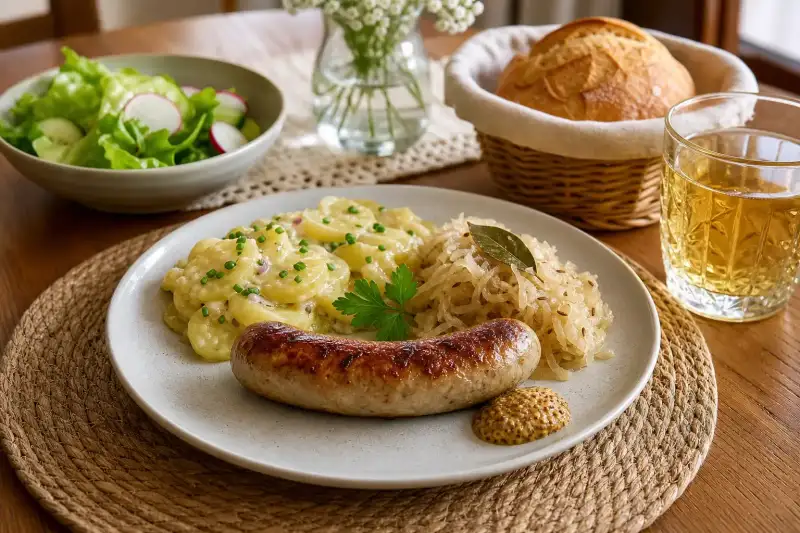
The Pork Bratwurst 4 x 100g fresh pack is the range anchor. Made with 85% pork and seasoned with delicate notes of marjoram and nutmeg, it gives shoppers the most immediately recognisable German sausage experience.
Its mild flavour makes it accessible without making it bland. Customers can serve it in a crusty roll, with mash, alongside potato salad or as part of a barbecue. That versatility matters because the classic product often needs to attract the broadest part of the retailer’s audience.
Bratwurst also explains the category. Even shoppers who know little about German sausages are likely to recognise the name, particularly from Christmas markets, festivals and German-themed events.
2. Cheese Frankfurter: the indulgent choice
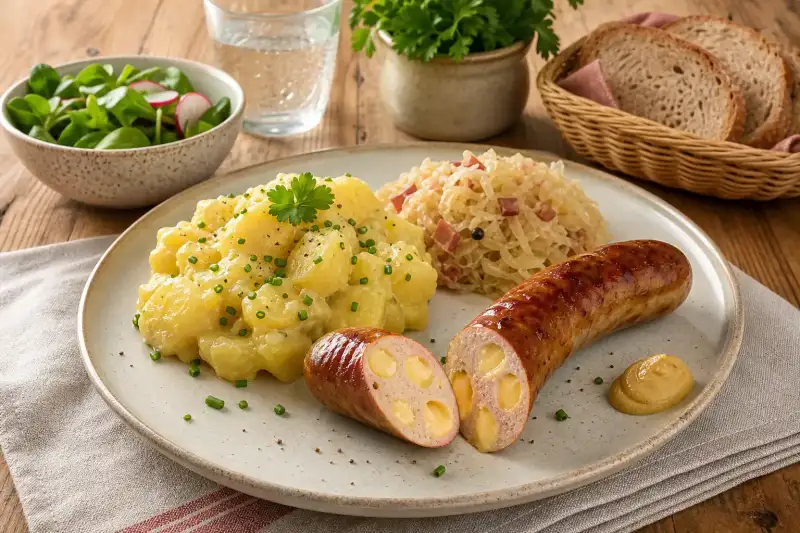
The Cheese Frankfurter 4 x 100g fresh pack offers a more indulgent proposition. It combines pork with 10% Emmental cheese, as well as bacon, producing a rich, smoky sausage with visible pieces of cheese.
This is the pack for shoppers who want something more distinctive than an everyday sausage. The flavour story is immediate, and the cheese provides a clear reason to trade across from the classic Bratwurst.
It also lends itself to strong serving imagery. A Cheese Frankfurter in a toasted roll, served with mash or placed at the centre of a loaded hotdog communicates comfort and generosity without requiring a complicated recipe.
3. Bacon Frankfurter: the smoky choice
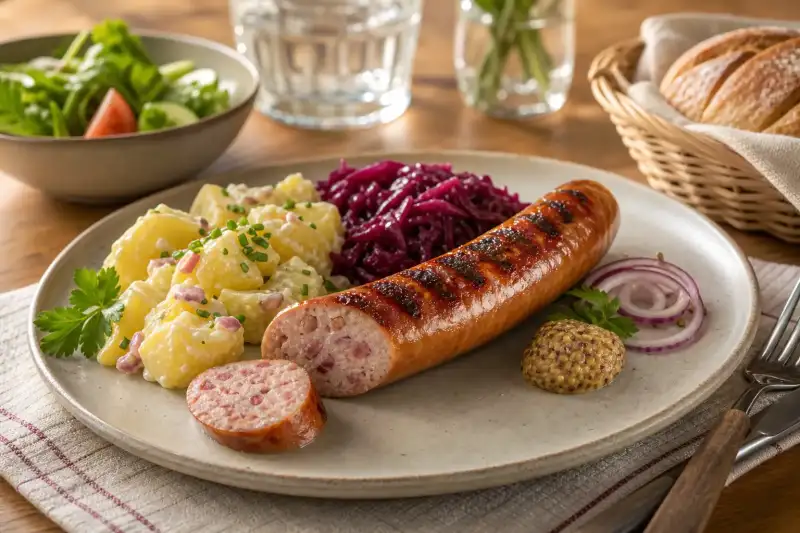
The Bacon Frankfurter 4 x 100g fresh pack completes the range with a heartier, smoky profile. It contains 85% pork and 7% bacon, with a coarser texture and visible bacon pieces.
Bacon is an easy flavour cue for UK shoppers. It makes the product feel familiar while the Frankfurter format preserves the German character of the range.
The Bacon Frankfurter is therefore not merely another pork sausage. It occupies the space between a classic Bratwurst and the richer Cheese Frankfurter, appealing to customers who want a pronounced savoury flavour without choosing a cheese-filled product.
Why the Shared 4 x 100g Format Matters
All three products use the same four-sausage, 400g pack format. That consistency helps the line-up read as a planned range rather than three unrelated products placed beside one another.
A shared format makes direct comparison easier. The customer can focus on flavour rather than working out whether one pack contains fewer sausages, a different portion size or a substantially different amount of food.
Four 100g sausages also create a straightforward household proposition. The pack is substantial enough for a family meal or barbecue but not so large that buying an unfamiliar variety feels like a major commitment. Customers can see how the product might fit into an ordinary dinner before they start considering elaborate German recipes.
For retailers, consistent case, pack and shelf dimensions can also simplify merchandising, although actual case quantities and delivery arrangements should always be confirmed before assigning space. The buyer can build one visual block with three flavour choices rather than trying to combine products of very different sizes.
The information displayed on the pack and shelf ticket must remain accurate, clear and easy to read. Retailers introducing any prepacked product should review the official UK food labelling and packaging requirements1, including rules covering product names, ingredients, quantity, date marking and storage instructions.
The useful commercial point is simple: variety should come from the sausages, not from unnecessary differences in pack structure.
Make the Difference Obvious in the Chiller
The three-product logic only works if shoppers can see it. If every shelf ticket says little more than “German sausage”, the retailer has created three choices but hidden the reason for choosing between them.
Each product should have one short, visible flavour message:
- Pork Bratwurst: classic, mild and traditionally seasoned
- Cheese Frankfurter: rich, smoky and filled with Emmental
- Bacon Frankfurter: hearty, smoky and made with bacon pieces
These descriptions are more useful at the point of sale than long explanations about sausage history. Heritage can support the range, but flavour closes the gap between curiosity and purchase.
Keep the products together where possible. A compact branded block allows the three packs to reinforce one another. Separating them across different chilled bays makes the range harder to understand and reduces the chance of useful comparison.
Serving photography can then show each product in a different role. Bratwurst might appear with potato salad or in a simple German-style roll. The Cheese Frankfurter suits an indulgent hotdog or comfort-food plate. The Bacon Frankfurter can be shown grilled with robust, smoky accompaniments. The images should demonstrate realistic home use rather than presenting restaurant dishes that bear little relation to the pack.
Allergen communication must remain prominent, particularly because the Cheese Frankfurter contains milk and the recipes may contain or refer to other regulated allergens. Buyers and retailers should check the product specification and current label rather than relying on shelf-copy assumptions. The Food Standards Agency provides detailed allergen guidance for food businesses2.
Plan Stock Depth Around Each Product’s Role
Equal shelf space does not require equal stock depth. The three products have separate jobs, and their sales may develop at different rates.
Bratwurst is the logical candidate for the broadest initial demand because it is the classic product and has the widest range of serving uses. The Cheese Frankfurter may attract a more targeted indulgence-led purchase, while the Bacon Frankfurter gives the range a strong smoky alternative. That is a starting hypothesis, not a substitute for the retailer’s own sales data.
Begin with a controlled trial quantity and record weekly performance by SKU. Useful measures include:
- packs sold
- gross profit generated
- reductions required
- packs wasted
- days of stock remaining before the next delivery
- performance during weekends, barbecue weather and seasonal events
Sales volume alone can be misleading. A product that sells slightly fewer packs but requires no reductions may be commercially stronger than a faster line that regularly leaves excess stock.
Rotation should be disciplined from the first delivery. Check dates when goods arrive, place shorter-dated packs at the front and review the cabinet before ordering more. Storage conditions and the instructions on the product label must be followed throughout the supply chain.
Use-by dates concern safety, not merely peak quality. Food should not be sold after its use-by date, and correct storage is essential for that date to remain valid. The government’s explanation of best-before and use-by dates3 provides a useful reference for staff and customers.
Do not build the initial order around the hope that every line will sell equally. Build it so the retailer can learn without creating avoidable waste.
Price and Promote the Range Without Blurring It
The three packs can sit at the same retail price if the underlying costs and margin requirements support that approach. A common price makes flavour the main decision and gives the range a clean, uniform appearance.
Different prices can also work where there is a genuine cost or positioning reason. The important point is that the Cheese Frankfurter should not look expensive simply because its shelf ticket is unclear, and the Bratwurst should not accidentally appear to be the inferior option because it is positioned as the cheapest.
The selling price, and unit price where required, should be displayed clearly and consistently. Requirements vary according to product and retailer circumstances, so buyers should check current retail price and unit-price guidance4 rather than copying another shop’s shelf-ticket format.
Early promotion should encourage trial while preserving the differences between the products. Useful options might include an introductory tasting session, a recipe card for each variety or a mixed display built around a barbecue or German food theme.
Be cautious about using repeated deep discounts as the main sales tool. They may shift packs temporarily without showing whether shoppers value the product at its normal price. Constant promotions can also teach regular customers to delay their purchase.
If a multi-buy or prominent placement promotion is being considered, check whether current restrictions for foods classed as high in fat, sugar or salt apply to the specific products, promotion and retail business. Eligibility should be assessed from the actual nutritional information and relevant regulations, not assumed from the product category.
The better aim is to help customers choose confidently. “Classic, cheesy or smoky?” is a stronger long-term retail conversation than “Which one happens to be reduced?”
Know When a Fourth Sausage Has Earned Its Space
Three products provide a disciplined starting range, not a permanent ceiling. A fourth SKU should be added when it covers a demonstrable gap rather than simply making the cabinet look fuller.
Look for repeated evidence. Customers might regularly ask for a beef sausage, a chilli option or a frozen format. Alternatively, a retailer may find that one flavour profile performs strongly enough to support a closely related addition without weakening the rest of the range.
Before expanding, review at least several normal trading cycles rather than one unusually sunny weekend or a single event. Compare sales by pack, waste, reductions and gross profit per facing. Staff feedback can also reveal questions shoppers repeatedly ask but never convert into a purchase.
A useful fourth product should do at least one of the following:
- reach a shopper the current range misses
- suit a genuinely different meal or occasion
- provide a useful fresh or frozen alternative
- strengthen a proven seasonal opportunity
- generate additional sales rather than divide existing ones
More choice is justified when it creates incremental demand. It is not justified when two products begin sharing the sales previously achieved by one.
Retailers should also maintain current supplier and delivery records as the range grows. Official food supplier and traceability guidance5 explains the records businesses need to keep so products can be traced and, where necessary, withdrawn efficiently.
Until another product can make a clear commercial case, the original three-pack structure remains easier to merchandise, explain and measure.
Frequently Asked Questions
Request the current product specification, ingredients and allergen information, case quantity, minimum order, wholesale price, expected shelf life on delivery, storage requirements, delivery schedule and barcode details. It is also worth asking what product photography, serving ideas or point-of-sale material is available.
Start with Pork Bratwurst as the classic anchor, then choose either Cheese Frankfurter or Bacon Frankfurter according to the shop’s customers. Cheese suits an indulgence-led premium range, while Bacon offers a more familiar smoky flavour. Record customer requests for the missing product before expanding.
llow enough time to cover several normal trading cycles, including quieter weekdays and stronger weekend periods. Four to eight weeks may provide a useful initial picture, but seasonality, local footfall and delivery frequency can affect the result. Avoid judging the entire range from one promotion or unusually busy weekend.
Not automatically. Equal facings create a neat launch display, but later allocation should reflect sales rate, replenishment frequency and waste. Give additional space to a product when it repeatedly sells through between deliveries, not simply because it is assumed to be the bestseller.
Use one short comparison: “Bratwurst is classic and mildly seasoned, Cheese Frankfurter is richer and filled with Emmental, and Bacon Frankfurter is hearty and smoky.” That is usually enough to help the customer choose. More detailed information can remain available for shoppers who want it.
It can be, especially when Frankfurters are unfamiliar to the local audience. Offer small, clearly identified samples and let customers compare the flavours under the same conditions. Record which product they preferred and, more importantly, which pack they subsequently bought.
ny tasting activity should follow the retailer’s food safety procedures, allergen controls and local operational requirements.
Yes, but the presentation may need to change. A farm shop can emphasise premium ingredients, provenance and meal use. A garden centre may gain more from easy lunch, barbecue and family-dinner ideas that connect with the customer’s visit.
The products remain the same, but the most persuasive reason to buy them may differ.
Only when each format serves a clear customer need. Fresh packs can support a premium chilled offer, while frozen packs may appeal to shoppers who prioritise longer storage and flexible meal planning. Stocking both without explaining the difference can create duplication rather than useful choice.
Look beyond margin percentage. Compare gross profit per pack, gross profit per facing per week, reductions, waste and the amount of staff attention each line requires. A slightly slower product can still justify its space if it sells at full price and strengthens the overall range.
Conclusion
A useful German sausage retail range is built around clear shopper decisions, not the largest possible SKU count. Pork Bratwurst, Cheese Frankfurter and Bacon Frankfurter provide three distinct routes into the category: classic, indulgent and smoky.
The shared 4 x 100g format keeps the range visually coherent and makes the products easy to compare. The flavour differences then give each pack a reason to exist. Bratwurst establishes the traditional German identity, Cheese Frankfurter provides the richest option, and Bacon Frankfurter offers an accessible smoky alternative.
The retailer’s job is to make those roles visible. Keep the packs together, use short flavour-led descriptions, show realistic serving ideas and order each SKU according to its actual rate of sale. Monitor reductions and waste alongside volume, because a range that sells cleanly is more useful than one that merely looks extensive.
A fourth sausage can always be introduced later. It should earn its place by meeting demand the first three products cannot satisfy.
For farm shops, food halls, garden centres and premium food retailers assessing a fresh German sausage range, The Sausage Haus can provide further product information and discuss the most suitable starting selection.
The Sausage Haüs
The Sausage Haus brings authentic German-style sausages to the UK market through a partnership between Hardy Remagen and Baird Foods.
Hardy Remagen is a long-established German producer with deep experience in traditional sausage making, continental meat products and modern food manufacturing. The range reflects the kind of products German shoppers already understand and enjoy: Bratwurst, Frankfurters, smoked hotdogs, cheese-filled sausages, Bockwurst, Weisswurst and other classic German-style lines.
In the UK, the range is represented and distributed by Baird Foods, giving retailers, wholesalers, caterers and foodservice operators access to German sausage products with a practical UK supply route. This combination is important: German manufacturing knowledge on one side, UK market understanding and distribution on the other.
For retail buyers, The Sausage Haus range offers a clear way to add something different to both chilled and frozen sausage fixtures. The products are built around real eating occasions: BBQs, premium hotdog nights, family meals, German street food, Oktoberfest promotions, Christmas market food and quick comfort meals at home.
The result is a range that gives shoppers something more distinctive than ordinary sausages and standard hotdogs, while giving buyers a compact, commercially useful product story with strong fresh and frozen potential.
References
UK food labelling and packaging requirements.
allergen guidance for food businesses.