I did not mean to become obsessed with schnitzel.
At first, I only wanted to make a really good one at home. Not a bad pub schnitzel. Not a dry breaded cutlet that happened to be called schnitzel. Not the kind that looks promising from across the table and then arrives thick, oily, and oddly heavy. I wanted the real thing. The kind that feels almost impossible the first time you have a truly great one. Thin but not dry. Crisp but not hard. Rich but not greasy. Golden, light, rippled, and somehow more delicate than a fried dish has any right to be.
That was the beginning of the problem.
Once you have had a schnitzel that good, average schnitzel becomes hard to tolerate. You start noticing every flaw. The crust is too tight. The meat is too thick. The crumbs are too coarse. The pan was not hot enough. The cook tried to compensate with more colour, more salt, more heaviness, but the result still felt wrong. And once I started noticing those things, I could not stop. I wanted to understand why one schnitzel felt alive and crisp and elegant, while another felt flat and forgettable.
So I started paying attention. Then I started comparing. Then I started changing one thing at a time.
I paid more attention to the meat. I paid more attention to thickness. I looked more closely at breadcrumbs, at frying fat, at heat, at the little handling details people often treat as secondary. I realised very quickly that schnitzel is not just a breaded piece of meat. It is a dish built on restraint and control. You do not improve it by piling on more. You improve it by understanding what matters and refusing to get careless with the fundamentals.
That is what this article is really about.
This is not just a recipe. It is the story of how I went from liking schnitzel to chasing it properly, and what that chase taught me about meat, coating, fat, heat, seasoning, and the side dishes that complete the plate. Along the way I made schnitzel that was too thick, too dark, too greasy, too heavy, too timid, and occasionally very good. The better I got, the more I understood that perfect schnitzel is not one secret. It is a chain of correct decisions.
And once you get enough of those decisions right, the whole dish changes.
How I Fell for Schnitzel in the First Place
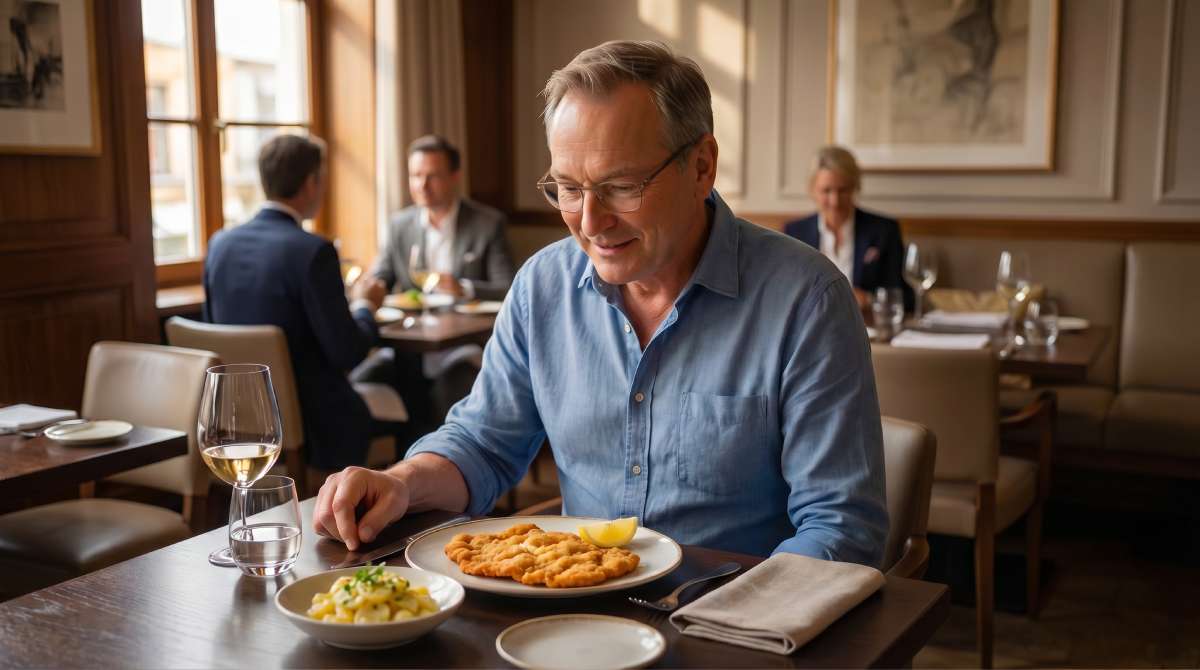
The schnitzels that made me care
My fascination with schnitzel began about thirty years ago in Vienna, still one of my favourite cities. I had eaten schnitzel before that, of course, but in a fairly casual way. It was something familiar, something pleasant, something I never thought too deeply about. Some versions were decent, some forgettable, and some were exactly what happens when a famous dish gets treated as routine. Bread the meat, fry it, add lemon, and that is apparently enough. For a long time, I more or less accepted that.
Then I had a schnitzel in Vienna that changed the whole dish for me.

I still remember the feeling of it more than any attempt at a formal description. It was one of those moments where a food you thought you already understood suddenly reveals a completely different standard. Nothing about it seemed forced. It was not trying to impress with size, heaviness, or unnecessary flourish. It was simply right in a way that made everything else seem slightly confused by comparison.
The meat was thin, but not mean or insubstantial. The coating was crisp, but so light that it almost seemed to hover around the meat rather than cling to it. It had those little ripples and blisters that I later came to think of as one of the visual signs of a proper schnitzel. A squeeze of lemon sharpened everything. The side dish knew its role. Nothing on the plate felt noisy or excessive. It all worked together with a kind of calm confidence that made the dish feel much more refined than I had ever realised schnitzel could be.
That meal stayed with me.
From that point on, schnitzel was no longer just a breaded cutlet I happened to like. It became a standard I kept measuring other schnitzels against. Once you have had one that good, average versions start to disappoint you in a different way. You notice the thickness, the heaviness, the dark crust, the flatness, the lack of balance. You stop asking whether the schnitzel is nice enough and start asking why it is not better.
That is what Vienna did to me, at least in schnitzel terms. It gave me the version that made the whole dish make sense, and I have been comparing every other one to it ever since.
Why average schnitzel started to frustrate me
Once I knew how good schnitzel could be, I started to notice how often it fell short. Not in dramatic ways. That was part of the frustration. Most disappointing schnitzel is not completely awful. It is just slightly wrong in several directions at the same time.
It is too thick, so the meat and coating feel disconnected. Or the crust is aggressively crisp, but in a way that seems coarse rather than light. Or the frying has given it colour but also a heaviness that lingers on the palate. Sometimes the crumbs sit too tightly on the meat, producing a compact shell instead of that airy, delicate crust I had started to admire. Sometimes the problem is the plate around it. A rich schnitzel served with sides that add even more weight can feel exhausting halfway through.
And because schnitzel looks simple, people often underestimate how obvious those flaws become. There is nowhere to hide in a dish like this. You cannot bury mistakes under sauce. You cannot distract the eater with garnish. A schnitzel is meat, coating, fat, lemon, and whatever sits beside it. That simplicity is part of its greatness, but it also makes it unforgiving.
The more I noticed, the more I wanted to understand.
The moment I realised this dish is all about technique
The turning point for me was understanding that schnitzel is not defined by ingredients alone. It is defined by treatment.
Before that, I think I was making the same mistake many people make. I was focusing on components in isolation. Better meat. Better crumbs. Better pan. Better oil. All of those things matter, of course, but none of them guarantees anything on its own. Schnitzel became much more interesting to me when I saw that it is really a technical dish disguised as a simple one.
The meat has to be the right cut, but it also has to be the right thickness. The coating has to be classic, but it also has to be handled lightly. The fat has to taste right, but it also has to be deep enough and hot enough. The seasoning has to be present, but it cannot bully the dish. Even the side dishes matter more than they first appear to, because great schnitzel needs contrast, freshness, and relief around it.
Once I saw all that, I stopped making schnitzel casually.
I started treating it like a craft problem. I paid attention to what happened when I used thicker pork instead of thinner veal. I paid attention to fine crumbs versus rougher crumbs. I paid attention to how the crust behaved when I pressed it down firmly, and how different it felt when I stopped doing that. I paid attention to how the frying fat affected both flavour and texture. Bit by bit, schnitzel stopped being a nice fried meal and turned into something far more interesting: a dish where small changes mattered.
That was when I really started chasing it.
Why So Much Schnitzel Falls Short
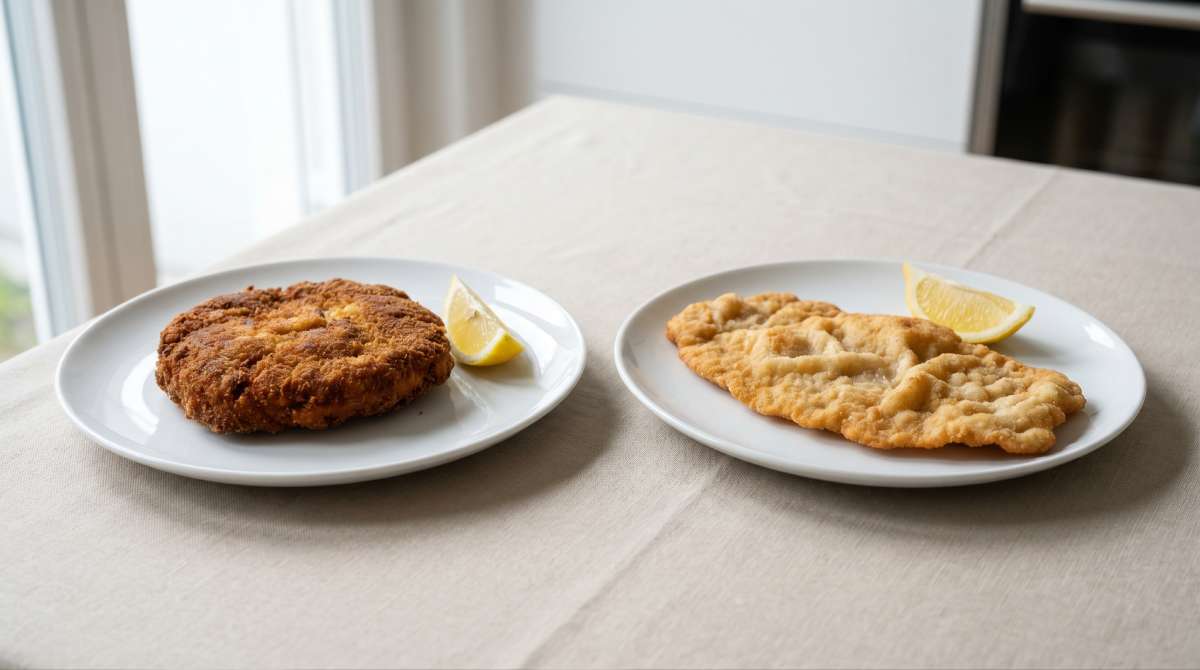
Too thick, too greasy, too dark
Most bad schnitzel is not ruined by one dramatic mistake. It is ruined by accumulation.
A lot of the time, the meat is simply too thick. That sounds minor, but it changes everything. A thick schnitzel cooks more slowly, which means the coating and the meat stop moving in harmony. The outside browns while the inside still needs more time. So the cook leaves it longer in the pan, and the crust gets darker, drier, and more aggressive. Or the heat is reduced to compensate, and then the coating absorbs more fat. Either way, the dish loses the grace that makes great schnitzel feel special.
Greasiness is another common failure, and it is usually the result of confusion rather than indulgence. People often think frying in less fat must make the result lighter. In practice, the opposite often happens. A schnitzel that does not have enough hot fat around it tends to sit there rather than fry properly. The crust does not bloom and crisp in the same way. It can turn patchy, flat, and heavy. The oiling becomes timid, but the final result feels greasier.
Then there is colour. A lot of people trust dark golden brown too much. They see deeper colour and assume deeper flavour. Sometimes that is true in other dishes. In schnitzel, it can be a trap. A schnitzel that goes too dark usually tastes less refined, not more. The crust starts to dominate. The freshness goes. The elegant contrast between meat and coating gets lost under the impression of fried crumbs.
A great schnitzel should feel confident, not overworked.
When the coating looks right but feels heavy
One of the most instructive things I learned is that schnitzel can look quite good before you bite it and still be wrong.
This is where a lot of average versions fool people. The coating is intact. The colour is acceptable. The plate looks convincing enough. But then you cut into it and the whole thing feels dense. The crust clings tightly to the meat. There is no lightness to it, no air, no sense that the coating and meat are in conversation. Instead, you get a single compact layer that eats more like generic breading than proper schnitzel.
That heaviness comes from several possible mistakes. The crumbs may be too coarse. The breading may have been pressed too firmly onto the meat. The egg layer may be too thick. The frying may have lacked the heat or movement needed to lift the crust. Or the entire piece may simply be too thick for the coating to feel elegant.
This was one of the most useful lessons for me because it changed my definition of success. I stopped judging schnitzel by whether the coating stayed on. That is too crude a standard. Plenty of mediocre schnitzel has perfectly attached coating. What I started looking for instead was a crust that felt lively and light, one that had structure but not density.
That is a much harder thing to achieve, but it is also the difference between ordinary schnitzel and memorable schnitzel.
Why disappointing schnitzel is usually a chain of small mistakes
The more schnitzel I made, the more convinced I became that perfection in this dish is cumulative. So is disappointment.
Very rarely is the problem just one thing. It is usually a sequence. The meat was slightly too thick. The seasoning was timid. The crumbs were slightly too heavy. The coating was pressed down too firmly. The pan was not quite hot enough. There was not enough fat to let the schnitzel fry properly. The cook compensated by leaving it longer. The crust darkened. The plate then got paired with a side dish that added even more heaviness. None of those choices sounds catastrophic on its own. Put them together and the result feels dull.
That is why I became so interested in schnitzel as a dish. It rewards care in a very transparent way. You cannot bluff your way to greatness with it. The best versions feel almost simple, but that simplicity is built on precision.
If I had to summarise why so much schnitzel falls short, I would say this: too many people treat it like a quick fried cutlet when it should be treated like a dish of balance.
The meat must be thin enough. The coating must be light enough. The fat must be generous enough. The heat must be controlled enough. The sides must be sharp enough to lift the whole plate.
When one of those things goes wrong, schnitzel becomes ordinary.
When several go wrong together, it becomes disappointing.
The Meat Question I Took Furthest
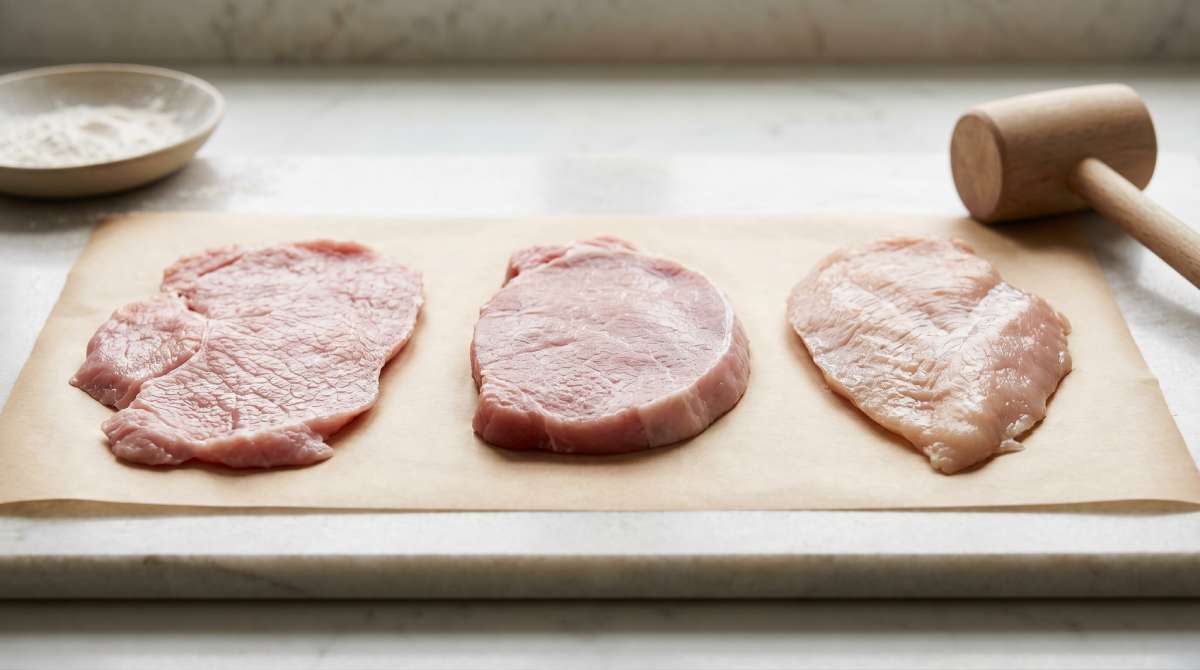
Why veal is the classic benchmark
If you spend enough time thinking about schnitzel, sooner or later you run into the meat question properly. Not just which meat can be breaded and fried, but which meat produces the kind of schnitzel you actually want.
For me, veal became the benchmark, even when I was not using it most often.
There is a reason the classic idea of Wiener Schnitzel carries so much weight. Veal has a particular delicacy that suits the dish beautifully. When it is pounded thin and fried properly, it gives you the combination that defines great schnitzel for a lot of people: tenderness without bulk, mild flavour without blandness, and an almost elegant relationship between the meat and the crust. The coating does not have to fight against strong flavour or heavy texture. The whole thing feels balanced from the start.
This recipe guide from SAVEUR shows a classic Wiener schnitzel method that is useful for comparing veal texture, breading, and pan-frying technique.
I understand immediately why people revere it. If you want to understand schnitzel as a craft, veal is incredibly instructive because it makes restraint feel natural. It invites a lighter hand. You are less tempted to over-season it, over-colour it, or overload the plate around it. Veal encourages you to keep the dish honest.
That said, veal also sharpened my thinking in another way. It taught me what the ideal was, but it also made me ask a more practical question: what meat gives me the best overall schnitzel experience most often in real life?
That answer, for me, was not always veal.
Why pork became my favourite for most real-life cooking
Pork is where my schnitzel obsession became most practical.
This chef recipe from SAVEUR shows how thin breaded pork cutlets are fried for a crisp finish, which is useful if you want to compare schnitzel-style pan technique.
I think pork works so well because it sits in a sweet spot between flavour, cost, availability, and satisfaction. A good pork schnitzel can be wonderfully tender, properly savoury, and slightly more forgiving than veal while still delivering most of the qualities I care about. It does not feel like a compromise in the negative sense. It feels like the version most people can return to again and again.
In real kitchens, that matters.
When I started making schnitzel more often, pork became the meat that allowed me to test and refine technique without feeling that every attempt had to justify a more precious ingredient. It also gave me a version of schnitzel that felt hearty enough for everyday appetite but still capable of real finesse when handled properly. Thin, well-pounded pork with a light crust, fried correctly and finished with lemon, can be outstanding.
In some ways, pork also taught me more than veal because it exposed my mistakes more bluntly. If the cut was wrong, I noticed. If the meat stayed too thick, I noticed. If the frying ran too cool, the dish lost some of its appeal faster. Pork is generous, but it still insists on good technique if you want it at its best.
For most home cooks, I think pork is probably the most useful starting point and the best long-term companion. It is accessible, satisfying, and capable of greatness.
That is why it became my favourite for regular cooking, even while veal remained the classic ideal in the back of my mind.
When chicken or turkey can work well
I used to think of chicken and turkey schnitzel mostly as substitutes, which was unfair.
They can be excellent, but only when treated on their own terms rather than judged as failed versions of veal or pork. Chicken and turkey bring a lighter character to the plate. They can feel cleaner, leaner, and particularly good with fresher sides. If I want a schnitzel meal that leans slightly less rich overall, poultry can make a lot of sense.
The problem is that chicken and turkey are less forgiving in their own way. They dry out more easily. They can become bland if you rely on the coating to do all the work. They need the same discipline with pounding and frying, perhaps even more so, because once they go too far there is less richness to rescue them.
Still, when done properly, they have real advantages. Chicken schnitzel can be wonderfully crisp and satisfying without feeling as heavy as pork. Turkey can be very good if kept thin and cooked with care. Both pair especially well with sharper, fresher side dishes that bring contrast rather than extra richness.
I would not call them the emotional centre of schnitzel culture for me, but I would absolutely call them worthwhile. They deserve to be considered properly, not dismissed automatically.
Why cut, thickness and tenderness matter more than people think
What I eventually learned is that the meat debate is not only about species. It is about suitability.
People often ask what the best meat for schnitzel is, as if there must be one final answer. I understand the question, but I now think it is slightly incomplete. The more important question is this: which meat, cut, and thickness combination gives the kind of schnitzel you are trying to make?
That is where the real answer lives.
A beautiful cut of meat can still make poor schnitzel if it is left too thick or too uneven. A more modest cut can produce excellent schnitzel if it is properly prepared. Tenderness matters, of course, but tenderness alone is not enough. Schnitzel needs meat that can be pounded thin without becoming ragged, fried quickly without losing juiciness, and paired with a light crust without the relationship feeling out of proportion.
This is why I stopped thinking in simplistic rankings and started thinking in outcomes.
If I want the classic benchmark, I think of veal.
If I want the best everyday balance, I think of pork.
If I want a lighter version with fresh sides, I think of chicken.
But in every case, I now know that the cut itself and the thickness I create from it matter at least as much as the label on the packet.
That was one of the biggest lessons schnitzel taught me. The dish does not reward vague ingredient worship. It rewards precision.
And with meat, precision starts long before the frying pan.
What I would ask a British butcher for
One practical problem with schnitzel in the UK is that the classic Central European idea of the cut does not always map neatly onto everyday British butcher language. So rather than overcomplicating it, I think it is best to ask for the result you want: thin, tender pieces that can be bashed out evenly for schnitzel. In UK retail language, the most useful terms are often veal escalopes, pork escalopes, or thin-cut pork loin steaks, while chicken schnitzel is usually built from butterflied chicken breasts.
If I were speaking to a British butcher, I would keep it simple and say something like this:
“I want thin pieces for schnitzel - tender, boneless, and easy to flatten evenly. What would you recommend?”
That immediately tells the butcher you are not looking for chops, roasting joints, or thick steaks. You are looking for something that cooks quickly and stays elegant once breaded and fried. In practice, that usually means asking for one of the following.
For veal, I would ask for veal escalopes or thin veal cutlets for schnitzel. “Escalope” is a term you will already see in UK retail, and it is probably the easiest way to avoid confusion. If the butcher has not cut them yet, I would ask for them thin enough to flatten a little more at home, not thick like a steak.
For pork, I would ask for pork escalopes first. If that is not the wording they use, I would ask for very thin boneless pork loin steaks or pork leg escalopes, specifically saying that I want them for schnitzel and plan to bash them out. UK product listings show both pork leg escalopes and thin-cut loin steaks, which is useful because it reflects the kind of language many butchers and meat counters will recognise.
For chicken, I would not overcomplicate the request. I would ask for large skinless chicken breast fillets for butterflying into schnitzels, or ask whether they can butterfly them for me. British chicken schnitzel recipes commonly use butterflied breasts that are then bashed thin, so that wording is both practical and easy to understand.
If you want one short version to remember at the counter, I think this is the most useful:
“I’m making schnitzel. I need boneless pieces that are tender and easy to flatten thin and even - escalopes if you have them.”
That is usually far more useful than trying to sound technically perfect. A good butcher will understand the cooking goal, and for schnitzel that matters more than reciting the anatomy of the animal.
The First Big Lesson - Thin and Even Beats Thick and Impressive
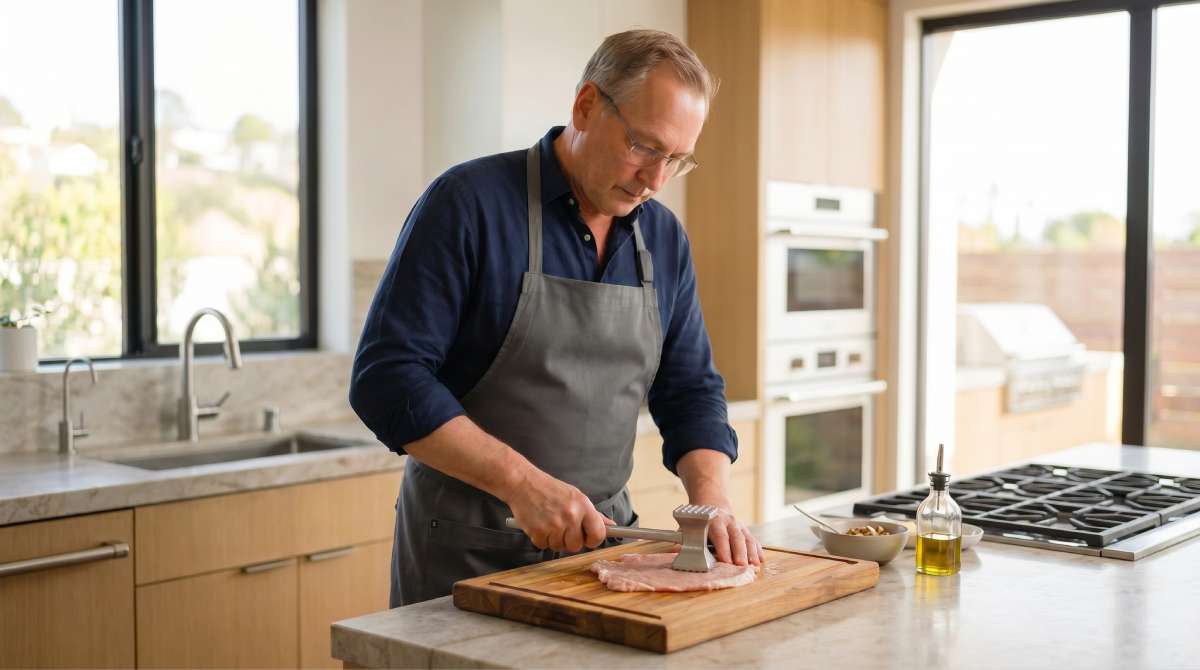
Why I started pounding schnitzel much thinner
One of the first mistakes I had to unlearn was the idea that bigger and thicker somehow meant better.
There is a certain instinct, especially when cooking meat, to equate thickness with generosity. A thick cut looks substantial. It feels like value. It suggests richness and abundance. But schnitzel does not really work on that logic. The whole beauty of the dish depends on proportion, and once I understood that, I started seeing thickness almost completely differently.
A great schnitzel should not feel bulky. It should feel broad, light, and beautifully controlled. The coating is not there to wrap around a chunky piece of meat. It is there to create a delicate, crisp shell around a thin one. When the meat is too thick, the whole relationship changes. The crust and the meat stop feeling like part of the same idea. Instead, the coating sits on the outside while the interior behaves like a separate dish.
That is why I started pounding schnitzel much thinner.
At first, I was hesitant. I worried I would overdo it, tear the meat, or end up with something dry and flimsy. But the opposite turned out to be true, provided I worked carefully. Thinner meat cooked quickly, more evenly, and more elegantly. It gave the coating a better chance to stay crisp without turning dark or heavy. The finished schnitzel felt closer to what I had been chasing all along: not a breaded slab, but a dish defined by lightness, crispness, and balance.
That was a major shift for me. I had been thinking in terms of substance. Schnitzel taught me to think in terms of finesse.
What happens when thickness is uneven
Uneven thickness is one of those problems that sounds minor until you start paying close attention to the results.
I used to think the main goal of pounding meat was simply to flatten it a bit and make it tender. That is only part of the story. What matters just as much is consistency. If one part of the schnitzel is thin and another part is noticeably thicker, the frying becomes a compromise from the start. One area wants to be done sooner. Another still needs time. The coating cannot respond perfectly to both at once.
This is where so many schnitzels quietly go wrong.
The thinner parts can turn dry before the thicker parts are ready. Or the crust develops more colour than you really want because you are waiting for the centre to catch up. Even when the result is technically acceptable, it often lacks that smooth, confident feel that good schnitzel should have. You notice slight toughness here, slight heaviness there, a piece of crust that seems right next to a piece that feels overworked.
Once I saw that happening clearly, I became much more deliberate when preparing the meat. I stopped treating pounding as a rough preliminary step and started treating it as one of the most important parts of the whole dish. I wanted the schnitzel to look almost calm before it ever reached the flour. Even surface. No awkward thick bulges. No ragged extremes. No part of it forcing the pan to solve a problem I should have solved earlier.
That attention changed more than I expected. It made frying easier, timing clearer, and the final texture far more coherent.
How thin the meat should really be
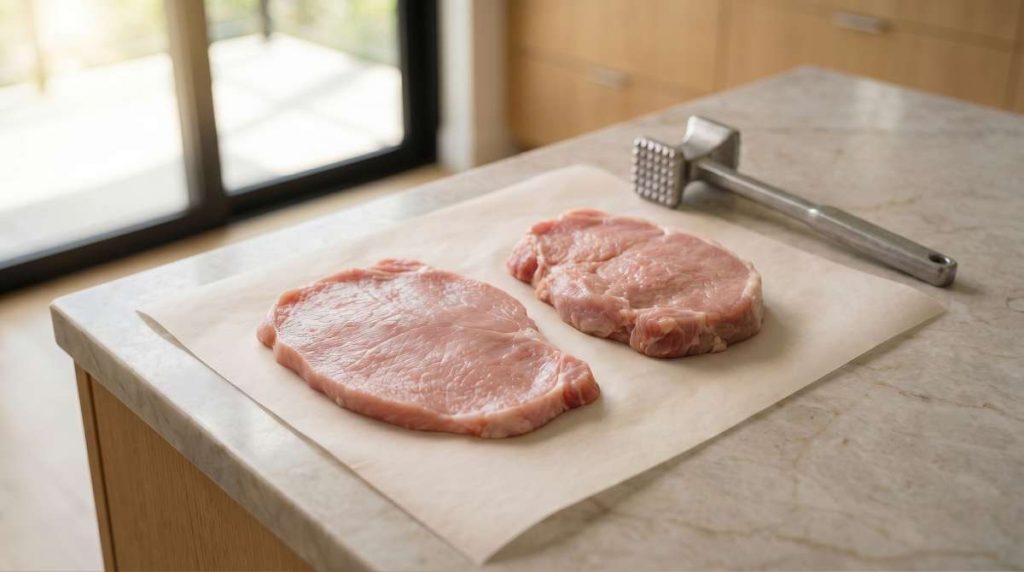
This was the question I kept returning to, because vague advice is not very helpful here. “Pound it thin” sounds good, but it leaves a lot open to interpretation.
What I learned is that schnitzel should be thinner than many people first feel comfortable making it. Not paper-thin to the point of fragility, but definitely thin enough that the meat cooks very quickly and the coating can become the elegant outer layer it is supposed to be. I no longer want anything that feels thick in the centre once fried. If it looks impressive because of its height, I already suspect I have gone in the wrong direction.
The ideal thickness depends a little on the meat. Veal naturally lends itself to that very refined, thin standard. Pork can tolerate a touch more body, but still benefits enormously from being properly flattened. Chicken and turkey also need to be treated with discipline, because thick poultry under a breadcrumb coating tends to produce exactly the sort of disconnected, slightly clumsy schnitzel I have learned to avoid.
For me, the correct thickness is the one that creates these results:
- the meat cooks fast enough that the crust never has to overdevelop
- the interior stays tender instead of turning dense
- the finished schnitzel folds or moves slightly rather than feeling rigid
- the proportion between meat and coating feels elegant, not heavy
That, in the end, is what I care about. Not the measurement in isolation, but the effect it creates. Once I understood that, I stopped being tempted by thick schnitzel altogether. It may look generous on the plate, but it rarely delivers the kind of experience I now want.
The better I got at schnitzel, the more I realised that thinness is not a sacrifice. It is part of the luxury.
The Coating Mistake I Kept Making
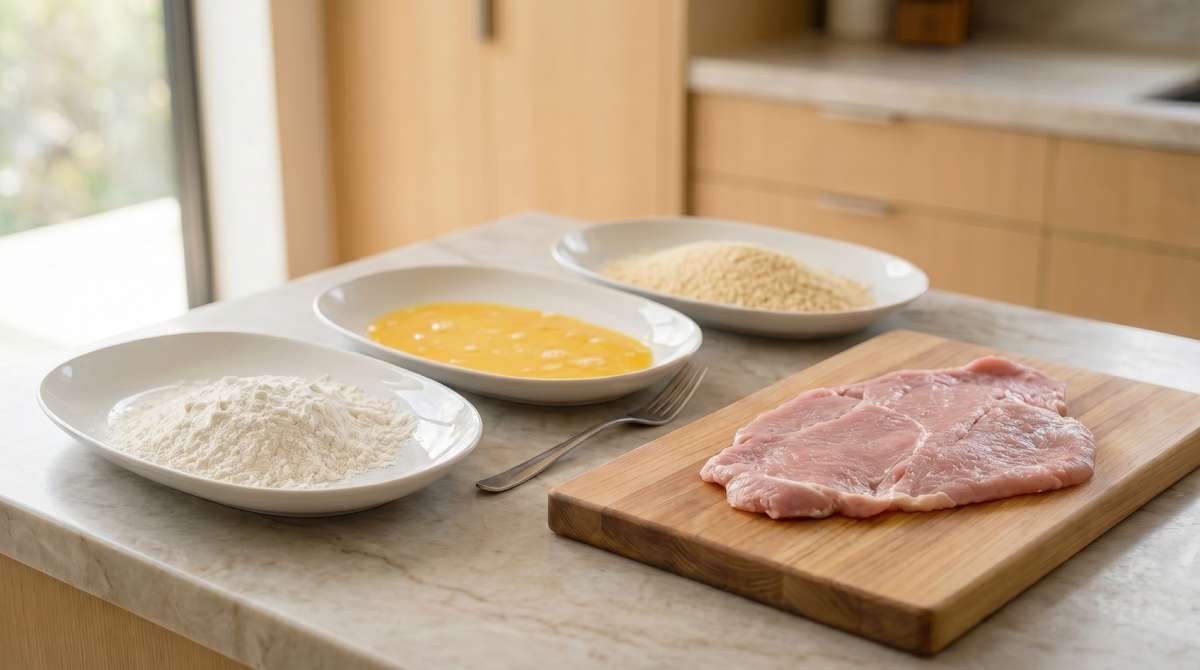
Flour, egg and breadcrumbs - the classic structure
For a long time, I thought I understood schnitzel coating because the sequence itself is so familiar. Flour, egg, breadcrumbs. It is one of the most recognisable patterns in cooking. It feels straightforward, almost foolproof. But this was exactly where I kept getting complacent.
Knowing the order is not the same as understanding the coating.
I had been treating the breading process as a practical necessity, just the thing that turns a cutlet into schnitzel. What I had not properly grasped yet was that the coating is not simply there to cover the meat. It is there to create a very specific kind of crust: thin, crisp, light, golden, and slightly lifted. That is a far more demanding brief than “make breadcrumbs stick”.
Once I started thinking about it that way, the classic structure became much more interesting.
The flour matters because it creates the dry, even first layer that helps everything else adhere cleanly. The egg matters because it binds, but it also needs to be controlled. Too much, and the coating starts to feel thick and slightly cakey. The breadcrumbs matter most of all, because they become the visible and tactile identity of the schnitzel. Their size, freshness, texture, and the way they are applied all shape the final result.
That was the real lesson for me. The classic coating is simple, but simplicity does not mean carelessness. In schnitzel, the breading stage is one of the most technical parts of the whole process.
The breadcrumbs I trust most, and what I make them from
One thing I took far too long to understand is that “breadcrumbs” is not a precise enough answer for schnitzel.
For a while, I treated breadcrumbs as a generic ingredient. If they were dry and pale enough, I assumed they would do the job. But once I started paying close attention to why some schnitzels felt delicate and elegant while others felt rougher or heavier, I realised the bread itself matters much more than people think. The crumb is not just the outside of the dish. It is the texture of the dish.
What I now trust most for schnitzel is a fine crumb made from plain white bread rolls or white bread with a soft, neutral interior. In Austrian or German terms, that usually points you towards the sort of roll used for Semmelbrösel: simple white rolls, not heavily enriched, not seeded, not flavoured, and not especially chewy. That style of bread gives you the kind of crumb I associate most strongly with classical schnitzel: pale, dry, fine, and light enough to create a crisp shell without turning the coating into a statement of its own.
If I am making breadcrumbs at home, I prefer day-old white bread rolls first. They dry well, grind finely, and produce a crumb that fries beautifully. A simple white loaf can also work very well, especially if it is not too soft and not too industrially sweet. In both cases, what I want is a crumb that feels neutral and controlled. Schnitzel does not benefit when the breadcrumb itself starts arriving with too much personality.
That is why I have become much more cautious about using certain breads, even when they sound more artisanal or more interesting on paper.
Sourdough bread is the obvious example. I understand the temptation. Good sourdough is flavourful, serious, and often excellent in other contexts. But for schnitzel, I think it usually changes the dish in ways that are not always helpful. Sourdough crumbs tend to be a little darker, sometimes a little tougher, and often a little more assertive in flavour. They can brown faster, give a slightly more rugged crust, and pull the coating away from that light, almost floating quality I want. That does not mean sourdough breadcrumbs are wrong. They can still produce a tasty breaded cutlet. But if I am chasing the classical schnitzel crust I care about most, sourdough usually takes me in the wrong direction.
The same goes for breads that are too rustic, too grainy, too chewy, too oily, or too strongly flavoured. Seeded loaves, wholegrain breads, dark crusty country bread, and breads with lots of visible structure can all make acceptable crumbs, but they tend to create a crust that feels rougher, heavier, and less refined. In schnitzel, I do not really want the breadcrumb to announce itself that loudly. I want it to support the meat and the frying, not compete with them.
Even the difference between a bread roll crumb and a standard sliced white loaf crumb is worth noticing. Roll-based crumbs often feel slightly drier, slightly finer, and slightly more classical to me. Loaf-based crumbs can still be excellent, but depending on the loaf they sometimes produce a more uniform, softer coating. That is not necessarily a flaw. It just means that if I want the most traditional, airy, lightly rippled result, I tend to trust dried white rolls first.
What I now aim for is this:
- a pale crumb, not dark
- a fine crumb, not coarse
- a dry crumb, but not dusty like powder
- a neutral crumb, not sour, seedy, or strongly flavoured
- a crumb made from bread that supports lightness and elegance, not crunch for its own sake
That last point matters a lot. There is a modern tendency to think more texture always means better texture. Schnitzel taught me the opposite. The best breadcrumbs are not the loudest ones. They are the ones that let the crust become thin, crisp, delicate, and alive.
So if I had to reduce the whole breadcrumb question to one practical answer, it would be this:
Use fine dry crumbs made from plain white bread rolls if you can. Use a simple white loaf if you cannot. Be cautious with sourdough and rustic breads unless you actively want a less classical, more assertive crust.
That was one of the clearest upgrades I made to my schnitzel, and once I noticed it, I could not really unnotice it.
Why pressing the crumbs down made my schnitzel worse
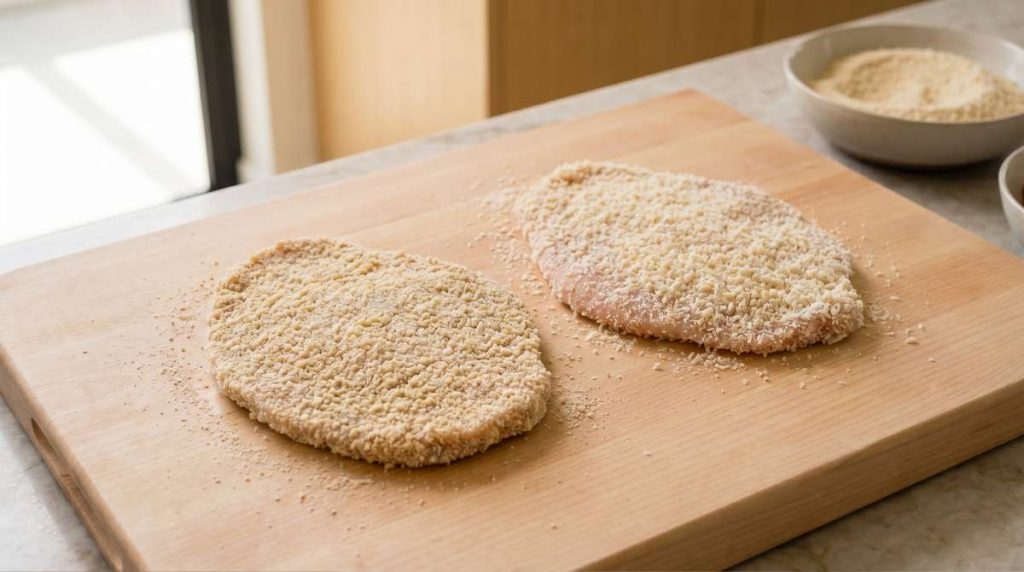
This was probably the single most useful coating lesson I learned.
For years, I had a habit that seemed sensible. Once the breadcrumbs were on, I pressed them down quite firmly. Not violently, but enough to make sure they were well attached. In my mind, I was being careful. I wanted a neat result. I wanted the crust to stay on. I wanted the schnitzel to look tidy and secure before it went into the pan.
What I was actually doing was making it heavier.
The more I chased better schnitzel, the more I noticed that the versions I admired most did not have a tight, compact breadcrumb shell. Their coating seemed lighter, almost relaxed. It sat on the meat properly, but it did not look compressed into it. When fried well, it developed that subtle separation and rippling that gives great schnitzel so much of its character.
Once I stopped pressing the crumbs down so hard, everything started to improve. The crust felt less dense. The texture became more delicate. The schnitzel ate more like the dish I had in mind and less like a generic breaded cutlet.
That was one of those moments where a small physical change altered the entire result. I had been equating firmness with quality when I should have been aiming for light contact and even coverage. Schnitzel does not want to be tightly packed. It wants room to become itself in the pan.
Fine crumbs, coarse crumbs and whether panko helps or hurts
Breadcrumbs turned out to be a much bigger subject than I first expected.
This chef recipe shows how breadcrumb choice, frying method, and a few classic details can make for a better perfect schnitzel at home or on the menu.
At the start, I assumed breadcrumbs were mostly interchangeable as long as they were dry enough and reasonably pale. But once I began paying attention to texture, I realised the crumb itself pushes the schnitzel in a particular direction. Fine crumbs tend to produce the kind of classical result I now associate with proper schnitzel: even coverage, delicate crispness, and a crust that feels light rather than aggressively crunchy. Coarser crumbs can still be pleasant, but they often create a rougher, louder texture.
That is why I gradually became more committed to finer crumbs for the style of schnitzel I wanted. They felt more elegant. They browned more gracefully. They allowed the dish to stay refined rather than drifting into something heavier and more rustic.
Panko is the obvious modern question here. And I understand why people reach for it. Panko gives dramatic crunch, plenty of surface texture, and a very visible crispness. I am not against it in principle. It can be delicious. But for the kind of schnitzel I ended up chasing, it usually pushes the dish away from the ideal rather than towards it. The crust becomes more assertive, more obviously crunchy, less subtle. It starts to feel like the coating is demanding attention rather than supporting the meat.
That is why I now see panko as a valid variation rather than the answer. If I want classical schnitzel character, I prefer fine breadcrumbs. If I want something crunchier and less traditional, panko has its place. The key is being honest about what result each one gives you.
What I learned about keeping the coating light
By the time I had made enough schnitzel to understand the pattern, I realised that almost everything I was aiming for in the crust could be summarised with one word: lightness.
Not weakness. Not fragility. Not lack of flavour. Lightness.
I wanted a coating that crisped without hardening, that browned without becoming heavy, that held together while still feeling slightly airy. And to get there, I had to stop overhandling it at every stage. The flour needed to be even, not clumpy. The egg needed to coat, not drown. The crumbs needed to cover, not be forced into the meat. The breaded schnitzel needed to go into the pan without being turned into a compressed package.
This sounds obvious when written out plainly, but it took me time to feel it properly in practice. Schnitzel punishes fussing. The more I tried to over-secure the coating, the less elegant the result became. The more I treated the breading as something to be controlled tightly, the less it behaved the way I wanted.
What finally worked was a lighter hand and a clearer goal. I stopped aiming for maximum adherence and started aiming for the right structure. I wanted the coating to have enough attachment to stay with the meat, but enough freedom to puff, ripple, and crisp beautifully.
That was the change.
The best schnitzel coating is not the one that feels most solid before frying. It is the one that feels most alive after it.
The Rippled Crust I Was Chasing All Along
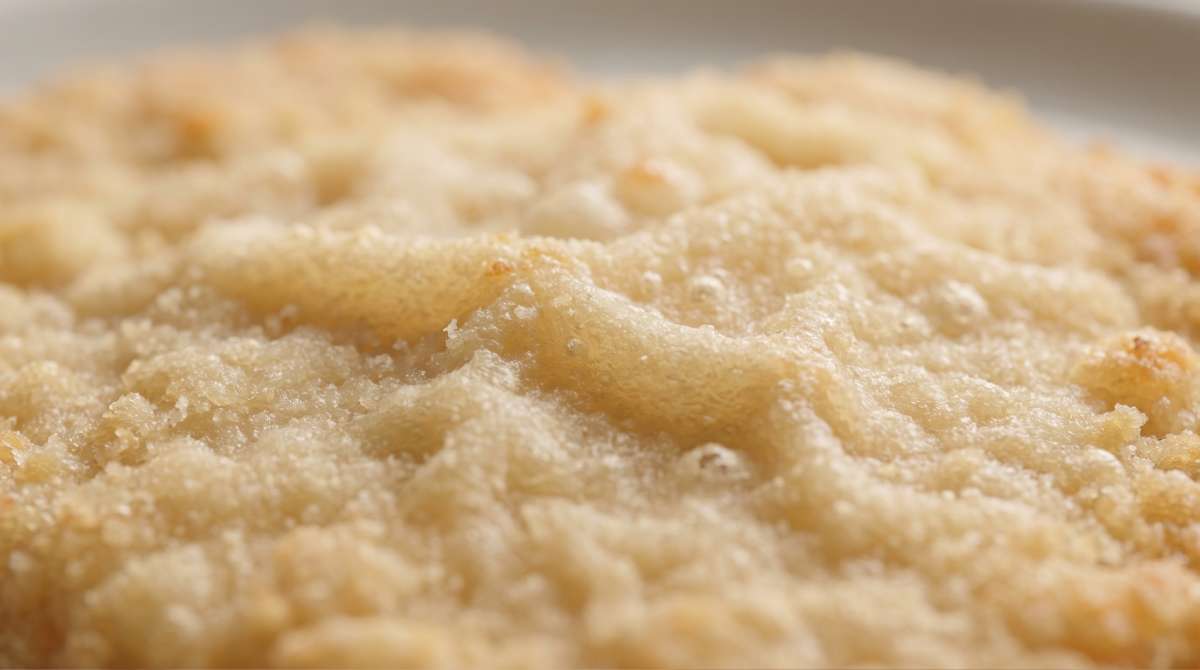
What a great schnitzel crust is supposed to feel like
At some point in this whole schnitzel obsession, I realised that what I was really chasing was not just a dish, but a texture.
The crust was always the signal.
Before I learned how to describe it properly, I only knew that some schnitzels felt thrilling and others felt merely competent. The difference was often in the crust. A great schnitzel crust is crisp, of course, but crispness alone is much too simple a standard. Plenty of fried coatings are crisp. Schnitzel asks for something more refined than that.
The crust I wanted had lightness to it. It had delicacy. It shattered gently rather than fighting back. It felt dry in the right way, never oily, never thick, never dense. It gave structure without turning into armour. Most importantly, it seemed to belong to the meat without being fused to it so tightly that the whole dish lost its grace.
That is what made a great schnitzel feel so distinctive to me. The coating was not merely attached. It had personality. It carried air and movement in it. It made the dish feel less like a breaded cutlet and more like something crafted with actual care.
Once I understood that, the crust stopped being a surface detail. It became the centre of the whole pursuit.
Why the coating should lift rather than cling flat
This was one of the biggest mental shifts for me, because it reversed what I had once assumed success looked like.
I used to think the ideal breading sat tightly and perfectly flat against the meat. That seemed neat. Professional. Efficient. But the more good schnitzel I paid attention to, the more I started noticing that the best crusts often did the opposite. They lifted slightly. They rippled. They formed little blisters and waves. There was a subtle separation between crust and meat that made the whole thing feel lighter and more alive.
At first, that seemed almost counterintuitive. Had the coating not adhered properly? Was that not a flaw? But once I understood the texture of great schnitzel, I saw that this gentle lifting was part of the beauty. It meant the crust had room to breathe. It meant the coating had fried in a way that created delicacy rather than compactness.
This does not mean the crust should detach in sheets or fall apart. That would be failure. What I mean is something much finer than that: a crust that does not cling like wallpaper, one that has just enough separation to create those light ripples and that unmistakable sense of movement.
That is the crust I kept chasing. Not a perfect seal, but the right kind of looseness.
And once I started aiming for that, my entire handling of schnitzel became more intelligent.
The small handling details that changed everything
What fascinates me about schnitzel now is how often the breakthrough comes from details that seem minor until you experience their cumulative effect.
The first was the way I handled the coating. As I have already said, pressing less made a real difference. The second was the way I thought about the pan. Schnitzel does not want to sit heavily in a thin film of fat. It wants enough hot fat around it to fry cleanly and confidently. That alone improved the crust far more than I expected.
Then there was movement. I began to understand that great schnitzel is not a static thing. The frying should feel active but controlled. A little movement in the pan, a little attention to how the fat meets the coating, a little awareness of whether the crust is blooming properly rather than just browning. These things sound subtle because they are subtle, but they are exactly the sort of subtleties that separate good schnitzel from memorable schnitzel.
Timing mattered too. Leaving a schnitzel in too long because I wanted extra colour nearly always pushed it in the wrong direction. Great crust seems to arrive with a certain decisiveness. When it is right, it is right. Waiting for it to become even more impressive usually makes it less so.
In the end, the rippled crust I was chasing was never about one magical trick. It came from a cluster of disciplined choices:
- thin, even meat
- a light coating
- fine crumbs
- generous hot fat
- confident but not aggressive frying
- the willingness to stop when the schnitzel is ready, not when it looks dramatic
That, for me, is where schnitzel became truly beautiful. Not in excess, but in control.
The ripples were never just decoration. They were proof that the whole method had come together.
The Fat Debate That Changed My Schnitzel
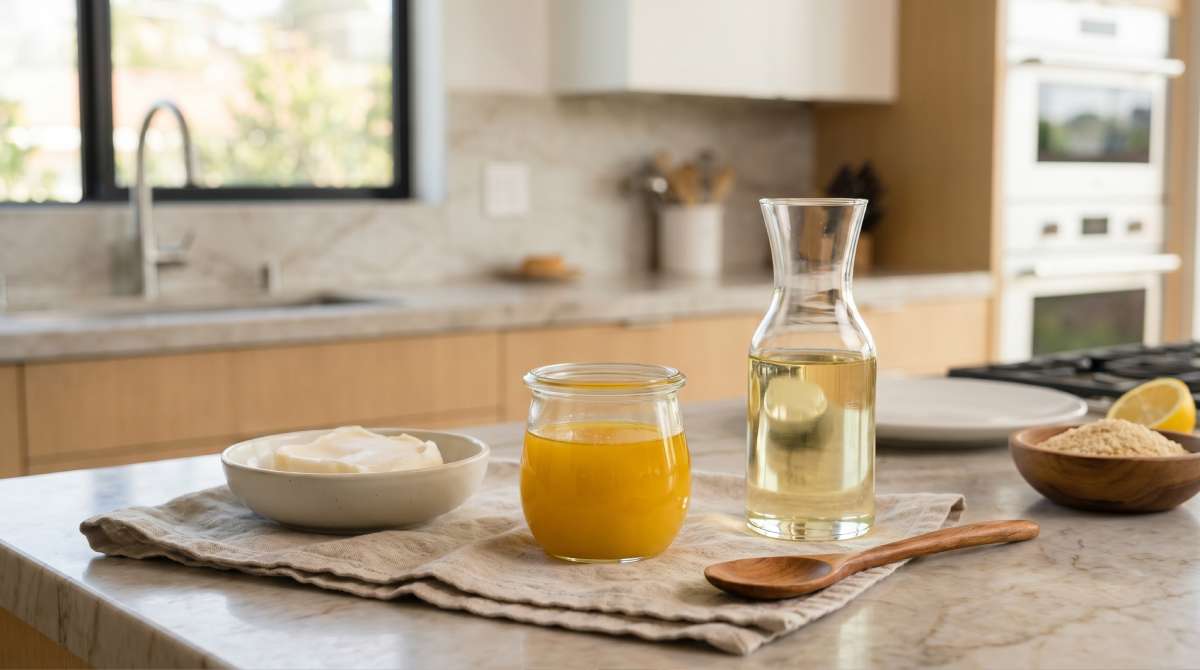
Clarified butter and why it feels special
There are certain ingredients that do more than perform a function. They also change the mood of a dish. Clarified butter became that ingredient for me with schnitzel.
At first, I thought of frying fat mostly in technical terms. Smoke point, stability, cleanliness, cost. All of that matters, obviously. But the more I worked on schnitzel, the more I realised that the fat shapes not only the cooking but the character of the final plate. Clarified butter has a way of making schnitzel feel more complete, more rounded, more in tune with the version I had in my head.
Part of that is flavour. Not loud flavour, not the kind that takes over, but a richness that sits behind the crust and makes the whole dish feel more integrated. It gives the coating a warmer, more graceful quality. The schnitzel still needs lemon, still needs freshness, still needs the right side dishes, but clarified butter gives it a sort of quiet authority. It tastes like the dish knows what it is.
What I also like about it is that it suits the spirit of schnitzel. This is not a dish that benefits from greasy excess, but it does benefit from a certain generosity. Clarified butter gives you that sense of generosity without making the result feel clumsy. When the meat is thin, the crumbs are right, and the heat is under control, it helps produce the sort of golden, elegant finish I kept trying to reproduce.
I would not say every excellent schnitzel must be fried in clarified butter. That would be too rigid. But I would absolutely say this: the more seriously I took schnitzel, the more often I found myself wanting the flavour and feel that clarified butter brings.
Lard, tradition and frying performance
Lard was one of the ingredients that made me reconsider my own assumptions.
For a while, I had the modern hesitation around it that many people do. It sounded heavy on paper. Old-fashioned. Perhaps a bit too much. But once I paid proper attention to how it behaves in the pan, I understood why it belongs in serious schnitzel conversations. Lard is not just about tradition for tradition’s sake. It is about performance.
It fries beautifully.
There is something very steady and convincing about the way schnitzel cooks in it. The crust develops well, the frying feels decisive, and the final result can have exactly the sort of confident texture I was chasing. Lard supports the dish rather than dragging it down. Used properly, it does not make schnitzel feel cumbersome. In fact, one of the things that surprised me most was how clean and effective it could feel.
That said, I still think its appeal depends partly on the sort of schnitzel experience you want. Lard brings a little more old-world solidity to the plate. That is not a criticism. Sometimes it is exactly right. It suits pork particularly well, and it can give the whole dish a grounded, deeply satisfying quality. But for me, it works best when everything else stays disciplined. The meat must still be thin. The coating must still be light. The sides must still provide contrast. Otherwise the plate can drift towards heaviness.
What lard taught me, more than anything, was that frying fat should not be judged by fashionable instinct alone. Schnitzel is one of those dishes that rewards ingredients people sometimes dismiss too quickly. Tradition, in this case, is not ornamental. It is often practical wisdom that has survived because it works.
Neutral oil and the practical home-cook argument
For all my affection for clarified butter and my growing respect for lard, I also had to admit something important to myself: most real-life cooking is not done in an idealised culinary universe.
Sometimes practicality matters.
Neutral oil became important in my schnitzel journey because it forced me to separate romance from usefulness. It may not have the same emotional pull. It may not carry the same sense of tradition. But it is convenient, dependable, widely available, and often the easiest fat for people to use with confidence. That counts for a lot.
Used properly, neutral oil can produce very good schnitzel. It gives clean frying, clear control, and a result that lets the meat and the coating speak without interference. If the rest of the method is strong, neutral oil does not get in the way. In fact, it can be exactly the right choice when I want to focus purely on technique and avoid complicating the process.
The danger is not the oil itself. The danger is thinking that because the flavour is neutral, the whole issue of fat stops mattering. It does not. The amount still matters. The temperature still matters. The way the schnitzel moves in the pan still matters. A timid amount of neutral oil does not become virtuous just because it sounds lighter. Schnitzel still needs proper frying conditions if it is going to become what it should be.
So I came to see neutral oil as the sensible baseline. It is not the most evocative option, and it is not the one that made me feel most emotionally attached to the result, but it is honest and effective. In many kitchens, that makes it a perfectly respectable choice.
What duck fat and goose fat taught me
At some point, once I had spent far too much time thinking about frying fat already, it became almost inevitable that I would start wondering about duck fat and goose fat too.
On paper, they are tempting. They sound luxurious, old-world, and exactly the sort of thing that might elevate schnitzel into something even more special. And to be fair, they can produce very good results. Both have enough substance and flavour to fry beautifully when used properly, and both bring a certain richness that can suit a breaded cutlet very well.
But the more I thought about them, and the more I compared them mentally against what I really want from schnitzel, the clearer the distinction became.
Goose fat makes more sense to me than duck fat in this context. It has a steadier, more Central European feel to it, and it can support the dish without pulling the flavour too far away from the classical idea. With pork schnitzel especially, I can absolutely see the appeal. It brings richness, but in a way that can still feel grounded and traditional rather than showy. If someone wanted to make a more indulgent, slightly more old-world version of schnitzel, goose fat would be a serious and respectable choice.
Duck fat, on the other hand, feels a little more assertive. That is not necessarily a flaw. Duck fat can fry beautifully, and it can taste excellent. But it has more personality of its own, and that is exactly where I start to hesitate with schnitzel. The longer I spent trying to understand this dish, the more convinced I became that schnitzel works best when the frying fat supports the crust rather than trying to become part of the headline. Duck fat edges a little closer to becoming part of the headline.
That is really the issue with both fats, though more so with duck than goose. They are not neutral, and they are not as quietly classical as clarified butter. They can make the dish richer and more distinctive, but they can also make it a little heavier in spirit. If the coating is not light enough, if the meat is not thin enough, or if the side dishes are not sharp and fresh enough, that extra richness can push the whole plate away from elegance and towards heaviness.
That is why I would never call them the best default choice for schnitzel, even though I would not dismiss them either.
For veal schnitzel, I still think clarified butter remains the better fit. Veal asks for delicacy, and clarified butter respects that. For pork schnitzel, goose fat is much more persuasive, because pork can carry a little more richness without losing its balance. For chicken or turkey schnitzel, I think both fats are possible, but often a little more than the dish really needs.
So my view of these two fats ended up being quite clear. They are not wrong. They are not gimmicks. But they are better understood as interesting variations than as the natural answer. Goose fat can be deeply satisfying and quite convincing in the right version of schnitzel. Duck fat can be delicious, but it pushes the dish a bit further away from the clean, refined character I spent most of this article chasing.
In the end, they taught me the same lesson the other fats did: the frying medium is not just a technical detail. It shapes the mood of the whole plate.
And with schnitzel, mood matters more than it first appears.
The fat I kept coming back to
After trying different approaches and thinking about them far more than a normal person probably should, I found that my preference became clearer.
If I wanted the schnitzel that felt closest to my idea of the dish at its best, I kept coming back to clarified butter.
That does not mean I rejected the others. Lard earned my respect. Neutral oil earned its place. But clarified butter kept winning the argument in my head because it gave me both performance and feeling. It fried well, supported the crust, and contributed that gentle richness which makes schnitzel feel complete without making it feel heavy. It gave me the balance I wanted between technical success and sensory pleasure.
What mattered just as much, though, was the real lesson underneath the choice. The fat question changed my schnitzel not because I found one magical answer, but because it taught me to stop treating frying fat as an afterthought. It is not a neutral background detail. It is one of the defining decisions in the whole dish.
Once I saw that properly, my schnitzel improved.
And that seems to be the pattern with this dish again and again. The things people are tempted to treat casually are often the very things that shape the result most deeply.
The Heat Problem I Did Not Understand at First
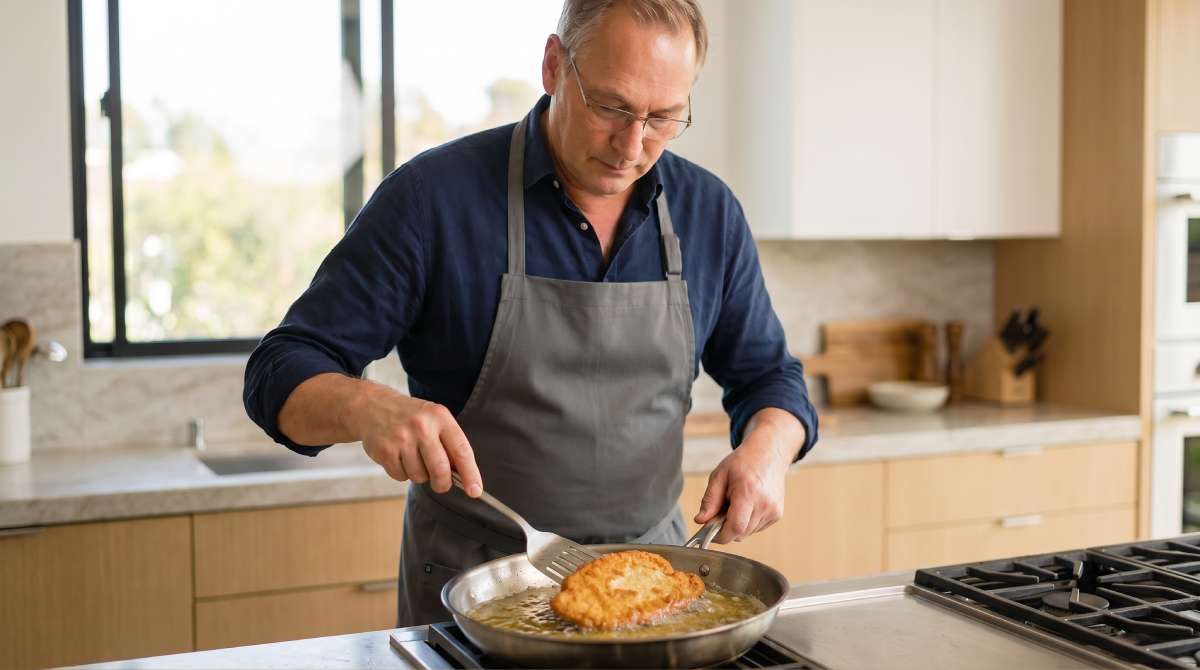
Why frying too cool makes schnitzel greasy
For a long time, I thought caution with heat was the safer path.
It seemed logical. If I kept the pan a little calmer, surely I would reduce the risk of burning the coating, overcooking the meat, or making the whole thing feel harsh. In theory, it sounded sensible. In practice, it was one of the reasons my schnitzel kept turning out heavier than I wanted.
Frying too cool does not make schnitzel gentler. It makes it duller.
The first sign is usually in the crust. Instead of blooming quickly into something crisp and lively, it sits there and slowly absorbs the cooking fat without developing the right sort of structure. The coating can still brown eventually, but the texture is wrong. It feels flatter, denser, and somehow less awake. The meat may still be edible, even pleasant, but the whole dish loses that sense of confidence I now associate with good schnitzel.
This was particularly frustrating because the result could appear respectable at first glance. The colour might be acceptable. The crust might remain intact. But once I cut into it, the problem became obvious. The schnitzel felt oilier, heavier, and less refined. It did not have that decisive crispness that makes the dish so satisfying. It felt as though it had been sitting in fat rather than transformed by it.
That was the key realisation for me. Good frying is not about exposing the schnitzel to fat for longer. It is about using enough well-heated fat to set the crust quickly and cleanly. Once I understood that, I stopped being nervous about proper frying conditions and started seeing them as essential.
Why frying too hot can ruin the crust before the meat is ready
Of course, once I corrected for timid heat, I encountered the opposite problem.
This is how schnitzel teaches humility. Solve one mistake too aggressively and it introduces you to the next one.
Heat that is too high creates its own kind of failure. The crust colours too quickly, often before the meat has had time to cook with the ease and evenness you want. At first, that faster browning can look exciting. The schnitzel seems lively, dramatic, properly fried. But the effect rarely lasts. The coating pushes towards a darker, more brittle state, and the interior loses the delicate timing that makes the dish feel balanced.
I have done this more than once. I wanted extra confidence from the pan and ended up with a schnitzel that looked assertive but ate badly. The crust had too much dominance. The freshness had narrowed. The whole thing felt slightly impatient, as though the cooking had been trying to impress rather than simply get it right.
This is one of the reasons schnitzel taught me to distrust visual drama. It is not the sort of dish that improves by becoming more extreme. Deeper brown is not automatically better. Louder sizzle is not automatically better. Faster is not automatically better. The ideal heat is not the one that makes the most theatre in the pan. It is the one that lets the coating set, colour, and crisp at the same pace the thin meat reaches perfection.
That balance took me time to understand, because it depends on paying attention rather than chasing intensity.
The temperature window that finally worked for me
Once I had made enough schnitzel badly, I started noticing that the versions I liked most all came from the same general heat range. Not a precise obsession with numbers for their own sake, but a recognisable zone where everything seemed to move together.
The fat needed to be properly hot before the schnitzel went in. Not smoking angrily, not timid and lazy, but ready. When the coating met the fat, I wanted immediate response. A confident sizzle. A sense that the crust had started cooking at once, not after a delay. From there, what mattered most was stability. I wanted the schnitzel to colour steadily, not race, not stall.
That was the window that finally worked for me: hot enough to create quick structure, controlled enough to avoid harshness.
Once I found that, a lot of other things improved automatically. The crust became cleaner. The meat stayed more tender. The frying felt more predictable. Even my own handling changed, because I stopped reacting anxiously and started trusting the process more. Good heat makes the cook calmer. Bad heat makes the cook compensate.
I also became much less interested in abstract debates about exact numbers unless they translated into something useful in the pan. The practical signs mattered more to me: how quickly the crust responded, how evenly the colour developed, whether the schnitzel felt buoyant rather than weighed down, whether the meat and coating seemed to be finishing together.
Those were the signs that told me I was finally in the right place.
Why the schnitzel needs to swim, not just sit in fat
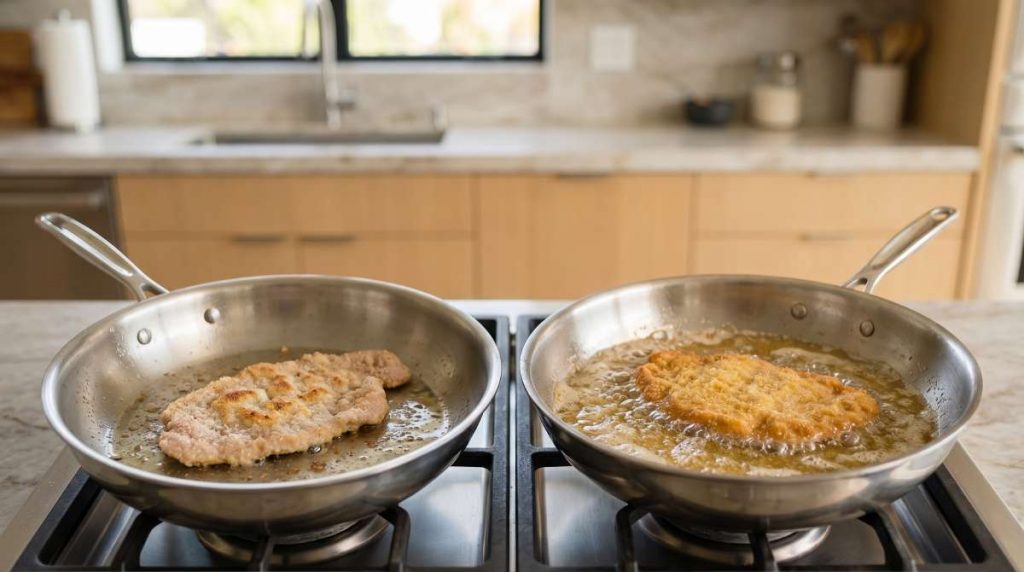
This was another lesson that changed the way I thought about frying altogether.
Before I took schnitzel seriously, I often approached frying with a sort of minimalist instinct. Less fat felt cleaner, more disciplined, perhaps even more virtuous. But schnitzel taught me that there is a difference between restraint and false economy. Too little fat does not refine the dish. It starves it of the conditions it needs.
A schnitzel should not be lying on a barely lubricated surface, hoping for the best. It should have enough hot fat around it to fry properly. I do not mean deep-fried in the sense of total immersion, but I do mean generously shallow-fried, with the fat actively participating in the cooking rather than simply coating the pan.
That changes the crust profoundly. When the schnitzel has enough fat around it, the coating develops more evenly and more naturally. It gains the structure, crispness, and slight lift I had been chasing. The frying feels dynamic rather than strained. The dish makes sense.
It also changes the psychology of cooking. Once I accepted that schnitzel needs generosity here, I stopped trying to force the dish into a half-measure version of itself. I stopped asking it to behave like something it is not. Schnitzel is a fried dish, and good schnitzel comes from embracing that fact with control rather than apologising for it.
That was one of the biggest lessons of the entire journey. The dish became better when I stopped trying to make it timid.
What I Learned About Seasoning
Why simple seasoning usually wins
Seasoning took me a surprisingly long time to understand, mostly because I overthought it in the wrong direction.
When a dish feels slightly underwhelming, the instinct is often to add more. More spice. More herbs. More layers. More assertiveness. I went down that road enough times to learn that schnitzel rarely thanks you for it. The more I tried to decorate the flavour, the more I moved away from what I actually loved about the dish.
Schnitzel is at its best when it feels clear.
The meat should taste like itself. The coating should taste clean and golden. The frying fat should support, not dominate. The lemon should sharpen the whole thing at the point of eating. Once I really accepted that structure, I stopped asking seasoning to do work that technique should be doing instead. If the meat is right, the crust is right, and the frying is right, you do not need much. In fact, too much starts to feel like a confession that the fundamentals were not trusted.
That was an important correction for me. I had been treating seasoning like an area for creativity when what schnitzel really needed was discipline. It is not a blank canvas that improves with endless flavour additions. It is a composed dish that depends on balance.
And balance, more often than not, sounds simpler than people expect.
Salt, pepper and the role of lemon
In the end, the seasoning that kept proving itself was the most traditional one.
Salt mattered, of course. More than I used to realise, because thin meat needs proper seasoning if it is going to carry itself through the coating. Not a harsh or aggressive amount, just enough to wake the meat up and give it shape. Pepper had its place too, though I became less interested in using it heavily. Too much pepper can begin to pull attention away from the more delicate pleasures of the dish. When used with restraint, it supports. When pushed, it starts to crowd.
Then there is lemon, which I now think of less as a garnish and more as part of the architecture of schnitzel.
A squeeze of lemon does not simply add brightness. It completes the dish. It cuts through the richness of the frying, sharpens the crust, lifts the meat, and makes the whole plate feel more awake. Without that acidic contrast, even a very good schnitzel can feel slightly unfinished to me. With it, the dish gathers itself properly.
This taught me something that now feels obvious. Schnitzel does not need louder seasoning because it already has contrast built into its ideal form. Salt gives the meat clarity. Pepper adds a touch of depth. Lemon brings lift and direction. The side dishes then continue that work by providing freshness, acidity, or relief. Once all of that is in place, extra embellishment often becomes unnecessary.
When extra seasoning starts to get in the way
I am not completely doctrinaire about this. There are times and places for variation. Different kitchens, different moods, different kinds of schnitzel can justify slightly different accents. But I have become convinced that over-seasoning is one of the fastest ways to make schnitzel feel less itself.
The problem is not only flavour. It is confusion.
The more spices, dried herbs, or assertive additions you build into the process, the more the dish begins to lose its line of thought. The coating stops being an elegant crust and starts becoming a flavour delivery system. The meat becomes secondary. The lemon becomes less important. The side dishes become less coherent. And suddenly the plate is no longer about the beautiful interplay of meat, crumbs, fat, and freshness. It has become something busier and less sure of itself.
I have done this often enough to know the pattern. The result is not necessarily bad. Sometimes it is perfectly enjoyable. But it is no longer the schnitzel I ended up chasing.
That is why my view on seasoning became much stricter over time. Not severe, just clearer. Schnitzel does not need to be made interesting by force. It becomes interesting when its essentials are handled well enough that very little has to be added.
That, in a way, is one of the most seductive things about the dish. It makes restraint feel luxurious.
And once I understood that, I stopped trying to season schnitzel into importance. I started letting it earn its importance through technique instead.
The Side Dishes That Finally Made It Feel Complete
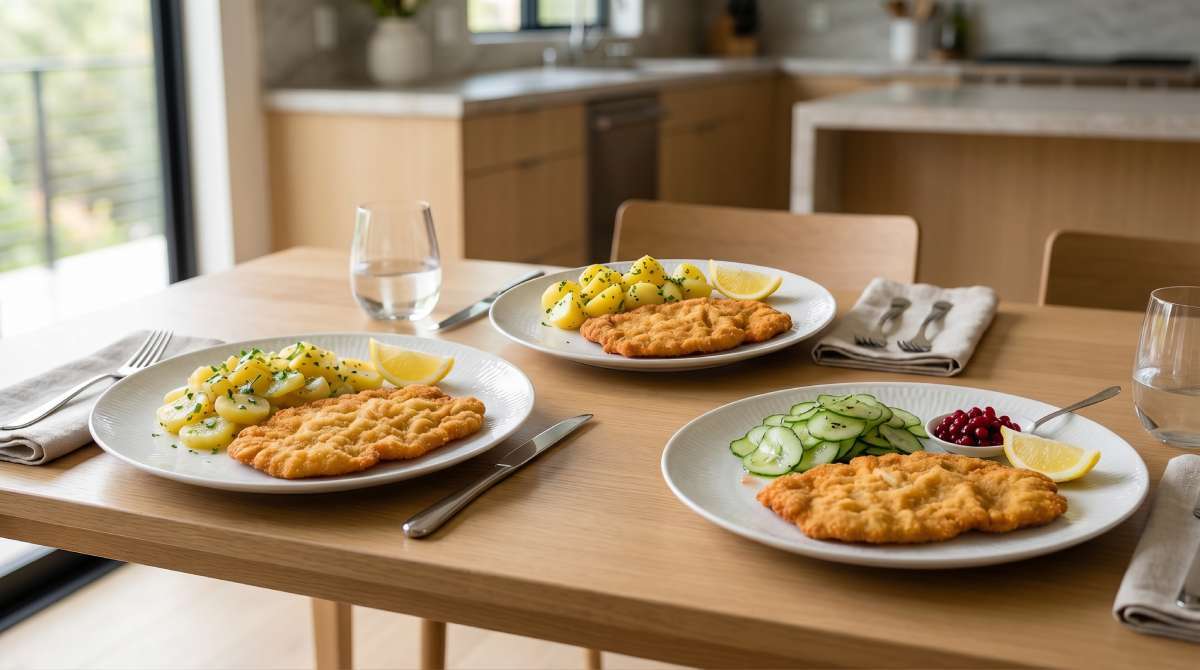
Why potato salad belongs in the conversation
For a long time, I treated side dishes as an afterthought in the schnitzel story. If the meat was right, the coating was right, and the frying was right, surely the rest was just support. That is what I assumed. But the better I got at schnitzel, the more obvious it became that the side dish can either complete the plate or quietly drag it in the wrong direction.
This chef recipe shows classic schnitzel accompaniments and side dish ideas that help round out a proper German plate.
Potato salad was the first side that made me understand this properly.
A good potato salad does not compete with schnitzel. It gives it shape. It introduces softness without dullness, substance without more frying, and, when done well, the kind of acidity that keeps the whole meal feeling awake. That mattered enormously to me because one of the easiest ways to ruin schnitzel is to surround it with things that make it feel heavier rather than sharper.
When I had schnitzel with the right kind of potato salad, the whole dish suddenly felt more intelligent. The contrast made sense. The warm, crisp, fried exterior of the schnitzel met something smoother, slightly dressed, slightly bright, and much less loud. Each bite improved the next. The potato salad was not there to impress on its own. It was there to make the schnitzel eat better from start to finish.
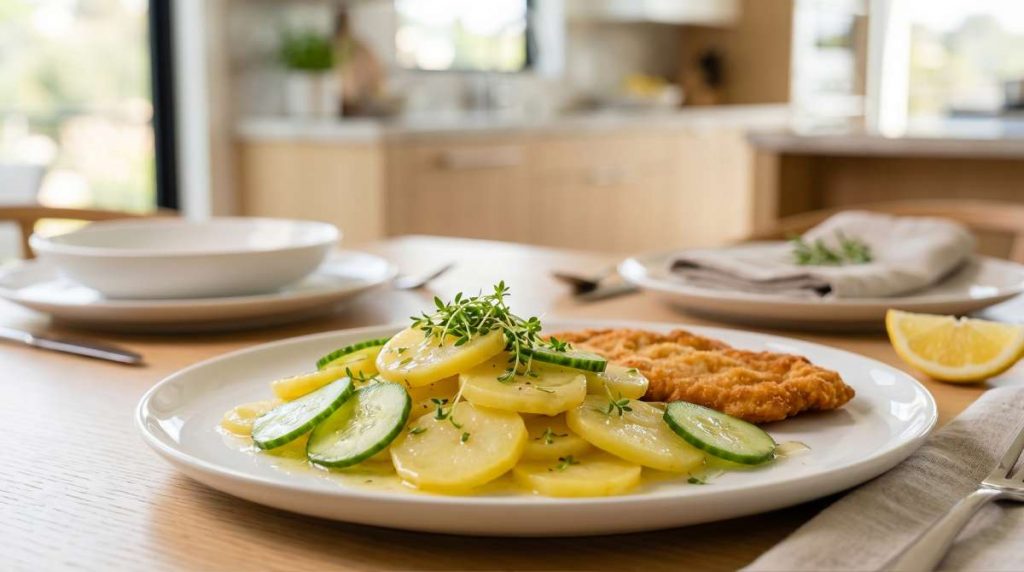
That was the key lesson for me. A great schnitzel side dish does not just fill the plate. It creates relief.
I also came to appreciate that potato salad can be many things, which makes it both useful and dangerous. A version that is too creamy, too heavy, or too rich can turn the meal sluggish. But a potato salad with balance, a bit of sharpness, and enough lightness to cut through the fried element can feel almost inevitable beside schnitzel. It makes the dish feel grounded without becoming weighty.
At some point, I stopped thinking of potato salad as one option among many and started thinking of it as one of the most serious answers to the question of what schnitzel needs beside it.
Parsley potatoes and the quieter classic option
If potato salad gives schnitzel brightness through dressing and contrast, parsley potatoes do something slightly different. They offer calm.
This recipe guide shows a traditional German potato salad you can use alongside schnitzel or sausages when planning classic sides.
There are times when I want the side dish to be more obviously active, and potato salad does that beautifully. But there are also times when I want the schnitzel itself to remain the unmistakable centre of gravity. That is where parsley potatoes started to matter more to me.
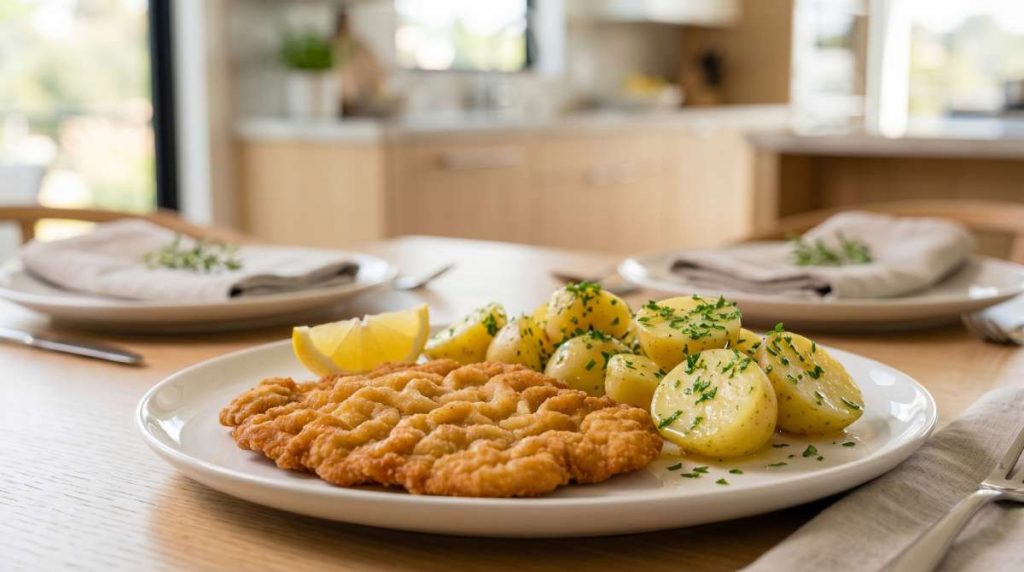
At first, I underestimated them. They seemed almost too simple. Boiled potatoes with parsley can sound modest to the point of understatement, especially next to a dish as golden and seductive as schnitzel. But once I paid attention to the plate as a whole, I understood their strength. Parsley potatoes do not flatten the meal with extra richness, and they do not distract it with too much personality. They give the dish steadiness. They bring warmth, softness, and a gentle earthiness that allows the schnitzel to keep speaking clearly.
That is an underrated quality in side dishes. Not every accompaniment needs to be clever. Sometimes the smartest thing a side can do is stay disciplined.
I also found that parsley potatoes work especially well when the schnitzel itself feels particularly refined. With a thin, well-fried piece of veal or a beautifully made pork schnitzel, they support the plate without introducing extra tension. Lemon over the schnitzel, a few parsley potatoes on the side, perhaps something fresh elsewhere on the plate, and suddenly the whole meal feels composed rather than busy.
That word matters to me. Composed. Good schnitzel is not just delicious. It is composed. The side dish must understand that.
Cucumber salad for freshness and contrast
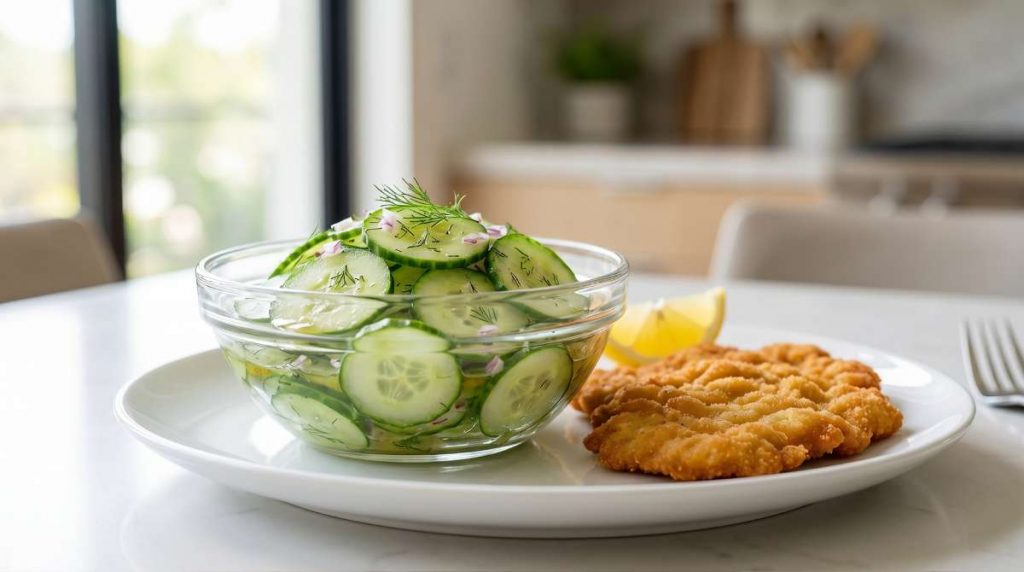
If potato salad and parsley potatoes represent stability, cucumber salad represents lift.
This recipe guide shows how a sweet and sour cucumber salad can add the crisp, cooling contrast that works so well alongside schnitzel.
I gradually became more devoted to cucumber salad because I realised that schnitzel does not only need support. It also needs freshness that cuts cleanly through the richness of the frying. And few things do that more elegantly than cucumber when it is treated properly.
There is something almost corrective about it. After a few bites of schnitzel, cucumber salad resets the palate without stealing the attention. It brings coolness, a little acidity, a little crunch or softness depending on the style, and a kind of ease that helps the fried element feel more graceful rather than less. This became especially important to me with pork schnitzel, which I love, but which can feel heavier than veal if the rest of the plate is not carefully chosen.
Cucumber salad taught me that freshness must not be decorative. It has to be functional.
A token leaf here or a random garnish there does not do much. But a proper cucumber salad changes the rhythm of the meal. It keeps everything moving. It stops the coating from becoming monotonous. It reminds you that schnitzel is at its best when richness is always kept under control by something sharper, cooler, or brighter nearby.
I also like what cucumber salad does emotionally. It makes the plate feel less wintry, less dense, less earthbound. It can make schnitzel feel surprisingly elegant, even light on its feet, which is exactly the sort of contradiction I love in this dish. It is fried, but it should never feel clumsy.
Lemon, lingonberries and the sharp notes that lift the plate
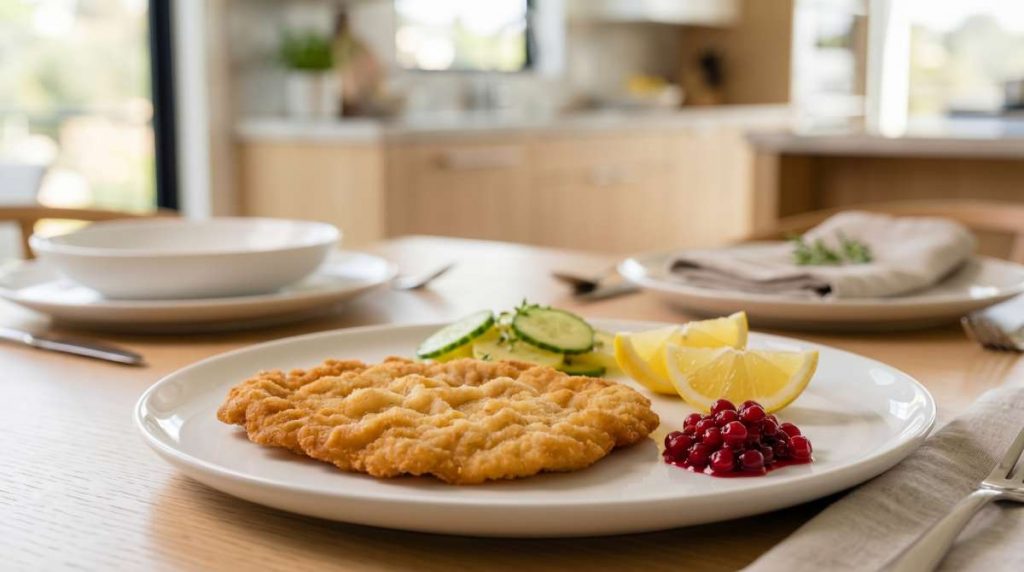
The longer I thought about schnitzel, the more convinced I became that the final lift of the dish often comes from the smallest things.
Lemon is the clearest example. I no longer see it as optional decoration. It is part of the structure of schnitzel itself. A squeeze over the hot crust sharpens the whole experience. It wakes the crumbs up, brightens the meat, and cuts through the frying with that clean, immediate acidity which makes the next bite feel as appealing as the first.
Without lemon, schnitzel can still be good. With lemon, it becomes itself more fully.
Lingonberries were a slower discovery for me, or perhaps a slower appreciation. At first, I saw them as an old-fashioned touch, something interesting but not central. Then I began to understand their role. They add a small, bright, tart-sweet contrast that changes the plate very subtly but very effectively. Used with restraint, they do not turn schnitzel into a sweet dish. They give it relief and a slightly more layered finish.
That balance is important. I would not want lingonberries overwhelming the meal or turning into a novelty. But in the right amount, they are one of those details that make the plate feel more complete, more thought through, more aware of the need for contrast.
Schnitzel taught me to respect these finishing notes. The dish is simple, yes, but its simplicity is built on careful balancing acts. Rich and bright. Crisp and tender. warm and fresh. Lemon and lingonberries are small expressions of that principle, and when they are right, the whole plate seems to gather itself properly.
Which side dishes work best with veal, pork and chicken schnitzel
One of the things I eventually stopped doing was searching for one universal best side dish.
That is too blunt a question. The better question is: best side dish for which schnitzel?
Veal, to me, asks for the most elegant treatment. It already carries a certain delicacy, so I like side dishes that protect that. Parsley potatoes work beautifully here, as does a lighter potato salad with enough acidity to sharpen without overwhelming. Cucumber salad can also be excellent, especially if the whole plate is meant to feel refined rather than abundant.
Pork schnitzel is a little broader in its appetite. It can handle a more substantial potato salad very well, and I think that is often its natural partner. Cucumber salad becomes especially useful here too, because pork benefits from the extra freshness. Lemon remains essential. Lingonberries also make particular sense with pork, because the slight tartness gives the meat and crust a very pleasing counterpoint.
Chicken and turkey schnitzel, for me, want the freshest company of all. Their lighter character makes them particularly good with cucumber salad and cleaner, sharper side dishes. Parsley potatoes can still work, but I find myself leaning more naturally towards the sides that make the plate feel bright rather than comforting.
If I had to summarise what I learned, it would be this:
- veal prefers elegance
- pork welcomes contrast
- chicken rewards freshness
And underneath all of those choices sits the same principle again: the side dish should never make schnitzel feel heavier than it already is. It should complete the plate by bringing clarity, balance, and relief.
That was the lesson I took far too long to learn. The perfect schnitzel is not only what happens in the pan. It is also what happens around it.
In spring, my favourite version is with white asparagus, simple potatoes, and sauce hollandaise
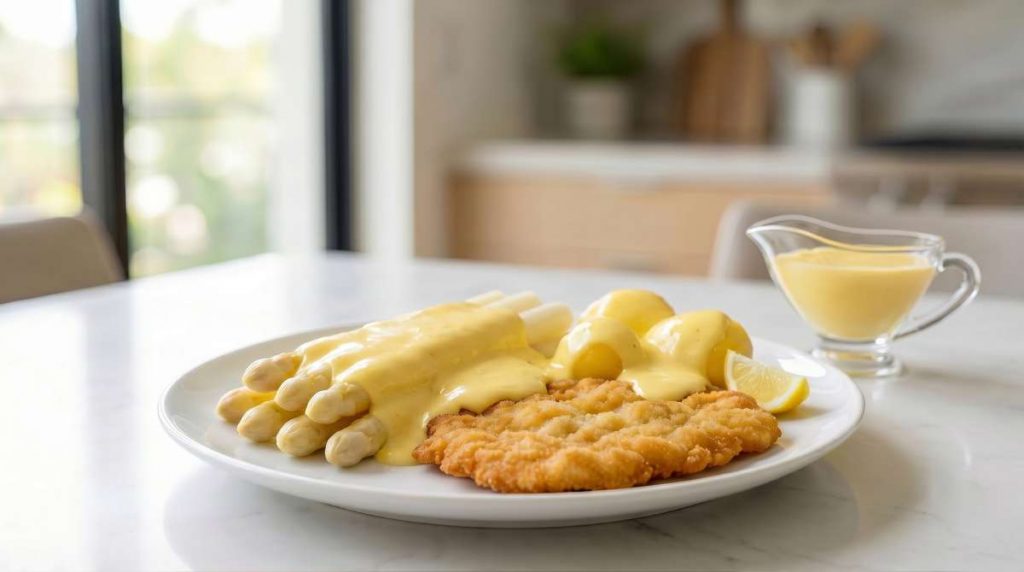
If I had to choose my favourite seasonal schnitzel plate of all, it would probably be this one.
In spring, I love schnitzel with German white asparagus, ideally from the Brandenburg or Hanover areas, served with simple steamed potatoes and a proper classic sauce hollandaise. For me, that is one of the most beautiful ways to eat schnitzel. It feels fresh, generous, and quietly luxurious without losing the balance that makes the dish work in the first place.
Find the full recipe for this delicious dish here.
White asparagus changes the whole mood of the plate. Where potato salad brings brightness and parsley potatoes bring gentle support, white asparagus brings a more delicate spring character. It has that pale, slightly earthy elegance which works beautifully beside a thin crisp schnitzel, especially when the schnitzel itself is kept light and properly fried. Then the hollandaise adds another layer - not heaviness, if it is done well, but warmth, silkiness, and a buttery richness that makes the whole plate feel more complete.
The potatoes matter too, precisely because they do not try too hard.
I do not want anything complicated here. Simple steamed potatoes are enough. They give the plate a quiet foundation and let the asparagus and hollandaise do what they are supposed to do. Anything more elaborate starts to pull attention away from the real spring combination. Good schnitzel, white asparagus, proper hollandaise, and plain steamed potatoes already know exactly what they are trying to be.
That balance is what I love about this version. The schnitzel brings crispness and warmth. The asparagus brings delicacy. The hollandaise brings richness. The potatoes keep everything grounded. And because the lemon on the schnitzel and the acidity in the sauce are still doing their work, the plate can feel luxurious without becoming too much.
For me, this is one of those dishes that feels unmistakably Central European in the best sense. Seasonal, confident, and deeply satisfying without needing novelty.
The frustrating part, unfortunately, is that it is not especially easy in the UK to get really good white asparagus at a reasonable price. You can find it, and sometimes it is excellent, but it is still nowhere near as natural or as accessible a spring ingredient as it is in Germany. That is probably part of why this plate still feels slightly special every time I have it. It is not an everyday schnitzel meal. It is a spring one.
If I want schnitzel in its most fresh, elegant, and quietly indulgent seasonal form, this is the version I keep coming back to: thin crisp schnitzel, white asparagus, classic hollandaise, and simple steamed potatoes.
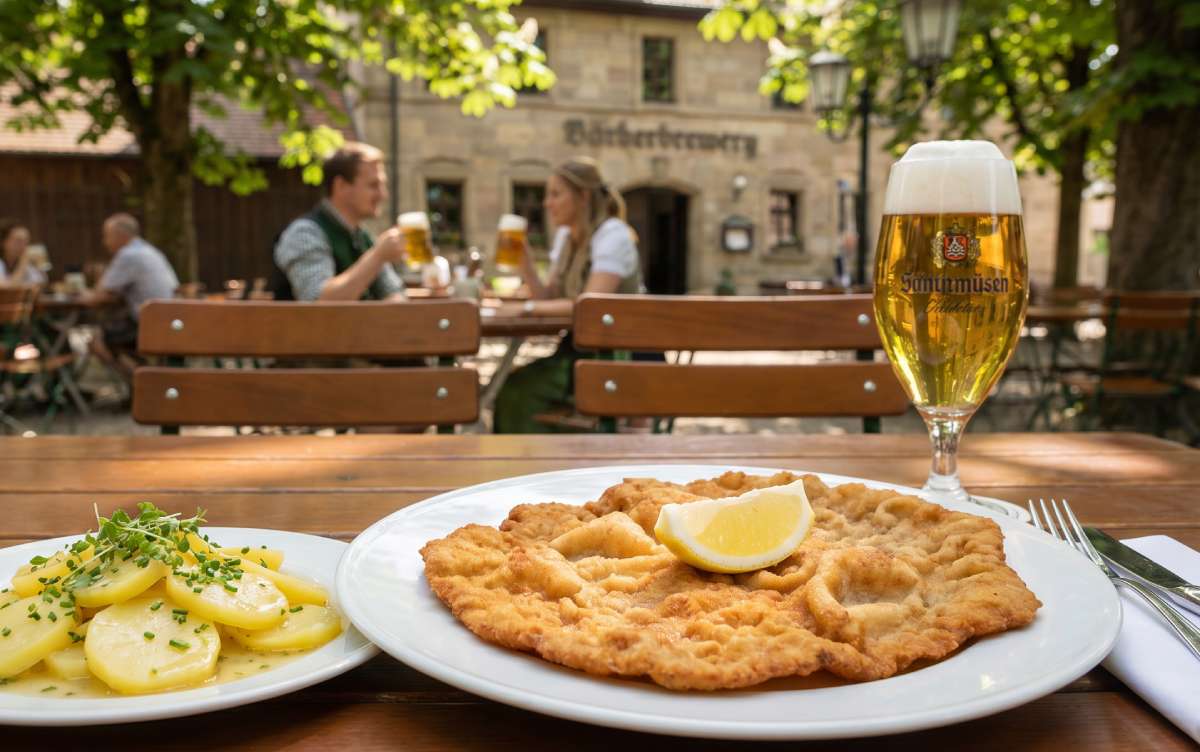
Perfect Veal Schnitzel with Swabian Potato Salad
Ingredients
Method
- Put the potatoes into a large pan of cold salted water. Bring to the boil, then lower to a gentle simmer and cook until just tender. Depending on size, this usually takes about 18 to 22 minutes. You want them cooked through but not breaking apart.
- Drain well and leave them only until you can handle them without burning yourself. Peel them while still warm, then slice them into thin rounds. Warm potatoes absorb dressing far better than cold ones, and this matters a great deal for a proper Swabian potato salad. Put the sliced potatoes into a large bowl.
- In a jug or bowl, whisk together the hot beef stock, white wine vinegar, mustard, neutral oil, salt, pepper, and the very finely diced shallot. Pour this over the warm potato slices and fold gently. Do not stir aggressively or the potatoes will start to break down.
- Leave the bowl for about 15 to 20 minutes so the potatoes can drink in the dressing properly. The salad should become glossy and well seasoned rather than wet and soupy.
- Add the thin cucumber slices, chopped chives, and most of the cress. Fold again very gently. Taste carefully. A good Swabian potato salad should taste rounded, lightly savoury, gently sharp, and fresh. If needed, add another small splash of vinegar or a little more salt. Set aside at room temperature. This salad should not be fridge-cold when served with schnitzel.
- If you are making your own crumbs, dry the white rolls or bread first. The easiest method is to tear the bread into pieces and let it dry out for several hours or overnight. Then blitz it to fine crumbs and, if needed, pass it through a sieve so the texture stays even and delicate.
- This is worth doing properly. Fine dry crumbs made from plain white bread rolls give the most classical schnitzel crust: light, pale, crisp, and elegant. Coarse crumbs make the crust louder and rougher. Sourdough crumbs can work, but they usually brown faster and taste more assertive, which pulls the coating away from the traditional style.
- Lay each veal escalope between two sheets of baking paper or cling film and pound gently until thin and even, about 3 to 4mm thick. This is one of the most important steps in the whole recipe. A thick schnitzel does not fry with the same elegance, and the coating and meat stop behaving as one.
- Season the veal lightly on both sides with salt and a little pepper.
- Put the flour into one shallow dish. In a second dish, beat the eggs with the milk until smooth. Put the fine breadcrumbs into a third dish.
- Coat each veal escalope first in flour, shaking off the excess. Then pass it through the egg mixture, letting any excess drip away. Finally coat it in the breadcrumbs. Cover it evenly, but do not press the crumbs down hard. The coating should sit lightly on the meat. That lightness is part of what later allows the crust to become delicate and slightly rippled rather than compact and heavy.
- Put a large frying pan over medium to medium-high heat and add enough clarified butter for generous shallow frying. The schnitzel should not be sitting on a barely greased surface. It needs enough fat around it to fry properly.
- If you prefer, you can use mostly clarified butter and add a little neutral oil to make the frying more practical, but for the finest flavour, clarified butter is the benchmark.
- The fat is ready when a breadcrumb dropped in starts sizzling immediately. It should be hot and lively, but not smoking aggressively.
- Fry the schnitzels one at a time, or at most two if the pan is large enough. Do not crowd the pan. Crowding lowers the temperature and makes the frying less precise.
- Cook the first side for about 1 1/2 to 2 minutes, then turn and cook the second side for another 1 to 1 1/2 minutes, until the schnitzel is golden, crisp, and just cooked through.
- This is one of the details that makes schnitzel better.
- As the schnitzel fries, gently tilt the pan and use a spoon to baste hot fat over the top surface, or carefully shake and move the pan so the fat washes up around the edges and over parts of the coating. This helps the crust cook more evenly and encourages that slightly lifted, airy, almost floating quality that great schnitzel can have.
- You are not drowning it for drama. You are helping the coating set and bloom properly. The goal is a crust that feels alive, not flat and compressed.
- Lift the schnitzel out and let it drain briefly on kitchen paper or a rack. Do not leave it sitting around too long. Schnitzel is at its best when the crust is still fully crisp and lively.
- Serve immediately with lemon wedges and a generous spoonful of the Swabian potato salad. Finish the salad with the remaining cress.
The Mistakes I Would Never Make Again
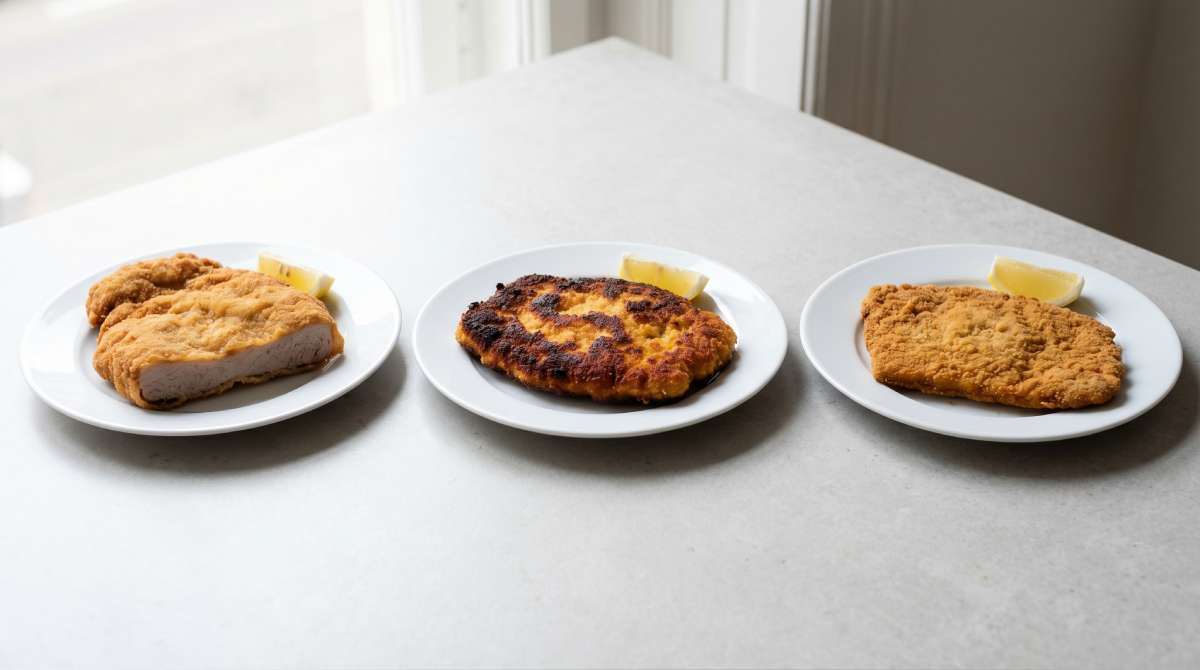
Using meat that is too thick
If I had to name the mistake that quietly ruins more schnitzel than any other, I would probably start here.
Thick meat looks generous. It photographs well. It gives the illusion of abundance. But in schnitzel, thickness is very often the beginning of trouble. I know this because I made that mistake repeatedly, and for a while I even thought I was doing something right. The schnitzel looked substantial. It felt impressive before cooking. It seemed like a meal with presence.
Then it hit the pan, and all the problems began.
The thicker the meat, the harder it becomes to keep the crust and the interior in harmony. The coating wants to colour and crisp. The meat wants more time. So something has to give. Either the crust is pushed too far while the interior catches up, or the heat is lowered and the whole result becomes heavier and less alive. Sometimes the meat is technically fine and the crust is acceptable, but the dish still feels wrong because the proportions are wrong. The coating and the meat are no longer part of the same elegant idea.
That is why I no longer chase thickness in schnitzel at all. I do not want the dish to feel monumental. I want it to feel right. Thin, even meat is not a downgrade. It is one of the reasons schnitzel becomes special in the first place.
Overworking or overpressing the coating
This was the mistake I made with the best intentions.
I thought careful pressure meant a better crust. I thought neat, firm adhesion meant security. I thought if I made sure the breadcrumbs were tightly attached, I was improving the final result. In reality, I was taking the life out of the coating before it ever reached the fat.
The more I pressed, the denser the crust became. The more I fussed with it, the less elegant it felt. It would still fry, still brown, still produce something recognisably schnitzel-like, but it lost the lift, the slight airiness, the rippled character that makes a great schnitzel crust feel so distinctive.
This taught me one of the most useful principles in the whole dish: schnitzel punishes overcontrol.
The coating needs enough structure to stay with the meat, but it also needs some freedom. It should be even, but not compressed. Secure, but not suffocated. Once I understood that, I stopped trying to manufacture perfection at the breading stage and started trusting the proper method to do the work in the pan.
Frying in too little fat
For a long time I treated this almost like a moral issue.
Less fat sounded cleaner, more modern, more disciplined. Surely it must be the smarter approach. But schnitzel kept proving otherwise. With too little fat, the dish does not become lighter. It becomes worse. The coating sits awkwardly against the pan, browns less evenly, and absorbs rather than transforms. The frying feels hesitant. The crust feels flatter. The final plate often tastes more oily precisely because the method was too timid.
That was one of the stranger lessons of this journey. Generosity, in the right place, creates elegance. False restraint creates heaviness.
Now I am much clearer about it. Schnitzel needs enough hot fat around it to cook properly. Not an apologetic smear. Not a token amount. Proper shallow frying that allows the coating to set, crisp, and lift. Once I accepted that, my schnitzel improved immediately.
Crowding the pan
This is one of those mistakes that feels efficient right up until it ruins the thing you were trying to save time on.
Crowding the pan seemed practical when I was in a hurry or cooking for more people. More schnitzels at once, less waiting, faster service. But the pan does not care about my sense of efficiency. Once it gets crowded, the temperature drops, the moisture has nowhere to go cleanly, and the whole frying environment becomes less controlled. The schnitzels stop frying in the way they should and start interfering with one another.
I have seen the results too many times: patchier colour, less buoyant crust, a general sense that the schnitzel came out merely serviceable rather than really good.
Schnitzel taught me that this is a dish that rewards focus. One or two at a time, depending on the pan, is not a sign of inefficiency. It is respect for the method. When the pan has space, the fat behaves properly, the crust develops properly, and I stay calmer too. There is room to watch, adjust, and stop at the right moment.
Letting schnitzel sit too long before serving
Some foods improve with a little rest. Schnitzel, in my experience, mostly improves by being eaten at the right moment.
That does not mean it collapses instantly or becomes inedible within minutes. But it is undeniably a dish with a peak, and I learned the hard way that the peak matters. Leave schnitzel sitting too long and the crust begins to lose the very thing you worked so hard to create. It softens slightly, settles slightly, and the whole plate becomes a quieter version of itself.
The more effort I put into achieving a light, crisp, lively crust, the less willing I became to let the dish wait around unnecessarily. This also changed how I thought about the whole cooking process. The side dishes needed to be ready. The lemon needed to be ready. The plates needed to be ready. Schnitzel should arrive at the table with some momentum still in it.
A great schnitzel is not only the result of correct cooking. It is the result of correct timing.
Assuming more colour means more flavour
This mistake is seductive because it borrows logic from other kinds of cooking.
Deep browning often does mean deeper flavour elsewhere. With schnitzel, though, it can become a trap. The more I chased that darker, more dramatic golden tone, the more often I ended up with crust that felt too assertive and less elegant. The dish lost refinement and started tasting more like fried breadcrumbs than schnitzel.
That was when I finally understood that schnitzel is not supposed to impress through force. Its beauty comes from balance, lightness, and control. The crust should be golden, yes, but golden in a way that still looks fresh. Once it moves too far into darkness, the whole mood of the dish changes. It becomes heavier in taste and spirit.
That is why I now distrust dramatic colour in schnitzel. I would rather stop a little earlier and preserve delicacy than push for extra visual impact and lose the quality I care about most.
If I step back and look at all these mistakes together, a pattern becomes obvious. Every one of them comes from the same bad instinct: trying to make schnitzel more by force. Thicker. Tighter. Drier. Darker. Faster. Leaner. Heavier.
The dish kept teaching me the same answer.
Better schnitzel comes from restraint, not aggression.
My Method Now - How I Make the Best Schnitzel I Can
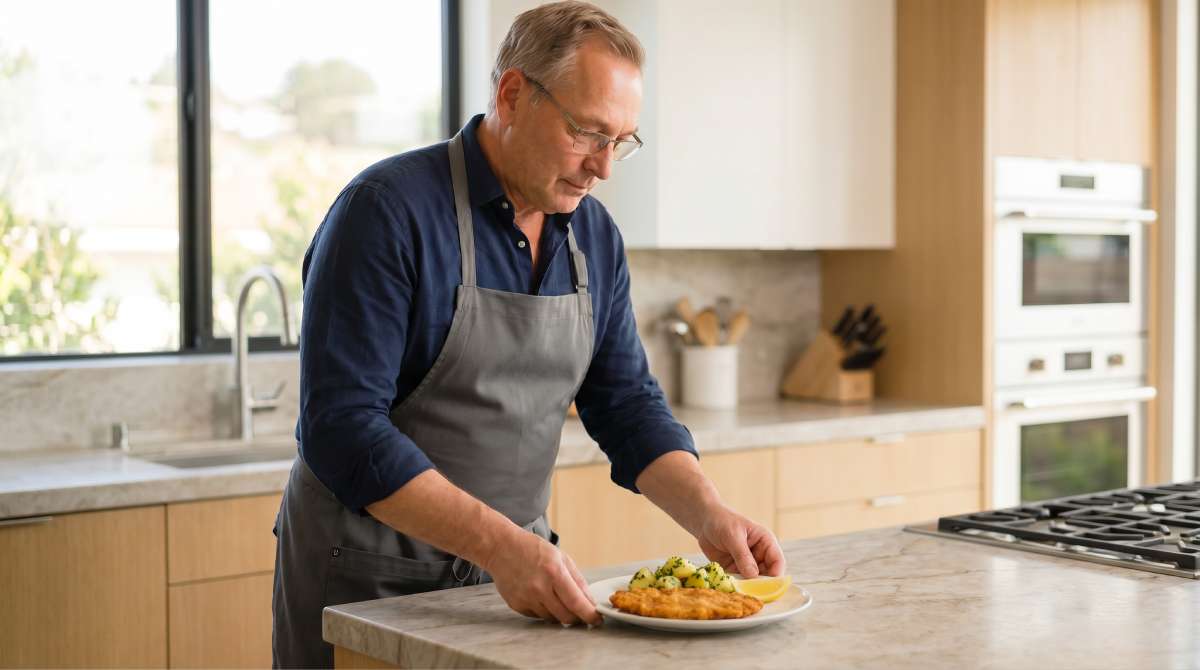
The ingredients I use
After all the experimenting, all the small corrections, and all the overthinking that this dish somehow invited out of me, my ingredient list became simpler rather than more complicated.
That was one of the most satisfying outcomes of the whole journey.
I now want meat that is suitable rather than extravagant. Thinly pounded veal if I want to aim at the classic benchmark. Thinly pounded pork if I want the version I make most often and enjoy most often in real life. Occasionally chicken if I want a lighter plate. Beyond that, I want plain flour, beaten egg, fine breadcrumbs, salt, pepper, lemon, and frying fat that I actually believe in.
That last part matters. I no longer treat the frying fat as a vague practical decision made in the last minute. If I want the schnitzel to feel particularly right, I reach for clarified butter. If I want a practical version with clean results, neutral oil can do very well. If I am leaning into tradition and want that particular solidity and frying performance, lard has its place too.
What I do not want anymore is clutter. No complicated seasoning mix. No breadcrumb chemistry experiment. No need to prove that the dish can carry endless embellishment. By this stage I have learned that the more faithfully I respect the structure of schnitzel, the better the result tends to be.
How I prepare the meat
Preparation starts with calmness.
That sounds slightly philosophical for a piece of fried meat, but I mean it quite literally. When I rush the preparation, the frying later becomes a negotiation with mistakes I should have solved already. So I now give the meat the attention it deserves at the beginning.
I trim what needs trimming. I pound the meat thin and, more importantly, evenly. I care less about exact visual perfection than I once did, but I care very much about proportion. No thick bulges. No strange lopsided centre that will force the pan to compensate. I want the piece to feel coherent before it ever touches flour.
Then I season the meat with enough confidence that the interior will have character, but not so much that the dish loses its balance. Salt is essential. Pepper is used with restraint. Already, at this stage, I am thinking ahead to lemon and to the side dishes. Schnitzel is never just the meat in isolation, and I now prepare it with the whole plate in mind.
How I coat it without making it heavy
The breading stage is where I now try hardest not to interfere.
I set up the classic sequence. Flour first, shaken so that it leaves a clean light layer rather than any clumps. Then beaten egg, enough to coat but not enough to soak. Then breadcrumbs, fine and even, applied so the meat is covered properly but never compacted. That last part changed everything for me. I do not press the crumbs into the meat the way I once did. I let them settle, I make sure there is no obvious excess, and then I stop.
That stopping is important.
The coating does not improve because I keep handling it. It improves because the structure is right and the frying is right. Too much fussing only tightens the crust before it has had the chance to become what it should be.
So my method now is lighter, faster, and more deliberate. I want evenness, not compression. Coverage, not density. The schnitzel should look ready for the pan, not packed for storage.
How I fry it for the crispest result
When it comes to frying, I have learned to be generous and controlled at the same time.
I heat enough fat in the pan that the schnitzel can fry properly, not just sit there half-supported. That was one of the biggest upgrades in my method. Once I stopped being timid with the amount of fat, the whole crust improved. It coloured more evenly, crisped more decisively, and developed the sort of slight lift and movement I had been chasing from the beginning.
The fat needs to be properly hot before the schnitzel goes in. I want immediate response, not hesitation. Once it is in the pan, I watch rather than panic. I do not crowd the pan. I do not keep poking. I let the frying do its work, adjusting only as needed. The goal is a confident golden crust, not a dramatic dark one.
I also no longer chase extra time in the pan out of insecurity. That was an old habit. I used to think another moment might make it even better. More often, it made it less refined. Now I stop when the crust is right, not when it looks most theatrical.
That change alone made my schnitzel more consistent.
How I serve it
Serving is where all the earlier decisions finally reveal whether they belonged together.
I want the schnitzel to reach the plate promptly, with lemon ready and the side dish already doing its job. This is not the moment for delay or improvisation. The crust is at its most alive when it has just come out of the pan. The sides should support that freshness, not wait around while it fades.
Most often, I serve schnitzel with potato salad, parsley potatoes, cucumber salad, or some combination that brings both substance and relief. Lemon is non-negotiable for me now. Lingonberries, when they suit the plate, can add a lovely counterpoint. But even here I try to stay disciplined. I do not want the plate to become crowded or busy. Schnitzel should feel complete, not overloaded.
That is probably the best summary of my method as it stands now. It is less about adding brilliance than about removing interference.
I prepare the meat properly.
I coat it lightly.
I fry it generously but with control.
I serve it while it still feels alive.
That is how I now make the best schnitzel I can.
And after all the obsession, that method feels reassuringly simple.
What I Now Believe Makes the Perfect Schnitzel
The five things that matter most
After all the trial and error, all the small disappointments, all the moments when I thought I had understood schnitzel only to realise I was still forcing it in the wrong direction, I think my view of the dish has become very clear.
If I strip everything back, five things matter more than anything else.
First, the meat must be thin and even. Without that, the whole structure of the dish begins to wobble. The coating and the meat stop cooking as one idea.
Second, the coating must be light. Not careless, not unstable, but light. It should never feel compressed, overworked, or too eager to prove itself.
Third, the frying fat must be generous enough and good enough to do its job properly. Schnitzel needs proper frying conditions. It does not respond well to apology.
Fourth, the heat must be right. Not timid, not aggressive. Hot enough to create immediate structure, controlled enough to preserve delicacy.
Fifth, the plate must have contrast. Lemon, the right side dish, the right freshness around the schnitzel - these are not decorative extras. They are part of why the whole meal feels complete.
Those are the five principles I now trust most. Whenever a schnitzel disappoints me, the explanation is usually somewhere inside them.
What matters less than people think
One of the most useful things this journey taught me was not only what matters most, but what matters less than people tend to assume.
Extreme seasoning matters less than people think. Schnitzel does not become more interesting just because it becomes louder.
Deep colour matters less than people think. A darker crust is often a sign that something has gone a little too far, not that the dish has gained sophistication.
Expensive ingredients, beyond a certain point, matter less than people think. Good meat matters, yes, but technique has more power than prestige in this dish. I have had pork schnitzel that felt far more satisfying than supposedly superior versions made with better ingredients but poorer judgement.
Even the question of the one true fat matters slightly less than people think, once you understand the larger principle. Clarified butter may be my preference, but good schnitzel still depends more on proper frying conditions than on fetishising a single ingredient.
That was actually quite liberating. It meant the dish was not asking me to chase perfection through status or complexity. It was asking me to pay attention properly.
Why perfect schnitzel is really about restraint
If I had to reduce everything I have learned about schnitzel to one final idea, it would be this: perfect schnitzel is a dish of restraint.
That does not mean smallness or meanness. It does not mean fear. It means discipline. It means understanding that the dish becomes more impressive when each element is handled with control rather than force.
The meat does not need to be thicker to feel better.
The coating does not need to be louder to feel more satisfying.
The crust does not need to be darker to taste more serious.
The seasoning does not need to be more elaborate to feel more complete.
The plate does not need more weight to feel generous.
Again and again, schnitzel pushed me away from excess and towards precision.
That is why I now think the perfect schnitzel has a very particular kind of beauty. It feels abundant without being heavy. Crisp without being hard. rich without being greasy. Simple without being plain. It looks modest on paper, but when everything comes together, it gives one of the most satisfying examples I know of how technique can turn a familiar dish into something quietly extraordinary.
I did not set out to learn all of that when I first started chasing better schnitzel. I only wanted one very good one.
What I found instead was a dish that kept teaching the same lesson in different ways.
Do less.
Do it properly.
And let the dish become great through balance rather than force.
That, for me, is the art of schnitzel.
Frequently Asked Questions
If the question is authenticity, veal still holds the highest status. If the question is what gives most people the best balance of flavour, cost, availability and repeatable success, I would say pork has a very strong claim. That is one of the reasons I kept coming back to it.
What matters here is being honest about the goal. Veal gives you delicacy and classical elegance. Pork gives you a slightly fuller, more everyday kind of pleasure that can still be excellent when treated properly. I would not call pork a lesser schnitzel by default. I would call it a different expression of the dish, and in many real kitchens it is the one that makes the most sense.
So the better question is not “Which is objectively best?” but “Which version am I trying to make?” If you want the classical benchmark, choose veal. If you want the schnitzel you are most likely to cook often and well, pork may be the smarter answer.
That usually comes down to how the coating was handled and how the schnitzel was fried.
A flat crust is often the result of one or more of these problems:
- the crumbs were pressed on too firmly
- the coating was too heavy
- the fat was not hot enough
- there was not enough fat in the pan
- the schnitzel was treated too statically while frying
A rippled crust is not an accident. It happens when the coating is light enough, the meat is thin enough, and the frying conditions allow the crust to set quickly and slightly lift. That is why the best schnitzel often looks almost delicate rather than tightly armoured.
So if your crust stays flat, I would not just blame the breadcrumbs. I would look at the whole chain of events.
Panko is not wrong in the sense that it cannot taste good. It often does taste good. The question is whether it gives the kind of schnitzel you are aiming for.
If you want a more dramatic, crunchier, rougher crust, panko can absolutely work. But if you want a more classical schnitzel texture, where the coating feels finer, lighter and more elegant, then panko usually pushes the result in the wrong direction. It tends to make the crust more assertive and less subtle.
So I would not frame it as right or wrong. I would frame it as a stylistic decision. Panko gives you a different kind of breaded cutlet experience. Fine breadcrumbs give you the classic schnitzel character I was chasing throughout this article.
A slight lift in the crust can be beautiful. A full detachment is something else.
When the coating falls away in large pieces, the usual causes are:
- the meat surface was too wet at the start
- the flour layer was uneven
- the egg coating was too thick
- the breadcrumbs were patchy
- the schnitzel was moved too roughly in the pan
- the frying temperature was not right
Sometimes people assume the problem is “not enough pressure” when breading, and then they overcorrect by pressing everything down too hard. That can create a denser crust, but it does not necessarily solve the real issue. Better adhesion usually comes from cleaner preparation, not heavier handling.
The goal is not to glue the crust on aggressively. The goal is to create a clean, even breading structure that can fry properly without breaking apart.
For me, the best pan is not the most fashionable one. It is the one that gives stable heat, enough space, and a feeling of control.
A wide frying pan or sauté pan with good heat retention works best. I want the schnitzel to have room to lie flat without crowding, and I want enough surface area that the frying fat can behave properly. If the pan is too small, too thin, or too crowded, the whole process becomes less even and more stressful.
This is one of those cases where the pan should make the method easier, not more dramatic. Schnitzel is not improved by panic or tight conditions. A sturdy pan with space is one of the quiet advantages that makes everything else more likely to go right.
You can prepare parts of it ahead, but I would be careful about how far you push that.
The best compromise is usually to prepare the components in advance:
- pound and season the meat
- set up the breading station
- prepare the side dishes
- cut the lemons
- have everything else ready to serve
What I do not love is frying schnitzel long in advance and hoping it will still feel at its best later. It may still be enjoyable, but the dish loses part of its magic once the crust settles and softens. Schnitzel is one of those foods where timing matters.
So yes, you can absolutely organise ahead for guests. In fact, you should. But I would keep the actual frying as close to serving as possible.
You can use butter, but ordinary butter creates a narrower margin for error because of the milk solids. Those solids brown and burn more easily, which makes pure butter a less forgiving choice for schnitzel frying.
Clarified butter gives you the butter flavour in a form that behaves more cleanly in the pan. That is why it feels so well suited to the dish. It gives richness without the same risk of the frying turning awkward or overly dark too quickly.
If I wanted butter flavour but did not have clarified butter, I would much rather combine a neutral frying fat with a little butter flavour logic than rely on plain butter alone and fight the pan. Schnitzel already asks for good timing. I do not like making it even more fragile than necessary.
This is usually a meat-preparation problem rather than a breadcrumb problem.
Curling often happens because the meat has tension in it that was never properly dealt with before frying. Uneven thickness also contributes. Once the schnitzel hits the heat, different parts contract differently, and the shape starts to pull against itself.
That is another reason I became so serious about pounding the meat evenly. A schnitzel should go into the pan already feeling settled. If it is awkwardly shaped, unevenly flattened, or still tense in thicker areas, the frying will expose those weaknesses immediately.
So if your schnitzel curls dramatically, I would look first at preparation, not just at pan technique.
A thermometer is useful, but you do not absolutely need one if you learn the signs.
I look for a few things:
- the fat should feel fully heated, not sluggish
- a breadcrumb dropped in should react promptly, not just sit there
- the schnitzel should sizzle immediately when it goes in
- the crust should begin setting quickly rather than slowly soaking
What I do not want is smoking fat or a pan that feels aggressive and unstable. I also do not want a lazy, hesitant response. Good schnitzel frying begins with confidence. If the pan feels indecisive, the result often will too.
This is one of those skills that becomes easier very quickly once you stop thinking only in numbers and start paying attention to behaviour.
It can be good, but I do not think it is the same.
An air fryer can produce a crisp breaded cutlet, and in some kitchens that may be a very practical option. But the kind of schnitzel I spent this whole article talking about depends on the behaviour of hot fat in a pan. That is part of what shapes the crust, the colour, and the overall feel of the dish. Once you remove that element, you are making something adjacent rather than identical.
So I would say this: air fryer schnitzel can be convenient and enjoyable, but if your goal is the perfect schnitzel in the classical sense, I would still choose pan frying every time.
This is a very good question because schnitzel is a richer dish than it first appears, and the drink can either refresh the meal or make it feel too heavy.
What I generally want is something with lift:
- a crisp lager
- a dry white wine
- sparkling water with lemon
- something bright rather than sweet or weighty
I would avoid drinks that make the meal feel even denser. Schnitzel already brings warmth, frying and richness. The drink should help keep the whole experience lively.
If I had to describe the ideal pairing principle, it would be this: choose something that does the same job lemon does. Not necessarily in flavour, but in effect. Something that cuts, brightens and keeps the palate alert.
I think most people misunderstand where the drama of the dish really belongs.
They assume the secret must be in stronger seasoning, a more extreme crust, darker colour, more thickness, more crunch, more something. But the longer I spent chasing better schnitzel, the more convinced I became that the real beauty of the dish lies in control. It is not about taking everything further. It is about keeping everything in proportion.
That is what makes schnitzel so interesting. It looks simple, but it is not casual. It asks for judgement. It asks for restraint. It asks you to stop at the right moment instead of chasing a louder result.
So if I had to answer in one line, I would say this: most people think schnitzel is a dish of force, when in reality it is a dish of balance.
Make the meat thinner and more even.
There are other strong candidates, of course. The right fat matters. The right heat matters. Not overpressing the coating matters. But if someone asked me for the single upgrade most likely to improve their schnitzel immediately, I would start with thickness.
Why? Because that one decision affects everything else. It improves the relationship between meat and crust. It makes frying easier. It reduces the temptation to overcook. It makes the whole dish feel more like schnitzel and less like a breaded chop.
So if you are trying to take your schnitzel from decent to genuinely good, start there. Then build the rest around it.
Conclusion
I did not expect schnitzel to teach me quite so much.
At the beginning, I thought I was chasing a better recipe. A better cut of meat, a better breadcrumb, a better frying trick. Something simple and transferable. But the longer I spent trying to understand why one schnitzel felt ordinary and another felt unforgettable, the more I realised I was not really chasing a list of ingredients at all. I was chasing judgement.
That is what perfect schnitzel has come to mean to me now. Not perfection in the rigid sense. Not some impossible final version beyond debate. But a dish where the right decisions line up so clearly that the result feels effortless, even though it is anything but accidental. Thin, even meat. A light coating. Proper frying fat. Proper heat. Seasoning that knows when to stop. Side dishes that sharpen and complete rather than smother. None of those things is dramatic on its own. Together, they create the dish I had been looking for all along.
And that, for me, is the real charm of schnitzel.
It is not flashy food. It does not rely on complexity to earn admiration. In fact, the more I worked on it, the more suspicious I became of anything that tried to make it louder than it needed to be. Schnitzel does not become better by becoming thicker, darker, busier, or more heavily flavoured. It becomes better when every part of it is handled with enough care that nothing has to shout.
That is why I still find it so satisfying. A great schnitzel feels generous without heaviness, crisp without aggression, rich without greasiness, simple without being plain. It delivers comfort and refinement at the same time, which is not an easy balance to achieve. But when it is right, it makes that balance feel completely natural.
If there is one thing this journey taught me, it is that the perfect schnitzel is not built on one magic secret. It is built on restraint, attention, and respect for proportion. The dish keeps rewarding the same lesson: do less, but do it more precisely.
That is what turned my curiosity into dedication, and dedication into obsession.
And if you have read this far, perhaps you understand why.