Spring menus need dishes that feel different from the ones that carry the colder months. Guests still want comfort and satisfaction, but they also start looking for something fresher, lighter in mood, and more obviously seasonal. That is exactly where schnitzel with white asparagus, hollandaise, and simple steamed potatoes becomes interesting.
This cultural overview explains Germany’s spring white asparagus season and why it shapes so many traditional seasonal menus.
It takes a dish people already understand and moves it into a more premium spring register. The schnitzel still gives the plate its crisp golden centre. The white asparagus adds delicacy and seasonality. Hollandaise brings polish and a restaurant feel. The potatoes keep everything grounded without making the plate heavier than it needs to be.
For quality pubs, hotel dining rooms, beer gardens, and food-led restaurants, that makes this a very useful seasonal special. It is recognisable enough to sell, but distinctive enough to surprise people. It also gives you a stronger sense of occasion than standard schnitzel formats, which matters when guests are deciding whether to trade up.
This is not a dish for every venue. White asparagus quality matters, hollandaise has to be properly judged, and the schnitzel itself has to stay thin and elegant. But in the right setting, this is one of the strongest spring directions a schnitzel menu can take.
Why This Works So Well as a Spring Special
A lot of attempts to make schnitzel feel more premium simply make it heavier. More garnish, more sauce, bigger portions, darker crust, richer sides. Those changes may make the plate look more substantial, but they do not necessarily make it more appealing. In many cases, they blur the balance that makes schnitzel satisfying in the first place.
This dish works because it does the opposite.
Instead of making schnitzel louder, it makes it more seasonal. White asparagus gives the plate an immediate spring identity. Hollandaise adds gloss and richness, but in a way that makes sense. Steamed potatoes provide structure without dragging the whole plate down. The result is still clearly a schnitzel dish, but it feels more refined, more timely, and more special than an everyday breaded cutlet offer.
That is commercially useful. Seasonal dishes need a reason to exist, and white asparagus provides one immediately. It tells the guest that this is not just another schnitzel with a different garnish. It is a spring plate. That helps with menu interest, perceived value, and the sense that the dish belongs to a limited period rather than to the permanent core offer.
It also helps that the combination feels both familiar and slightly surprising. Schnitzel is easy to understand. Asparagus with hollandaise is easy to understand. Put them together properly, and the plate feels more distinctive without becoming difficult to sell. That is often the sweet spot for quality pubs and restaurants. Guests feel confident ordering it, but it still gives them something that feels beyond the routine.
Visually, it works as well. A good schnitzel already has broad appeal: golden crust, recognisable shape, immediate comfort value. White asparagus adds elegance and seasonality. Hollandaise brings sheen and finish. The potatoes keep the plate from feeling too sparse. All of that creates a dish that looks generous and premium without looking cluttered.
As a spring special, then, this is strong not because it is more indulgent than everything around it, but because it gives schnitzel a more refined and seasonal identity while keeping the dish fundamentally easy to understand.
White Asparagus and Hollandaise - What They Add to the Plate
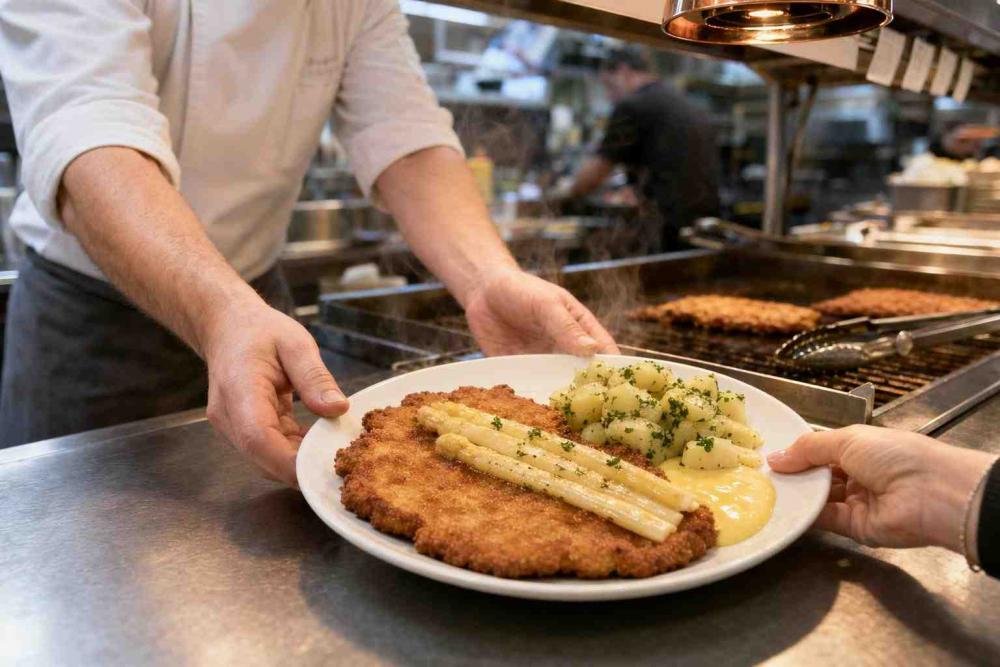
White asparagus is what changes this from a variation into a proper seasonal special.
This chef recipe shows how German white asparagus with hollandaise and parsley potatoes is traditionally prepared and plated for a proper seasonal special.
With ordinary sides, schnitzel stays in familiar territory: comforting, crisp, filling, reliable. That can be exactly right in many cases. But white asparagus shifts the plate into a different mood. It brings a gentler, more delicate spring character and gives the dish a stronger Central European seasonal identity. The plate starts to feel less like routine comfort food and more like something tied to a particular moment in the year.
That matters because seasonality is one of the strongest ways to justify a special. It gives the guest a reason to order now rather than later. It also gives the menu line more authority. White asparagus reads as more premium than standard sides, and that alone helps position the dish above an everyday schnitzel offer.
It also genuinely suits the food. White asparagus has a pale, slightly earthy elegance that works beautifully against the warmth and crispness of a well-made schnitzel. The asparagus is soft where the schnitzel is crisp. It is delicate where the crust is golden and more assertive. That contrast makes the whole plate feel more composed.
The difficulty, of course, is sourcing. In the UK, good white asparagus is still not especially easy to get at a reasonable price. You can find it, and sometimes it is excellent, but it is not nearly as accessible as it is in Germany. That is one reason this dish works better as a limited spring special than as a longer-running menu item. The asparagus needs to be good enough to justify its place. If it is tired, woody, or inconsistent, the whole point of the plate weakens.
Hollandaise then gives the asparagus, and the dish as a whole, its restaurant finish.
Used properly, it adds exactly the kind of richness the plate wants. It makes the asparagus feel more complete, brings a glossy premium character, and helps the dish read immediately as something more polished than a standard schnitzel main. Guests understand hollandaise. They associate it with asparagus, with spring, and with a certain kind of dining value.
But the sauce is also where things can go wrong. Schnitzel is not a dish that wants to be smothered. If the hollandaise is too thick, too heavy, or too generous, it flattens the contrasts that make the plate satisfying. The crust loses its edge, the asparagus starts to feel weighed down, and the whole dish becomes less elegant.
That is why hollandaise should support the asparagus first, not drown the schnitzel. It should connect the elements on the plate, not blanket them. A measured amount does far more than an excessive one. In fact, too much hollandaise usually makes the dish feel cheaper rather than more luxurious, because it replaces precision with bulk.
The other important point is acidity. Lemon on the schnitzel still matters here. A good hollandaise also needs enough lift to keep the richness in check. Those bright elements are what stop the plate becoming dull. Without them, the whole thing can feel heavier than intended surprisingly quickly.
Used well, then, white asparagus and hollandaise do not just make the plate richer. They make it more seasonal, more premium, and more complete.
Why Simple Potatoes and the Right Venue Matter
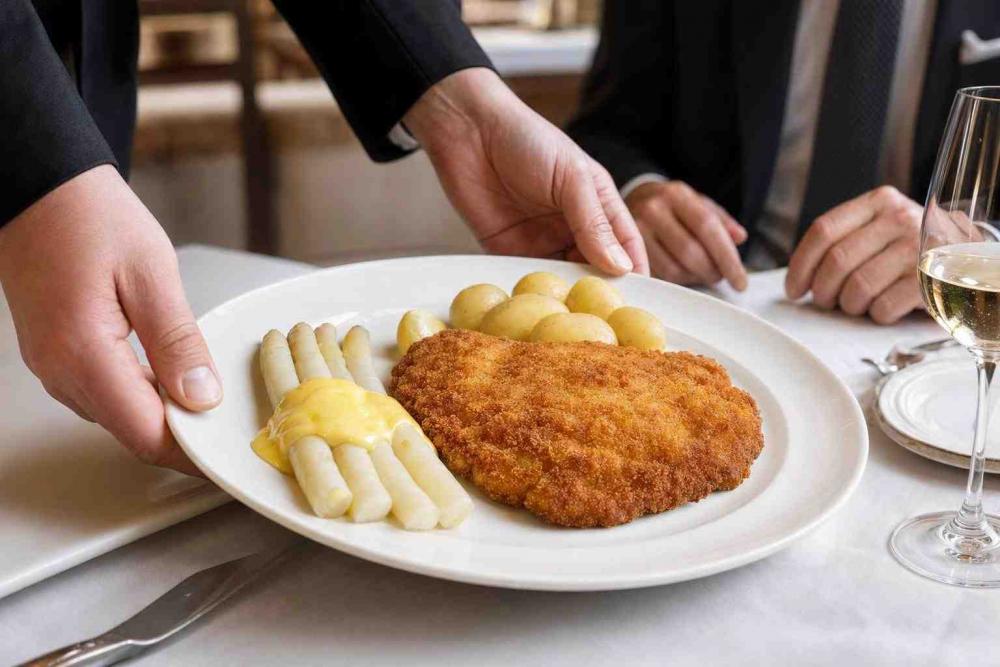
This is one of those dishes where the supporting element has to know its place.
This AHDB industry update on spring calving sire rankings is not relevant to schnitzel, asparagus, hollandaise, or side-dish planning, so it is best left out here.
There are many potato formats that could be used here, but simple steamed potatoes are the best choice because they stop the plate becoming overworked. The schnitzel already brings crispness and body. The asparagus brings delicacy and spring identity. The hollandaise brings richness and finish. If the potatoes also start making a strong statement, the dish risks losing its clarity.
Simple steamed potatoes solve that immediately. They add warmth and substance, but they do not compete. They keep the plate grounded and complete without dragging attention away from the asparagus and the schnitzel. In quality terms, that restraint actually helps the dish feel more premium. It shows that the kitchen understands where the value sits and where simplicity is the more intelligent decision.
For UK kitchens, waxy potatoes are the right fit. Charlotte works very well. Jersey Royals can be excellent in season. Anya or a good waxy salad potato also makes sense. What matters most is that the potatoes stay neat, tender, and quiet. Floury potatoes are more likely to make the supporting element feel clumsy, which is the wrong direction for a dish like this.
That same principle applies to where the dish sits on a menu.
This is best suited to quality pubs, hotel dining rooms, food-led restaurants, and premium beer gardens where guests are open to a more seasonal spring special. It is particularly strong in venues that already trade on good produce, thoughtful specials, and a slightly more polished style of comfort food. In those settings, schnitzel with white asparagus and hollandaise feels distinctive without becoming too niche.
It is less suited to fast-paced low-price operations, menus built heavily around speed and volume, or kitchens that cannot source and handle white asparagus consistently. The dish depends on detail. If the asparagus is poor, the hollandaise inconsistent, or the schnitzel too thick and heavy, the premium logic disappears.
That does not make it impractical. It simply makes it selective. In the right venue, it is exactly the sort of spring special that can lift a menu and give guests a reason to order something more memorable than the standard schnitzel format.
The Best Schnitzel Style for This Plate
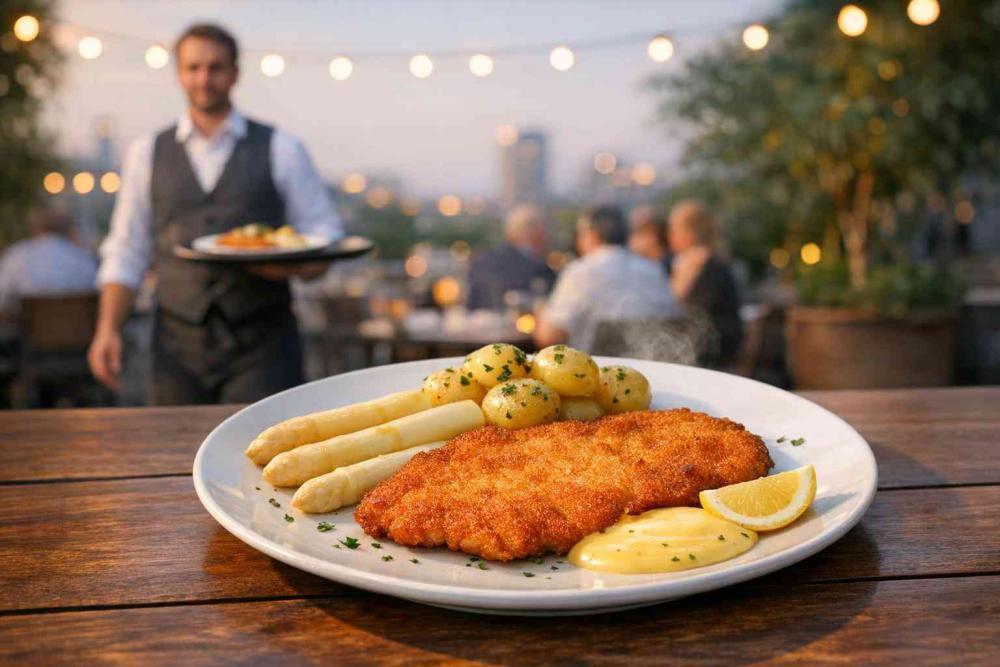
If this dish is going to work properly, the schnitzel itself has to stay disciplined.
That matters because white asparagus and hollandaise already bring delicacy and richness to the plate. If the schnitzel is too thick, too dark, or too heavy in the coating, it starts fighting the rest of the dish rather than supporting it. The whole balance shifts in the wrong direction and what should feel elegant becomes clumsy.
For that reason, veal schnitzel is the best fit here. Veal has the lightness and refinement this plate wants. When it is pounded thin and fried properly, it stays elegant beside the asparagus instead of overpowering it. The crust can remain delicate, the lemon still has room to work, and the whole dish feels composed rather than oversized.
Pork schnitzel can still work, but the effect is different. Pork brings more weight and a more everyday kind of comfort. That is not necessarily a problem, but it does make the plate feel broader and slightly less refined. In some venues, especially those leaning more pub than restaurant, that may still be a sensible choice. But if the aim is to create the cleanest, most premium spring version of this dish, veal is the better answer.
Chicken schnitzel is possible too, but it changes the identity again. It can feel lighter in one sense, but it also loses some of the classical character that makes this particular combination so convincing. White asparagus and hollandaise beside chicken can still be good, but the plate starts to feel less like a serious Central European spring special and more like a modern variation.
Whatever meat is used, the important thing is that the schnitzel stays thin, even, and properly fried. This is not the place for a thick breaded cutlet or an aggressively crunchy crumb. The crust needs to stay light, the meat needs to stay broad and elegant, and the frying must be controlled enough that the schnitzel still feels alive beside the asparagus and sauce.
That is really the rule here. The more refined the plate around the schnitzel becomes, the less room there is for the schnitzel itself to be rough.
What Makes the Plate Feel Balanced Rather Than Heavy
This dish only works if the different kinds of richness stay in proportion.
This recipe guide rounds up white asparagus dishes that can help you compare lighter and richer approaches before building a balanced spring plate.
On paper, there is a lot going on. You have fried schnitzel, buttery hollandaise, tender asparagus, and potatoes. That could easily turn into a plate that feels too much. But when it is done properly, it feels balanced rather than heavy, and that comes down to contrast.
The schnitzel brings crispness, warmth, and the golden fried character that gives the dish its centre. The asparagus softens the mood of the plate and gives it spring identity. The hollandaise adds richness, but it should be a measured richness rather than an overwhelming one. The potatoes bring quiet support and make the dish feel complete without demanding attention. Then the lemon comes in and sharpens everything back into focus.
That last part matters more than it might seem. Without acidity, the plate would feel flatter very quickly. Lemon keeps the schnitzel bright. A good hollandaise has enough lift to avoid becoming dull. The asparagus itself carries a gentler freshness. Together, those elements stop the dish from settling into one long buttery note.
Portioning matters too. The best version is not the one with the most hollandaise or the biggest pile of asparagus. It is the one where each component has enough room to do its job. The asparagus should feel generous, but not overwhelming. The hollandaise should be present, but not poured over everything. The potatoes should support the plate, not dominate it. And the schnitzel should still feel like the dish’s anchor.
This is one of those meals where quality is really a matter of proportion. When the balance is right, the plate feels luxurious. When it slips, it just feels rich.
Veal Schnitzel with Steamed White Asparagus, Refined Hollandaise and Steamed Potatoes
Ingredients
Method
- Wash the potatoes well. If they are small and neat, leave them whole. If they are larger, halve them into even pieces.
- Put them into a steamer or steaming basket over simmering water, cover, and steam until tender. This usually takes around 20 to 25 minutes, depending on size. Once cooked, keep them warm. If you like, toss them very lightly with a small knob of butter and a little salt just before serving.
- The potatoes should stay simple and restrained. Their job is to support the asparagus and schnitzel, not to compete with them.
- Peel the asparagus thoroughly from just below the tip down to the base. Trim off the woody ends. White asparagus only feels elegant when it has been peeled properly, so do not rush this step.
- Arrange the asparagus in a steamer in as even a layer as possible. Sprinkle with the salt and sugar and add the small knob of butter. Steam gently for about 12 to 18 minutes, depending on thickness, until just tender. Keep warm once cooked.
- Steaming rather than boiling gives the asparagus a cleaner flavour and stops it becoming waterlogged.
- Put the white wine, white wine vinegar, sliced shallot, crushed white peppercorns, parsley stalk, tarragon stalk, optional chervil stalk, and the small strip of lemon peel into a small saucepan.
- Bring to a gentle simmer and reduce slowly until only about 1 1/2 to 2 tablespoons of liquid remain. Strain the reduction through a fine sieve and leave it to cool slightly.
- This reduction gives the hollandaise far more depth and refinement than a simple lemon-only version. It should smell aromatic, lifted, and elegant.
- Melt the butter gently over low heat. Pour off or spoon off the clear golden butterfat, leaving the milky solids behind as much as possible. Keep the clarified butter warm, but not hot.
- Using clarified butter gives the hollandaise a finer, cleaner texture and makes the sauce more stable.
- Lay each veal escalope between two sheets of baking paper or cling film and pound gently until thin and even, about 3 to 4mm thick. Be careful not to tear the meat.
- Season lightly on both sides with salt and pepper.
- Put the flour into one shallow dish. In a second dish, beat the eggs with the milk. Put the breadcrumbs into a third dish.
- Coat each veal escalope first in flour, shaking off the excess. Then pass it through the egg mixture, letting the excess drip away. Finally coat it in the breadcrumbs. Cover it evenly, but do not press the crumbs down hard. The coating should sit lightly on the meat so it can fry up crisp, delicate, and slightly rippled rather than dense and compact.
- Put the egg yolks, the strained reduction, and the cold water into a heatproof bowl set over a pan of barely simmering water. Make sure the bottom of the bowl does not touch the water.
- Whisk continuously until the yolks thicken, lighten in colour, and become airy. This is the sabayon base and it should feel smooth and slightly voluminous before the butter goes in.
- Now start adding the warm clarified butter very slowly, whisking all the time. Begin almost drop by drop, then increase to a thin steady stream once the sauce starts to come together. Keep whisking until the hollandaise is smooth, glossy, and silky.
- Season with fine sea salt and finish with 1 to 2 teaspoons lemon juice, just enough to brighten the sauce without making it sharp. If the sauce becomes too thick, loosen it with a teaspoon of warm water.
- Keep warm in a barely warm place for a short time only. Do not let it get hot again or it may split.
- Put a large frying pan over medium to medium-high heat and add enough clarified butter for generous shallow frying. The schnitzels should not sit on a barely greased surface. They need enough hot fat around them to fry properly.
- If needed, you can mix in a little neutral oil, but clarified butter gives the most elegant and classical result.
- The fat is ready when a breadcrumb dropped in starts sizzling immediately.
- Fry the schnitzels one at a time, or at most two if the pan is large enough. Do not crowd the pan.
- Cook for about 1 1/2 to 2 minutes on the first side, then turn and cook the second side for another 1 to 1 1/2 minutes, until golden, crisp, and lightly rippled.
- As the schnitzels cook, gently tilt the pan and spoon hot clarified butter over the top surface, or carefully move the pan so the fat washes around the schnitzel. This helps the crust cook evenly and encourages the light, delicate, slightly lifted structure that makes a really good schnitzel feel elegant rather than flat.
- The goal is not drama. The goal is a crust that feels alive.
- Lift the schnitzels out and let them drain briefly on kitchen paper or a rack. Do not leave them sitting too long. They should go to the plate while the crust is still crisp and at its best.
- Arrange the schnitzel on warm plates with a lemon wedge. Add the steamed white asparagus and the steamed potatoes. Spoon a measured amount of hollandaise over the asparagus, or serve the sauce alongside. Do not drown the schnitzel in sauce.
- The finished plate should feel balanced, elegant, and seasonal rather than overloaded.
- Use veal escalopes if you want the most refined version of this dish. Pork can work, but it makes the plate heavier.
- Steam the asparagus rather than boiling it if you want a cleaner, less diluted flavour and a more elegant texture.
- Use waxy potatoes such as Charlotte, Jersey Royals, Anya, or good salad potatoes. Avoid floury potatoes here.
- Make the hollandaise with the proper herb reduction if you want a more restaurant-level result. It adds depth without making the sauce loudly herbal.
- The schnitzel must stay thin, light, and properly fried. This dish only works when the schnitzel still feels elegant beside the asparagus and hollandaise.
Common Mistakes That Can Ruin the Dish on a Menu
The biggest risk with this dish is that it looks more expensive than it actually tastes.
That usually happens when one of the elements is allowed to drift too far away from its job. The most obvious problem is the asparagus itself. White asparagus only earns its place here if it is genuinely good. If it is woody, tired, watery, or overcooked, it stops bringing elegance and starts feeling like an awkward premium gesture. Because it is the ingredient that gives the dish its spring identity, poor asparagus weakens the whole concept immediately.
The second problem is hollandaise. This is a sauce that rewards restraint and punishes laziness. If it is thick, blunt, or overapplied, it smothers the plate instead of refining it. The schnitzel loses its edge, the asparagus loses its delicacy, and the whole thing becomes rich in a way that feels slow rather than luxurious. Too much hollandaise is probably the fastest way to make this dish feel less intelligent than it should.
The schnitzel itself can also go wrong in predictable ways. If it is too thick, the plate loses its elegance. If it is too dark, the crust becomes more aggressive than the asparagus can comfortably balance. If it sits too long before service, the crispness softens and the whole dish loses one of its essential contrasts. This is not a plate that forgives a heavy or poorly timed schnitzel.
The potatoes can also let the dish down if they are not chosen well. Floury potatoes tend to make the supporting element feel clumsier than it needs to be. What you want here is a waxy potato that stays neat and tender. The potato component is supposed to steady the plate, not drag it down.
There is also a menu-level mistake that matters: trying to make the dish look more luxurious by adding too much. Extra garnish, more sauce, more richness, more decoration. Most of those moves weaken the plate. The strength of this dish lies in the contrast between a few well-chosen elements, not in turning it into a showcase of abundance.
In practice, the best way to protect the dish is to keep asking one question: is each element still doing its own job clearly? If the answer is yes, the plate usually works. If the answer is no, the dish quickly starts feeling more expensive than it is good.
How to Present It as a Seasonal Menu Special
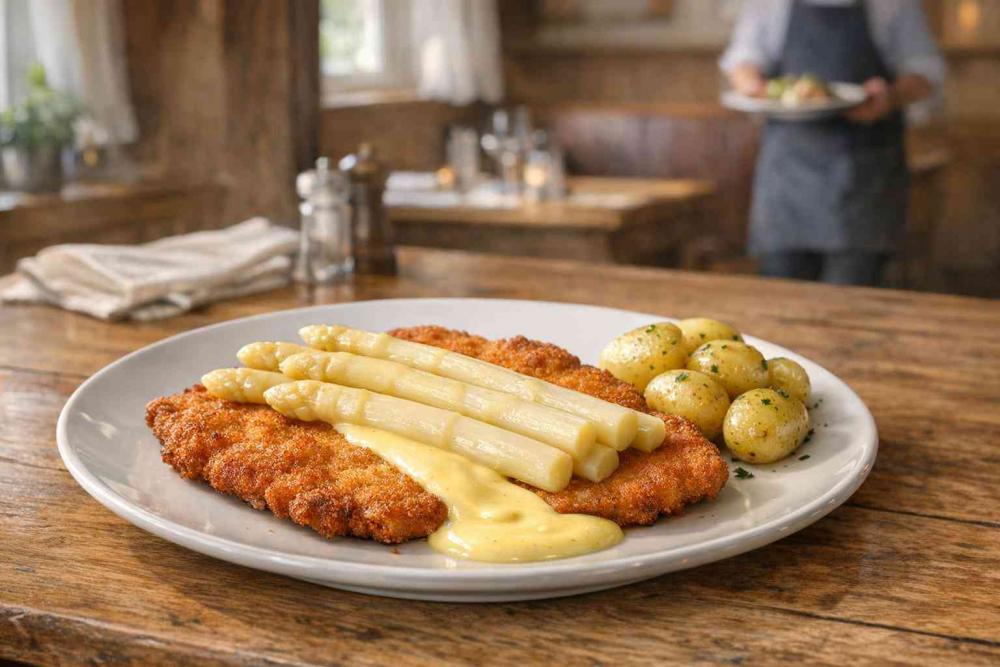
This is the kind of dish that should be sold on seasonality and refinement, not on complication.
This culinary guide explains the seasonal appeal and premium positioning of white asparagus, which helps put this spring schnitzel plate in context.
The wording on the menu needs to make clear that this is not just schnitzel with a couple of extras added to it. The white asparagus has to be central to the description, because that is what gives the dish its spring identity. Hollandaise should also be named, because it signals polish and helps the plate read as premium. The potatoes can stay simpler in the wording, because part of their value is that they do not compete for attention.
What matters is that the description sounds clear, appealing, and a little more special than the everyday schnitzel line.
For example, something in the range of:
Veal schnitzel with white asparagus, classic hollandaise and steamed potatoes
works well because it says exactly what the guest needs to know. It is recognisable, seasonal, and clearly more refined than a standard schnitzel main. If the venue wants a slightly more descriptive line, that can work too, but I would still avoid making it too literary. The dish sells best when it sounds confident rather than overexplained.
This is also a plate that benefits from being framed as a limited spring special rather than a permanent offer. That creates urgency, helps justify the ingredient choice, and makes the white asparagus feel like the point rather than just another garnish. Because the asparagus is also a more difficult ingredient to source well in the UK, the seasonal special format is often the most commercially sensible one too.
If presented cleanly, this is the sort of dish that can help a venue look more thoughtful without making the menu feel inaccessible. It feels like a spring occasion plate, and that is exactly how it should be sold.