Ingredients
Method
Start with the potato salad
- Put the potatoes into a large pan of cold salted water. Bring to the boil, then lower to a gentle simmer and cook until just tender. Depending on size, this usually takes about 18 to 22 minutes. You want them cooked through but not breaking apart.
- Drain well and leave them only until you can handle them without burning yourself. Peel them while still warm, then slice them into thin rounds. Warm potatoes absorb dressing far better than cold ones, and this matters a great deal for a proper Swabian potato salad. Put the sliced potatoes into a large bowl.
Make the warm dressing
- In a jug or bowl, whisk together the hot beef stock, white wine vinegar, mustard, neutral oil, salt, pepper, and the very finely diced shallot. Pour this over the warm potato slices and fold gently. Do not stir aggressively or the potatoes will start to break down.
- Leave the bowl for about 15 to 20 minutes so the potatoes can drink in the dressing properly. The salad should become glossy and well seasoned rather than wet and soupy.
Finish the potato salad
- Add the thin cucumber slices, chopped chives, and most of the cress. Fold again very gently. Taste carefully. A good Swabian potato salad should taste rounded, lightly savoury, gently sharp, and fresh. If needed, add another small splash of vinegar or a little more salt. Set aside at room temperature. This salad should not be fridge-cold when served with schnitzel.
Make the breadcrumbs if doing them fresh
- If you are making your own crumbs, dry the white rolls or bread first. The easiest method is to tear the bread into pieces and let it dry out for several hours or overnight. Then blitz it to fine crumbs and, if needed, pass it through a sieve so the texture stays even and delicate.
- This is worth doing properly. Fine dry crumbs made from plain white bread rolls give the most classical schnitzel crust: light, pale, crisp, and elegant. Coarse crumbs make the crust louder and rougher. Sourdough crumbs can work, but they usually brown faster and taste more assertive, which pulls the coating away from the traditional style.
Prepare the veal
- Lay each veal escalope between two sheets of baking paper or cling film and pound gently until thin and even, about 3 to 4mm thick. This is one of the most important steps in the whole recipe. A thick schnitzel does not fry with the same elegance, and the coating and meat stop behaving as one.
- Season the veal lightly on both sides with salt and a little pepper.
Set up the breading station
- Put the flour into one shallow dish. In a second dish, beat the eggs with the milk until smooth. Put the fine breadcrumbs into a third dish.
- Coat each veal escalope first in flour, shaking off the excess. Then pass it through the egg mixture, letting any excess drip away. Finally coat it in the breadcrumbs. Cover it evenly, but do not press the crumbs down hard. The coating should sit lightly on the meat. That lightness is part of what later allows the crust to become delicate and slightly rippled rather than compact and heavy.
Heat the frying fat properly
- Put a large frying pan over medium to medium-high heat and add enough clarified butter for generous shallow frying. The schnitzel should not be sitting on a barely greased surface. It needs enough fat around it to fry properly.
- If you prefer, you can use mostly clarified butter and add a little neutral oil to make the frying more practical, but for the finest flavour, clarified butter is the benchmark.
- The fat is ready when a breadcrumb dropped in starts sizzling immediately. It should be hot and lively, but not smoking aggressively.
Fry the schnitzels
- Fry the schnitzels one at a time, or at most two if the pan is large enough. Do not crowd the pan. Crowding lowers the temperature and makes the frying less precise.
- Cook the first side for about 1 1/2 to 2 minutes, then turn and cook the second side for another 1 to 1 1/2 minutes, until the schnitzel is golden, crisp, and just cooked through.
Baste and move the fat as it cooks
- This is one of the details that makes schnitzel better.
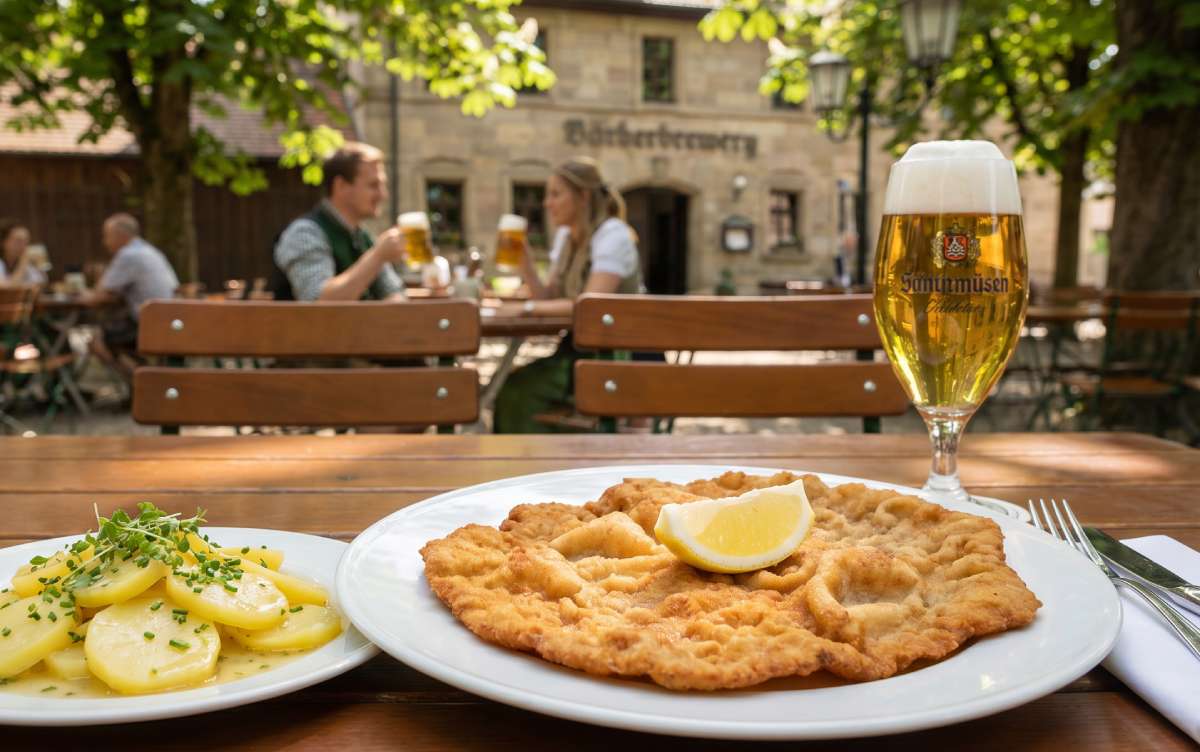
- As the schnitzel fries, gently tilt the pan and use a spoon to baste hot fat over the top surface, or carefully shake and move the pan so the fat washes up around the edges and over parts of the coating. This helps the crust cook more evenly and encourages that slightly lifted, airy, almost floating quality that great schnitzel can have.
- You are not drowning it for drama. You are helping the coating set and bloom properly. The goal is a crust that feels alive, not flat and compressed.
Drain briefly and serve at once
- Lift the schnitzel out and let it drain briefly on kitchen paper or a rack. Do not leave it sitting around too long. Schnitzel is at its best when the crust is still fully crisp and lively.
- Serve immediately with lemon wedges and a generous spoonful of the Swabian potato salad. Finish the salad with the remaining cress.