A good festival catering tent layout is not just about fitting equipment under canvas. It is about protecting speed, safety, staff movement, queue flow and food quality when pressure rises. This article compares 3x3m and 6x3m setups for sausage service, with a practical focus on station roles, power and gas realities, bottlenecks, and menu discipline.

Tight Menus Keep Queues Moving

3x3m Works With Clear Roles

6x3m Adds Control, Not Speed
Introduction
At a busy event, a small catering tent can either feel like a well-drilled service system or a very expensive cupboard with steam in it. The difference is rarely just the size of the pitch. It is usually the layout, the menu, the equipment choices, and whether each person on the stand has a clear job.
For UK caterers, showmen, festival traders and street food operators, the common question is whether a 3x3m setup is enough, or whether moving to a 6x3m pitch genuinely improves service speed. A larger tent gives more working room, better separation between stations and more space for holding, but it also costs more, takes longer to set up, and can encourage menu creep if not controlled.
A compact 3x3m tent can still be very effective if the menu is disciplined and the operation is designed around fast repeatable moves. For a German sausage offer, that usually means limiting choice, separating cooking from finishing, avoiding slow garnish decisions, and keeping the till, bun, sausage, sauce and handover flow clean.
This article looks at the operational differences between 3x3m and 6x3m festival catering tent layouts, with the practical aim of moving customers through faster while protecting quality and staff sanity.
Key Takeaways
- A 3x3m catering tent can work well for a tight sausage menu, but only if the layout is simple and every station has a clear purpose.
- A 6x3m setup gives more room for separation, holding, stock movement and staff comfort, but it does not automatically make service faster.
- The biggest bottlenecks are often not the grill itself, but payment, bun handling, topping choices, handover space and unclear staff roles.
- A realistic 200–300 portions per hour target depends on menu discipline, pre-planned flow, enough hot holding, and staff who repeat the same movements under pressure.
- Power and gas planning must be checked early, because the best layout on paper can fail if the site supply, appliance needs or safety requirements do not match.
- The fastest service systems usually reduce customer decisions at the point of order and keep the menu focused around a few high-throughput products.
- German sausages suit this style of operation because they can deliver strong perceived value without needing a complicated build process.
Why Tent Size Alone Does Not Decide Service Speed
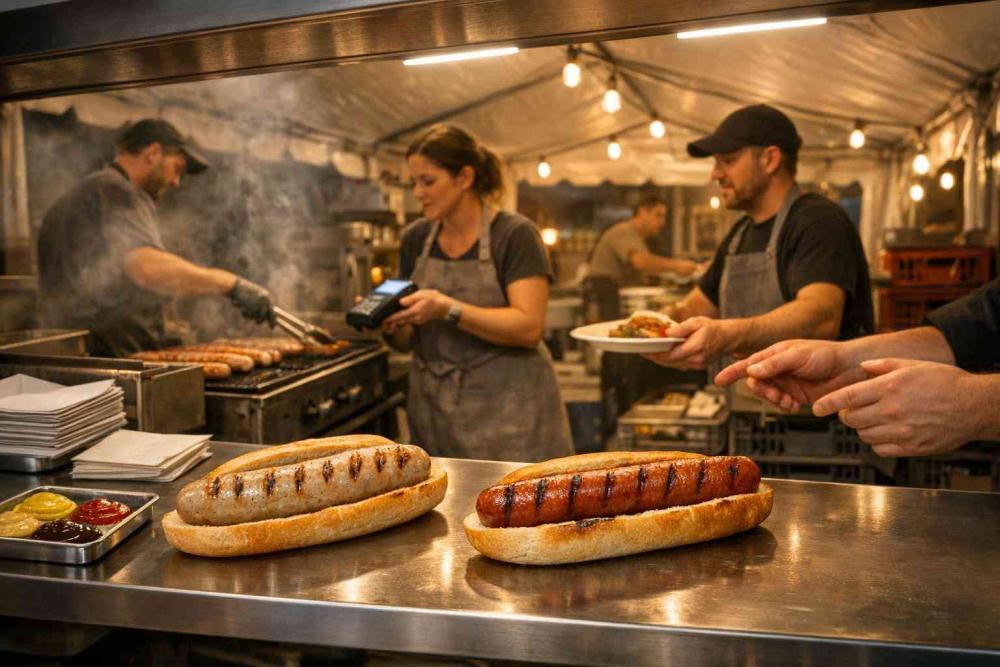
A bigger catering tent can make service easier, but it does not automatically make it faster. Speed comes from flow. If the customer, staff, food, money, buns, sauces and stock all move through the same cramped point, even a 6x3m stand can feel slow and confused.
The most important question is not “How much space do we have?” It is “What happens next?” After a customer orders, the system should be obvious. Payment should not block collection. Bun preparation should not block the grill. Sauce choices should not stop the next customer being served. Stock should not need to be dragged through the service line during the lunch rush.
A compact 3x3m tent can outperform a poorly organised larger stand if the menu is tight and every movement is repeatable. One person takes orders, one controls the grill or hot holding, one builds and hands over. There is little room for wandering, but there is also little room for unnecessary complexity.
A 6x3m tent gives more scope for separation: cooking at one end, finishing in the middle, payment and handover at the front, stock and backup behind. That can help hugely, especially at events with surges. But it only works if the extra space is used to remove bottlenecks, not to add more products, more toppings and more staff crossing each other.
For sausage service, the best layout is the one that turns each order into a short, predictable sequence.
3x3m Catering Tent Layout: Compact, Fast and Unforgiving
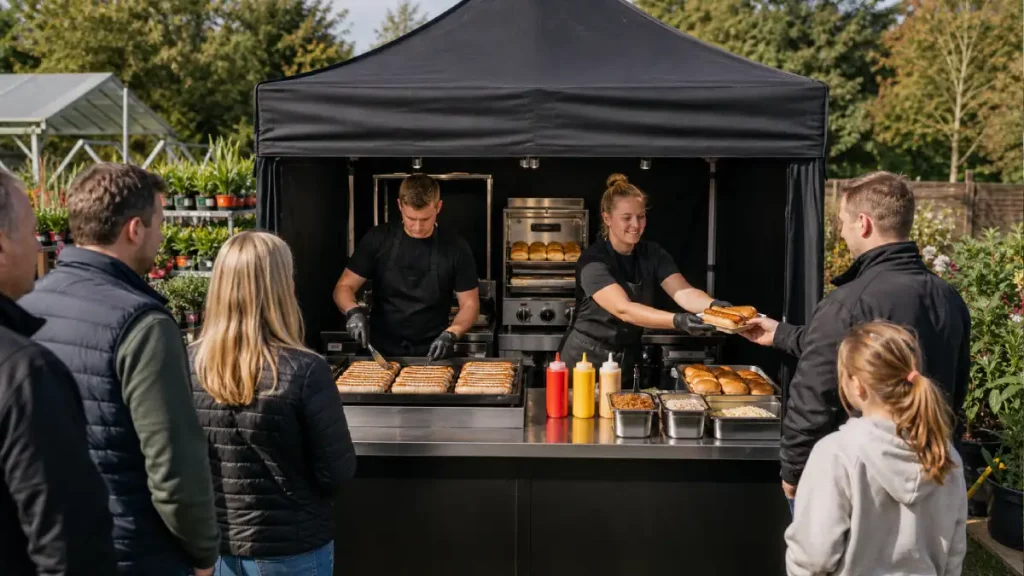
A 3x3m catering tent is the classic compact event setup. It is quick to pitch, relatively affordable, easier to staff, and often suitable for smaller events, local shows, garden centres, farm shop weekends and contained street food pitches. For a focused German sausage offer, it can work very well.
This tourism page highlights Berlin currywurst culture and serving traditions, which is useful when shaping a focused German sausage menu.
The strength of a 3x3m layout is discipline. There is no space for a sprawling menu, several cooking methods or complicated garnish builds. The setup needs to be direct: order point, cooking or hot holding, bun station, sauce station and handover. Ideally, customers should not be watching staff search for stock, squeeze past each other or decide where the next tray goes.
The weakness is that mistakes become visible quickly. A badly placed bin, spare box, till, gas bottle position, bun tray or sauce bottle can slow the whole system. Two staff may work comfortably; three can work if the layout is sharp; four may become counterproductive unless the roles are very tightly defined.
A 3x3m sausage stand usually suits a menu built around fast sellers, such as bratwurst, frankfurters, currywurst-style portions, sausage and chips, or one strong special. The fewer the customer decisions, the better.
In a small tent, every item must justify its footprint. If it does not help sales, speed or presentation, it probably does not belong there.
6x3m Catering Tent Layout: More Space, More Control, More Temptation
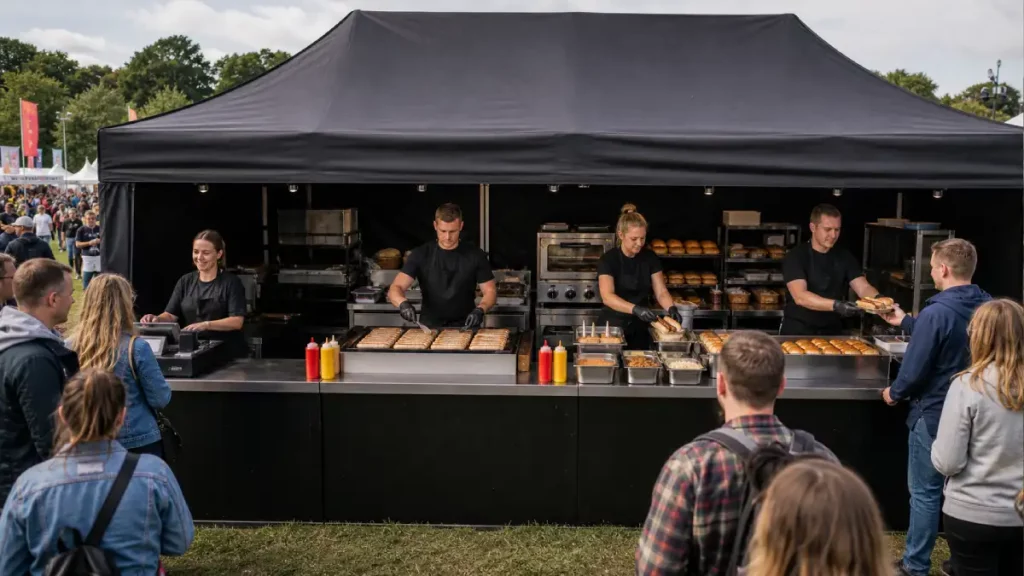
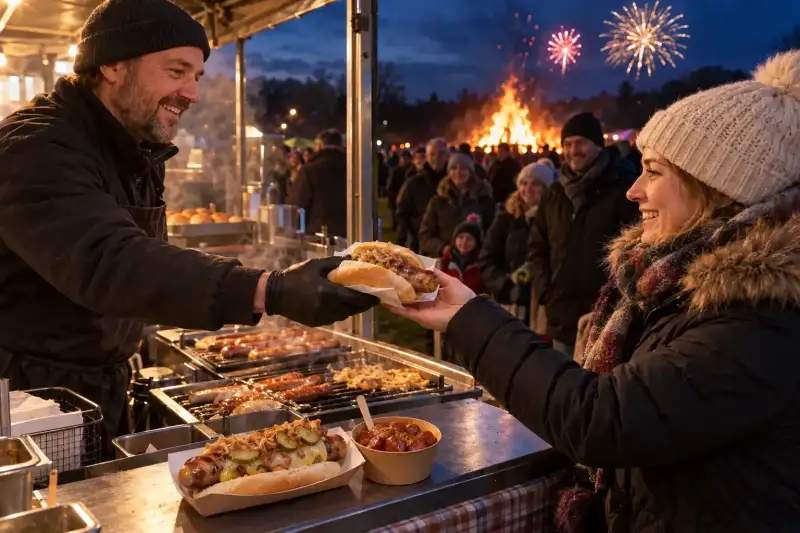
A 6x3m catering tent gives an operator a different kind of control. The extra width can allow a clearer split between order taking, cooking, finishing, handover and backup stock. At busier festivals and shows, that separation can be the difference between a queue that moves steadily and a queue that quietly gives up.
This tourism page highlights Berlin currywurst stand service and setup, giving festival caterers a useful real-world point of reference for counter flow and handover.
The main advantage is that staff do not need to work on top of each other. One person can manage payment and customer questions. Another can control the grill or hot holding. A third can build buns or portions. A fourth can restock, manage chips, sauces, packaging or collection. The layout can also allow a better customer-facing front, with one point for ordering and another for collection.
This is particularly useful when serving a German sausage menu at higher volume. Bratwurst, frankfurters and hotdogs can move quickly, but only if the finishing area keeps pace with the cooking side. More space means more room for buns, trays, sauces, wrapped portions, backup stock and staff movement.
The temptation is to fill the extra area with extra menu lines. That can damage the very speed the larger tent was meant to create. More sausages, more sides, more sauces, more chips, more specials and more customer questions can quickly turn a tidy system into a slow one.
A 6x3m layout should create breathing room, not menu sprawl.
The 200–300 Portions Per Hour Question
Serving 200–300 portions per hour from a small tent is possible in the right conditions, but it should be treated as a system target, not a casual promise. The layout, menu, staffing, equipment, holding capacity, payment speed and event flow all have to support it.
At 200 portions per hour, the stand is serving more than three portions per minute. At 300 portions per hour, it is five portions per minute. That leaves very little room for indecision, slow payment, complicated toppings, missing buns, cold holding gaps or staff confusion.
The practical question is whether each part of the line can keep pace:
- Can the grill or hot holding produce enough ready-to-serve sausages?
- Can buns or trays be prepared without slowing cooking?
- Can payment be taken quickly enough?
- Can sauces and toppings be added without creating a decision queue?
- Can stock be replenished without blocking service?
- Can finished food be handed over clearly and safely?
For a sausage offer, the best route to this kind of speed is usually menu restraint. A narrow, well-executed menu can move far faster than a broad menu that looks good on a board but collapses under pressure.
A strong example would be a focused bratwurst and frankfurter setup, with one or two clear serving formats and limited sauces. Customers understand it quickly. Staff repeat the same actions. Stock planning is cleaner. Waste is easier to control.
The number sounds impressive, but the real commercial value is steadiness. A stand that can keep serving cleanly through the rush protects revenue, reduces stress and gives customers more confidence in the operation.
Station Roles: Who Takes Money, Who Cooks, Who Finishes?
A fast sausage stand needs clear station roles before the first customer arrives. If everyone does a bit of everything, the line often looks busy but moves slowly. Staff cross over, orders get repeated, buns are opened twice, and nobody is quite sure who is responsible for the next handover.
This hospitality trade article looks at how a compact high-speed oven setup can support faster festival service and clearer station roles in a busy sausage tent.
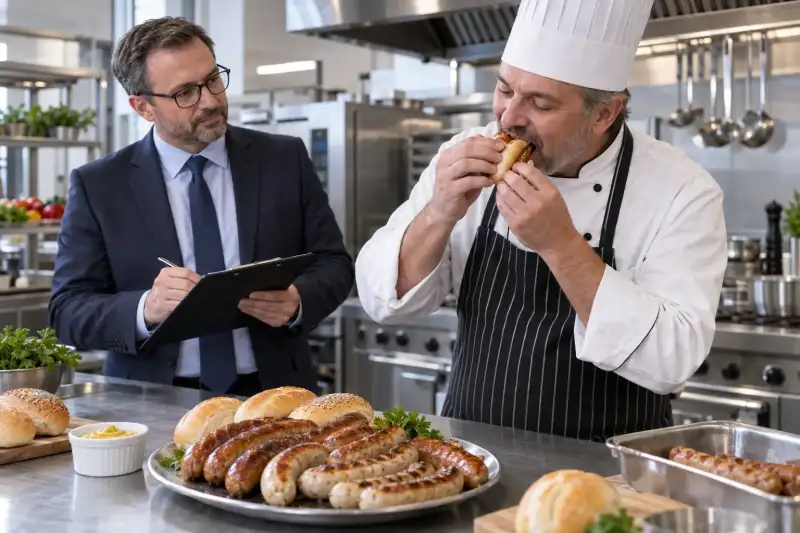
In a compact 3x3m catering tent, the simplest split is usually order/payment, cooking or hot holding, and finishing/handover. The till person keeps the queue moving and controls customer decisions. The cooking person protects product flow, temperature and replenishment. The finishing person builds the order, adds sauces or toppings, and gets the food out cleanly.
In a 6x3m setup, those roles can become more specialised. One person can focus entirely on payment and queue control. One can manage grill and holding. One can build buns or trays. One can restock, support chips, sauces, napkins and packaging, and prevent the front line from running dry.
The key is to avoid role drift. During a rush, the payment person should not disappear to fetch buns. The grill person should not be answering long menu questions. The finisher should not be handling cash and then food without proper hygiene controls.
A simple role system makes training easier, especially with casual event staff. It also makes performance visible. When service slows, you can see whether the problem is ordering, cooking, finishing, stock or handover.
Power, Gas and Holding: The Practical Limits Behind the Layout
A festival catering tent layout must work with the power and gas realities of the site, not just the ideal drawing on paper. Many service problems begin because the operator designs the menu first and checks the utilities later.
This technical reference outlines the safety checks for second-hand gas cooking appliances that festival caterers should review before planning power and gas realities in a tent setup.
Before settling on a 3x3m or 6x3m layout, confirm what the event allows and what your equipment actually needs. Electrical supply can limit refrigeration, hot holding, lighting, tills, card machines, fryers, extraction support or water heating. Gas planning affects grill position, bottle storage, ventilation, hose routing and safe access. These details are not cosmetic; they shape the working layout.
Hot holding is especially important for fast sausage service. If every sausage has to come straight from the grill to the bun, the grill becomes the throttle. A well-managed holding system can give the finishing station a steady flow of ready product, but it must be suitable for the product, the equipment and food safety requirements.
Operators should check:
- event rules on gas and electrical appliances
- available electrical load and connector type
- gas bottle position and access requirements
- safe separation between heat, staff and customers
- refrigeration and backup stock needs
- whether holding equipment can keep pace with expected sales
A 6x3m stand may allow better separation of hot, cold and customer-facing areas. A 3x3m stand can still work, but it leaves less margin for awkward utility placement. In both cases, the layout must respect the practical limits behind the service.
Bottlenecks That Slow Sausage Service Down
The obvious bottleneck is the grill, but in many sausage operations the real delay happens somewhere else. The food may be ready, but the order is not paid for, the bun is not open, the sauce choice is still being discussed, or the handover point is blocked by customers waiting for chips.
Bottlenecks usually appear where two flows collide. Staff need to move one way, customers gather in another, and stock has to pass through the middle. In a small tent this becomes visible immediately. In a larger tent it can hide for longer, but it still costs sales during the rush.
Common bottlenecks include slow card payments, too many menu questions, unclear collection points, topping choices that require discussion, stock stored behind the busiest worker, and packaging that is not ready when the food is ready. Even small delays add up when the target is several portions per minute.
The best way to find bottlenecks is to watch the stand during a busy period and ask one question: where does finished food wait? If cooked sausages wait for buns, the bun station is the problem. If built portions wait for payment, the till is the problem. If customers wait while staff search for sauce bottles, the finishing area is the problem.
Good layout removes unnecessary decisions and unnecessary movement. Fast sausage service is rarely about staff rushing harder. It is about designing a system where they do not have to.
Menu Discipline: The Quiet Difference Between Busy and Chaotic
Menu discipline is one of the least glamorous parts of event catering, but it is often the difference between a stand that feels busy and one that feels chaotic. A broad menu may look attractive before the event. During service, every extra line adds stock, signage, questions, prep, holding issues and slower decision-making.
This hospitality trade article explains how plant-forward menu discipline can help festival caterers keep service faster and offers more focused.
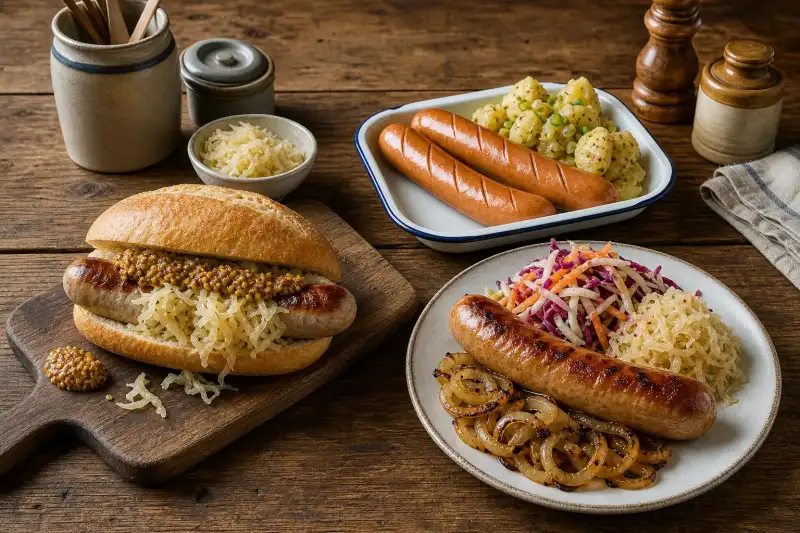
For a German sausage stand, a disciplined menu does not mean a boring menu. It means a focused offer that customers understand quickly and staff can execute repeatedly. A bratwurst, a frankfurter, a currywurst-style option and perhaps one premium special can feel complete without overwhelming the line.
The strongest event menus often use variation carefully. Instead of offering six different sausages, five sauces and several build styles, the operator can create clear formats: classic bratwurst in a bun, currywurst with chips, premium cheese frankfurter, or a simple sausage and chips box. The customer still sees choice, but the operation remains controlled.
Menu discipline also improves stock planning. Fewer lines mean fewer part-used boxes, fewer slow sellers, cleaner replenishment and easier staff training. It reduces the chance that one awkward item holds up the whole stand.
In a 3x3m catering tent, menu discipline is almost non-negotiable. In a 6x3m setup, it is still essential because extra space can tempt operators into adding complexity. The aim is not to show everything you can sell. It is to sell the right things quickly, consistently and profitably.
The Author’s Proven 3x3m Speed System
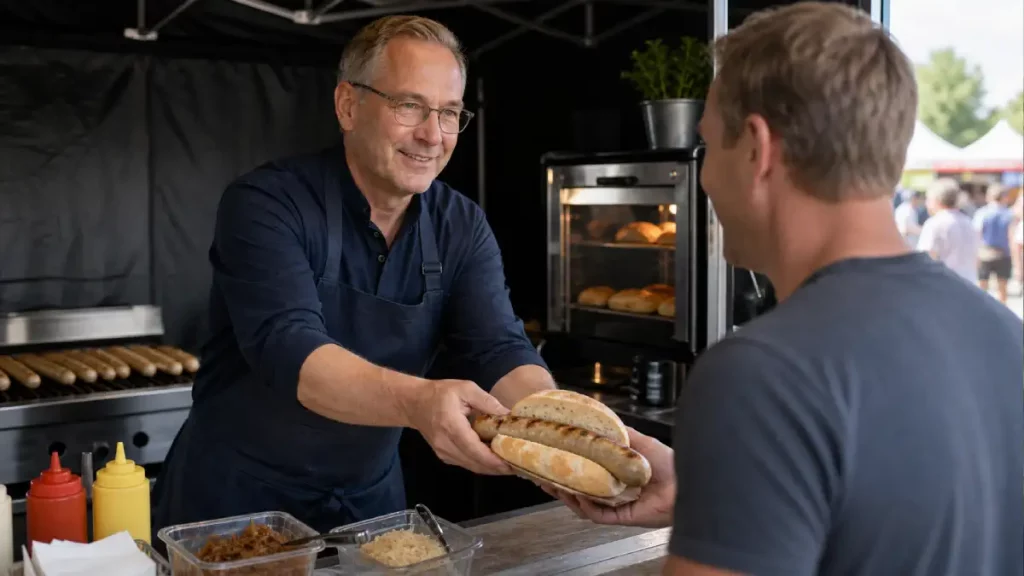
The author’s larger 6x3m festival setup was built for very high-volume sausage-and-chips service, but the same thinking also worked in a smaller 3x3m tent: fewer decisions, tighter movement, and a line that never had to stop. The compact version was not a cut-down compromise. It was a deliberately simple speed system for smaller events, capable of serving around 200–300 portions per hour when the queue was there and the team was properly set.
The menu was the first part of the system. Customers had two strong choices: Bratwurst or Bacon Krakauer, both served in a high-quality ciabatta-style, pre-baked bread roll. That gave customers enough choice to feel satisfied, but not so much that every order turned into a conversation. Staff did not need to explain six products, check multiple garnish combinations or slow down for complicated builds.
The cooking side was equally direct. One grill handled the sausages. A small oven reheated the bread rolls for around three minutes, creating the warm, freshly baked feel without turning bread handling into a bottleneck. That small detail mattered commercially: the product felt more premium, but the process stayed fast and repeatable.
The clever part was moving condiments away from the service line. In front of the tent, a separate station table held self-service ketchup, mustard and good-quality ready-bought caramelised onions. Customers received the sausage immediately, then moved to the condiment station to finish it themselves. That cleared the counter for the next customer instead of letting sauce choices block the till and handover point.
The rhythm was simple. The till person called the order. While the customer paid by cash or card, the sausage was already being served. By the time payment was finished, the food was ready. No waiting, no discussion, no lost movement.
That is the real lesson of the 3x3m system: speed did not come from rushing. It came from removing every avoidable pause.
Frequently Asked Questions
Yes, if the offer is focused and the layout is built for speed rather than variety. A 3x3m tent can work very well for smaller events, farm shop weekends, garden centre pop-ups, local shows and compact street food pitches.
The main limit is not whether sausages can be sold from that space. They can. The issue is whether there is enough room for safe cooking, payment, handover, stock, bread handling, packaging and staff movement without everything colliding. A simple two-product menu is far more realistic in a 3x3m tent than a broad menu with several sausages, chips, toppings, sides and specials.
6x3m tent becomes worth considering when the extra space helps you remove a genuine trading constraint. That might be a longer queue, more staff, a bigger holding setup, chips or sides, larger stock requirements, or a separate collection point.
It is not automatically the better commercial choice. If the event is smaller, the pitch fee is high, or the menu is very simple, a disciplined 3x3m setup may produce a better return. The larger tent earns its keep when the extra space improves throughput, reduces stress and helps you serve more customers during peak trading windows.
Self-service condiments can be very effective if the event, layout and food handling setup allow it. Moving ketchup, mustard and ready-prepared onions away from the main service point can stop sauce choices from slowing the queue.
The key is to make the station clean, visible and easy to manage. It needs regular checking, enough serving utensils or dispensers, sensible positioning and proper attention to hygiene. Some events may have rules about self-service food items, so operators should confirm what is acceptable before relying on that setup.
For high-speed event catering, fewer choices usually work better. That does not mean the offer has to feel thin. A strong Bratwurst and a Bacon Krakauer, for example, can give customers a clear choice without slowing the line.
The danger with too many options is not only stock complexity. It also creates hesitation at the till. Every extra sausage, topping or serving style adds a question. In a rush, those small delays become expensive. A tight menu is often more profitable because customers decide faster and staff repeat the same process more accurately.
For a compact sausage stand, two experienced people can often run a simple setup, but three is usually more comfortable when the queue builds. A common structure is one person on till and queue control, one on cooking or hot holding, and one on finishing and handover.
The important point is not just headcount. It is role clarity. Adding more people to a small tent can make things worse if they are stepping across each other. A 3x3m stand needs staff who know exactly where they stand, what they touch, and when they move.
The biggest mistake is adding more instead of simplifying. More menu lines, more toppings, more signs, more cooking processes and more staff can all feel like growth, but they often make the stand slower.
faster system usually comes from removing friction: fewer customer decisions, clearer handover, prepared packaging, reliable hot holding, simple payment flow and stock that can be reached without blocking service. Speed is rarely about rushing harder. It is about designing fewer reasons to pause.
Yes. A simple system does not have to mean a cheap-looking offer. In fact, premium ingredients often work best when the service format is clean and easy to understand.
good German sausage, a warm quality roll, clear menu wording and well-chosen condiments can feel more appealing than a cluttered stand with too many average options. Customers at events often want something that looks good, tastes good and arrives quickly. They do not always want a long ordering decision.
Chips can increase basket value, but they also add equipment, power demand, queue pressure, oil management, holding questions and more service steps. In a 3x3m tent, they should only be added if the setup can handle them without slowing the core sausage line.
For smaller events, a sausage-in-roll system may be cleaner and faster. For larger events or a 6x3m setup, sausage and chips can work very well if the frying, holding, packaging and handover areas are properly separated. The decision should be based on capacity, utilities and staff, not just menu appeal.
The best test is a timed service rehearsal. Set up the tent as it will be used, place equipment and stock in their real positions, then run through typical orders with staff. Watch where people reach, turn, wait or cross paths.
useful test is to simulate a short rush rather than a calm service. Can one person take payment while the next order is already being built? Are rolls, napkins, trays and sauces in the right place? Can stock be replenished without interrupting the front line? Small layout problems are much easier to fix before the event than during the lunch rush.
Operators should check the pitch size, frontage, queue direction, permitted equipment, gas rules, electrical supply, access times, waste arrangements, water requirements and any restrictions on self-service condiments or cooking position.
It is also worth asking about expected footfall patterns. A site with one short lunch rush needs a different system from an event with steady trade across the day. The layout should be designed around the real trading conditions, not just the tent dimensions.
Conclusion
The right festival catering tent layout depends less on the headline size and more on the system inside it. A 3x3m setup can be fast, profitable and tidy when the menu is narrow, the staff roles are clear and the customer journey is simple. It suits operators who want a compact stand, quick setup and a focused sausage offer without unnecessary complexity.
A 6x3m layout gives more breathing room. It can support better stock handling, clearer station separation, more staff, improved holding and a smoother handover area. But the extra space only helps if it is used with discipline. If the larger pitch simply adds more menu options, more garnishes and more decisions, it can slow the line down rather than speed it up.
For sausage service, the practical goal is not to build the biggest stand. It is to build the clearest route from order to handover. That means thinking about customer flow, equipment position, staff movement, bun handling, sauce choices, gas and power before the event starts.
For UK operators looking to serve German sausages at speed, the strongest setup is usually the one that keeps the offer simple, the line moving and the product consistently good.
About The Sausage Haus
The Sausage Haus supplies authentic German sausages for UK caterers, event traders, pubs, cafés, garden centres, farm shops and foodservice operators who want a premium product that is also practical to serve.
This tourism page highlights Hamburg currywurst culture, which is useful context if you want to serve authentic German sausages with a stronger sense of place.
The sausages are produced by Remagen, a long-established German producer known for proper German sausage-making, and distributed in the UK by Baird Foods. This gives operators access to products that feel authentic, consistent and commercially useful, without making the service system more complicated than it needs to be.
For busy stands and high-footfall sites, the right sausage can make a real operational difference. A strong German bratwurst, frankfurter or hotdog-style product can offer good perceived value, fast service, clear menu language and broad customer appeal. That matters whether the setup is a compact 3x3m catering tent, a larger 6x3m festival stand, a pub menu, a café special or a seasonal retail food offer.
The Sausage Haus is built around that practical balance: authentic German sausages, reliable UK supply and a service-friendly format for operators who need food that works when the queue starts moving.