
Why Curry Pork Bratwurst Works Across Different Menus
Curry Pork Bratwurst occupies a useful middle ground. It is recognisably a German-style sausage, but its curry character gives operators a clearer menu hook than a standard bratwurst. Customers can understand the idea quickly, whether it appears as currywurst and chips, in a loaded roll or as part of a plated meal.
The Sausage Haus approach is to build curry flavour into the sausage itself, rather than expecting the sauce to carry the entire dish. This gives the sausage enough identity to work with several accompaniments. A curry sauce can reinforce the flavour, while mustard, pickles, slaw, grilled vegetables or fresh herbs can take the finished dish in different directions.
That flexibility is commercially useful. The same core product can support a straightforward takeaway tray, a higher-priced pub plate and a controlled buffet portion without requiring three unrelated ingredient lists. Operators can adapt the presentation and portion around the customer, rather than changing the main product.
The important distinction is that this is fresh bratwurst, not simply a frankfurter that can be reheated and served immediately. Cooking time, raw-product handling, equipment capacity and batch planning therefore need proper consideration. Preparation must follow the supplier’s cooking guidance and the operator’s documented food-safety procedures.
Once that process is organised, Curry Pork Bratwurst offers controlled variety: one recognisable product with enough character to support several sellable formats.
Choosing the Right Format for Your Customers and Service Style
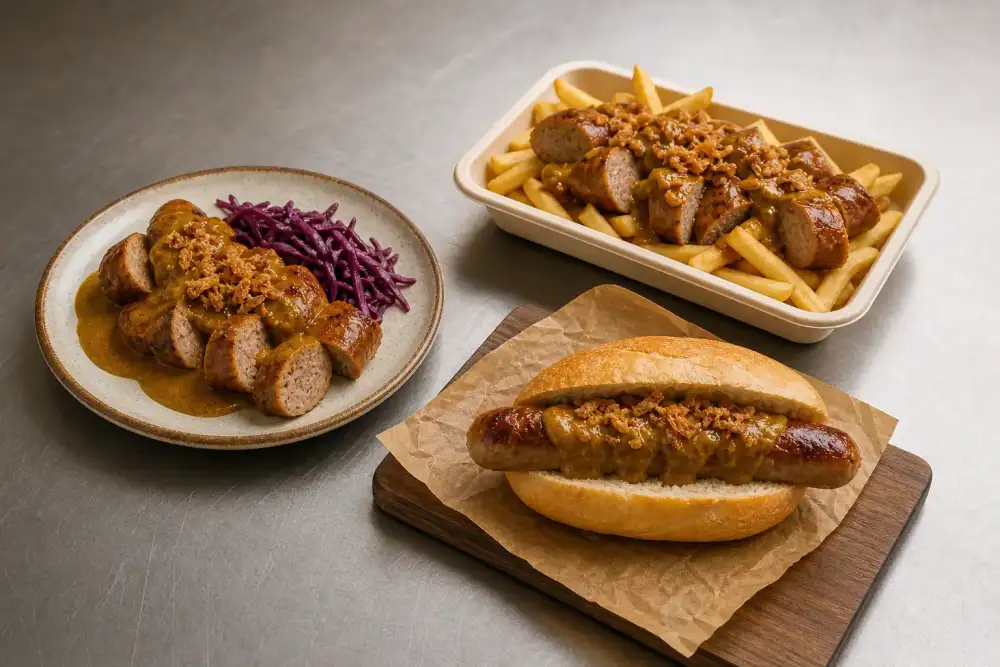
The best menu format is the one that fits how customers order, eat and move through the venue. A substantial pub plate may look appealing, but it is a poor match for a festival customer trying to eat while standing. Equally, a simple takeaway tray may feel underdeveloped in a pub where customers expect a complete meal.
Start with the service environment:
- Pubs and casual dining: Use a plated format with a proper side, a fresh or pickled element and controlled sauce presentation.
- Street food and festivals: Choose a tray, roll or loaded-fries format that can be assembled quickly and eaten without a knife.
- Buffets and functions: Keep portions compact, easy to collect and stable enough to remain presentable during service.
- Cafés, farm shops and garden centres: Consider a recognisable lunch plate or a lighter seasonal bowl that does not rely entirely on chips.
- High-volume event counters: Limit customer choices and build the format around repeatable assembly.
Equipment should influence the decision as much as presentation. A chargrill can provide visible colour and theatre, while a flat-top griddle may support steadier batch cooking. A combi oven can help with controlled preparation, but the finishing method still needs to produce an appetising exterior. Fryer capacity matters if every portion includes chips or loaded fries.
The menu price also has to match the format. A roll needs enough substance to feel like a meal, while a plated version must offer more than the same roll emptied onto crockery. Choose one clear role for the dish and build the portion, service method and selling price around it.
Seven Sellable Curry Bratwurst Formats for Professional Catering
1. Classic Currywurst and Chips Tray
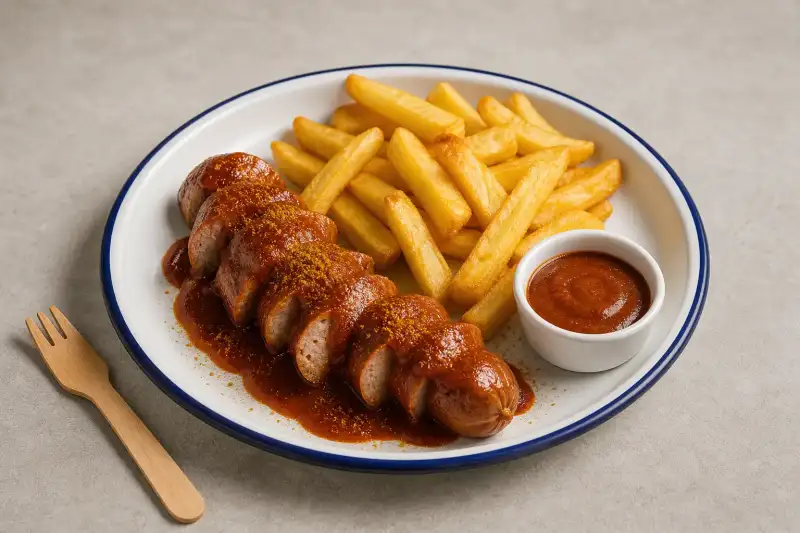
The most immediately understandable format is sliced Curry Pork Bratwurst with curry sauce, a restrained dusting of curry powder and a proper portion of chips. It works for street food traders, event caterers, showmen, food halls and casual pub service because customers can see exactly what they are buying.
This recipe guide shows how Berliner currywurst is traditionally served with curry ketchup, making it useful for checking an authentic currywurst sauce pairing.
The sausage should remain the centre of the dish. Slice it into substantial, even pieces rather than small coins, arrange it neatly and apply enough sauce to coat without drowning it. Serving the chips beside the sausage rather than underneath helps them remain crisp and keeps the presentation cleaner.
A lidded sauce pot or defined ladle makes portion control easier. The finishing curry powder should be applied with a shaker to avoid heavy patches and inconsistent heat. Wooden forks suit event service, while pubs may prefer an enamel-style plate or shallow bowl.
Operationally, the format depends on coordinated sausage and fryer production. If the chips take longer than the bratwurst, the cooking sequence must prevent finished sausages sitting too long at the pass. Keep optional extras limited—perhaps crispy onions or extra-hot curry seasoning—so the core order remains fast.
2. Loaded Curry Bratwurst Roll
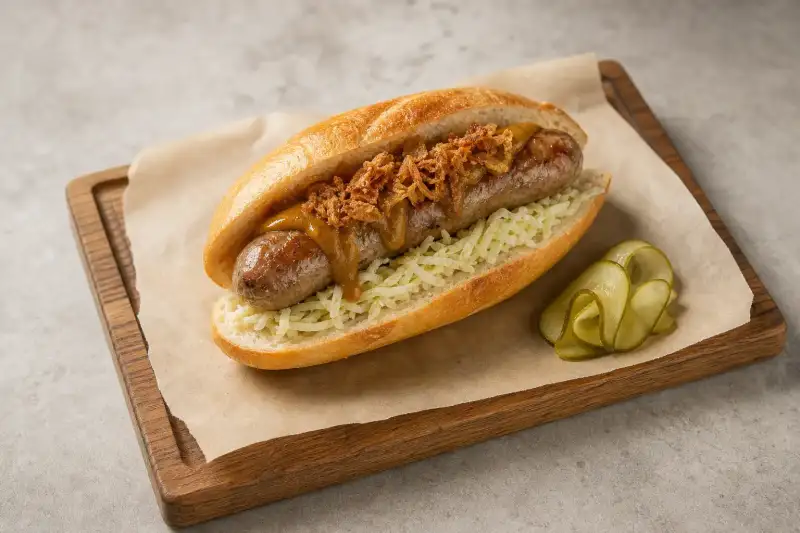
A whole bratwurst in a quality roll creates a hand-held format with stronger street food and beer-garden appeal. It can command more attention than a standard hot dog, provided the toppings are deliberate and the sausage remains visible.
A lightly toasted roll gives useful structure. Add a narrow base of slaw or grilled onions, followed by the bratwurst, a controlled line of curry sauce and one crisp finish such as fried onions. Pickled cucumber ribbons or a small amount of apple-and-cabbage slaw can provide acidity without making the roll wet.
The greatest risk is overloading. Too much sauce, several loose toppings and an undersized roll create a product that collapses after the first bite. The roll should be long and robust enough for the sausage, with toppings measured rather than added by eye.
This format suits counters where customers are moving, but it still requires a sensible wrapping method. A half-wrap or narrow tray supports the roll while leaving the top visible. For smoother service, use one standard build and offer heat as a simple finishing choice rather than a long topping menu.
3. Curry Bratwurst Pub Plate
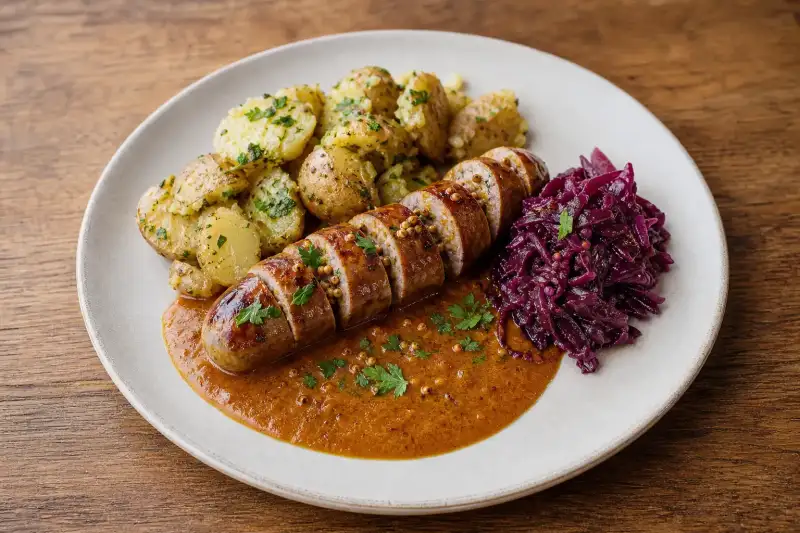
For pubs, cafés and garden-centre restaurants, Curry Pork Bratwurst can become a complete plated meal without turning into an oversized mixed grill. One or two sausages can be paired with a substantial potato side, a sharp vegetable element and a sauce that connects the plate.
Herbed crushed new potatoes, warm German-style potato salad or good skin-on chips can provide the main accompaniment. Add braised cabbage, dressed slaw or chargrilled peppers for freshness and colour. Curry sauce can be served beneath part of the sausage or in a small pot, allowing the customer to control it.
This recipe guide shows how to make a Berlin-style warm potato salad that works well as a traditional side for curry bratwurst plates.
The plate should feel more considered than the takeaway tray. That does not mean adding more components for the sake of it. A sausage, potato element, vegetable or salad and sauce are normally enough. Fresh herbs or pickled mustard seeds can provide a final detail if they are already practical for the kitchen.
This format works particularly well as a lunch special, beer-pairing dish or seasonal pub feature. Its value comes from confident cooking and a coherent plate, not decorative complexity. Staff should be able to reproduce the presentation during a busy service without needing prolonged assembly or delicate garnishing.
4. Curry Bratwurst Loaded Fries
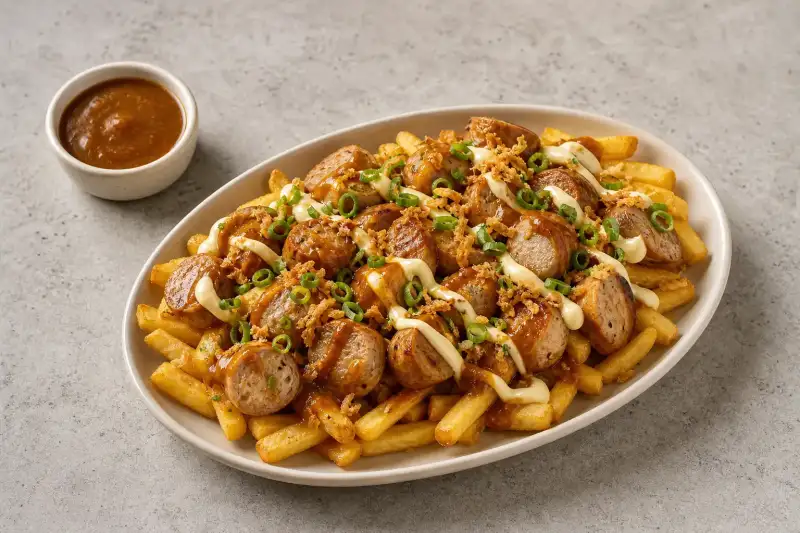
Loaded fries can turn Curry Pork Bratwurst into a generous street food special or sharing dish. The format is familiar to UK customers, visually strong and easy to explain on a menu board.
Use crisp fries as the base, topped with evenly sliced bratwurst and a measured amount of curry sauce. Finish with one creamy or sharp element and one crunchy garnish. Curry mayonnaise, pickled red cabbage, spring onion or crispy onions can work, but using all of them together quickly becomes excessive.
The order of assembly matters. Wet sauce should not cover the entire portion, and heavily sauced sausage should not sit on the fries while waiting at the pass. Build the dish immediately before handover and use a wide tray rather than a deep box that traps steam.
Loaded fries can support a higher selling price, but the additional ingredients, packaging and assembly time must be included in the costing. They also place more demand on the fryer than a standard sausage portion. During events, check whether fryer output can support the expected order mix without slowing every other product.
A standard version plus one clearly priced extra-hot option is usually more workable than several customised builds.
5. Curry Bratwurst Flatbread or Wrap
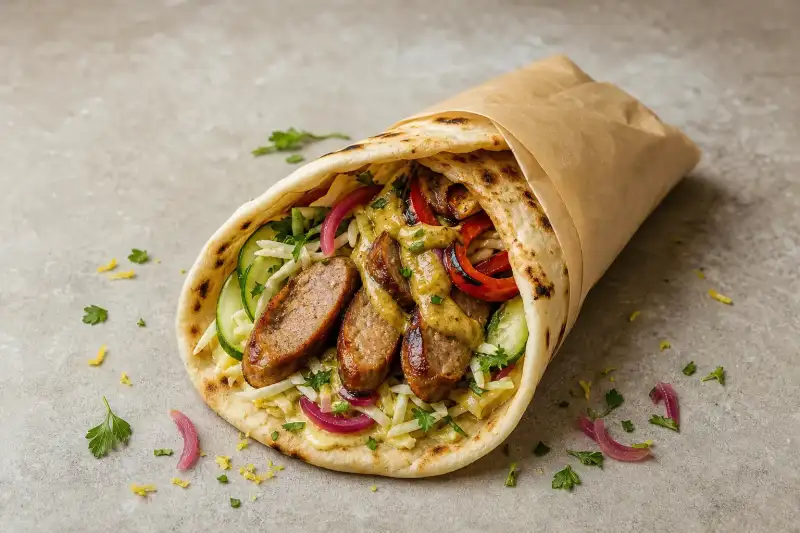
A flatbread gives the bratwurst a fresher, more flexible lunch format. It can suit cafés, food trucks, garden centres and spring or summer events where a heavy sausage-and-chips meal may not be the only option customers want.
Slice the cooked bratwurst lengthways or into diagonal pieces and combine it with shredded cabbage, cucumber, grilled peppers or a crisp herb salad. A curry-mustard dressing or lightly spiced yoghurt-style sauce can connect the ingredients without overwhelming them. Pickled onions or lemon-dressed herbs add the acidity needed to balance the pork.
The flatbread must still eat cleanly. Warm it briefly on a griddle or contact grill, keep wet ingredients controlled and avoid filling it so heavily that it cannot be folded. A paper wrap can support the lower half for takeaway service.
This format also creates an opportunity to use some of the same prepared vegetables as a plated salad or side dish. That cross-use makes more sense than buying several ingredients for one specialist wrap.
Menu wording should remain straightforward. “Curry Bratwurst Flatbread with Charred Peppers and Cabbage Slaw” tells the customer what to expect without requiring a long explanation.
6. Curry Bratwurst Buffet Bites
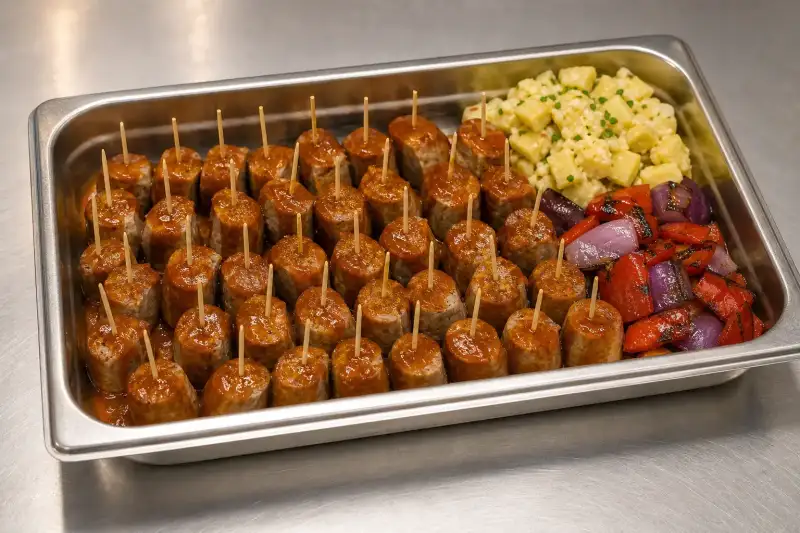
For buffets, corporate catering and private functions, a full bratwurst can be divided into smaller portions that are easier to collect and eat. Thick slices or short sections can be served with a glaze, dip or small supporting ingredient.
One approach is to cook the sausages fully, rest them briefly, cut them into even pieces and finish them with a light curry glaze. They can then be served in a shallow gastronorm tray with cocktail sticks or portioned into small cups with a spoonful of warm potato salad. Another option is a short bratwurst skewer with grilled pepper and red onion, provided the pieces remain moist and easy to remove.
Buffet food must hold its appearance as well as its temperature. Small sausage pieces can dry more quickly than whole sausages, so batch size and replenishment frequency matter. Avoid leaving cut pieces exposed under dry heat for extended periods.
The portion should also be obvious. If the item is part of a larger buffet, two or three pieces may be appropriate; if it is being sold as an individual bowl, it needs a more substantial build. Use suitable hot-holding equipment, follow the event’s food-safety plan and replenish in smaller batches rather than filling the display for the entire service.
7. Seasonal Curry Bratwurst Bowl
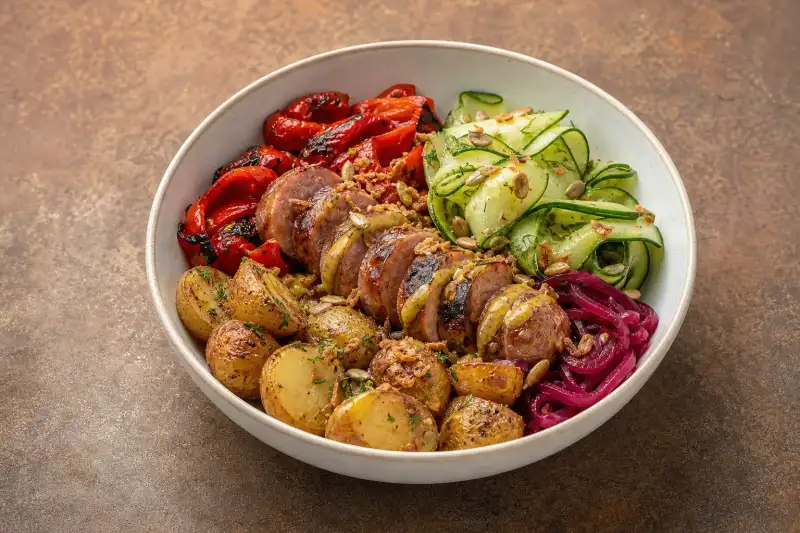
A seasonal bowl allows Curry Pork Bratwurst to reach customers who want something more composed than a roll but less chip-led than classic currywurst. It can work for pub lunches, cafés, farm shops and garden-centre restaurants.
Build the bowl around sliced grilled bratwurst, roasted new potatoes or a modest grain portion, and two contrasting vegetables. In spring or summer, charred peppers, cucumber, cabbage, peas or fresh herbs keep the presentation bright. In colder months, roasted roots, warm cabbage or spiced lentils can create a more substantial version.
Use a lighter curry-mustard dressing rather than covering the entire bowl with thick sauce. The bratwurst should still look properly grilled and remain the main item. A pickled element provides acidity, while toasted seeds or crisp onions can add texture in a controlled quantity.
This format requires more mise en place than currywurst and chips, so it is best suited to kitchens already using the vegetables, grains or potatoes elsewhere. It should not introduce five ingredients that have no other purpose.
A seasonal bowl can broaden the product’s lunch appeal, but it should still be described honestly. It is a well-balanced bratwurst meal, not automatically a health dish simply because it contains salad.
Building a Complete Dish Without Overloading the Plate
A complete bratwurst dish needs contrast, not a large collection of unrelated sides. A useful starting structure is the sausage, one main accompaniment, one fresh or acidic component and one sauce. A crisp garnish can be added if it improves texture, but it should not become another full ingredient layer.
For example, Curry Pork Bratwurst with chips, curry sauce and pickled cabbage already covers richness, starch, moisture, acidity and crunch. Adding cheese sauce, bacon, fried onions, mayonnaise and another slaw would make the plate busier without necessarily making it better.
The same principle applies to lighter formats. A seasonal bowl might combine bratwurst, roasted new potatoes, cucumber-and-herb slaw and curry-mustard dressing. The ingredients have distinct roles and can be eaten together. Nothing is there merely to occupy an empty part of the bowl.
Sauce placement deserves particular attention. Completely covering the sausage hides its colour and makes every menu format look similar. Applying sauce beneath part of the product, in a controlled stripe or in a separate pot keeps the bratwurst visible and lets the customer recognise what they have paid for.
Perceived value comes from a confident portion, appetising cooking and a dish that feels intentional. It does not require the plate to be crowded. Before approving a build, remove the least important component. If the dish becomes clearer and easier to serve, that ingredient probably was not earning its place.
Sauces, Sides and Toppings That Complement Curry Bratwurst
Because curry flavour is already present in the bratwurst, supporting ingredients should add balance rather than simply more curry. The most useful accompaniments introduce acidity, sweetness, freshness or crunch.
This recipe guide shows how quick pickled red cabbage can add sharpness, sweetness, and crunch to a curry bratwurst plate or loaded roll.
A tomato-based currywurst sauce is the obvious partner for the classic tray. It should be thick enough to cling to sliced sausage but still easy to portion from a ladle or pump. For rolls and bowls, curry mustard or a lighter curry mayonnaise can provide flavour with less mess. A chilled herb-and-curry dressing may suit seasonal plates, provided its preparation and storage fit the kitchen’s food-safety system.
Suitable sides include:
- chips or seasoned potato wedges
- warm German-style potato salad
- roasted or crushed new potatoes
- grilled peppers and onions
- apple, cucumber or cabbage slaw
- rice, grains or lentils for bowl formats
- a simple dressed leaf or herb salad
Toppings should be used more sparingly. Crispy onions, pickled cabbage, gherkin ribbons, spring onions, chopped herbs and toasted seeds can all provide contrast. One well-chosen topping is usually more effective than four competing finishes.
It is also sensible to separate warmth from heat. Keep the main sausage and sauce accessible to a broad customer base, then offer chilli flakes, hot curry powder or a hotter sauce as an optional finish. This gives customers a meaningful choice without forcing the kitchen to manage several entirely different recipes.
Test every sauce after realistic holding, not only when freshly made. Some thicken, split or become sweeter as they sit. The version that works in a tasting bowl may need adjustment before it is ready for a busy service.
Preparing Each Format for Fast, Consistent Service
Consistency begins with a written build specification. Staff should know the sausage portion, cooking method, resting time, cut, sauce quantity, side portion and garnish for each format. Photographs of the finished dish are useful, but they should support measurable instructions rather than replace them.
This catering guide outlines practical checks for consistent sausage portions, cooking times, hot holding and kitchen workflow during busy service.
Fresh bratwurst needs a properly planned raw-to-cooked workflow. Follow the supplier’s cooking directions, use a calibrated probe where required by the business’s food-safety procedure and keep raw-product utensils and surfaces separate from the cooked assembly area. Do not introduce partial cooking or cooling steps unless the process has been properly assessed and documented.
During service, divide the operation into clear stages:
- cooking and finishing the bratwurst
- producing or replenishing the side
- slicing or placing the sausage
- adding measured sauce
- applying the final garnish and checking the order
Batch size should reflect actual demand. Very large batches may look efficient, but quality falls if sausages sit too long before serving. Smaller, timed batches often give better colour, texture and control. Record how long the product takes on the chosen equipment under real load, not only during a quiet kitchen test.
The pass should contain only the ingredients required for the live menu. Label sauce ladles or use fixed-volume dispensers, pre-portion garnishes where practical and give every format a consistent serving container.
Before launch, run several consecutive orders with the staff who will actually serve them. A dish that works when prepared slowly by its creator may reveal unnecessary movements as soon as five orders arrive together.
Controlling Portions, Waste and Menu Complexity
A sellable format must remain commercially sensible after the sausage, sides, sauce, packaging, cooking oil, garnish and labour have all been counted. Looking only at the cost of the bratwurst gives an incomplete picture.
Carry out a yield test using the actual cooking method. Record the starting weight or count, finished yield and realistic number of saleable portions. Then set portions with a scale, scoop, ladle or piece count. “A handful of chips” and “some sauce” create variation that becomes expensive over hundreds of servings.
Waste control begins with menu design. Two formats that share curry sauce, slaw and crispy onions are easier to manage than two dishes with entirely separate ingredient lists. This does not mean every plate should look the same; it means supporting ingredients should work hard enough to justify their stock space.
Keep customer choices purposeful. A standard curry sauce, one hotter option and perhaps one premium topping are easier to execute than an unrestricted topping bar. Too many choices slow ordering, complicate allergen communication and leave low-volume ingredients open at the end of service.
Track waste by cause rather than recording only a total. Separate overproduction, cooking loss, damaged rolls, returned food and unused garnish. Each problem needs a different response.
Finally, calculate the contribution from each format after its direct costs, not merely its headline food-cost percentage. A simple currywurst tray may contribute more reliably than a heavily loaded dish that costs more to assemble and regularly holds up the queue.
Testing a New Bratwurst Dish Before Making It Permanent
Begin with one format that suits the existing operation. Testing a tray, roll and buffet version simultaneously makes it difficult to identify what customers actually like and where operational problems originate.
This catering guide explains how to use Delia Smith’s recipe scaling advice to test one curry bratwurst format at a time and adjust quantities for service more realistically.
First run a controlled kitchen test. Prepare several consecutive portions using the equipment, packaging and staff positions intended for service. Check cooking time, assembly time, sauce behaviour, portion consistency and how the dish looks after several minutes—not only at the instant it leaves the pass.
Next, offer it as a clearly described special during a representative trading period. A quiet Tuesday may be useful for training, but it will not show how the format behaves when the fryer is full and several orders arrive together.
Record a small set of useful measures:
- number of portions offered and sold
- average preparation or ticket time
- food and packaging cost per portion
- unsold product and preparation waste
- common staff errors or service delays
- customer comments and repeat requests
Feedback should be specific. “Did you like it?” usually produces polite but limited answers. Ask whether the portion felt right, whether the curry flavour was clear, whether the dish was easy to eat and what customers would compare it with on the menu.
Set the decision criteria before the trial. A dish may sell well but still be unsuitable if it disrupts the entire counter. Conversely, a slower first day may reflect unclear menu wording rather than a poor product. Adjust one significant element at a time, retest it, and only then decide whether the format deserves permanent menu space.
Frequently Asked Questions
Use the name that makes the format easiest to understand. “Currywurst and chips” works well for sliced sausage with curry sauce because it describes a recognised dish. For a roll, plate or seasonal bowl, “Curry Pork Bratwurst” is usually clearer.
Not necessarily. The two products serve different menu expectations. A traditional bratwurst is more adaptable when customers want mustard, onions or familiar German flavours without curry. Curry Pork Bratwurst has a more specific identity and provides a stronger hook for currywurst, loaded rolls and seasonal specials.
Operators with sufficient demand could offer both, but each should have a clear job. Two sausages presented with almost identical toppings may confuse customers and add stock complexity without creating a meaningful choice.
Serve it sliced when sauce coverage, easy tray eating and a recognisable currywurst presentation matter most. Substantial, evenly cut pieces also make the portion look deliberate and allow customers to eat it with a small fork.
Keep it whole for rolls, plated sausage meals and formats where the grilled appearance is part of the appeal. Avoid cutting it into very small pieces simply to make the portion appear larger. That can make the sausage cool more quickly and reduce its visual impact.
For most businesses, one main format and perhaps one clearly different secondary option are enough. A street food trader might offer classic currywurst and chips alongside a loaded roll. A pub could use a plated meal permanently and run loaded fries as an occasional special.
The seven formats in this article are alternatives, not a recommendation to launch all seven. Too many versions divide demand, increase mise en place and make the menu harder to understand. Expand only when the first format has established reliable sales and smooth service.
Yes, without creating two completely separate dishes. Keep the standard build warmly spiced and offer additional heat through hot curry powder, chilli flakes or a measured hotter finishing sauce.
This protects the broadest customer appeal while still giving heat-seeking customers a genuine choice. Make the difference clear on the menu and ensure staff use consistent measures. Simply labelling one version “extra hot” while applying an unpredictable amount of seasoning is likely to produce uneven results.
It can, but the menu should still make its curry character clear. Some customers may prefer it with mustard, grilled onions or slaw, particularly in a roll. That can provide a less messy alternative without pretending the product is an ordinary unseasoned bratwurst.
Before offering a sauce-free version, taste the sausage in that exact format. Removing the sauce changes moisture, balance and perceived portion value. A little mustard, dressed slaw or another suitable accompaniment may be needed to make the finished dish feel complete.
There is no universal premium because selling prices depend on portion size, venue, local competition and service style. Cost the complete format first, including sides, sauces, toppings, cooking oil, disposable packaging and direct preparation time.
Then compare it with the closest alternatives already selling on the menu. A higher price is easier to justify when the portion is visibly substantial and the format offers a clear difference—not merely an extra drizzle and a more ambitious name. Trial sales will show whether customers recognise enough added value at the proposed price.
Confirm that the site permits the intended cooking equipment and that available gas, electricity, extraction, refrigeration and hand-washing facilities support the planned setup. Fresh bratwurst also requires a suitable raw-product handling system and enough cooking capacity for anticipated demand.
Check the event organiser’s rules, local authority expectations, allergen information, waste arrangements and permitted serving materials. It is also worth planning for poor weather. Rain or sudden cold can alter order patterns, customer movement and how well chips or open trays hold during handover.
It is a poor fit when the operation lacks the equipment, staff or safe workflow to cook fresh sausage properly during service. It may also be unnecessary if the menu already contains several similar loaded sausage dishes competing for the same customers.
product can be appealing and still be wrong for a particular counter. If it adds another sauce station, slows the fryer, creates low-volume ingredients and requires lengthy customer explanations, simplify the proposed format or postpone it. The right addition should strengthen the offer without making the whole operation harder to run.
Conclusion
Curry Pork Bratwurst is flexible enough to work as a plated pub meal, a loaded street food special, a compact buffet serving or a simple takeaway option. The important decision is not merely what looks attractive in a photograph. The format must also suit the available equipment, expected customer numbers, serving speed and price point.
For busy service, the strongest concepts usually use a limited number of toppings and sides that can be prepared in advance, portioned consistently and used elsewhere on the menu. A well-chosen sauce, one substantial accompaniment and a fresh or pickled element can create a complete dish without slowing the kitchen or making stock control unnecessarily complicated.
Operators should also consider how the product will be cooked, held and finished during quieter periods as well as peak demand. Site rules, equipment capacity, safe holding procedures and local food-handling requirements should be checked before introducing any new format.
Start with the version that best matches your existing operation, rather than trying to launch several variations at once. Run it as a special, record preparation time, portions, waste and customer response, then refine the dish before giving it permanent menu space. The Sausage Haus Curry Pork Bratwurst can provide the centrepiece; the most successful format will be the one your team can serve quickly, consistently and profitably.
The Sausage Haüs
The Sausage Haus brings authentic German-style sausages to the UK market through a partnership between Hardy Remagen and Baird Foods.
Hardy Remagen is a long-established German producer with deep experience in traditional sausage making, continental meat products and modern food manufacturing. The range reflects the kind of products German shoppers already understand and enjoy: Bratwurst, Frankfurters, smoked hotdogs, cheese-filled sausages, Bockwurst, Weisswurst and other classic German-style lines.
In the UK, the range is represented and distributed by Baird Foods, giving retailers, wholesalers, caterers and foodservice operators access to German sausage products with a practical UK supply route. This combination is important: German manufacturing knowledge on one side, UK market understanding and distribution on the other.
For retail buyers, The Sausage Haus range offers a clear way to add something different to both chilled and frozen sausage fixtures. The products are built around real eating occasions: BBQs, premium hotdog nights, family meals, German street food, Oktoberfest promotions, Christmas market food and quick comfort meals at home.
The result is a range that gives shoppers something more distinctive than ordinary sausages and standard hotdogs, while giving buyers a compact, commercially useful product story with strong fresh and frozen potential.