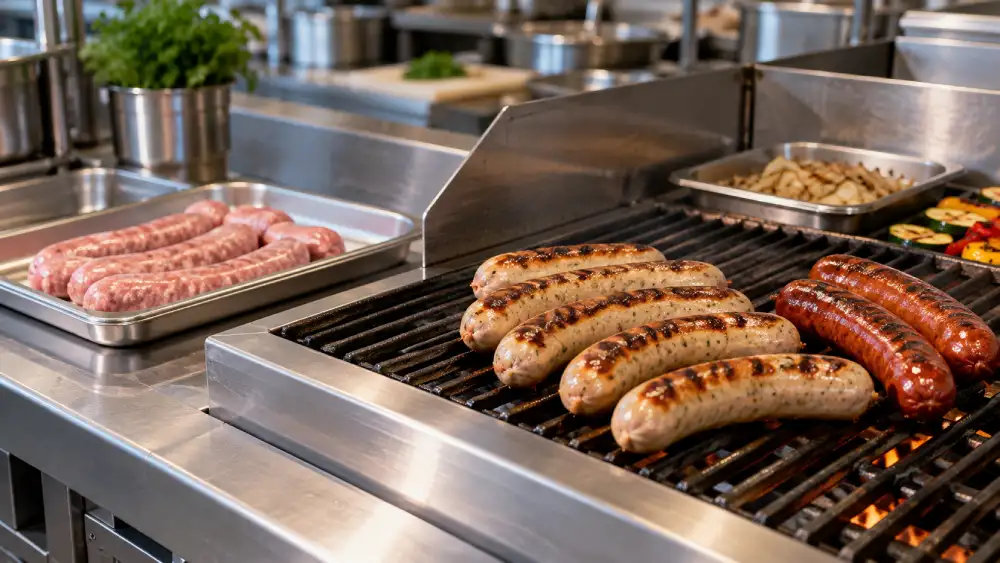
A 150g hotdog creates an immediate sense of value, but size alone does not make a strong menu item. The bun, toppings, price and assembly method still need to work together.
This article focuses on the Sausage Haüs Jumbo Pork Hotdog sold through Costco UK, rather than the hotdog served at Costco food courts. It is a smoked pork hotdog intended for customers who want a substantial serve and operators who need predictable portioning.
The most useful way to develop the product is not to create a long topping menu. It is to establish three clearly defined builds, each with its own price, appearance and reason to order.
The classic build protects speed. The middle tier adds a recognisable German market character. The premium tier delivers the visibly loaded option that earns space on menu boards and social media.
Know Which Costco Hotdog You Are Building Around
The Sausage Haüs Costco pack contains 150g Jumbo Pork Hotdogs. That is a considerably more substantial starting point than a small catering frankfurter, so it needs a bun and topping structure designed around its actual dimensions.
Do not select buns from an online description alone. Test the sausage in the bun you intend to use. It should sit securely without disappearing into the bread, hanging excessively over both ends or splitting the bun when toppings are added.
The smoked pork flavour also affects the build. Strong toppings can work, but piling together cheese, chilli, barbecue sauce, mustard, pickles and onions can obscure the product and create an untidy serve. A signature build should have one clear direction rather than every available topping.
Operators should also check the current pack label whenever stock is received. Heating instructions, storage conditions, use-by dates, ingredients and allergen information from the actual pack should take precedence over a general menu guide.
If you are introducing the product into an existing operation, add it to your documented food safety procedures. The Food Standards Agency’s food safety management guidance1 explains the controls expected around cooking, chilling, cleaning, cross-contamination, storage and transport.
The commercial advantage of the 150g format is clarity. One sausage is one portion. Once the bun and toppings are also specified, costing, training and stock forecasting become much easier.
Design the Serve Before Choosing the Toppings
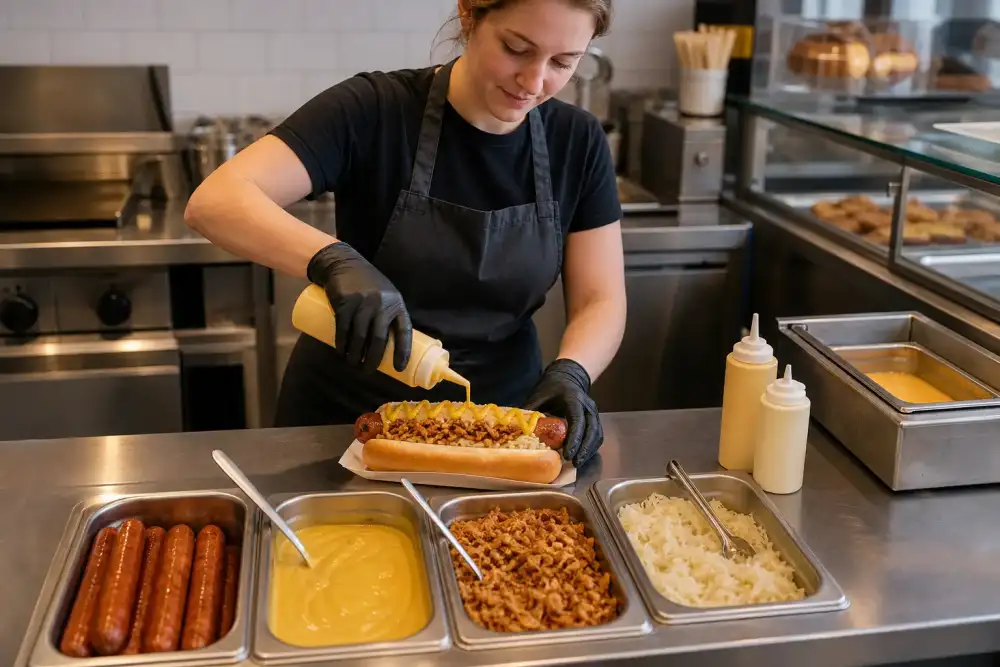
A good hotdog build begins with operational limits, not a list of sauces. Decide how many assembly actions the counter can support during its busiest period.
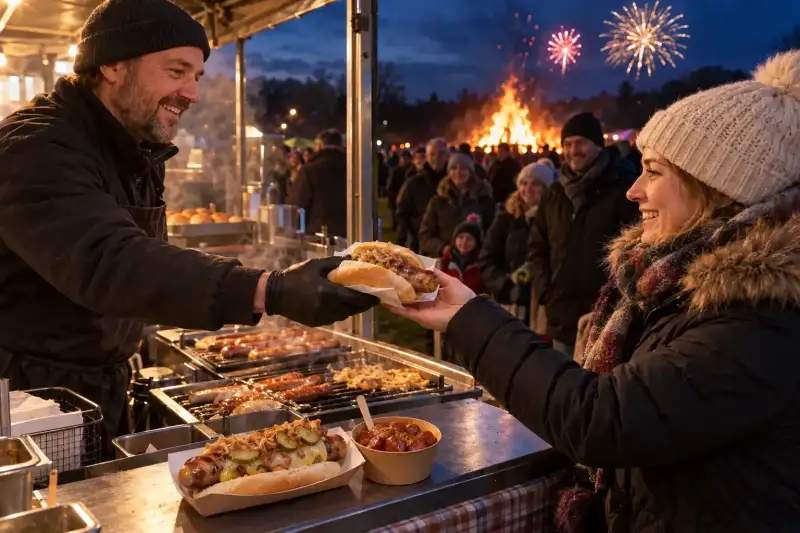
For a high-volume event stall, that may mean placing the sausage in the bun, adding two sauces and finishing with one dry topping. A pub kitchen with table service may be able to manage warm sauerkraut, cheese sauce and a plated side without creating a queue.
Five practical questions should shape the specification:
- Can one member of staff assemble it consistently?
- Can it be served without toppings falling out immediately?
- Will the bread remain intact long enough to eat it?
- Can each ingredient be portioned quickly?
- Does the finished hotdog look clearly worth its menu price?
Moisture needs particular attention. Sauerkraut should be well drained, cheese sauce should be thick enough to stay on the sausage, and chopped pickles should not carry excessive brine into the bun. Toasting or warming the cut face of the bread can improve resilience, although it adds another step and should only be used when the equipment and service flow support it.
Build upwards from a common base. If all three tiers use the same sausage, bun, mustard and crispy onions, the more expensive options can be created with a small number of additional ingredients. That is easier to stock and teach than three unrelated recipes.
The FSA provides a downloadable Safer Food, Better Business pack for caterers2, which can help smaller operators document their heating, holding and service procedures.
Three Signature Builds from Fast to Fully Loaded
These three builds are practical starting specifications rather than compulsory recipes. Portions should be tested with the actual bun, sauce consistency and serving equipment used by the business.
The important principle is progression. Each tier should look and taste different enough to justify its position without requiring an entirely separate preparation system.
1. The Classic Smoked Hotdog
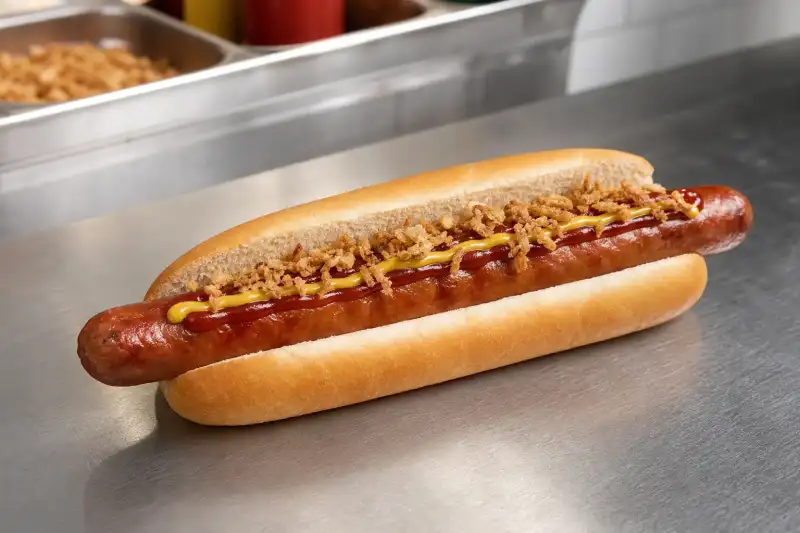
The first tier should be the quickest and most widely understood option.
Suggested build:
- One 150g Jumbo Pork Hotdog
- One suitably sized hotdog bun
- Tomato ketchup
- Mild or American-style mustard
- Crispy onions
Keep the sauces controlled rather than flooding the bun. A measured bottle or fixed squeeze pattern gives a more consistent result than allowing each member of staff to judge the quantity.
Crispy onions provide texture without introducing much moisture. They are also quick to apply and give the finished hotdog a more complete appearance. If service speed is the overriding concern, this is the build that should remain available even when the more complicated tiers are temporarily paused.
This option fits event stalls, cafés, sports clubs, garden centres and fish and chip shops that want a straightforward hot handheld item. Its job is not to look adventurous. Its job is to be recognisable, substantial and easy to execute.
2. The German Market Hotdog
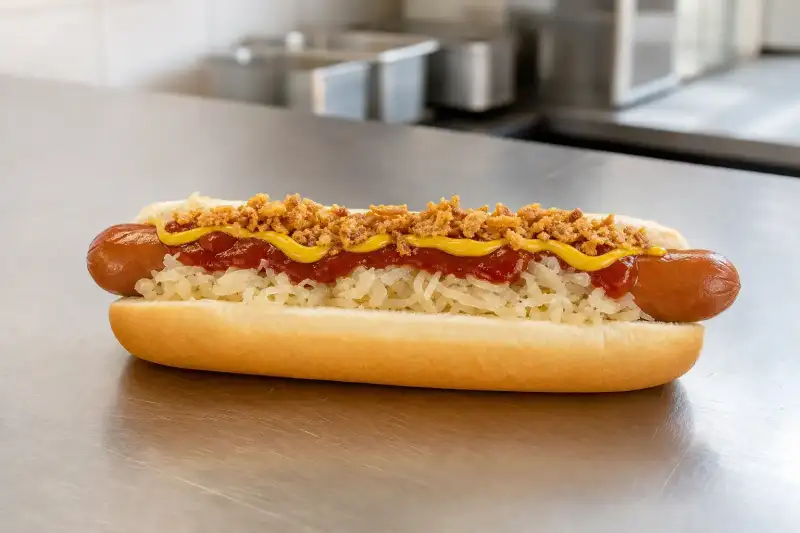
The middle tier should create a stronger identity without becoming difficult to handle.
Suggested build:
- One 150g Jumbo Pork Hotdog
- One suitably sized hotdog bun
- Approximately 35 to 40g of well-drained sauerkraut
- Curry ketchup
- Mustard
- A light crispy onion finish
Sauerkraut gives the serve a more recognisably German direction, while curry ketchup adds colour and familiarity. The quantity should be enough to remain visible without overwhelming the bun or cooling the sausage.
The sauerkraut can be served warm or cold, depending on the menu concept and the operator’s documented handling system. Warm sauerkraut may feel more suitable at autumn and winter events, but it requires another controlled hot component. A chilled, properly drained version is simpler for many seasonal stalls.
This tier provides a useful bridge between the standard hotdog and the fully loaded option. It has a stronger story and appearance, but still relies mainly on ingredients already used elsewhere in a German sausage operation.
3. The Loaded Cheese Hotdog
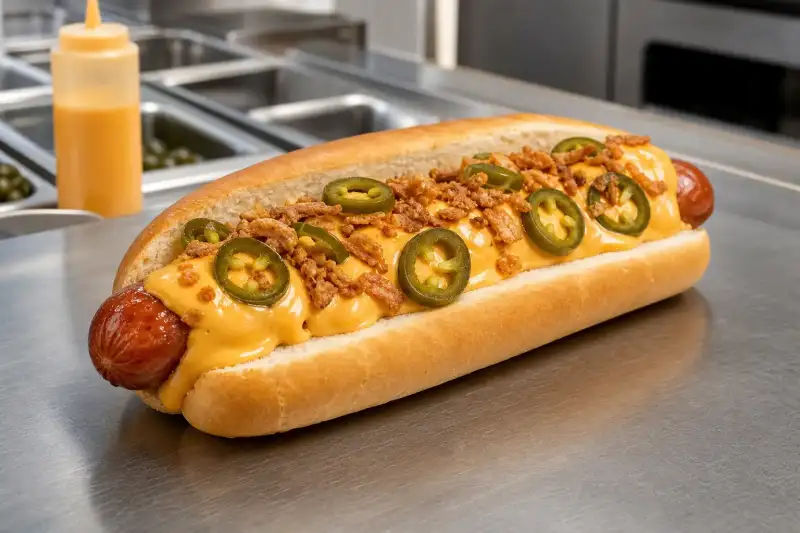
The highest tier needs to look immediately different. Customers should not have to read a long description to understand why it costs more.
Suggested build:
- One 150g Jumbo Pork Hotdog
- One sturdy hotdog bun
- Approximately 30 to 35g of thick cheese sauce
- Curry ketchup or mustard
- Chopped gherkins or sliced pickled jalapeños
- Crispy onions
The cheese sauce supplies richness and visual coverage. Pickles or jalapeños provide acidity, helping to balance the sausage and cheese rather than simply adding more weight.
Choose one pickle finish rather than offering several minor variations. Gherkins have broad appeal and fit the German sausage context. Jalapeños create a clearer spicy option but may narrow the audience. The right choice depends on the site and its existing customers.
This build suits pubs, evening events, street food menus and locations where customers are comfortable paying more for a visibly loaded item. It will usually take longer to assemble, so it should be designed around a measured ladle or portion bottle rather than an open-ended spoonful of cheese sauce.
The premium tier should look generous, but generosity still needs a specification. Uncontrolled sauce portions quickly turn a profitable upsell into an expensive, messy hotdog.
Price the Tiers from Cost, Not Instinct
Calculate the full serving cost before choosing menu prices. Include the sausage, bun, sauces, toppings, packaging, napkins and a realistic allowance for waste.
The simplest starting calculation is:
Selling price before VAT considerations = total portion cost ÷ target food-cost percentage
If a complete serve costs £2.10 and the operator uses a 30 per cent food-cost target, the calculation produces a £7 selling price. This is only an illustration. Card fees, labour, pitch fees, delivery commissions, energy and other overheads still need to be covered.
Cost each tier separately. Do not assume that an extra pound automatically covers cheese sauce, pickles, additional packaging and slower assembly.
The price gaps should be meaningful but easy to understand. If the middle tier costs almost as much as the premium hotdog, many customers will skip it. If the gaps are too small, the premium toppings may not generate enough additional contribution.
VAT-registered businesses must also calculate margins using the correct net figures. Hot takeaway food is generally standard-rated when the relevant conditions apply, as explained in HMRC’s guidance on catering, takeaway food and VAT3.
A three-tier menu does not have to mean three equal sellers. The classic can provide dependable volume, while the loaded option creates a higher-value choice and makes the middle tier feel accessible.
Set Up the Counter for Repeatable Fast Service
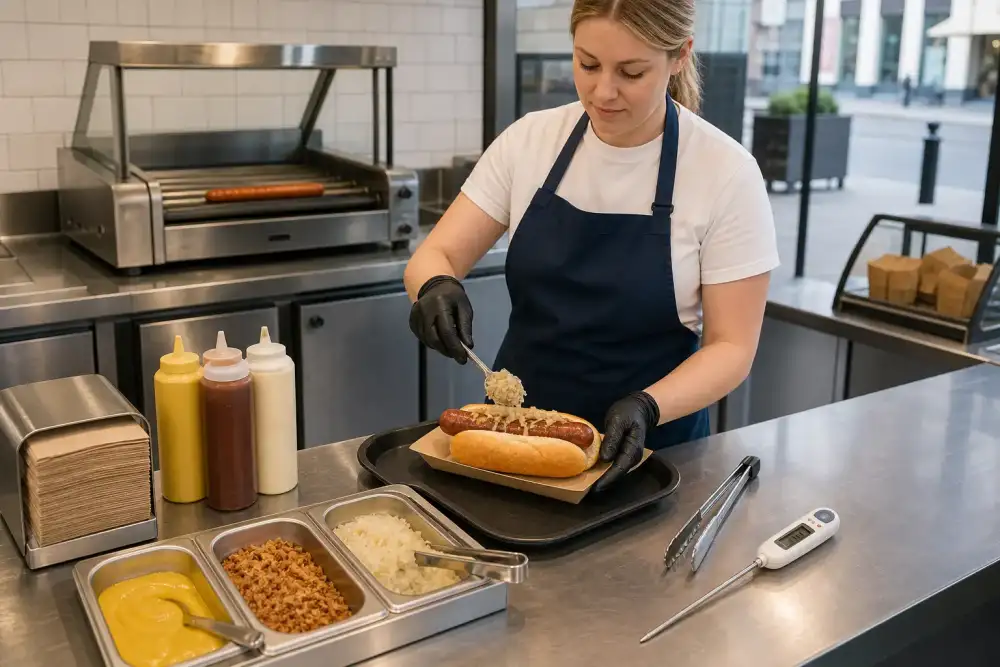
Fast service comes from separating heating from final assembly. The customer-facing stage should involve building the hotdog, not waiting for a cold sausage to heat through.
Follow the current pack instructions and validate the chosen method in the actual equipment. A water bath, grill, griddle or other system can produce different results, particularly during sustained service. Equipment capacity, recovery time and electrical or gas limitations should be checked before an event.
If food is hot held, it generally needs to remain at 63°C or above in England, Wales and Northern Ireland. Use a clean, sanitised probe and include checks in the business’s documented system. Equipment displays alone should not be assumed to represent the centre temperature of the food.
The assembly station should follow the order in which the hotdog is built:
- Buns and serving trays
- Hot sausages and clean tongs
- Main warm or chilled topping
- Sauces
- Dry garnish
- Napkins and handover point
The FSA’s guidance for food businesses at community and charity events also provides a useful overview of hygiene, registration and allergen responsibilities. Commercial event operators should additionally check the requirements of their local authority, organiser and individual site.
During quieter periods, heat smaller batches instead of filling the holding equipment automatically. A full unit may look reassuring, but unnecessarily long holding can affect texture and increase end-of-service waste.
Control Allergens, Holding and Product Changes
Every complete build needs its own ingredient and allergen record. Checking the sausage is not enough. Buns, mustard, crispy onions, cheese sauce, curry ketchup and pickles may introduce additional allergens or change when a supplier substitutes a product.
For food made to order, staff need access to accurate information covering the complete serve. The FSA guidance for allergen information on non-prepacked food4 explains how businesses should communicate this information effectively.
Keep current product labels or specifications available. Do not rely on memory, packaging colour or the assumption that a replacement product has the same recipe. If an ingredient changes, update the build sheet before it enters service.
Separate utensils may be required as part of the business’s allergen controls, but separate tongs or bottles should never be used to promise an allergen-free product unless the complete process supports that claim. Cross-contact risks need to be assessed across storage, preparation, holding and service.
The build sheet should record:
- Exact product used
- Standard portion
- Required utensil
- Assembly order
- Allergen information
- Holding or storage method
- Acceptable substitutions
- Date of the latest review
Different rules can apply when hotdogs are assembled, wrapped and packaged before the customer selects them. Operators considering that model should check whether the product falls within the FSA rules for prepacked for direct sale food5.
A short specification protects more than food cost. It also reduces disagreements between shifts about what the customer is supposed to receive.
Test the Menu Before Committing to It
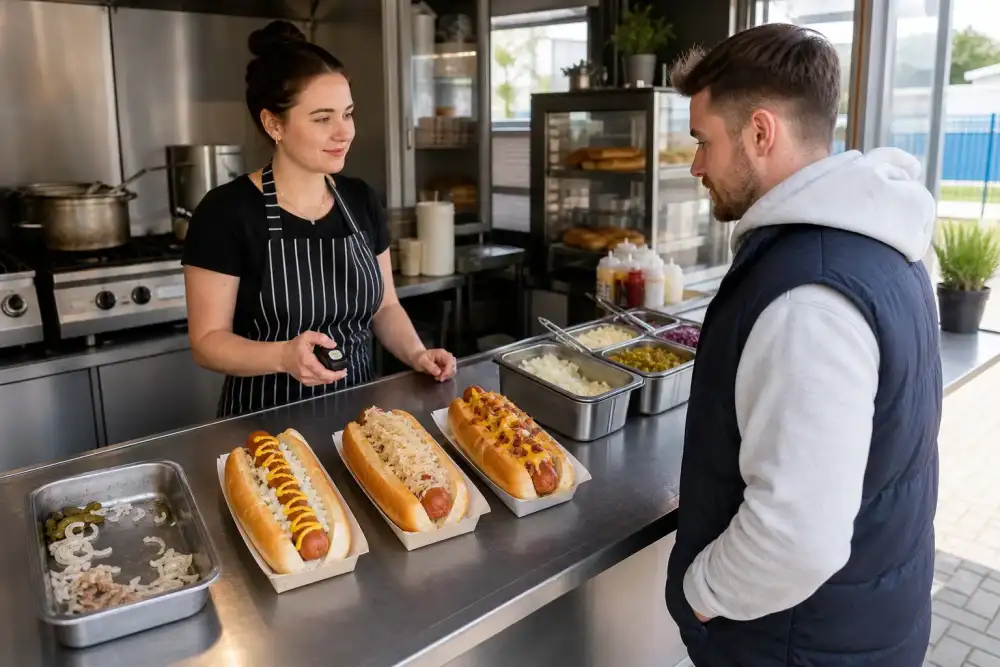
Begin with a controlled trial rather than printing a permanent menu board immediately. One weekend, event or promotional period can reveal whether the three tiers make sense to customers and staff.
Record more than total sales. Useful measures include:
- Number sold from each tier
- Average assembly time
- Most common customer modifications
- Topping waste
- Hotdogs remaining at close
- Complaints about size, mess or value
- Gross contribution from each build
Watch how customers actually order. If nearly everyone asks to remove the sauerkraut from the German Market build, the recipe may not suit that site. If the loaded version sells well but repeatedly slows the queue, the build or station needs adjusting.
Waste should be measured by ingredient. A low-cost topping can still be commercially troublesome if it is prepared in large quantities and discarded every night. WRAP’s Guardians of Grub food-waste resources6 provide practical support for hospitality and foodservice operators looking to measure and reduce waste.
The final range may not need all three tiers at every location. A daytime café might keep the classic and German versions, while a pub or evening event leads with the loaded cheese build.
Seasonal changes can be made without rebuilding the whole menu. Warm sauerkraut may become a stronger feature in colder months, while a lighter pickle-based finish may work better during summer. Keep the sausage, bun and assembly logic stable so the change remains manageable.
Frequently Asked Questions
No. A smaller operator may be better starting with the classic and one clearly premium build. This tests whether customers will pay more for added toppings without introducing unnecessary stock and preparation. Add the middle tier only when it fills a genuine gap rather than simply making the menu look larger.
Limited customisation usually works better than a completely open topping bar. Let customers remove an ingredient or choose between two sauces, but keep the core builds fixed. Too many choices slow ordering, make portion control harder and blur the difference between the price tiers. Extra premium toppings can be offered for a clear additional charge.
Not automatically. Brioche can look premium, but its sweetness may compete with the smoked sausage and some softer versions collapse under warm, moist toppings. A long, sturdy white roll may perform better during fast service. Test shortlisted buns with the complete build, not just the sausage, and leave the assembled hotdog standing for several minutes before judging it.
Yes, but the build may need adjusting. Cheese sauce, sauerkraut and pickle brine can soften the bun during a longer journey. Use well-drained toppings, controlled sauce portions and suitable vented packaging. Crispy onions can be packed separately for delivery orders. Test the complete meal after the realistic collection or delivery time rather than assessing it immediately at the counter.
Not necessarily. A 150g hotdog is already a substantial item, and including chips can push the price or portion beyond what a lunchtime customer wants. Offering chips as a clearly priced add-on gives customers more control. A fixed meal deal may still work at pubs, evening events and sites with sufficient fryer capacity, but it should not disrupt the main service line.
Measure its contribution after accounting for every added cost, including toppings, packaging, waste and extra assembly time. A higher selling price does not guarantee a better result if cheese sauce is over-portioned or the build slows the queue. Compare contribution per sale and contribution during a typical service hour, particularly at busy events where speed affects total turnover.
void substituting a different sausage without checking the complete specification. A replacement may have a different weight, length, flavour, heating method, ingredient list or allergen profile. It may also require another bun and a different selling price. Either pause the affected menu line or approve a replacement as a separate product with updated costing, instructions and allergen information.
Yes, if the surrounding serve remains restrained. Use mustard, drained sauerkraut, gherkins or another sharp topping rather than heavy cheese sauce and a large side. The hotdog can also be sold on its own, with chips or extras available separately. Avoid describing it as “light”; position it as a complete, straightforward lunch without unnecessary additions.
Give each build a short name, its defining toppings and a clear price. Customers should be able to understand the difference between the tiers in a few seconds. Long descriptions slow decisions and create queues. Include an allergen prompt, but keep the complete and current allergen information available through the business’s established system rather than trying to fit everything into promotional copy.
Review the sourcing model when demand becomes predictable enough to justify scheduled deliveries or larger case quantities. Compare the complete cost, including collection time, travel, warehouse availability, minimum orders, storage space and delivery terms. Costco can be convenient for trials and flexible purchasing, while a regular foodservice arrangement may become more efficient as weekly volume and forward bookings grow.
Conclusion
The Costco Jumbo Pork Hotdog works best when it is treated as a defined menu product rather than a large sausage surrounded by optional toppings.
A three-tier structure gives each customer a clear choice. The Classic Smoked Hotdog prioritises familiarity and speed. The German Market build adds sauerkraut and curry ketchup for a more distinctive identity. The Loaded Cheese Hotdog provides the visible premium option that can support a higher selling price.
The commercial detail sits behind those simple choices. The bun must fit the 150g sausage, every topping needs a portion, and the selling price should come from the complete serving cost. Heating, hot holding, allergen communication and assembly also need to be written into the operating system rather than left to individual judgement.
Start with trial specifications and watch what happens during real service. Sales mix, assembly time, modifications and waste will show whether each tier deserves its place.
A useful signature build is not the one with the most toppings. It is the one customers understand, staff can reproduce and the business can sell profitably. Once those three tests are met, the Jumbo Pork Hotdog can become a dependable menu line rather than another product the counter has to work around.
The Sausage Haüs
The Sausage Haus brings authentic German-style sausages to the UK market through a partnership between Hardy Remagen and Baird Foods.
Hardy Remagen is a long-established German producer with deep experience in traditional sausage making, continental meat products and modern food manufacturing. The range reflects the kind of products German shoppers already understand and enjoy: Bratwurst, Frankfurters, smoked hotdogs, cheese-filled sausages, Bockwurst, Weisswurst and other classic German-style lines.
In the UK, the range is represented and distributed by Baird Foods, giving retailers, wholesalers, caterers and foodservice operators access to German sausage products with a practical UK supply route. This combination is important: German manufacturing knowledge on one side, UK market understanding and distribution on the other.
For retail buyers, The Sausage Haus range offers a clear way to add something different to both chilled and frozen sausage fixtures. The products are built around real eating occasions: BBQs, premium hotdog nights, family meals, German street food, Oktoberfest promotions, Christmas market food and quick comfort meals at home.
The result is a range that gives shoppers something more distinctive than ordinary sausages and standard hotdogs, while giving buyers a compact, commercially useful product story with strong fresh and frozen potential.
References
Food Standards Agency’s food safety management guidance.
Safer Food, Better Business pack for caterers.
UK Government. Catering, takeaway food (VAT Notice 709/1). GOV.UK. Updated June 8, 2026.
FSA guidance for allergen information on non-prepacked food.
FSA rules for prepacked for direct sale food.
WRAP - The Waste and Resources Action Programme. Guardians of Grub.