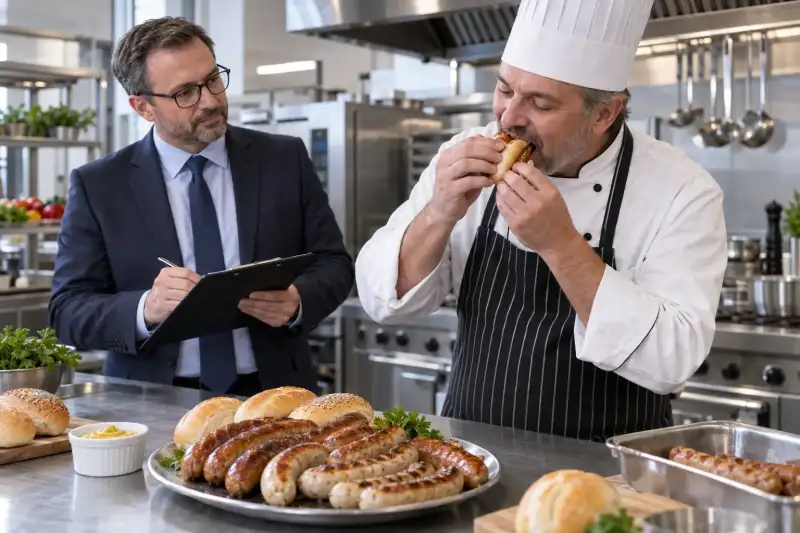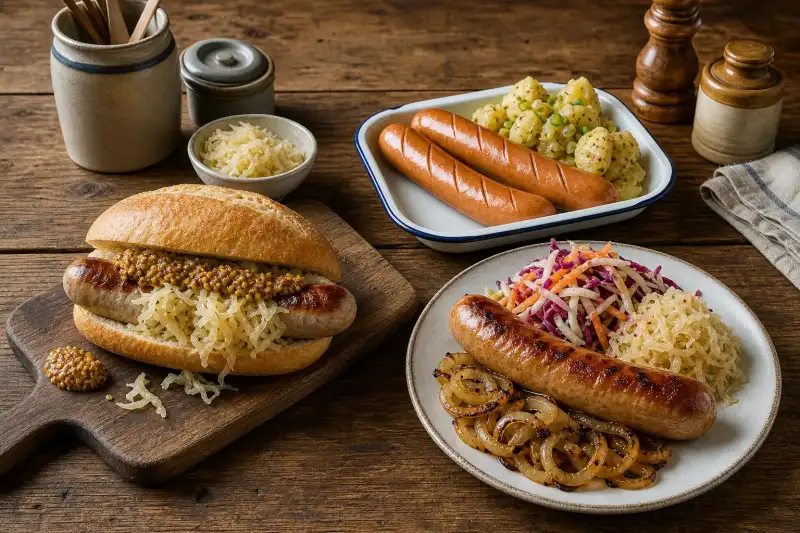
Sausage casings change more than many operators expect. They affect snap, appearance, grill behaviour, hot holding, and how the product feels to the customer on first bite. For UK traders, caterers and foodservice buyers, the right choice is not about theory. It is about choosing sausage casings that suit your service style, your equipment, and the kind of plate or bun you want to put out consistently.
Introduction
When operators compare sausages, they often start with flavour, size, or price per portion. Fair enough. But sausage casings play a big role in how the product actually performs once it hits a grill, roller, hot hold, or fast event service. They influence how evenly the sausage colours, whether it blisters attractively or sits a bit flat, how much snap you get on the bite, and how well the product holds up over time.
In practical terms, most of the conversation comes down to three common formats: natural casing, collagen sausage casings, and skinless sausages. Each has strengths, and each suits a different type of operation. A busy street food trader doing short, sharp service may not want exactly the same result as a caterer holding stock for longer periods. Likewise, a German-style bratwurst offer may need a different eating quality from a fast lunch frankfurter line.
This is where many buying decisions get muddled. People talk about “better” sausage casings as if there is one correct answer. Usually there is not. The more useful question is this: which casing format works best for your menu, your equipment, and your service rhythm?
For UK operators, that matters because real service is rarely ideal. You may be dealing with a windy outdoor pitch, mixed staff experience, rush periods, and equipment that has to earn its keep all day.
A practical comparison usually comes down to four things:
- how the sausage cooks and colours
- how it feels on the bite
- how it behaves in holding
- how forgiving it is under pressure
That is why sausage casings deserve more attention than they usually get. A better casing decision can make service cleaner, easier, and more consistent without changing your whole menu.
Key Takeaways
- Natural sausage casings usually give the most traditional snap and visual character, especially for German-style sausages.
- Collagen sausage casings can offer a more uniform look and a more controlled result across batches.
- Skinless sausages are often simpler to eat and can suit customers who do not want a pronounced bite from the casing.
- For grilling, sausage casings affect blistering, browning, and the final visual appeal on the plate or in the bun.
- For hot holding, the best sausage casing for catering depends on holding time, moisture management, and how much texture loss you can tolerate.
- Natural vs collagen vs skinless is not a quality ranking. It is an operational choice tied to menu style and service method.
- Before locking in a format, test sausage casings on your actual equipment and under your real holding conditions.
Sausage casings: what actually changes in real service
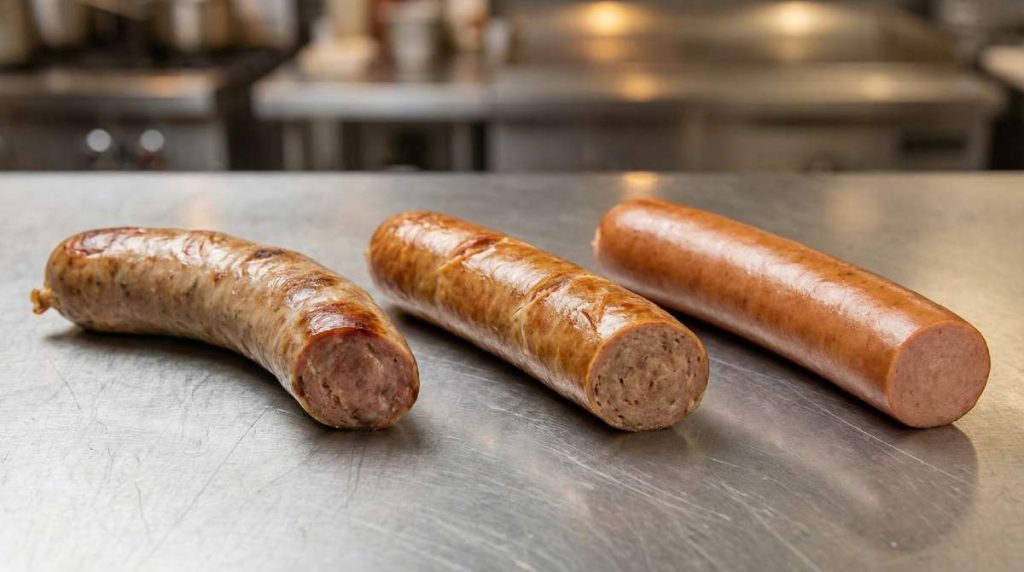
In a real UK service environment, sausage casings affect far more than whether the sausage has a bit of snap. They change how the sausage looks in the pan or on the grill, how evenly it presents in the bun, how much character it has on the first bite, and how well it tolerates holding without turning tired. Natural casings are widely associated with a distinctive snap and a more traditional appearance, while collagen casings are valued for constant, uniform sizing and a controlled production result. Skinless sausages, usually produced in cellulose casings that are removed after cooking, move the eating experience in a softer and more uniform direction.
That matters because customers react quickly, even when they do not have the vocabulary for it. A bratwurst that looks slightly irregular, browns attractively and gives a proper bite often reads as more “real” or more premium. A sausage that is perfectly even from link to link may be easier to standardise, portion and line up in service. A skinless sausage can feel easier and less resistant to eat, which can be a plus in some hot dog and fast-lunch formats. None of that means one option is always better. It means sausage casings are doing commercial work whether you pay attention to them or not.
The practical mistake is to judge sausage casings only at the buying stage, usually by price or by a quick tasting in ideal conditions. Traders and caterers do not serve in ideal conditions. They serve in rushes, with mixed staff, with changing weather, and often with a holding window that is longer than anyone wants to admit. That is where the casing choice starts to show itself properly. The same sausage can look and feel very different after a quick finish to order than after a period in steam, bain-marie, or a cabinet that is drying the ends more than it should.
A sensible operator usually judges sausage casings against four service questions:
- How does it look after cooking, not just before?
- What does the customer notice on the first bite?
- How badly does it change during holding?
- How forgiving is it when service gets messy?
That is the useful lens for the rest of this post. The right answer is rarely “the best casing in theory”. It is the casing that protects the eating quality you are actually selling, under the service conditions you actually run.
The three main sausage casing types at a glance
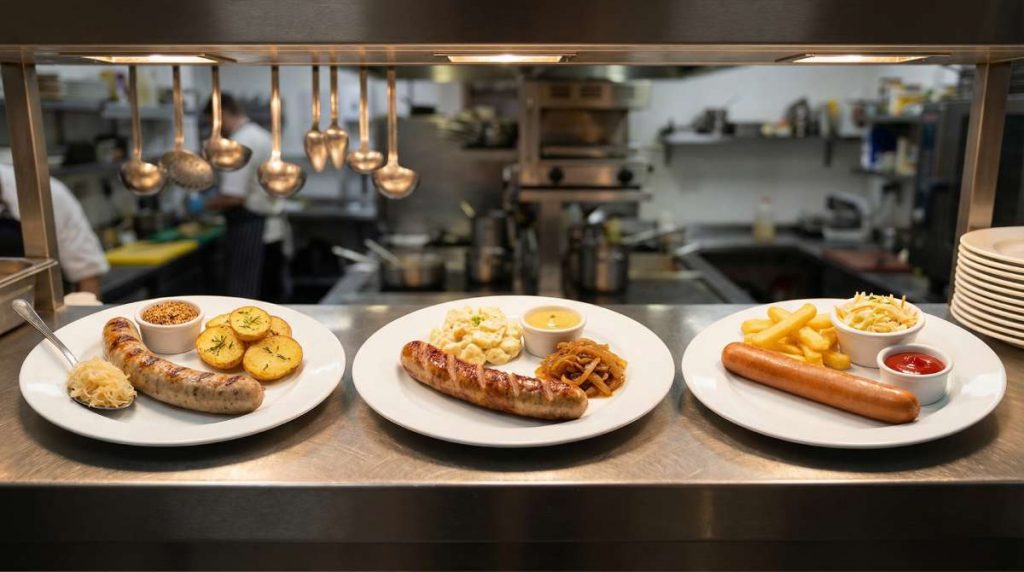
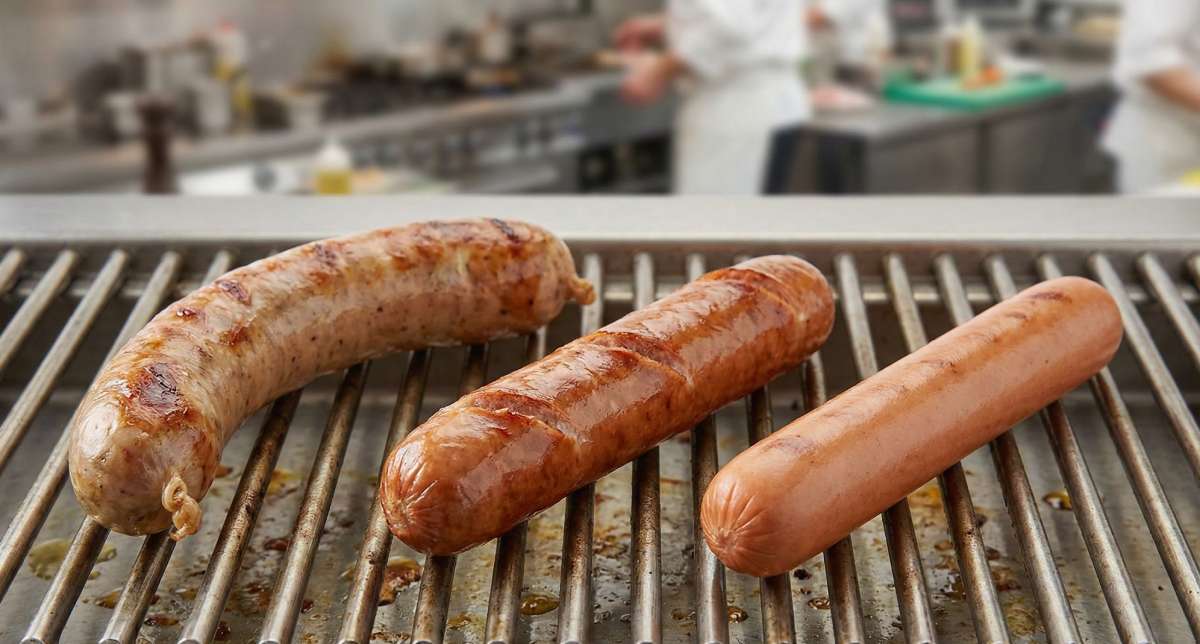
For most operators, the casing conversation becomes simpler once you stop treating sausage casings as a big technical mystery and break them into three working groups: natural, collagen, and skinless. Natural sausage casings come from cleaned and processed animal intestines and are edible. Collagen sausage casings are made from purified collagen and are designed to give a more standardised result. Skinless sausages are commonly formed in cellulose casings during production, then peeled so the final product is served without that outer skin.
Natural sausage casings are the classic choice when tradition, bite and visual character matter. Industry sources describe them as giving a distinctive snap, with sheep and hog casings commonly used for products such as frankfurters, bratwurst, bockwurst and other small-to-medium diameter sausages. They also tend to look more individual rather than perfectly identical, which is often part of the appeal rather than a flaw.
Collagen sausage casings sit in the operational middle. They are widely used because they are ready to stuff, resistant in processing, and noticeably more uniform in size. Viscofan describes edible collagen casings as offering constant and uniform sizes, while also offering options from very soft bite through to products designed for a more defined eating quality. That is useful where consistency matters from batch to batch and from one team member to the next.
Skinless sausages are a different proposition again. The most common route is a cellulose casing during manufacture, which is later removed. The result is the familiar smooth hot dog or frankfurter style that gives exact sizing and a softer eating experience because the consumer is not biting through an edible outer skin. That can be a strong fit for quick-service formats where speed, uniformity and ease of eating matter more than traditional snap.
A simple operator view looks like this:
- Natural: more traditional bite and character
- Collagen: more standardised and process-friendly
- Skinless: softer eating and very uniform presentation
- All three: useful in the right menu and service setting
So the right question is not “which one is best?” It is “which type of sausage casing matches the product promise on my menu?” That is a much more commercial question, and usually a much more honest one as well.
Natural casing: where it performs best
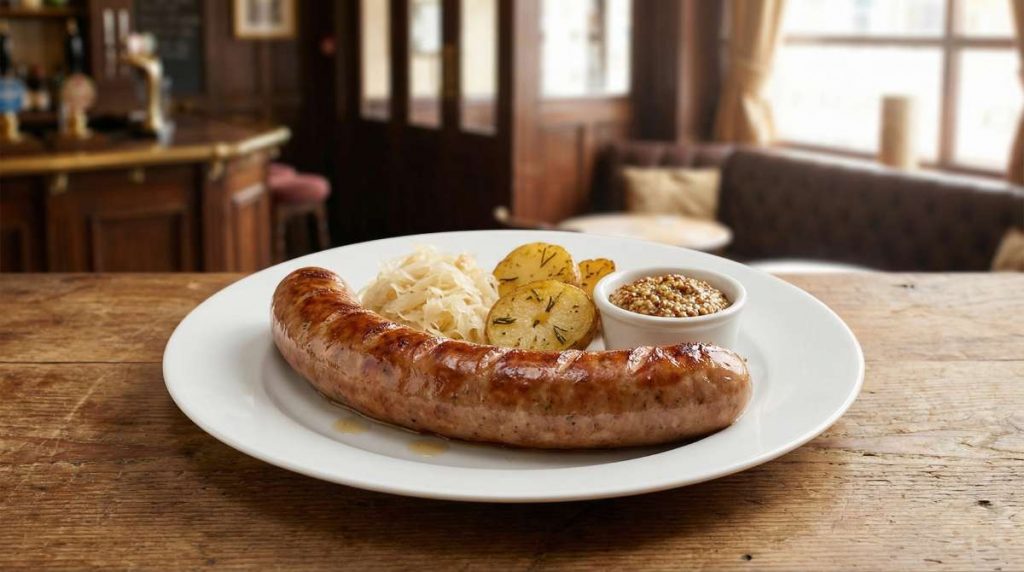
Natural sausage casings earn their keep when the eating experience matters as much as the filling inside. The big selling point is the bite. INSCA describes natural casings as having a distinctive snap compared with artificial casings, and major casing suppliers describe hog and sheep casings as giving the right resistance, tenderness and a glossy, professional look. In plain trader language, natural casing is often what gives a bratwurst or traditional frankfurter that satisfying first bite customers remember.
Natural sausage casings are usually chosen when bite, curved shape and a more traditional sausage appearance matter more than absolute uniformity.
This is why natural casing tends to suit more premium German-style offers, especially where the sausage is the centre of the sale rather than just a carrier for sauces and toppings. If the product is being finished on a grill, shown clearly in the bun, or plated more simply with mustard, onions or a side, natural casing often helps the sausage feel more substantial and more authentic. It is not magic. It just brings more casing character to the party, and sometimes that is exactly the point.
Natural sausage casings also work well where appearance is allowed to look a bit more like actual food and a bit less like a production line. Natural wieners are described by the National Hot Dog and Sausage Council as more traditional and not exact in size in the way cellulose-produced skinless hot dogs are. That slight variation can be acceptable, or even desirable, if your offer is meant to read as craft-led, German, butcher-style, or premium rather than uniform to the millimetre.
That said, natural casing is not automatically the answer for every operator. The more you rely on exact visual consistency, very soft eating, or a highly standardised hot dog format, the more natural casing can feel like the wrong tool. It gives more character, but character is only useful if your menu actually benefits from it. Put differently: a proper snap is wonderful, but not every lunchtime queue is asking for a philosophy lesson in sausage texture.
Natural casing tends to make the most sense when you want:
- a traditional German sausage feel
- clear bite and snap
- a product that looks less factory-identical
- a simpler topping style that lets the sausage lead
If your offer trades on authenticity, visible quality and a better eating experience, natural sausage casings are often where the conversation should start. If your offer trades on absolute uniformity and effortless bite, they may not be where it ends.
Collagen sausage casings: the operational middle ground
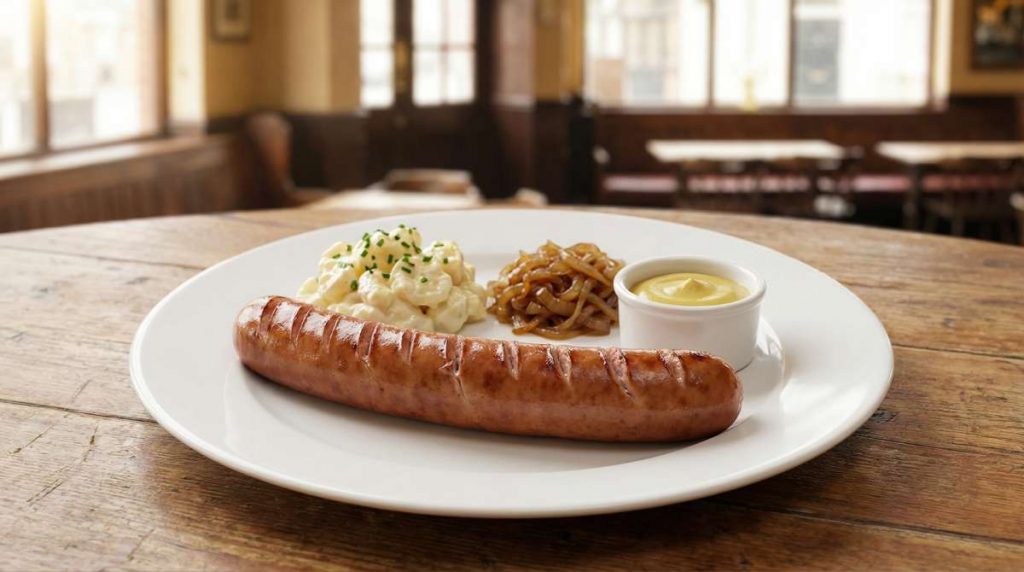
Collagen sausage casings exist because many operators and manufacturers want a result that is more controlled without fully moving into skinless territory. They are not simply a “cheap alternative” story. The better way to see them is as a practical middle ground between the character of natural casing and the high uniformity of skinless production. Viscofan describes edible collagen casings as ready to stuff, resistant during processing, and constant and uniform in size, with product options that can be tuned for different bite characteristics.
Collagen sausage casings are widely used when operators want a more standardised sausage with consistent sizing, controlled bite and cleaner batch-to-batch presentation.
That uniformity matters more than it sounds. If every sausage comes out closer in diameter and length, portion control gets easier, bun fit gets easier, and service becomes less dependent on a skilled operator compensating on the fly. For foodservice buyers and volume-led caterers, that can be a meaningful commercial advantage. A line that looks tidier and behaves more predictably is easier to train, easier to repeat, and easier to scale. None of this is glamorous, but glamour has never been the main engine of margin.
On bite, collagen can go in different directions depending on the product. Viscofan’s range includes very soft-bite options for gourmet sausages as well as small collagen formats positioned around a good bite and good frying behaviour. So the useful point is not “collagen feels like X every time”. The useful point is that collagen sausage casings are designed to deliver a more engineered, repeatable outcome, which can include either tenderness or a firmer eating feel depending on the casing and sausage style.
For UK operators, collagen sausage casings often suit menus where the sausage still needs to feel like a proper sausage, but where standardisation matters almost as much as character. They can be a sensible choice for branded hot dog programmes, staff-canteen lines, chain-style offers, and event menus where output consistency matters across a long day. They may not give the same traditional marketing romance as natural casing, but they can reduce friction where friction is genuinely costing you money.
Collagen usually comes into its own when you want:
- tighter control over size and presentation
- easier batch consistency
- a sausage that still has casing, not a skinless feel
- less variation from one service window to the next
That is why collagen sausage casings are often the operational compromise people end up respecting more after service than before it. They may not win the poetry contest, but they often do rather well in the shift.
Skinless sausages: when simplicity wins
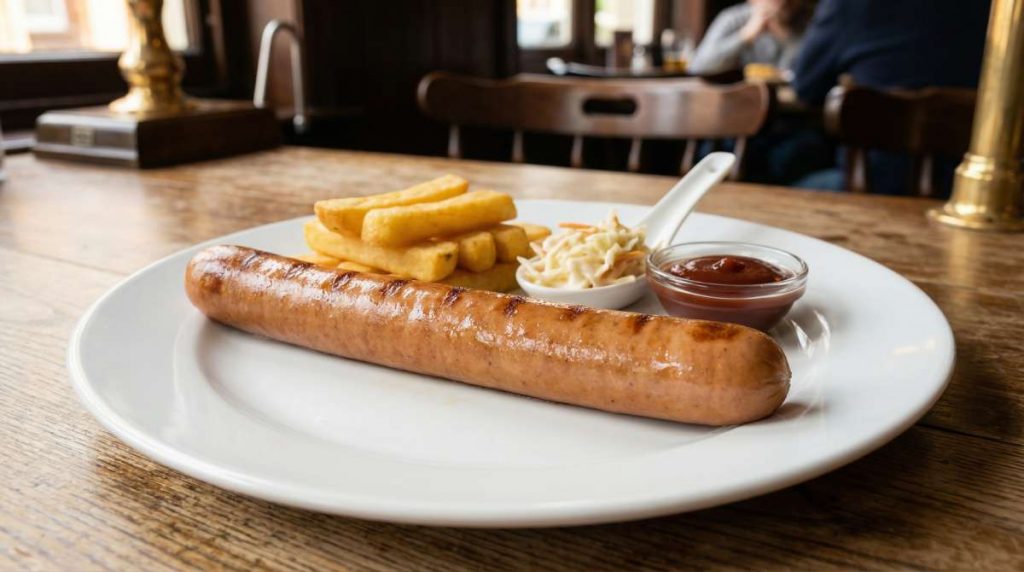
Skinless sausages are easy to dismiss if you only think in terms of tradition, but that would miss the operational point entirely. In many formats, especially hot dogs and fast-service frankfurters, skinless sausages are not the compromise option. They are the correct option. The basic production method is well established: the sausage is formed in cellulose casing and the casing is later removed, leaving a smooth finished product with very precise size and weight control.
Many skinless hot dogs are made in cellulose casings that are removed after cooking, which helps create the exact size, weight and smooth finish that suit fast-service formats.
That precision brings several service advantages. First, skinless sausages are easier to standardise across buns, portion packs and menu boards. Secondly, the bite is softer because the customer is not going through an edible outer casing. That can suit a mainstream audience, a family-oriented offer, or a fast lunch service where the sausage is loaded with condiments and the eating experience needs to stay easy rather than assertive. In other words, skinless can make the whole serve feel more straightforward, which is sometimes exactly what the customer wants.
Skinless Hot Dogs also make sense where you want speed without too much casing-led personality. Not every menu wants a pronounced snap. If the format is based around soft buns, quick pick-up and a high-volume lunch queue, too much casing resistance can actually work against the simplicity of the serve. That does not make skinless “better” than natural sausage casings. It makes it better for a different job. The mistake is pretending the same measure of quality should apply to every product type.
There is also one format where skinless is not just a good option, but effectively the mandatory one in practice: the roller grill. Straight skinless hotdogs rotate evenly, heat more consistently, and present more cleanly across the rollers. Curved natural-casing sausages tend to sit unevenly, make poorer contact with the rollers, and create a less consistent display. That is why roller-grill programmes are usually built around straight skinless hotdogs rather than natural-casing products. Johnsonville’s foodservice hot dogs recommended for roller-grill use are skinless, which lines up with that practical reality.
Where skinless usually gives ground is in perceived authenticity and that classic first-bite character. Natural casing wieners are still marketed as the more traditional version, while cellulose-led skinless production is strongly associated with exact size and weight. So if your offer is built around “proper German sausage” cues, skinless may feel a bit too smooth and a bit too polite. If your offer is built around clean service, ease of eating and reliable repeatability, that politeness may suddenly look rather useful.
Skinless sausages are usually strongest when you need:
- exact sizing
- a softer bite
- easy eating in a loaded bun
- a straightforward, mainstream hot dog format
- the correct format for roller-grill service
They are not trying to be a rustic bratwurst. Judging them by that standard is like criticising a transit van for not being a sports car. Different road, different job, fewer unnecessary tears.
Sausage casings on the grill: colour, blistering and split risk
When operators talk about sausage casings for grilling, they are usually talking about three visible things: how the sausage colours, how much character it gets on the outside, and whether it still looks attractive after a finish under pressure. Natural sausage casings tend to help deliver a traditional, well-filled look and a noticeable bite, while collagen products are often valued for uniformity and controlled frying behaviour. Skinless products, by design, are less about casing character and more about consistency and ease.
On a grill, that means natural sausage casings often suit operators who want the sausage to look like the hero. A little variation in shape is not usually a problem here; it can actually add visual appeal. Hog casings are specifically used for grill sausages and bratwurst, and suppliers describe them as transparent enough to highlight the product while still giving the right resistance on the bite. That combination is one reason natural casing often feels more “alive” once it has seen heat.
Collagen sausage casings can make grill output easier to control because of their uniform size and process consistency. If every sausage sits the same way, colours at a similar pace, and fits the bun in the same manner, the line becomes easier to run, especially with less experienced staff. For some operators, that matters more than chasing the highest possible level of casing character. This is especially true where the sausage is one component in a busy assembly line rather than the whole point of the dish.
Split risk is where operators often blame the casing when the real issue is the workflow. Repeated aggressive reheating, uncovered drying, and trying to “freshen up” sausages by putting them back through hard heat again and again can split skins and dry the exterior, even when the core temperature is technically fine. The Sausage Haus hot-holding guidance makes that point clearly: repeated finishing is a quality killer. So when reviewing sausage casings for grilling, judge the casing and the method together, not separately.
A practical grill test should look at:
- initial colour and surface character
- appearance after 10 to 20 minutes’ wait
- how the casing feels after a reheat or refresh
- whether the sausage still looks saleable in the bun
That is how you turn theory into a buying decision. A casing that looks excellent only in the first 90 seconds may be wonderful for an Instagram photo and surprisingly annoying for an actual shift.
Sausage casings and bite: what the customer notices first
If grill appearance gets the sale started, bite usually finishes the job. Most customers will not say, “Ah yes, admirable casing architecture.” They will simply decide, in one second, whether the sausage felt satisfying, too soft, too chewy, too plain, or just right. That is why sausage casings matter so much commercially. INSCA explicitly points to a distinctive bite or snap as a sign of natural casing, while suppliers describe natural hog casings as giving the right resistance and a tender but firm feel.
This is where natural sausage casings often earn their reputation. They tend to suit sausage styles where that first bite is supposed to feel noticeable and a bit celebratory. Frankfurters with a proper snap, bratwurst with visible grill character, or simpler German serves with mustard and onions all benefit from a casing that contributes to the experience rather than quietly disappearing. If the menu promise is “proper sausage”, a casing-led bite is often part of what customers think they are paying for.
Collagen sausage casings create a different conversation. The category is broad enough that bite can range from very tender to more defined, depending on the casing and application. Viscofan’s own materials show both ends of that spectrum: super-fine collagen options for exceptionally soft bite and other collagen formats built around good frying properties and a good bite. So the honest operator view is that collagen is flexible, but usually chosen because it lets you dial in a more repeatable result.
Skinless sausages strip bite back to the filling itself. That can be exactly right for hot dog formats where the sausage should feel easy, neat and accessible. NHDSC notes that cellulose-made hot dogs are peeled after cooking, leaving the finished product with exact size and weight control. The customer benefit is not snap; it is simplicity. That is often a very good trade where the toppings, bun and speed of service do more of the commercial lifting than the casing texture.
A useful buying lens is this:
- Natural when bite is part of the premium signal
- Collagen when you want controlled and repeatable bite
- Skinless when you want the easiest, softest eating style
That is why the “best” sausage casings question is usually the wrong one. The better question is: what bite am I promising, and does the sausage actually deliver it after a real shift rather than a showroom tasting?
Sausage casings in hot holding: what changes over time
Hot holding is where many sausage comparisons become honest very quickly. A sausage that behaves beautifully straight off the grill can feel quite different after twenty, forty or sixty minutes in the wrong holding environment. The Sausage Haus guidance on hot-hold sausages makes the key point well: different sausages tolerate holding differently, frankfurter-style products usually play well with steam-led holding, and thicker sausages such as bratwurst often benefit from gentler heat and a deliberate finish because texture and casing bite are part of why customers order them.
That matters for sausage casings because holding changes the outside first. Steam, airflow, pooled condensation and repeated re-finishing can all shift the eating quality. High airflow can dry ends. Repeated finishing can split skins. Excess moisture can dull the outside and soften what should have been a lively bite. So when people compare sausage casings for hot holding, the right test is not just “can I keep it warm?” but “what does it feel and look like at the moment of sale?”
In practical terms, skinless sausages and frankfurter-style products often suit steam-led service because the format prioritises quick pick-up and consistent heat. Natural casing products can still hold well, but they are more likely to reward a gentler setup and a shorter, more disciplined holding window if you want to preserve the point of the casing in the first place. Collagen sits between those poles, depending on the product design and how much bite it was meant to carry.
This is one reason the best sausage casing for catering depends so heavily on workflow. A casing that shines in cook-to-order service may lose its edge in long moist holding. A casing that feels less exciting straight off the grill may deliver a more stable result after a service delay. There is no shame in that. A menu sold through holding should be judged through holding. Anything else is theatre, and the cruel sort where the audience still expects lunch on time.
When testing sausage casings for hot holding, watch for:
- loss of snap or firmness
- wrinkling or dull appearance
- drying at the ends
- whether the sausage still feels worth the menu price
That is the practical test. Safe and hot is only part of the job. Saleable and enjoyable is the rest of it, and that is usually where casing choice either justifies itself or quietly gives up.
Which sausage casing suits which type of operator?
The right sausage casings often depend less on abstract quality and more on what kind of operator you are. A showman running fast event service, a street food trader selling premium bratwurst, and a foodservice buyer sourcing for a repeatable lunch offer may all want different answers, and all may be right. Natural casings bring the strongest traditional cues, collagen sausage casings bring control and standardisation, and skinless formats bring uniformity and ease. The trick is matching the casing to the trading model rather than to your personal romance with sausage history.
For street food traders and premium German-style operators, natural sausage casings often make sense because visual character and bite are part of the value proposition. If the menu is simple and the sausage is meant to carry the sale, that extra snap and a more traditional look can strengthen the whole offer. This is especially true where the sausage is finished to order and holding is disciplined rather than extended.
For caterers, event firms and buyers who need repeatability across staff and sites, collagen sausage casings are often a strong fit. The more you care about standard size, consistent fit, cleaner batch control and easier training, the more appealing collagen becomes. It still gives you a cased sausage rather than a skinless one, but usually with less variation to manage. That can be commercially more valuable than a slightly more traditional bite.
For very high-volume hot dog formats, family-heavy events, or menus where ease of eating matters more than casing character, skinless sausages deserve serious attention. The production route using cellulose and peeling is strongly associated with exact size and weight, and the final serve is usually easier to eat quickly and consistently. If that sounds suspiciously like what your queue actually needs, that may not be a coincidence.
A simple operator match-up looks like this:
- Premium bratwurst / German street food: usually natural
- Repeatable catering line: often collagen
- Classic fast hot dog service: often skinless
- Mixed menu with varied holding: test more than one format
That last point matters most. The best sausage casing for catering is not chosen by tribal loyalty. It is chosen by how the product performs on your menu, through your equipment, with your staff, under your service pressure. That is less romantic, yes. It is also why some operators make money while others keep having passionate conversations with split sausages.
How to test sausage casings before changing your range
If you are thinking of changing suppliers or reviewing a sausage line, do not decide on sausage casings from a brochure and one tidy tasting. Test them in conditions that resemble your actual business. That means your grill, your bun, your holding window, your staff, and your likely rush pattern. Natural sausage casings, collagen sausage casings and skinless sausages all have different strengths, but those strengths only matter if they survive contact with a real service.
A useful test is to cook and serve all three in the same format, then repeat after a short holding period. Do not only judge flavour. Judge appearance, bite, bun fit, surface character, and how the sausage feels after ten to twenty minutes of realistic delay. If you run steam, test steam. If you finish on the grill after holding, test that. The Sausage Haus guidance is very clear that repeated finishing can split skins and reduce consistency, so your workflow needs to be part of the casing test rather than treated as a separate issue.
It also helps to make the scoring brutally practical. Ask whether the sausage still looks worth the menu price. Ask whether the first bite matches the menu promise. Ask whether staff can handle the product consistently. Ask whether you would still choose it on a wet Saturday, with a queue, when someone newer is on the section and your patience is already on its second warning. That is not cynical; it is proper buying discipline.
Keep the review tight and commercial:
- test cook-to-order and short hold
- score look, bite, holding and bun fit
- compare waste, breakage and consistency
- involve the person who actually runs the line
- choose on service outcome, not on theory
If the casing change also means equipment or workflow changes, verify the basics before rolling it out widely. That may include site rules, gas safety, electrical load, local authority requirements, or event licensing if your service format changes with it. None of those are likely to be caused by the casing itself, but operational changes tend to travel in groups, and it is cheaper to check early than apologise later.
Done well, this kind of test turns sausage casings from a vague product detail into a proper buying decision. That is the point. You are not shopping for ideology. You are choosing which version of “works best here” deserves a permanent place on the menu.
Frequently Asked Questions
Not generally. They are better for different jobs. Collagen sausage casings are often the more practical choice when you want straighter shape, tighter uniformity and easier standardisation across batches. Natural casing is often stronger where visual character and bite matter more than exact consistency.
Not automatically. Skinless sausages are not “worse”; they are designed for a different job. If you need smooth appearance, exact sizing and easy eating, they can be the right choice. They simply do not deliver the same casing-led bite or traditional feel as natural sausage casings.
In practice, roller grills are usually better suited to straight skinless sausages. Natural casing sausages are often curved, which can make them sit unevenly on the rollers and create a less consistent result. If roller-grill performance is central to the offer, skinless is normally the safer format.
Yes, very often. Natural sausage casings usually make the sausage look more traditional, slightly less identical, and more visibly “real”, which can help a premium German-style serve. Collagen gives a cleaner, more standardised appearance. Skinless usually looks the smoothest and most mainstream.
Start with the service style, not the theory. Ask what the sausage needs to do on the grill, in holding, in the bun and on the first bite. Then test natural, collagen and skinless formats on your actual equipment and under your real service conditions. The best choice is the one that fits your menu promise and still performs when the shift gets busy.
The three main types covered in this post are natural, collagen, and skinless. Natural sausage casings are used when bite, snap and a more traditional look matter. Collagen sits in the middle, offering a more standardised result. Skinless sausages are the smoothest and most uniform, often used where easy eating and repeatability matter most.
That depends on the result you want. Natural sausage casings often give the most traditional grilled look and the strongest bite. Collagen sausage casings can give a more controlled and uniform grill result. Skinless sausages suit formats where a smooth, neat and easy-eating product matters more than casing character.
There is no single winner. The best sausage casings for hot holding depend on the sausage type, holding time and service method. Skinless and frankfurter-style products often suit steam-led service well. Natural casing can still work well, but usually benefits from more careful handling if you want to preserve bite and appearance.
Natural sausage casings usually give the clearest snap and the most traditional first-bite feel. That is one reason they are often chosen for bratwurst, frankfurters and premium German-style serves. If the eating experience is a big part of the sale, natural casing often has the edge.
Skinless sausages are smooth, even and easier to standardise. They fit buns more consistently, are simpler to eat, and suit menus where the sausage is part of a quick, mainstream serve rather than a premium sausage-led presentation. That makes them very useful for high-speed lunch and hot dog formats.
Conclusion
Sausage casings are not a minor detail. They shape the eating experience and they also shape the operation behind it. On a customer level, they influence snap, bite, appearance and overall product character. On an operator level, they influence consistency, holding behaviour, and how well the sausage fits the pace of service.
Natural casing is often the go-to choice when you want a more authentic, traditional sausage feel with proper bite and visual character. Collagen sausage casings can make sense when you want a cleaner, more standardised result that is easier to manage across volume. Skinless sausages can work well where ease of eating, softer texture, or a more familiar mainstream format matters more than classic snap.
That is the real point of comparing sausage casings. It is not about finding a winner in the abstract. It is about finding the right tool for the job. A sausage that looks brilliant on a grill but struggles in holding may not suit your event setup. Equally, a sausage that holds well but lacks presence on the bite may not suit a premium German offer.
If you are reviewing your range, this is worth testing properly. Put natural, collagen and skinless formats through your real service conditions, then judge them on performance rather than assumption. That is usually where the best buying decisions start.
About The Sausage Haus
The Sausage Haus supplies authentic German sausages for UK operators who want better product performance and a more reliable service system. We work with caterers, showmen, festival traders, street food operators, pubs and foodservice buyers who need sausages that do more than sound good on paper. They need to cook well, hold sensibly, and make commercial sense in real trading conditions.
Our sausages are produced by Remagen, a German manufacturer with deep roots in proper sausage making, and distributed in the UK by Baird Foods. That combination gives operators access to genuine German products with practical UK supply behind them.
We focus on helping customers build a faster, cleaner and more profitable German sausage operation. That means looking beyond the sausage itself and paying attention to menu fit, service speed, holding method, portion logic and the small operational choices that make a big difference over a trading day. If you want authentic German sausages with a practical UK route to market, The Sausage Haus is built for that job.