
Why a Sauce System Beats a Crowded Condiment List
A broad sauce selection can look impressive on a menu, but every extra bottle, tub and recipe adds another ingredient to order, label, store, monitor and explain. What begins as customer choice can quickly become slower service, crowded refrigeration and several half-used containers at the end of the week.
A sauce system takes a different approach. Instead of treating every sauce as a separate product, it begins with a small number of dependable bases that can perform several roles. A balanced tomato base might become Currywurst sauce, a smoky Frankfurter topping or the finishing sauce for loaded fries. A mustard base might work as a roll dressing, a dip and a glaze.
This does not mean making every dish taste the same. The base provides operational consistency, while small finishing changes create distinction. Chilli, fresh herbs, crispy onions, pickles or a different spice blend can change the customer experience without requiring another full pan of sauce.
Before adding a sauce, ask four practical questions:
- Which sausage and service formats will use it?
- Can it be prepared and held with the available equipment?
- Can staff portion it quickly and consistently?
- Does it create a genuinely different flavour or merely another version of something already offered?
A useful sauce should normally earn its space across more than one dish. For a busy street food unit, pub kitchen or event stand, that produces a menu that appears varied to the customer but remains manageable behind the counter.
What Makes a Sausage Sauce Work in Commercial Service?

A good homemade sauce is not automatically a good commercial sauce. It may taste excellent straight from the pan yet become too thick after an hour, separate when reheated or take too long to portion during a queue.
Commercial suitability begins with the service method. A sauce intended for a squeeze bottle needs to remain smooth and flow reliably. A ladled Currywurst sauce needs enough body to coat sliced sausage without collecting at the bottom of the tray. A gravy served with a plated Bratwurst must remain glossy and spoonable while being held hot.
The most useful tests are practical:
- Does the sauce still taste balanced after holding?
- Can it be stirred back to the correct consistency?
- Does it form a skin, split or catch around the edges?
- Can a new member of staff portion it correctly?
- Are the ingredients and allergens easy to identify?
- Does it work with at least two profitable menu items?
Food safety must be designed into the process rather than added afterwards. Every business should document how its sauces are prepared, cooled, stored, reheated and served within its food safety procedures. The Food Standards Agency’s food safety management guidance1 provides a useful starting point for operators in England, Wales and Northern Ireland.
Finally, test the sauce under realistic conditions. Make a small production batch, hold it in the actual service equipment and use the intended ladle, pump or bottle. A ten-minute kitchen tasting cannot reveal what the sauce will be like two hours into a wet Saturday event.
Six Practical Sauces for Bratwurst, Frankfurters and Currywurst
These sauces cover different customer expectations without requiring completely separate styles of preparation. Together, they provide a spiced red sauce, a mustard option, a pub-style gravy, a textured relish and a fresher cold sauce.
The aim is not to put all on every menu. Operators can select the systems that suit their customers, equipment and trading format, then use each one across several dishes.
1. Classic Curry Tomato Sauce

Curry tomato sauce provides the clearest starting point because it already has a well-understood purpose. Traditional Berlin Currywurst is served with a spiced, curry-flavoured tomato sauce2, usually alongside chips. For a UK operator, that same sauce can also support loaded fries, sliced Frankfurter pots and a Currywurst roll.
The base should be tomato-led, gently sweet, tangy and warmly spiced rather than aggressively hot. Keeping the main batch accessible allows heat to be added at the finishing stage with chilli sauce, chilli flakes or a hotter curry seasoning. One pot can then serve both the standard dish and a hotter variation.
Texture matters. The sauce should coat sliced sausage but still spread easily through a portion of chips. A very thin sauce makes takeaway trays wet, while an over-reduced sauce becomes heavy and difficult to ladle.
This system is particularly useful for event traders because customers immediately understand the offer. It can be described simply, prepared in advance and served with few last-minute steps. Its strongest cross-uses are Currywurst, loaded fries, sausage bowls and a warm dip for bite-sized Bratwurst.
2. Mustard Sauce with Several Finishes

Mustard is an obvious partner for German sausages, but a basic squeeze of prepared mustard does not always create enough perceived value for a premium roll or plated meal. A house mustard sauce offers more flexibility.
Begin with a balanced mustard base and divide it according to use. One portion might remain sharp and savoury for Bratwurst rolls. Another could receive a restrained amount of honey for a sweeter Bavarian-style finish. A third could be loosened appropriately for use as a drizzle or warm plate sauce.
The commercial advantage is familiarity. Customers recognise mustard, while the finishing ingredients allow the operator to create mild, sweet or sharper applications without stocking several unrelated products. It works with pork Bratwurst, beef Frankfurters, pretzel rolls, potato dishes and sausage platters.
Ingredient control is important. Mustard is itself one of the regulated allergens, while beer, cream or mayonnaise can introduce cereals containing gluten, milk or egg depending on the recipe. The FSA allergen guidance for food businesses3 explains the responsibilities around allergen information and handling.
Keep the versions visually or physically distinct and record every change to the base recipe. A last-minute spoonful of mayonnaise or beer may seem harmless, but it can change both the allergen information and the way the sauce must be stored.
3. Beer and Onion Gravy

Beer and onion gravy gives Bratwurst a stronger pub and sit-down-meal identity. It can turn a simple sausage into a complete plate with mash, chips, Spätzle or seasonal vegetables, while also working as a topping for loaded fries.
The system begins with a properly cooked onion base. Beer, stock and seasoning build the sauce, while the thickening method should be chosen for reliable holding and reheating. Onions need enough cooking time to become soft and rounded before the liquid is added. Trying to rush this stage can produce a gravy that tastes harsh rather than deeply savoury.
For cross-use, keep the master batch relatively restrained. A portion can be finished with mustard for Bratwurst, black pepper for a beef Frankfurter or mushrooms for a more substantial pub special. These additions are made in controlled quantities rather than turning the whole batch into a narrowly defined sauce.
Beer and onion gravy is more equipment-dependent than a bottled condiment. It needs suitable hot holding, regular stirring and a consistent method for correcting thickness. Beer may also introduce barley or other cereals containing gluten, so the exact product and recipe must appear correctly in the allergen information. It should never be described as alcohol-free merely because it has been cooked.
4. Smoky Pepper and Tomato Relish

A smoky pepper and tomato relish gives a sausage roll colour, texture and a more contemporary street food character. It also creates a clear alternative to Currywurst sauce, provided the two are kept genuinely distinct.
The relish should be thicker and more textured than the curry tomato base. Peppers provide sweetness, while smoked paprika, vinegar and restrained seasoning give it definition. It can be served warm on a grilled Frankfurter, used at ambient service only where the business’s food safety controls allow, or chilled for later use.
This system is particularly effective with loaded hotdogs. A measured spoonful sits neatly beneath or above the sausage and can be finished with shredded cabbage, herbs, pickles or a mustard drizzle. It also works with loaded fries and as a topping for sliced Bratwurst bowls.
The danger is allowing it to become another red sauce that customers cannot distinguish from Currywurst sauce. Keep the curry version smooth and warmly spiced, while making the pepper relish chunkier, smokier and less sweet. If both products occupy different roles, they can justify being on the same menu.
Because chopped vegetables release water during holding, the finished recipe should be tested in the actual service container. A relish that looks perfect when freshly made may become loose after several hours.
5. Warm Cheese Sauce

Cheese sauce gives the system a deliberately indulgent option and works particularly well with loaded fries, Frankfurter rolls and sliced Bratwurst. It can also be offered as a paid addition, allowing customers to upgrade a straightforward sausage-and-chips order without creating another complete dish.
The sauce needs enough cheese flavour to remain noticeable beside a grilled or smoked sausage, but it should not become excessively salty, greasy or heavy. A smooth, pourable consistency is more useful than a thick sauce that sits in one lump or tears the bread. Mustard, paprika, black pepper or restrained chilli can create controlled variations from the same base.
Cheese sauce requires more careful holding than tomato-based sauces. Prolonged heat can cause it to thicken, form a skin or separate. Smaller service pans, regular gentle stirring and shorter replenishment cycles usually protect the texture better than holding one large batch throughout the day. Any consistency adjustment should follow a written method rather than relying on unmeasured additions during service.
Milk will normally be a declared allergen, while individual recipes may introduce mustard or cereals containing gluten. The complete recipe and product specifications should therefore be reflected in the business’s allergen information.
For clear menu distinction, reserve cheese sauce for loaded or premium formats. Used selectively, it adds perceived value without making every sausage dish unnecessarily rich.
6. Cold Herb and Gherkin Sauce

Not every sausage sauce needs to be hot, brown or tomato-based. A cold herb and gherkin sauce provides a fresher contrast, particularly for spring and summer menus, lunchtime trade and garden-centre cafés.
A mayonnaise, soured cream or yoghurt-style base can be combined with chopped gherkin, dill, chives, lemon and carefully measured seasoning. The precise base should suit the desired texture and allergen profile. It needs enough acidity to cut through the sausage without becoming so sharp that it overwhelms a mild Bratwurst.
The sauce can be used as a roll dressing, a dip for sausage bites or a finishing drizzle for loaded fries. It can also flavour a cabbage slaw or potato salad, although the kitchen should account for the sauce used in those preparations rather than treating it as an invisible extra.
Cold sauces should generally be produced in smaller batches than robust tomato sauces or gravies. Fresh herbs lose brightness, chopped gherkins release liquid and repeated opening during service affects quality. Keeping one working container in service and protected backup stock under controlled refrigeration is usually more practical than filling a large service tub.
This system gives operators a useful lighter option without adding an entirely separate menu category. The same sausage feels different when paired with herbs, gherkin and crisp salad rather than gravy or curry sauce.
Batch Preparation Without Losing Flavour or Texture
Scaling a sauce is not simply a matter of multiplying every ingredient by ten. Salt, chilli, acidity, thickeners and strongly flavoured spices may behave differently in a larger pan, while evaporation depends on the vessel, heat source and cooking time.
Start with a written production recipe based on weights rather than casual spoonfuls. Record the expected finished yield, not just the quantity of ingredients added. If a tomato sauce is supposed to produce five litres after reduction, staff need a clear visual, weight or volume target for the finished batch.
Build flavour in the correct order. Onions and spices may need cooking before liquid is added. Tomato sauces need enough reduction before final adjustment, while mustard, fresh herbs or dairy ingredients may be better added later. Final seasoning should take place only after the sauce has reached its intended consistency.
If a cooked sauce is being made in advance, divide it into manageable containers and cool it using the method documented in the business’s food safety system. The FSA guidance on chilling, freezing and defrosting food safely4 explains why effective chilling matters. Deep containers of hot sauce cool less efficiently than appropriately sized, shallower batches.
Avoid making the largest possible batch simply because the pan allows it. A slightly smaller batch that sells through cleanly often gives better flavour, safer handling and more useful sales information. Once demand is predictable, production can be increased with evidence rather than optimism.
Holding and Reheating Sauces Through a Busy Service
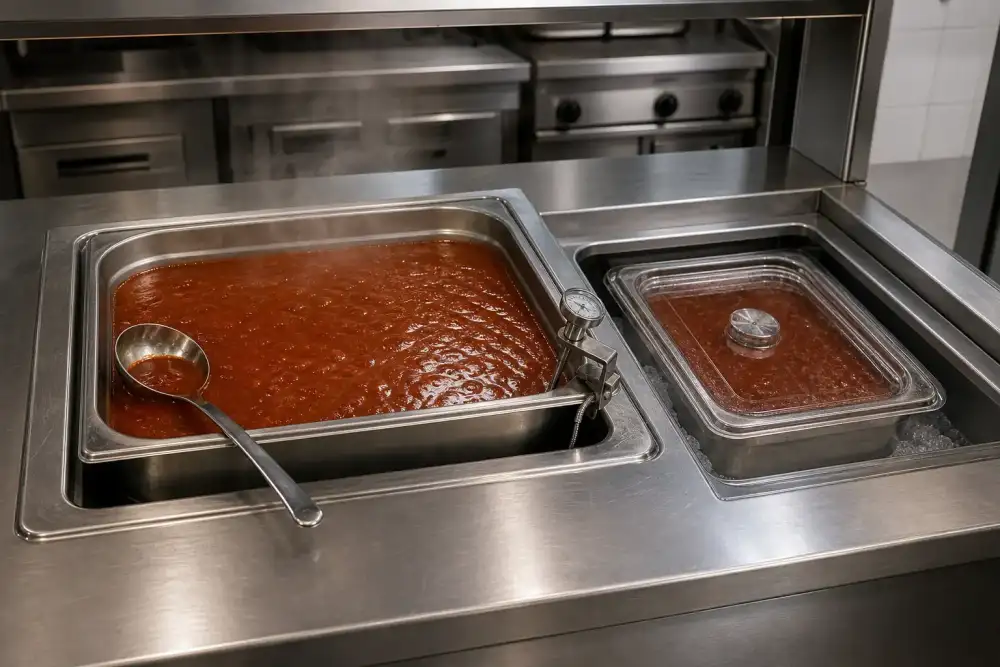
Holding is where a workable recipe proves itself. Heat continues to affect a sauce after cooking, even when the temperature is no longer high enough to produce an obvious simmer. Water evaporates, starches continue to absorb liquid and dairy-based sauces may begin to separate.
Hot sauces should enter a preheated holding unit at the correct temperature. A bain-marie is intended to maintain heat, not bring a cold pan of sauce safely up to serving temperature. Use clean containers, suitable lids and a stirring schedule that reaches the edges and bottom of the pan.
Sauces being held hot will generally need to remain at 63°C or above unless an appropriate time control is being used within the business’s documented system. The FSA’s Safer Food, Better Business pack for caterers5 includes specific resources covering reheating and hot holding.
Consistency adjustments should also be controlled. Staff should not pour unmeasured cold water into a hot sauce whenever it looks thick. Decide what liquid may be used, how much can be added and whether the sauce must be brought back to the required temperature before service continues.
Cold sauces need equally clear controls. Keep backup stock refrigerated, minimise time outside temperature control and replace service bottles or containers rather than repeatedly topping them up. Labels should identify the sauce, production date and any other information required by the business’s procedures.
Scottish caterers can use the Food Standards Scotland CookSafe guide6 to develop appropriate HACCP-based controls, including cooking, cooling, reheating and hot holding.
Record what happens during a real service. If a sauce regularly thickens, splits or remains unsold, the answer may be a smaller service pan or shorter replenishment cycle rather than another recipe adjustment.
Portion Control for Consistent Plates and Predictable Costs
Sauce is easily overlooked in menu costing because each individual serving appears inexpensive. Across hundreds of portions, however, an uncontrolled extra squeeze or overfilled ladle can remove a noticeable part of the margin.
Set the portion according to the dish rather than forcing one measure across the menu. A sausage roll needs enough sauce to flavour each bite without soaking the bread. Currywurst requires fuller coverage, while loaded fries need enough sauce to reach beyond the top layer. Each format should have its own specified serving measure.
Test the measure with the people who will actually serve the food. Ask several staff members to portion the same sauce ten times, then weigh or measure the results. If the variation is large, the equipment or instruction is not clear enough. A fixed ladle, portion pump, dispensing bottle or measured pot can make the standard easier to repeat.
Portioning also affects customer satisfaction and waste. WRAP research into out-of-home plate waste7 found that portion size was the leading reason customers gave for leaving food. More sauce is not automatically better value if it makes chips soggy or hides the sausage.
Cost the sauce from its finished yield. Divide the total batch cost by the realistic number of portions, allowing for residue left in pans and bottles. This produces a more credible figure than dividing the ingredient cost by an ideal yield that service never achieves.
Cross-Using Sauces Across Rolls, Loaded Fries and Plated Meals
Cross-use works when the sauce keeps its identity but performs a different role in each dish. Simply pouring the same quantity over everything makes the menu repetitive. Changing the portion, placement and finishing ingredients produces a more deliberate result.
A practical menu map might look like this:
- Sausage rolls: use a controlled line or spoonful of sauce, then add one contrasting element such as slaw, gherkin or crisp onions.
- Loaded fries: use the sauce to connect sliced sausage and chips, with a small finishing garnish for colour and texture.
- Plated meals: use the sauce more generously as part of the meal, matched with mash, Spätzle, potato salad or vegetables.
- Tasting portions: offer a small amount as a dip beside sliced Bratwurst or Frankfurter pieces.
The curry tomato system might appear as classic Currywurst, a loaded-fries sauce and a warm dip. Beer and onion gravy could support a pub plate and a winter loaded-fries special. Herb and gherkin sauce might dress a summer roll and provide the base for a matching slaw.
Menu wording helps maintain distinction. “Bratwurst with beer and onion gravy” promises a different experience from “loaded Bratwurst fries”, even if both use the same sauce. The sausage format, portion size, side and finishing ingredients create the rest of the dish.
Cross-use should simplify purchasing and preparation without making every menu item interchangeable. If customers can no longer tell why two dishes have different names or prices, the system has been stretched too far.
Reducing Waste Without Making the Menu Feel Smaller
Waste reduction starts with finding out what is actually being discarded. A sauce may be cheap per litre but still expensive once preparation time, refrigeration, containers and repeated small leftovers are included.
Track each sauce for several trading periods. Record how much was prepared, how much entered service and how much remained. Note relevant conditions such as weather, event type, day of the week and whether a particular dish was promoted. This quickly shows whether waste comes from the recipe, the batch size or weak customer demand.
The WRAP hospitality and food-service resources8 provide guidance and case studies on measuring and reducing food waste. Measurement is more useful than relying on staff impressions that a sauce “usually sells”.
Reducing the number of permanent sauces does not require a duller menu. Keep dependable, high-use systems as the core and rotate narrower flavours as specials. A mushroom finish might appear during autumn, while a cold herb sauce can take a stronger role in spring and summer.
Use smaller service containers and replenish them from controlled backup stock. This protects quality and prevents the entire prepared batch from spending a long service period on the counter. Freezing may be useful for some sauces, but only where the recipe retains its quality and the method fits the business’s documented food safety procedures.
Finally, remove sauces that do not earn their place. A flavour that sells only occasionally, has no convincing cross-use and regularly leaves waste is not adding genuine choice. It is adding work.
Frequently Asked Questions
Two or three are usually enough for a small unit. Choose one familiar hot sauce, one mustard or fresher cold option, and perhaps one premium sauce such as cheese or beer and onion gravy.
The full six-sauce system is a menu-development framework, not a requirement to offer everything simultaneously. Add another sauce only when sales, equipment and staff capacity justify the extra preparation.
It depends on what the sauce needs to achieve. A bought-in product may offer dependable consistency, simpler preparation and easier stock planning. A house recipe can provide stronger differentiation, but only if the additional labour and handling produce a noticeable improvement.
Compare the complete cost, including preparation time, energy, storage, spoilage and training. A practical compromise is to use a reliable commercial base and apply a controlled house finish. Menu descriptions must accurately reflect how the sauce is produced.
Include the sauce when it defines the dish, as with classic Currywurst or Bratwurst with beer and onion gravy. Charging separately for an essential element can make the advertised price feel misleading.Premium additions such as cheese sauce, an extra sauce pot or a hotter upgrade can be priced separately. Keep the choice simple and make the portion clear. At busy events, a short upgrade list is generally easier to communicate than a complicated series of small charges.
Run it as a controlled special using one defined batch and one or two suitable dishes. Avoid changing the sausage, bread, toppings and price at the same time, or it becomes difficult to tell what customers actually liked.
Record how many portions were offered and sold, how much sauce remained, whether it slowed assembly and what customers asked about. Testing across several representative services is more useful than judging it from one unusually busy or quiet day.
Keep the main curry tomato sauce mild or medium, then add heat at the finishing stage. A measured hot sauce, chilli seasoning or spiced oil can create a hotter version without requiring another full holding pan.
Use a defined quantity rather than allowing staff to guess. The menu should explain the heat levels clearly, and any finishing sauce must be included in the allergen and ingredient information where relevant. This keeps the choice understandable and the result repeatable.
Yes, but suitability must be checked across the complete dish. A plant-based sausage does not make the finished meal vegan if the sauce contains dairy, egg, honey, meat stock or another animal-derived ingredient.
Check every bought-in ingredient and recipe variation rather than relying on the sauce name. Worcestershire-style sauces, stocks, beer and mayonnaise-style products deserve particular attention. Staff also need clear procedures for utensils, storage and cross-contact if vegetarian or vegan suitability is being communicated to customers.
That depends on the sauces selected. Hot sauces may require suitable reheating and holding equipment, while cold herb or mayonnaise-based sauces need dependable chilled storage. Clean portioning tools, covered backup containers and an accurate probe thermometer are also important.Before expanding the sauce menu, check the available electrical load, gas setup, counter space, water access and service layout. Event and site requirements should also be verified. It is better to offer three sauces properly than six sauces that the unit cannot store, monitor or serve efficiently.
Give them a short build card for each dish. It should show the correct serving tool, number of pumps or ladles, order of assembly, finishing garnish and what to do when a customer asks about allergens.
Train staff using the actual equipment before service begins. Ask them to prepare several portions and check the results. A photograph of the finished dish is useful, but it should be supported by a measurable instruction. “A generous amount” will mean something different to every person behind the counter.
Usually not. Curated pairings make ordering quicker and help each dish feel intentional. Beer and onion gravy may suit a plated Bratwurst, while herb and gherkin sauce may work better in a lighter roll. Cheese sauce can remain a premium option rather than appearing automatically on everything.
Customers can still be offered limited substitutions where practical. The important point is to avoid turning the ordering process into a lengthy build-your-own system that slows the queue and makes costing unpredictable.
Look beyond the number of portions sold. Consider its contribution to gross profit, waste level, effect on service time, customer response and usefulness across the wider menu.
moderately popular sauce may deserve to stay if it has a strong margin, low waste and several applications. A popular sauce may be less attractive if it is routinely over-portioned, difficult to hold or dependent on ingredients used nowhere else. Review performance after several typical services rather than keeping or removing it on instinct.
Conclusion
A commercially useful sausage menu does not need a separate sauce for every product. It needs a small, carefully chosen group of sauces that can perform several jobs without making preparation, stock control or staff training unnecessarily complicated.
The strongest sauce systems begin with service realities. They can be prepared in sensible batches, held without quickly losing their texture, portioned consistently and used across Bratwurst, Frankfurters, Currywurst, loaded chips and plated dishes. That flexibility gives operators more apparent menu variety while keeping the number of ingredients and processes under control.
Portioning deserves particular attention. A measured ladle, pump or squeeze bottle improves presentation and cost consistency, while a clear labelling and rotation system helps prevent half-used containers from disappearing into the fridge. Actual batch sizes, holding temperatures, cooling methods and use-by periods should always be set according to the ingredients, equipment and food safety procedures of the individual business.
There is no need to introduce all systems at once. Start with the sauces that fit the greatest number of existing dishes, monitor sales and waste, and expand only when the menu has earned the extra complexity. Used intelligently, the right sauces can make a German sausage offer feel broader, faster and more distinctive without making the operation harder to run.
The Sausage Haüs
The Sausage Haus brings authentic German-style sausages to the UK market through a partnership between Hardy Remagen and Baird Foods.
Hardy Remagen is a long-established German producer with deep experience in traditional sausage making, continental meat products and modern food manufacturing. The range reflects the kind of products German shoppers already understand and enjoy: Bratwurst, Frankfurters, smoked hotdogs, cheese-filled sausages, Bockwurst, Weisswurst and other classic German-style lines.
In the UK, the range is represented and distributed by Baird Foods, giving retailers, wholesalers, caterers and foodservice operators access to German sausage products with a practical UK supply route. This combination is important: German manufacturing knowledge on one side, UK market understanding and distribution on the other.
For retail buyers, The Sausage Haus range offers a clear way to add something different to both chilled and frozen sausage fixtures. The products are built around real eating occasions: BBQs, premium hotdog nights, family meals, German street food, Oktoberfest promotions, Christmas market food and quick comfort meals at home.
The result is a range that gives shoppers something more distinctive than ordinary sausages and standard hotdogs, while giving buyers a compact, commercially useful product story with strong fresh and frozen potential.
References
Food Standards Agency’s food safety management guidance.
Berlin Currywurst is served with a spiced, curry-flavoured tomato sauce.
FSA allergen guidance for food businesses.
FSA guidance on chilling, freezing and defrosting food safely.
FSA’s Safer Food, Better Business pack for caterers.
Food Standards Scotland CookSafe guide.
WRAP - The Waste and Resources Action Programme. Hospitality and food service.