For many UK caterers, the word sausage still suggests a raw product that goes onto the grill and has to be cooked all the way through before it can be served.
With German sausages, that is often the wrong starting point.
Many of the German sausages supplied commercially are already fully cooked during manufacture. Frankfurter-style sausages, Wiener, Bockwurst, many smoked sausages and numerous Bratwurst styles belong to a tradition in which heat treatment is part of making the finished sausage.
The German term Brühwurst (scalded sausage) is particularly useful here. Germany's official food guidelines define Brühwürste as sausages that have been heat-treated during manufacture. They also distinguish these from raw Bratwurst products that still require cooking before consumption.
German Food Book Commission guidance on meat and sausage products1
That distinction changes the commercial comparison considerably.
For a foodservice operator using a fully cooked German sausage, the job is normally not to cook raw meat safely. It is to heat the sausage for serving and, where appropriate, finish it with colour and roasting flavours.
For a Bratwurst, that finishing stage can be particularly important. The grill still has a job to do. It is simply a different job.
Most commercial German sausages start life already cooked
German sausage culture covers an enormous range of products, so there is no single production method for every sausage carrying a German name.
Raw Bratwurst certainly exists. Fresh regional sausages are still produced in Germany and are intended to be fried, grilled or otherwise cooked before eating.
But many of the familiar German sausages encountered in commercial catering are heat-treated during production rather than being supplied as raw sausages.
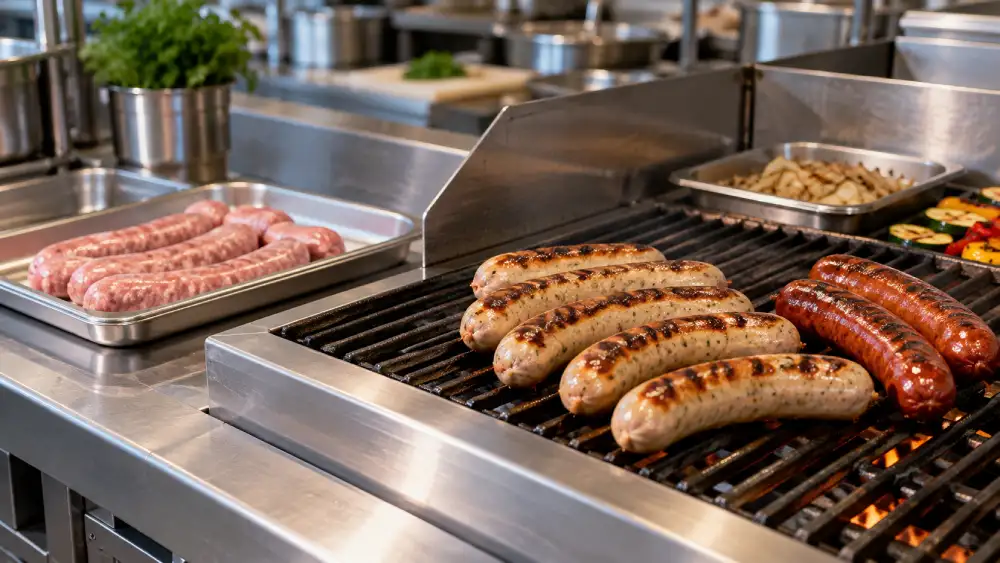
That includes classic Brühwurst products such as Wiener, Bockwurst and numerous other fine or coarse sausage styles. Germany's official sausage classifications also make clear that Bratwurst itself is not automatically synonymous with raw sausage. Depending on the product, a Bratwurst can fall into different manufacturing categories.
This matters because the factory heat treatment is not simply an optional preparation step that has been moved away from the caterer.
It helps create the finished product.
With a finely emulsified sausage, heating changes the structure of the sausage meat and sets the proteins. With smoked products, smoking, heating and the wider production process contribute to the characteristic colour, texture and flavour.
A red smoked German sausage is therefore not simply a raw sausage that someone has conveniently cooked in advance.
The processing is part of what makes it that sausage.
For a UK buyer comparing raw British-style sausages with German Bratwurst, Frankfurters or smoked sausages, that is an important distinction to understand.
Cooking the sausage and heating it for service are two different things
This is probably the most useful practical distinction in the entire subject.
With a raw sausage, the cooking performed by the operator is a food-safety step. The centre of the sausage has to receive sufficient heat before the product can safely be served.
With a fully cooked German sausage, that critical production step has already happened.
The sausage may arrive chilled or frozen, depending on the format. Once correctly stored and defrosted where required, the operator's task is generally to bring it to an enjoyable serving temperature and prepare it in the way the menu requires.
That might mean warming it gently.
It might mean heating it and then finishing it on a grill.
Or it might mean putting a Bratwurst directly onto a suitable grill or hotplate until it is hot, attractively browned and ready for the roll.
The distinction is especially useful operationally because a fully cooked sausage does not depend on the grill to transform raw meat into a safe finished product.
The Sausage Haus sausages are supplied fully cooked. When they have been stored and handled according to their instructions, they can also be eaten cold.
That provides a useful way of understanding the process.
Heating is normally desirable because nobody ordering a hot Bratwurst wants a cold sausage in the middle. But with a fully cooked ready-to-eat product, the heating stage is principally about the dish you want to serve rather than completing the original manufacture of the sausage.
A Bratwurst still benefits enormously from the grill
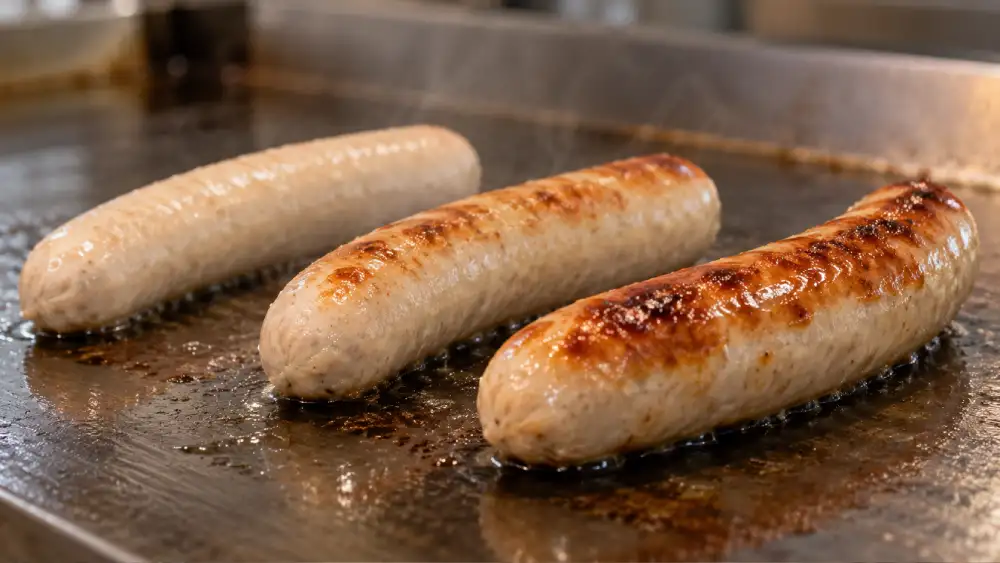
Pre-cooked should never be confused with finished.
Take a pale German Bratwurst straight from the pack, warm it and put it in a roll and you may have a perfectly hot sausage. You have not necessarily created a particularly appealing Bratwurst.
Colour matters.
So does the smell produced when the sausage reaches a hot grill. Browning and roasting add another layer of flavour and create the familiar appearance customers associate with freshly grilled Bratwurst.
This is why a good commercial system can separate heating from finishing.
During a busy service, sausages can be brought up towards serving condition using the preparation method appropriate for that particular product and operation. They can then spend relatively little time on the grill to develop colour before being served.
Alternatively, where demand and grill capacity allow, they can simply be heated and browned on the grill.
The important point is that the grill operator is no longer trying to solve two problems simultaneously.
With a raw sausage, the outside can look completely ready while the middle still requires more cooking.
With a pre-cooked Bratwurst, colour is no longer a proxy for whether the raw meat in the centre has received sufficient heat treatment. The operator can concentrate much more directly on the result the customer actually sees and tastes.
That is especially useful during peak periods, when the difference between cooking to safety and finishing to order becomes commercially significant.
Smoked German sausages make the distinction even clearer
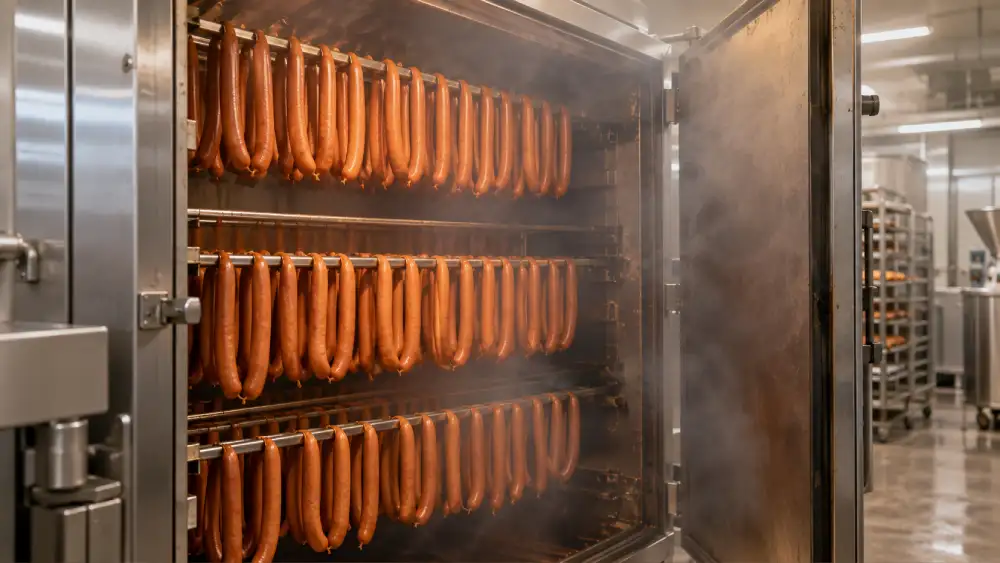
The argument becomes still clearer with many of Germany's red and smoked sausages.
Products such as Bockwurst, Knacker and similar smoked styles are not simply mixtures of raw meat waiting for a caterer to cook them.
Their production involves a combination of processes that may include fine or coarse comminution, seasoning, filling, reddening, smoking and heat treatment, depending on the individual sausage.
The finished texture and characteristic appearance are created during manufacture.
Germany's official guidance places familiar products including Wiener and Bockwurst within the Brühwurst category of heat-treated sausages.
That makes the idea of giving the chef "more control by supplying the sausage raw" rather misleading in this context.
Remove the controlled production stages and you no longer simply have the same sausage in an uncooked form. You have an unfinished product that still needs important parts of its manufacturing process.
That is fundamentally different from comparing two conventional fresh sausages, one raw and one pre-cooked.
For a foodservice buyer, the practical advantage is straightforward.
The manufacturer creates the sausage. The operator serves it.
The caterer's skill can then go into the elements that actually differentiate the finished offer: how well the sausage is browned, the quality of the roll, onions, sauces, toppings, sides and the speed and consistency with which the complete dish reaches the customer.
Food safety is simpler, but it does not disappear
Fully cooked sausages remove one obvious food-safety issue from the service operation: the caterer is not handling that product as raw sausage meat and relying on the final cooking stage to make it safe.
That can simplify a compact catering setup considerably.
A street food trader may be working with rolls, cooked onions, sauces, salad ingredients and garnishes within a relatively small space. Not introducing raw sausage meat into that workflow can make separation and handling easier.
That does not mean there are no controls.
The sausages still need to be stored correctly, used within the appropriate shelf life, protected from contamination and handled according to the manufacturer's instructions and the operator's food-safety procedures.
The Food Standards Agency provides broader food hygiene guidance for UK food businesses2 covering the controls operators should build into their systems.
Temperature is also worth understanding properly.
If a fully cooked sausage is suitable to eat cold and is heated before being served immediately, the operator is not using that heating stage as the original raw-meat kill step. In practical terms, the important outcome is that the sausage reaches the customer properly hot and enjoyable to eat, while the preparation method remains consistent with the manufacturer's instructions and the business's food-safety system.
The situation changes when sausages are kept hot waiting for customers.
In England, food that requires hot holding should normally be kept at 63°C or above. The official GOV.UK guidance on reheating and keeping food hot3 explains the hot-holding requirements.
This is where temperature monitoring becomes particularly relevant.
The Food Standards Agency's Safer Food Better Business guidance also explains how operators can use probe checks to establish and verify a safe, repeatable method rather than treating temperature probing as something that has to be performed on every individual item.
The real commercial advantage is service flow
For many operators, the biggest advantage of pre-cooked German sausages appears at 12.30 pm, not during a quiet preparation period.
A queue forms.
Six customers want Bratwurst. Three want Currywurst. Someone wants four sausages to take away. Another group has just joined the queue.
With raw sausages, grill capacity and cooking time are hard limits. A sausage cannot safely be declared ready simply because the queue has become inconvenient.
Fully cooked sausages give the operator more options and are cooked much faster than raw sausages.
The service can be organised around warming, finishing and assembly rather than cooking batches of raw meat from start to finish.
That can be particularly valuable for:
- festival and event traders
- showmen
- Christmas markets
- football and sports catering
- busy garden centres
- farm shops with hot-food counters
- cafés and pubs with sharp lunchtime peaks
- operators working from trailers, kiosks or compact kitchens
The exact system will depend on the product, available equipment and expected volume.
But the basic operational principle is powerful.
The slowest part of the sausage manufacturing process has already taken place before the product arrives.
The caterer can therefore design the final preparation around the realities of service.
That may allow one person to manage more orders, make it easier to train temporary staff or reduce the amount of grill space needed simply to cope with a sudden peak.
None of those savings should be assumed automatically. They should be tested against the actual operation.
But they are precisely the sort of factors that do not appear when buyers compare sausages purely on price per kilogram.
Consistency becomes easier to engineer
A busy catering operation does not make money by producing one perfect sausage.
It needs to produce the same good sausage again and again.
That can be difficult with raw products when different members of staff have different ideas about heat, timing and when a sausage is ready.
One person cooks cautiously and slowly. Another turns the grill up. Someone else keeps moving sausages between hot and cooler areas because the queue changes every five minutes.
With a fully cooked German sausage, the preparation process can be reduced to a much more repeatable sequence.
For example, the operator can define how the product is stored, how it is heated, how long it is normally finished on the grill and how it moves into immediate service or controlled hot holding.
The Food Standards Agency's Safer Food Better Business system for caterers4 is built around exactly this principle of establishing safe methods that staff can consistently follow.
Once the technical process is straightforward, training can focus more heavily on the things customers notice.
- Is the Bratwurst nicely coloured rather than burnt?
- Is the roll fresh?
- Are portions of onions consistent?
- Is the correct sauce being used?
- Is the person serving able to complete the order quickly without making the counter look as though Oktoberfest has collided with rush hour at Victoria Station?
That is where operational simplicity starts to become customer experience.
What should a buyer actually compare?
The useful comparison is therefore not simply:
Raw sausage versus pre-cooked sausage.
For German foodservice products, a better question is:
What work is left for my operation after the manufacturer has finished making the sausage?
A buyer should understand whether the product is already fully cooked, whether it can be eaten cold, whether it is supplied chilled or frozen and what the recommended preparation method is.
Then look at the service operation itself.
How long does it take to produce a customer-ready sausage during normal service? What happens when 20 orders arrive together? How much grill space is needed? Can less experienced staff achieve the same result? Can the sausages be prepared in a controlled sequence and finished to order? Will they tolerate the service method without splitting, drying out or losing their appearance?
Storage format and pack size matter as well. So do portion weight, allergen information and consistency between one case and the next.
The Food Standards Agency's allergen guidance for food businesses5 remains relevant whether a sausage is raw or fully cooked.
For operators serving German sausages at volume, however, one of the most important questions is remarkably simple:
Am I buying something that still needs to be manufactured on my grill, or something that is already a finished sausage and simply needs to be served well?
With a properly manufactured pre-cooked German sausage, it is very much the latter.
Frequently Asked Questions
No. With many German sausage styles, pre-cooking is not a shortcut or a way of compensating for quality. It is part of the traditional production process.
For products such as Wiener, Bockwurst and many other German Brühwurst-style sausages, heat treatment helps create the characteristic texture and finished structure of the sausage. Quality depends on the recipe, ingredients, production method and execution, not simply on whether the sausage reaches the customer raw or cooked.
Usually what the customer notices is how well the final sausage has been prepared.
pre-cooked Bratwurst can still be grilled to develop browning, roasting flavours and the freshly prepared appearance customers expect. The aim is not to disguise the fact that it is pre-cooked, but to use the grill for finishing rather than relying on it to cook raw meat all the way through.
Good colour, a quality roll, appropriate toppings and serving the sausage properly hot will normally have a much greater effect on the customer's experience.
Some can, including fully cooked Sausage Haus sausages, provided they have been stored and handled correctly and the product is suitable for ready-to-eat use.
That can open up applications beyond the traditional hot sausage roll, such as sliced sausage in cold platters, salads, snack boards or prepared retail dishes.
Operators should always check the instructions for the particular product rather than assuming that every sausage sold as pre-cooked is intended to be served cold.
It can be, particularly during busy service.
Pre-heating can allow the grill to concentrate on colour and finishing rather than bringing every sausage up from chilled temperature individually. That can make service more predictable when demand arrives in waves.
For quieter operations, putting the sausage directly onto the grill may be perfectly practical.
The best system depends on grill capacity, service volume, staffing and the preparation instructions for the product. A Christmas market stall serving hundreds of sausages may need a very different workflow from a pub serving occasional Bratwurst throughout the day.
They can be particularly useful where workspace and cooking capacity are limited.
Removing raw sausage handling from the process can simplify the workflow, while reheating and finishing can often be organised around relatively compact equipment.
That does not remove the need to consider refrigeration, hot holding, handwashing, power or gas supply and the requirements of the individual trading site. Before committing to a setup, operators should work through the entire service process from storage to handing the finished dish to the customer.
Not automatically.
They can simplify preparation and make the process easier to teach, but whether that produces a measurable labour saving depends on the business.
The better question is how much staff time and attention each serving requires. If a pre-cooked product allows one person to manage heating, finishing and assembly during a busy period more effectively, the operational value may be significant even if the hourly wage bill does not immediately change.
This is why buyers should look beyond the purchase price and consider the **work required per saleable portion**.
Start with taste and product quality, but do not stop there.
Compare portion weight, pack format, chilled or frozen supply, storage requirements, preparation method and how the sausage performs during actual service. A product that looks attractive on a specification sheet may be less suitable if it splits easily, dries out during finishing or takes too long to prepare during peak periods.
It is also worth testing the product with the equipment and service method you actually intend to use. A short trial during realistic conditions can tell you much more than comparing case prices alone.
No. High-volume operators often see the benefits most clearly because speed and consistency become critical during peak periods, but the same advantages can matter at smaller scale.
café may value straightforward preparation because only one member of staff is covering the kitchen. A pub may want to add German sausages without introducing another raw-meat process. A farm shop or garden centre may want a product that different staff members can prepare consistently.
The value of a pre-cooked sausage is therefore not simply how many portions are sold. It is how well the product fits the operation.
Conclusion
The comparison between raw and pre-cooked sausages makes much more sense once German sausage production is understood properly.
Many familiar commercial German sausages are heat-treated as part of their manufacture. In products such as Wiener, Bockwurst and numerous Bratwurst and smoked sausage styles, that factory process contributes directly to the texture, structure, colour and character of the finished sausage.
The caterer is therefore not taking over the manufacturer's cooking job.
The sausage has already been made.
What remains is heating, finishing and serving it well.
For Bratwurst, the grill remains important because colour and roasting flavours are part of the appeal. For smoked sausages, gentle heating may be all that is required for some applications. And because fully cooked Sausage Haus sausages can also be eaten cold when correctly stored and handled, the service heating stage is not equivalent to cooking a raw sausage until it becomes safe.
Where sausages are hot-held, temperature control becomes an important part of the operation, with the relevant food-safety rules and the operator's own procedures still applying.
Commercially, the advantage is simplicity.
Less raw-meat handling, a shorter route to the finished dish, easier staff execution and greater flexibility when a queue suddenly appears can all matter far more than a few pence difference in the purchase price.
For buyers and operators, that is the useful comparison: not simply what the sausage costs in the case, but what it asks from the business before it can be sold.
The Sausage Haus range is supplied fully cooked for retail and professional foodservice. Trade customers looking at German sausages for events, catering, retail or menu development can contact us to discuss the most suitable products and formats.
The Sausage Haüs
The Sausage Haus brings authentic German-style sausages to the UK market through a partnership between Hardy Remagen and Baird Foods.
Hardy Remagen is a long-established German producer with deep experience in traditional sausage making, continental meat products and modern food manufacturing. The range reflects the kind of products German shoppers already understand and enjoy: Bratwurst, Frankfurters, smoked hotdogs, cheese-filled sausages, Bockwurst, Weisswurst and other classic German-style lines.
In the UK, the range is represented and distributed by Baird Foods, giving retailers, wholesalers, caterers and foodservice operators access to German sausage products with a practical UK supply route. This combination is important: German manufacturing knowledge on one side, UK market understanding and distribution on the other.
For retail buyers, The Sausage Haus range offers a clear way to add something different to both chilled and frozen sausage fixtures. The products are built around real eating occasions: BBQs, premium hotdog nights, family meals, German street food, Oktoberfest promotions, Christmas market food and quick comfort meals at home.
The result is a range that gives shoppers something more distinctive than ordinary sausages and standard hotdogs, while giving buyers a compact, commercially useful product story with strong fresh and frozen potential.
References
German Food Book Commission guidance on meat and sausage products.
UK Government. Food Hygiene. GOV.UK.
UK Government. Food hygiene for businesses. GOV.UK. Updated June 25, 2026.
UK Government. Safer food, better business (SFBB). GOV.UK. Updated June 4, 2025.
UK Government. food businesses. GOV.UK. Updated July 17, 2026.