Updated January 2026.
Welcome to Schnitzel heaven. In this in-depth guide, we explore the world’s most iconic breaded cutlets — from classic Wiener Schnitzel to hearty Pork Schnitzel, crisp and juicy Chicken Schnitzel, and the legendary German variants such as Cordon Bleu, Jägerschnitzel and Paprika Schnitzel. Whether you’re a home cook, a passionate foodie or a UK pub operator looking for irresistible menu inspiration, this article breaks down every major type of Schnitzel with history, flavour notes, expert cooking techniques and three essential Schnitzel recipes to elevate any kitchen.
Introduction
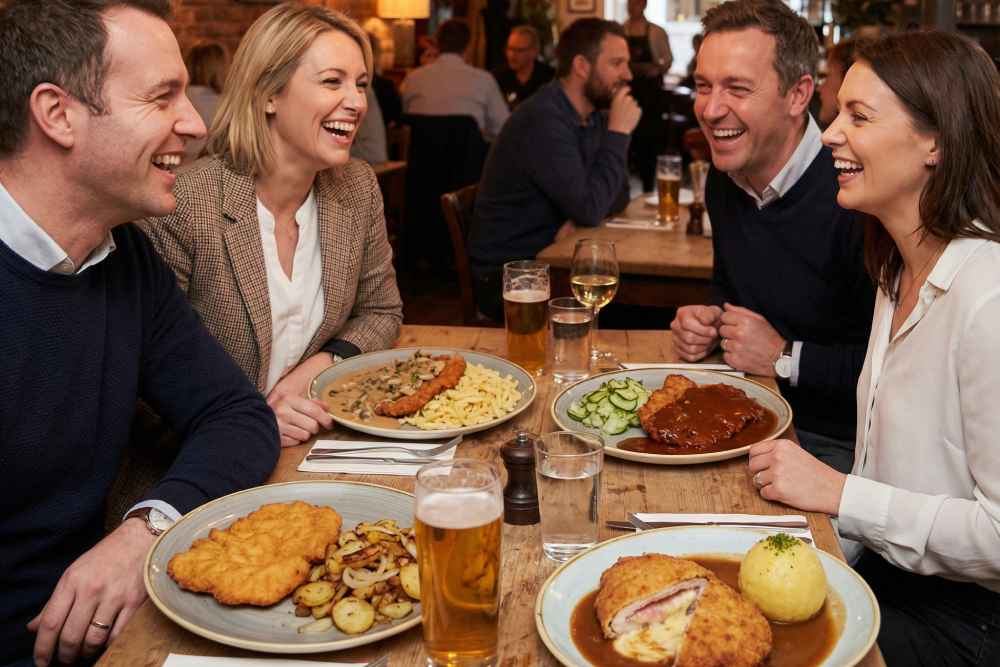
A pub-table schnitzel spread: classic Wiener Schnitzel, Cordon Bleu with melted cheese, and Jägerschnitzel with mushroom sauce.
Few dishes command such instant comfort as a beautifully cooked Schnitzel. Golden on the outside, tender within, and full of character depending on its regional style — a good Schnitzel is the kind of meal that makes a table fall silent for a moment, just to appreciate it. There’s a simple magic to it: that first crisp bite, the gentle seasoning, the aroma of butter or oil rising from the plate, and the unmistakable contrast between delicate crust and softly steaming meat. It is one of the rare dishes that manages to be both humble and celebratory at the same time.
Across Austria and Germany, Schnitzel is not merely food — it’s memory, heritage and tradition. Families have their own preferred breadcrumbs, favourite cuts of meat, cherished frying pans and generational secrets. In Vienna, diners still debate which restaurant makes the most perfectly “souffléd” Wiener Schnitzel. In Bavaria, pork Schnitzel with creamy sauces is a staple of village inns. And in Berlin, Paprika Schnitzel remains a nostalgic favourite. Each region has shaped its own interpretation, and each interpretation reveals a little piece of cultural identity.
The UK already loves breaded chicken, breaded pork and cutlets, but real Austrian and German Schnitzel is something else entirely: lighter, crispier, more aromatic, and far more rooted in history than most people realise. Proper Schnitzel is never heavy, never stodgy, never greasy — when done correctly, it is almost airy. And because “Schnitzel” is a fast-rising search term, it’s clear that British cooks, home food enthusiasts and pub chefs alike are increasingly curious. They want to know what makes Wiener Schnitzel different from Chicken Schnitzel, why pork is the German favourite, and how to reproduce that authentic European texture that feels worlds apart from standard breaded meat.
This guide gives you everything: the origins, the types, the cuts, the techniques, the mistakes to avoid, and the classic recipes every kitchen should know. Whether you’re exploring Schnitzel for the first time or refining your craft, this deep dive will show you how to bring true Continental quality to your table — and why Schnitzel remains one of the most loved dishes in Central Europe and far beyond.
Description
A comprehensive and deeply detailed guide to one of Europe’s most iconic dishes: Schnitzel. This article explores every major style — from the refined elegance of Wiener Schnitzel to the hearty comfort of Pork Schnitzel, the global appeal of Chicken Schnitzel and beloved classics such as Cordon Bleu, Jägerschnitzel and Paprika Schnitzel. Along the way, we explain the origins, the essential techniques, the best cuts of meat and the subtle differences that define each regional variant. Whether you’re searching for culinary inspiration, researching traditional German and Austrian cooking, or looking for reliable Schnitzel recipes to elevate your home or pub kitchen, this guide provides everything you need to create authentic, crisp, golden Schnitzel with unmistakable Continental flavour.
Key Takeaways
- There are three primary types of Schnitzel: Wiener, Pork and Chicken.
- Wiener Schnitzel must legally be veal; anything else is not authentic.
- Pork Schnitzel is Germany’s everyday favourite — affordable, flavourful, crowd-pleasing.
- Chicken Schnitzel has become a modern global classic and is one of the easiest to cook.
- Variants like Cordon Bleu, Jägerschnitzel and Paprika Schnitzel add sauces, fillings or regional twists.
- A perfect Schnitzel relies on thin meat, seasoning, and a three-stage coating that stays airy and crisp.
- Traditional frying uses neutral oil or clarified butter for authentic aroma and colour.
- British pubs can easily integrate Schnitzel into menus as it pairs with chips, salads, pickles, sauces and craft beers.
- This post includes three classic Schnitzel recipes for immediate use.
What Makes a Schnitzel?
At its heart, Schnitzel is a celebration of simplicity done with precision. It begins with a thin cutlet of meat — veal, pork or chicken — carefully pounded to an even thickness, lightly seasoned, coated in flour, dipped in egg and finished with a layer of fine breadcrumbs. From there, it is fried until the exterior achieves a golden, delicate crispness while the interior stays tender and succulent. What sounds basic on paper becomes, in practice, a dish that demands finesse, timing and respect for technique.
The true magic of Schnitzel does not come from elaborate ingredients or complex preparation. Instead, it hinges on details: the quality of the meat, the rhythm of the breading process, the temperature of the frying fat and the lightness of touch during cooking. When all of these elements align, you get a Schnitzel that is unmistakably “right” — crisp but not heavy, flavourful but not overloaded, comforting yet refined.
A properly prepared Schnitzel should be:
- Evenly thin (4–6 mm) so it cooks uniformly without tough edges
- Crisp yet light, never oily or dense
- Soft and steaming inside, retaining moisture despite the quick fry
- Gently seasoned, allowing the flavour of the meat to shine
- Delicately coated, with breadcrumbs that cling but never compact
- Golden in colour, with tiny air pockets indicating proper frying technique
- Slightly wavy or “soufflé-like” in places, especially in Wiener Schnitzel
These qualities are what distinguish true Austrian and German Schnitzel from generic breaded cutlets.
The name “Schnitzel” comes from the German word Schnitz, meaning “slice.” Historically, slicing meat thinly was both economical and practical. Long before modern stoves existed, cooks in Central Europe needed dishes that could cook quickly and consistently over open flames. Schnitzel, with its thin, fast-frying nature, was the perfect solution for roadside inns, taverns and large households.
As culinary traditions evolved, so did Schnitzel. Different regions adopted different meats, sauces and accompaniments, creating a wide spectrum of styles:
- Austria refined the veal-based Wiener Schnitzel into a symbol of national pride.
- Germany embraced pork Schnitzel as an everyday favourite, adding sauces like mushroom (Jäger), paprika and cream.
- Switzerland gave the world Cordon Bleu — a luxurious cheese-and-ham-filled interpretation.
- Israel and Australia elevated Chicken Schnitzel into iconic street and pub food.
Today, Schnitzel remains one of the most beloved dishes in Central Europe and increasingly abroad. Its broad appeal lies in its balance: familiar enough to be comforting, but versatile enough to adapt to countless regional variations. Whether served with lemon and parsley potatoes or covered in earthy mushroom gravy, Schnitzel embodies the kind of honest, satisfying cooking that endures through generations.
Wiener Schnitzel — The Icon
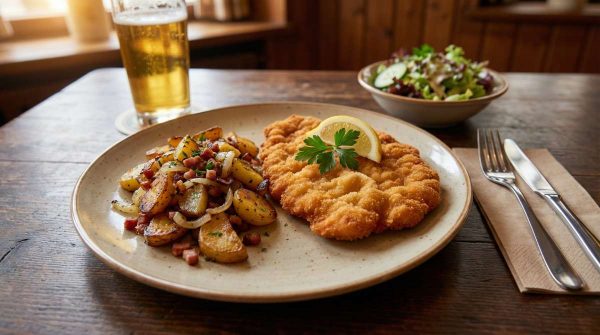
Classic Wiener Schnitzel with crispy Bratkartoffeln, lemon, parsley, a fresh side salad and a cold lager.
Wiener Schnitzel is not just a dish; it is a national treasure and one of the most recognisable symbols of Austrian cuisine. Protected by law and revered by chefs across Europe, true Wiener Schnitzel must be made from veal, pounded thin and fried to a delicate, blistered crispness in clarified butter. Anything else — even if it looks identical — cannot legally claim the name.
Its charm lies in finesse. A Wiener Schnitzel should lift gently away from the meat, creating a lace-like crust with tiny air pockets that give it a light, almost soufflé-like appearance. This effect is impossible to achieve if the breadcrumbs are pressed on or the pan is too hot; instead, it results from a patient, careful technique that honours tradition.
The flavour is subtle but unforgettable — buttery, golden, aromatic and clean. It is the kind of dish that needs no heavy sauce, only a simple lemon wedge and perhaps parsley potatoes or a refreshing cucumber salad.
Characteristics of an authentic Wiener Schnitzel:
- Must be veal, never pork or chicken
- Fried traditionally in clarified butter (Butterschmalz)
- Coating should balloon and ripple slightly as it fries
- Breadcrumbs remain delicate, not compacted
- Colour should be light golden, not deep brown
- Served with lemon, sometimes anchovies or capers in Vienna
- Texture is light, airy, almost crispy parchment around tender meat
The dish has roots stretching back to the Habsburg Empire, and its preparation has become a ritual in Austrian households. Many families still swear by specific breadcrumb types, oil ratios or pan shapes, and they pass down these details as proudly as family heirlooms.
When cooked properly, a Wiener Schnitzel is elegant yet comforting — a masterclass in restraint that lets technique speak louder than spice.
Pork Schnitzel — Germany’s Everyday Favourite
While Austria may be famous for Wiener Schnitzel, Germany belongs to pork. Pork Schnitzel — Schweineschnitzel — is the backbone of German comfort cooking, served everywhere from village Gasthäuser to motorway service stops. It is hearty, versatile and deeply satisfying, making it arguably the most widespread Schnitzel in the world.
Pork has an ideal natural tenderness when sliced thinly, and its slight marbling keeps the meat juicy even at high frying temperatures. This makes it forgiving for beginners and wonderfully flavourful for professionals. Pork Schnitzel is also the starting point for nearly all of Germany’s legendary Schnitzel variants.
Where Austria specialises in purity, Germany excels in abundance. Pork Schnitzel often becomes the foundation for dazzling flavours — earthy mushroom gravies, bright paprika sauces, rich cream reductions or even the famous Holsteiner garnishes of egg, sardines and capers. In pubs and restaurants across Germany, no two Schnitzel dishes look quite the same.
Why Pork Schnitzel is so beloved:
- Affordable, making it ideal for pubs and home cooking
- Juicy and flavourful, even when cut thin
- Works beautifully with bold sauces and toppings
- Can be prepared in high volume for service kitchens
- Extremely versatile — from classic to adventurous
- Has a higher tolerance for slight overcooking compared to veal
- Pairs well with fries, salads, spaetzle, mushrooms and beer
Most importantly, Pork Schnitzel embodies German hospitality. It’s the dish you order when you want something generous, warm and familiar — the culinary equivalent of someone pulling a chair out for you at the table.
For UK pubs, Pork Schnitzel offers the perfect balance of premium feel and excellent margins. With the right preparation, it can become one of the most reliable comfort-food sellers on any menu.
Chicken Schnitzel — The Modern Global Classic
Chicken Schnitzel has become an international phenomenon. From Israeli street stalls to Australian pubs, American diners and now British kitchens, this simple breaded chicken cutlet has evolved into one of the most recognisable comfort foods of the modern era.
Its popularity comes from universal appeal: almost everyone enjoys chicken, and when it’s pounded thin, seasoned well and fried quickly, it becomes irresistibly tender beneath a crisp, golden crust. Chicken Schnitzel is fast, lean, adaptable and endlessly pairable — qualities that have made it a staple on family dinner tables as well as trendy restaurant menus.
Chicken also absorbs seasoning particularly well, allowing chefs to experiment with flavours from paprika and garlic to za’atar, lemon zest and chili flakes. Yet even without embellishment, a classic Chicken Schnitzel remains a masterpiece of simplicity.
What makes Chicken Schnitzel so popular worldwide?
- Universally liked and family-friendly
- Cooks extremely quickly due to thinness
- Lower in fat, higher in protein compared to pork
- Lends itself to sandwiches, wraps, salads and pub plates
- Works brilliantly with contemporary seasoning styles
- Stays tender with minimal effort if not overcooked
- Ideal for quick-service kitchens and large batch preparation
In many countries, Chicken Schnitzel has evolved into its own culture. Israelis serve it with chips and hummus. Australians turn it into a pub classic with cheese and tomato sauce (Parmigiana). In the UK, Chicken Schnitzel is becoming a premium upgrade from ordinary breaded chicken breasts, turning a familiar favourite into a more refined, Continental-style experience.
A perfect Chicken Schnitzel should be thin, juicy, bright in flavour and crisp enough to hold its own even in a sandwich. With the right technique, it becomes one of the most satisfying and crowd-pleasing dishes any chef can offer.
The Best Cuts of Meat for Schnitzel
Choosing the right cut of meat is one of the most important steps in creating a truly exceptional Schnitzel. Because the meat is pounded thin, coated and fried quickly, the ideal cut must strike a perfect balance between tenderness, structural integrity and flavour. Too tough, and the Schnitzel becomes chewy; too fatty, and the coating won’t adhere properly; too soft, and it will tear under the mallet. This is why traditional Schnitzel recipes consistently favour lean, tender muscles with fine fibres and minimal connective tissue.
A great Schnitzel begins long before it reaches the pan — it starts with understanding which cuts behave best under the unique demands of pounding, breading and frying.
Recommended cuts for perfect Schnitzel:
Veal Topside — For Authentic Wiener Schnitzel
- The classic choice, protected by Austrian culinary tradition
- Lean but naturally tender, allowing it to be pounded thin without tearing
- Offers a delicate, refined flavour that pairs beautifully with clarified butter
- Produces the iconic “soufflé” crust when cooked correctly
Veal topside provides the silkiness and mild flavour profile that distinguishes Wiener Schnitzel from all other variations. Its fine grain ensures a perfectly even texture.
Pork Loin or Pork Shoulder Steaks — Germany’s Favourite Choice
- Pork loin: lean, tender, mild and consistent in texture
- Pork shoulder steaks: slightly more marbled, offering extra juiciness
- Excellent value for pubs, restaurants and large-batch cooking
- Works with bold sauces such as mushroom, paprika or cream
Pork is the workhorse of Schnitzel cuisine in Germany. When sliced thinly and pounded evenly, pork becomes exceptionally tender, with just enough fat to stay juicy during frying. Shoulder steaks, when trimmed properly, provide outstanding flavour.
Chicken Breast — Easy to Portion and Universally Loved
- Naturally tender when butterflied and pounded
- Cooks quickly and evenly
- Ideal for lighter, globally inspired Schnitzel dishes
- Works well for sandwiches, wraps and pub menu flexibility
Chicken breast is especially forgiving, making it perfect for home cooks and high-volume kitchens alike. Its neutral flavour also takes seasoning very well, from classic salt-and-pepper to more adventurous spice blends.
Cuts to Avoid
Not all cuts are suited for Schnitzel. In fact, the wrong cut can ruin the texture even if the breading and frying are perfect.
Avoid:
- Overly fatty cuts (e.g., pork belly) — fat prevents even pounding and interferes with breading adhesion
- Tough, sinewy cuts (e.g., beef chuck or brisket) — fibres don’t break down under fast frying
- Cuts with heavy connective tissue — they contract unevenly when exposed to high heat
These cuts tear easily when pounded and result in an uneven, chewy Schnitzel.
Why the Cut Matters So Much
Because Schnitzel relies on thinness, every flaw in the meat becomes more pronounced once it is flattened. The cut determines:
- How evenly the meat pounds out
- How well it retains moisture
- How tender the final result becomes
- How the crust adheres and behaves during frying
When you choose the correct cut, the rest of the process becomes far easier — and the results instantly more authentic.
How to Make Schnitzel Extra Crispy
Achieving the perfect crispy coating is the hallmark of a great Schnitzel. When you cut into it, the crust should crack lightly under the fork, revealing tender, steaming meat beneath. It should never be heavy, never oily, never soggy — instead, it should feel almost weightless, delicate, and beautifully golden. A Schnitzel’s crispiness is not the result of luck or guesswork; it comes from technique, discipline and a few time-tested principles that professional cooks follow religiously.
The goal is simple: a light, airy crust that remains crisp even after the first bite. To achieve this, every step — from pounding the meat to handling the breadcrumbs to controlling the frying temperature — needs thoughtful attention.
Below are the essential principles behind truly exceptional crispiness, written in a way that makes the reader feel confident, empowered and ready to produce restaurant-level results.
1. Start With Evenly Pounded Meat
A Schnitzel must be thin, but more importantly, evenly thin. Any thick spots will cook slower than thin ones, causing the crust to brown before the meat is ready.
Why this matters:
- Ensures the meat cooks through in minutes
- Prevents burning or undercooking
- Helps the coating adhere consistently
Aim for 4–6 mm thickness, using either a meat mallet or a rolling pin. Place the meat between cling film sheets to avoid tearing.
2. Season the Meat Before Breading
Many cooks make the mistake of adding all flavour into the breadcrumbs. Traditional Austrian and German cooks season the meat itself.
Benefits of seasoning early:
- Creates flavour under the crust
- Helps the meat retain moisture
- Produces a more balanced, refined taste
Salt the meat lightly on both sides and let it rest for a moment before coating.
3. Use the Classic Three-Bowl Breading Method
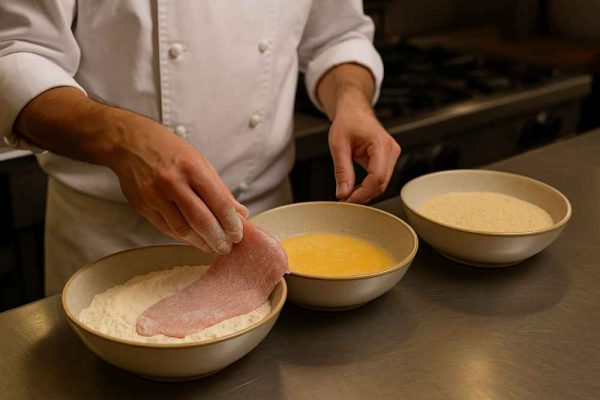
A chef demonstrates the classic three-bowl breading method for Schnitzel: flour, beaten egg and fine breadcrumbs — the foundation of every authentic Wiener Schnitzel.
Proper breading is essential for crispiness.
The three bowls:
- Flour
- Beaten eggs
- Breadcrumbs
Each step plays a role:
- Flour dries the surface
- Egg binds the breadcrumbs
- Breadcrumbs form the crisp outer shell
The transitions should be gentle, especially the breadcrumb stage.
4. Don’t Press the Breadcrumbs Into the Meat
This is one of the most misunderstood steps in Schnitzel making. Pressing breadcrumbs in may seem intuitive, but it creates a dense, thick coating that does not crisp properly.
Instead:
- Lift the Schnitzel
- Sprinkle breadcrumbs over it
- Shake gently to remove excess
The coating should sit lightly — almost floating — on the surface of the meat.
The result:
- A crust that “soufflés”
- Air pockets that enhance crispiness
- A lighter, more elegant texture
This is the secret behind true Wiener Schnitzel-style crispiness.
5. Use the Right Fat for Frying
Authentic Schnitzel is shallow-fried, not deep-fried. The fat should be deep enough for the Schnitzel to “swim,” but not so much that it becomes submerged.
Recommended fats:
- Clarified butter (Butterschmalz) for traditional Austrian flavour
- Neutral oils such as sunflower or rapeseed for a cleaner taste
- A mix of oil and clarified butter for the best of both worlds
Avoid:
- Olive oil (burns too quickly)
- Butter alone (foam and scorching issues)
Clarified butter gives the most beautiful golden colour and light, aromatic flavour.
6. Maintain Proper Temperature: 170–180°C
This is one of the most crucial aspects of achieving crispiness.
If oil is too cold:
- The breading absorbs fat
- Schnitzel becomes greasy and heavy
- Coating may fall off
If oil is too hot:
- Outside burns before inside cooks
- Breadcrumbs turn bitter
Perfect temperature:
- Produces tiny, rapid bubbles
- Fries the crust evenly
- Keeps the Schnitzel light
Use a thermometer if possible, especially in professional kitchens.
7. Spoon Hot Fat Over the Top While Frying
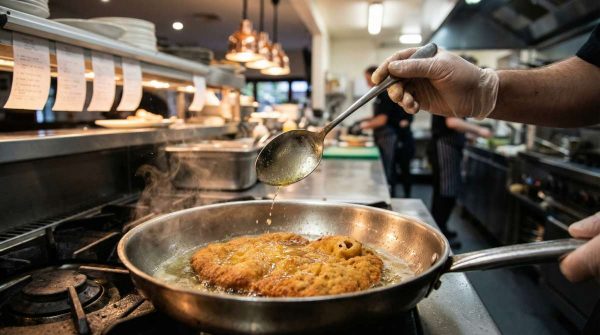
The key to a great schnitzel: shallow-frying and basting in hot butter for a crisp, golden crumb.
This Austrian technique creates an even, golden crust and helps the surface puff slightly.
Technique:
- Carefully tilt the pan
- Spoon hot fat over the upper surface
- Continue until both sides match in colour
This gives the Schnitzel its signature lofty, blistered coating.
8. Drain on a Rack, Not Paper Towels
Paper towels trap steam, making the underside soggy.
Use instead:
- A wire rack
- A preheated plate
- A perforated tray in professional kitchens
This allows air to circulate and preserves crispness.
9. Serve Immediately — Schnitzel Waits for No One
Crispness fades if the Schnitzel sits too long. Ideally, it should go from pan to plate in under two minutes.
If holding is necessary:
- Keep warm in a low oven (not above 70°C)
- Do not cover
- Do not stack
Schnitzels placed on top of each other lose their crunch.
Bonus Tips for Maximum Crispiness
- Use day-old breadcrumbs — fresher ones absorb more oil
- Add a touch of soda water to the egg mixture for extra lift
- Always bread just before frying, not hours in advance
- Use coarse breadcrumbs for more texture, fine crumbs for a more traditional finish
- Make sure the meat is dry before starting the breading
These refinements take a good Schnitzel and turn it into a fantastic one.
Schnitzel Variants Worth Knowing
Cordon Bleu — The Indulgent Classic
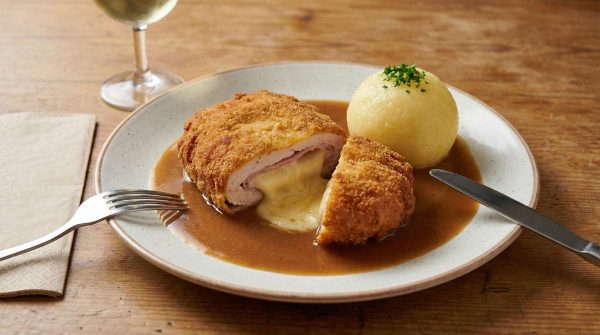
Golden, crispy Cordon Bleu with melted cheese and ham, served with rich brown gravy and a classic Kartoffelknödel.
Few dishes evoke sheer indulgence like a perfectly made Cordon Bleu. More luxurious than a standard Schnitzel, this variant transforms a simple cutlet into a layered celebration of flavour: juicy meat on the outside, savoury ham in the middle and molten cheese flowing gently from the centre. It is decadent, comforting and irresistibly nostalgic — a dish that feels both old-world traditional and timelessly satisfying.
Cordon Bleu is usually prepared with pork or chicken, though veal versions exist in more classical kitchens. The meat is either rolled or folded around thin slices of ham and cheese, then coated in the familiar trio of flour, egg and breadcrumbs before being gently fried or baked. When sliced open, the cheese should ooze in a soft, slow ribbon — not gush out uncontrollably. Achieving that perfect melt is part of the craft.
Historically, the dish is Swiss rather than Austrian or German, though it became deeply woven into Central European home cooking during the 20th century. It remains one of the most beloved comfort meals in Germany and Switzerland, frequently found in Gasthäuser, school canteens, family kitchens and modern European bistros.
Why Cordon Bleu is so beloved:
- Combines three textures: crisp crust, tender meat, melting cheese
- Feels premium without requiring premium ingredients
- Works with pork, chicken or veal
- Pairs beautifully with potatoes, pickles, salads or creamy sauces
- Offers tremendous visual appeal when cut open
- Provides excellent value on pub and restaurant menus
A well-made Cordon Bleu delivers the kind of satisfaction people remember — rich, cosy and deeply rewarding.
Jägerschnitzel — The Forest Classic
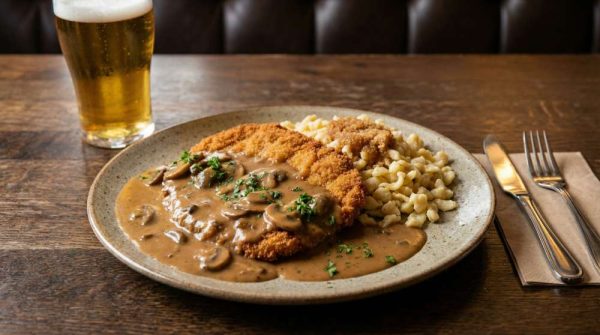
Classic Jägerschnitzel with rich mushroom sauce, golden breaded schnitzel and Swabian-style spätzle, served in a traditional pub setting.
If Schnitzel represents comfort, then Jägerschnitzel represents comfort taken into the woods. Named after the German word Jäger (“hunter”), this iconic dish pairs a crisp pork Schnitzel with a rich, earthy mushroom sauce that smells and tastes like autumn in a forest. Pan-seared mushrooms, onions, stock and cream create a gravy that wraps the Schnitzel in warmth and aroma.
In Germany, Jägerschnitzel is a staple of countryside taverns. It is hearty, generous and almost rustic — the sort of meal enjoyed after a long walk through woodland, ideally with a beer in hand. Variations abound: some regions add bacon, others use mixed mushrooms, and some prefer a lighter, broth-based sauce rather than a creamy one. But the spirit remains the same: a dish rooted in the aromas of the forest.
The sauce is the star, and when spooned over the crisp breading, it creates a beautiful contrast — crunchy beneath, velvety above, with flavours that deepen as you eat. It’s one of the most comforting plates in all of German cuisine and always a bestseller on autumn and winter menus.
What defines classic Jägerschnitzel:
- Always based on pork Schnitzel, never chicken in the German tradition
- Features a mushroom gravy rich in umami
- Sauce ingredients often include mushrooms, onions, stock and cream
- Perfect cold-weather pub dish with high customer satisfaction
- Ideal with fries, spaetzle, rösti, bread dumplings or mashed potatoes
- Appeals to diners who enjoy deep, savoury flavours
Few dishes embody German heartiness more completely than Jägerschnitzel.
Paprika Schnitzel (Zigeunerschnitzel) — The Vibrant Classic
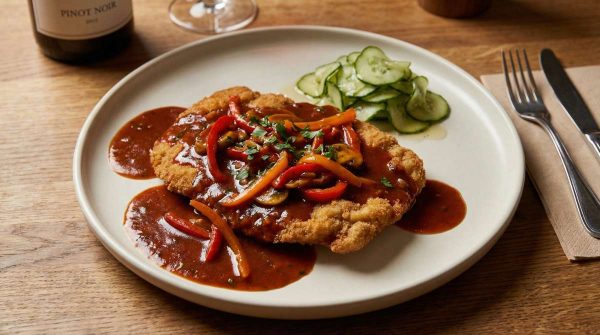
Crispy Zigeunerschnitzel (Paprika Schnitzel) with glossy pepper-tomato sauce, mushrooms and a fresh side of Gurkensalat.
Paprika Schnitzel — historically known as Zigeunerschnitzel — is a colourful, lively and aromatic dish that contrasts beautifully with the richer, earthier flavours of Jägerschnitzel. Instead of mushrooms and cream, it highlights sweet peppers, onions, tomatoes and paprika, resulting in a bright, tangy sauce with a gentle warmth. It is visually striking: red and yellow peppers tumbling over a golden Schnitzel like confetti.
This dish reflects Central Europe’s love for pepper-based cooking, influenced by Hungarian, Balkan and even Mediterranean flavours. The sauce is typically sautéed until the peppers soften and release their sweetness, then simmered with tomato and spices to create a vibrant, lightly spiced topping.
Paprika Schnitzel is ideal for those who enjoy fresher, more aromatic flavours. It’s lighter than Jägerschnitzel, more colourful on the plate, and a perfect match for chips, salads, rice, buttery noodles or even crusty bread.
What makes Paprika Schnitzel special:
- Uses a pepper and tomato-based sauce with paprika spice
- Offers bright, lively flavours instead of heavy richness
- Typically served with pork Schnitzel
- Sauce can be mild or warmly spiced depending on region
- Highly visual dish with strong plate appeal
- Popular choice for pub menus looking for colour and contrast
Where Jägerschnitzel warms you, Paprika Schnitzel wakes you up — a celebration of brightness, sweetness and spice.
Rahmschnitzel — The Cream Sauce Classic
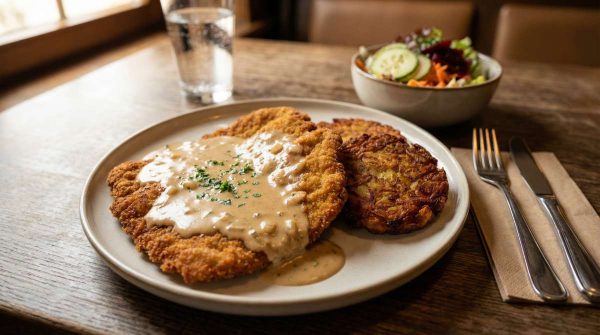
Classic German Rahmschnitzel with rich cream sauce, crisp potato rösti, and a traditional Swabian mixed salad, served in a warm pub setting.
Tender pork Schnitzel coated in a velvety cream sauce, served with buttery Spätzle and fresh parsley on a warm, rustic plate.
A crisp German Rahmschnitzel resting beneath a smooth, aromatic cream gravy — elegant, comforting and unmistakably traditional.
If Jägerschnitzel belongs to the forest, then Rahmschnitzel belongs to the warm glow of a classic German Gasthaus. “Rahm” means cream, and this dish is defined by its silky, savoury sauce that transforms a simple pork Schnitzel into something refined, comforting and deeply satisfying.
The base is always a perfectly fried Schnitzel — golden, crisp and thin — which is then finished with a luxurious cream reduction made from onions, stock and a hint of white wine or brandy. Some kitchens enrich the sauce with mushrooms, while others keep it smooth and elegant. Either way, the flavour is subtle, rounded and full of depth, with the richness of the cream balancing the savoury notes of the meat.
Rahmschnitzel is a staple of German home cooking as well as restaurant menus, especially in southern regions where cream-based sauces are beloved. It is less rustic than Jägerschnitzel and more about refinement: a dish that feels both everyday-easy and restaurant-worthy. Because the sauce does not overpower the breading, it preserves the delicate crispness underneath while adding warming richness to every bite.
Served with Spätzle, Rösti, fries or buttered ribbon noodles, it’s one of the most universally loved Schnitzel variations — smooth, comforting and crowd-pleasing in all seasons.
What defines classic Rahmschnitzel:
- Always based on a pork Schnitzel, thin and crispy
- Finished with a velvety cream sauce (“Rahmsoße”)
- Sauce typically includes cream, stock, onions and sometimes a splash of white wine
- Elegant alternative to Jägerschnitzel — less earthy, more refined
- Pairs perfectly with Spätzle, fries, ribbon noodles or Rösti
- Ideal for diners who enjoy rich, creamy comfort dishes
- A timeless Gasthaus classic that performs year-round on pub menus
Few dishes offer such a perfect balance of crispness and creaminess as Rahmschnitzel — a true comfort classic that keeps guests coming back.
Holsteiner Schnitzel — The Bold Northern Original
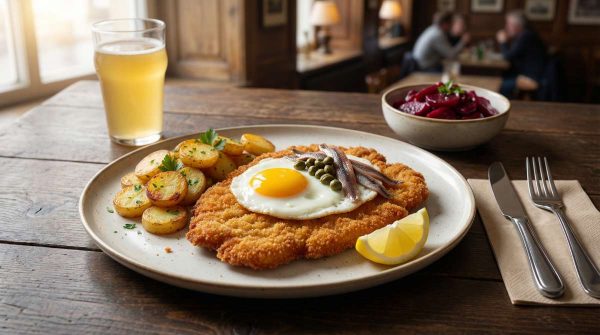
Holsteiner Schnitzel: crisp breaded schnitzel topped with a sunny-side-up egg, anchovies and capers, served with fried potatoes and a lemon wedge.
A crisp pork or veal Schnitzel crowned with a sunny fried egg, garnished with salty sardines and bright capers, served with rustic fried potatoes and a squeeze of lemon.
A striking plate: golden breaded Schnitzel beneath rich egg yolk, accented with briny seafood and tangy capers — a unique expression of Northern German cuisine.
If Jägerschnitzel speaks of the forest, and Rahmschnitzel whispers comfort from a warm Gasthaus, then Holsteiner Schnitzel shouts proudly from the North Sea coast. Originating in Schleswig-Holstein, Germany’s northernmost region, this variation stands out for its bold, salty, maritime flavours and its dramatic presentation. Few schnitzels feel as distinct, as regionally expressive, or as unapologetically seasoned.
The foundation is a classic, golden Schnitzel — perfectly crisp, thin, and tender. What transforms it into Holsteiner style are the three signature garnishes:
- a fried egg, usually sunny-side up, its warm yolk acting as a rich, natural sauce,
- sardines or anchovies, reflecting the coastal heritage of the region,
- and capers, adding acidity, tang and freshness.
Together, these elements create an extraordinary interplay of textures and tastes: the crunch of the breading beneath the creamy yolk, the savoury depth of the sardines, and the bright, pickled lift from the capers. It’s a dish that balances richness with sharp, maritime character — hearty yet vibrant, rustic yet sharply defined.
Historically, the dish is said to be associated with Friedrich von Holstein, a 19th-century diplomat whose fondness for this combination helped popularise it in Berlin and beyond. Whether legend or fact, the association speaks to its distinctive personality — this isn’t a subtle schnitzel; it’s a statement plate.
Today, Holsteiner Schnitzel remains a beloved regional favourite in Northern Germany. It is often served with Bratkartoffeln, parsley potatoes, or refreshing cucumber salad, all of which help balance the dish’s salty, savoury intensity. Because of its dramatic appearance and memorable flavour profile, it performs exceptionally well as a pub special or seasonal highlight — especially for diners who appreciate robust, confident flavours.
What defines classic Holsteiner Schnitzel:
- Based on pork or veal Schnitzel, always crisp and golden
- Topped with a sunny fried egg (Spiegelei)
- Garnished with sardines or anchovies
- Finished with capers for acidity and balance
- Strong, salty, savoury flavour profile with Northern maritime character
- Perfect with Bratkartoffeln, cucumber salad, pickles or beetroot salad
- A visually striking dish ideal for pub specials and themed menus
Few schnitzel variations offer such personality and regional identity as Holsteiner Schnitzel — bold, colourful and entirely unforgettable.
Other Schnitzel Variants You Should Know
Beyond the classic styles we’ve already covered, these lesser-known or more niche schnitzel variants add extra flavour, fun or regional flair. They could be great ideas for specials, seasonal menus or future recipe posts:
- Bolognese Schnitzel — A schnitzel smothered in rich Italian-style Bolognese sauce with melted cheese — merging German comfort with Italian heartiness.
- Hawaii Schnitzel — A throwback favourite topped with ham, pineapple rings and melted cheese; sweet-salty-savory, ideal for casual pub menus.
- Münchner Schnitzel (Mustard & Horseradish Style) — Schnitzel brushed with Bavarian mustard and horseradish before breading — aromatic, slightly spicy and full of character.
- Parmesan Schnitzel (Italian-inspired) — Schnitzel served with tomato sauce and melted Parmesan cheese — a crispy, umami-rich crossover.
- Schwäbisches Schnitzel (Swabian Style) — A southern-German variation often served with Spätzle or regional sauces — rustic, home-style and comforting.
- Frankfurter Schnitzel with Green Sauce — Schnitzel served with Frankfurt’s famous herbal “Green Sauce” — fresh, herbal and very different from creamy or mushroom sauces.
- Tiroler Schnitzel (Alpine Style) — Topped with speck, onions and melted cheese — smoky, hearty and alpine.
- Zwiebel-Schnitzel (Onion Schnitzel) — Served with caramelised or crispy fried onions (and often gravy) — deliciously sweet-savoury and rustic.
- Bauernschnitzel (Farmer’s Schnitzel) — A hearty build topped with fried potatoes, onions, bacon and sometimes a fried egg — a rustic comfort classic.
- Cream-Paprika Schnitzel (Rahm-Paprika Style) — Schnitzel with a creamy paprika sauce — rich, smoky and slightly spicy.
- Green Pepper Schnitzel (Pfefferrahmschnitzel) — Schnitzel served with a green peppercorn cream sauce — peppery, creamy and aromatic, similar to a pepper-steak sauce.
- Schnitzel Burger — A modern hybrid: breaded Schnitzel in a bun with toppings and sauce — ideal fast-casual or pub-burger menus.
- XXL Schnitzel (The Monster Schnitzel) — An oversized schnitzel (200–400 g) served as a novelty dish or share plate — makes for strong social-media appeal.
- Camembert & Cranberry Schnitzel — Schnitzel topped with fried/baked Camembert and cranberry sauce — creamy and slightly sweet, a comfort-food fusion.
- Balkan Schnitzel with Ajvar — Schnitzel topped with ajvar (roasted pepper and aubergine spread) instead of tomato sauce — smoky, peppery and slightly spicy.
The Best Side Dishes for Schnitzel
A great Schnitzel deserves an equally thoughtful side dish. In Austria and Germany, the accompaniments are just as important as the cutlet itself — they balance richness, add freshness, provide contrast and complete the plate visually. Whether crisp and golden, creamy and comforting or cool and refreshing, the right side elevates Schnitzel from a simple fried cutlet to a perfectly rounded meal.
Schnitzel’s versatility makes it ideal for pairing with a wide variety of sides, from traditional Alpine classics to modern pub favourites. The key is balance: the crisp, savoury coating of the Schnitzel benefits from bright acidity, gentle sweetness, or a soft starch that absorbs flavour beautifully.
Below are the most traditional — and most delicious — sides to serve with Schnitzel, each bringing its own character and purpose to the dish.
1. Potato Salad (German or Austrian Style)
One of the most iconic Schnitzel pairings. In Austria, Viennese potato salad is lightly warm, tangy and dressed with broth, vinegar and mustard — never mayonnaise. Its acidity cuts through the richness of Wiener Schnitzel, creating a perfect balance.
In Southern Germany, potato salads may be slightly creamier or include bacon, onions or herbs.
Why it works:
- Light acidity balances fried food
- Soft texture contrasts with crisp breading
- Authentic pairing loved across Central Europe
2. Lemon Wedges
Not exactly a “side dish,” but absolutely essential. A squeeze of lemon brightens the entire dish, sharpening the flavour of the meat and cutting through the butter or oil.
Why it works:
- Adds freshness and acidity
- Enhances the golden crust
- Traditional for Wiener Schnitzel
3. Cucumber Salad (Gurkensalat)
Thinly sliced cucumbers in a light vinegar dressing with dill, sugar and salt. Cool, refreshing and aromatic, it offers a welcome contrast to hot Schnitzel.
Why it works:
- Refreshing temperature contrast
- Cleanses the palate between bites
- Simple, classic and beautifully light
4. Mixed Leaf Salad
A crisp green salad with a bright vinaigrette is a popular modern companion. It turns the dish into a fresher, lighter plate — ideal for summer service or health-conscious diners.
Why it works:
- Adds freshness and crunch
- Balances the meal nutritionally
- Keeps the dish from feeling too heavy
5. Chips / Fries
A favourite in pubs worldwide. Crisp French fries or chunky chips are universally loved, cost-efficient, and pair naturally with breaded dishes.
Why it works:
- Textures complement each other
- Familiar and comforting
- Great for pub-style Schnitzel plates
6. Spaetzle (German Egg Noodles)
Soft, comforting and wonderfully traditional, Spätzle are one of the most beloved side dishes across Southern Germany, Austria and Switzerland. These tiny, irregular egg noodles are made from a simple dough of flour, eggs, salt and water, then pressed or scraped into boiling water and finished in a hot pan with butter until lightly golden. Their tender, chewy texture makes them the perfect counterpoint to crisp Schnitzel.
Spätzle are especially popular with saucy Schnitzel dishes such as Jägerschnitzel or Rahmschnitzel, because the small noodles absorb gravy beautifully. They can also be enriched with cheese (Käsespätzle), herbs or caramelised onions for extra depth.
Why it works:
- Soft, buttery texture balances the crisp coating of Schnitzel
- Ideal for sauced Schnitzel (mushroom, paprika, cream sauces)
- Traditional pairing in Southern Germany and Austria
- Highly comforting, perfect for cold-weather menus
- Elegant enough for restaurants yet homely enough for family kitchens
A plate of Schnitzel with warm, buttery Spätzle is one of the most iconic combinations of the entire Central European region — satisfying, nostalgic and deeply crowd-pleasing.
7. Bratkartoffeln (German Fried Potatoes)
Bratkartoffeln are a classic German side dish made from sliced or cubed potatoes pan-fried until golden and crisp. They’re traditionally cooked with onions and, in many regions, smoky bacon or speck to deepen the flavour. The result is a wonderful contrast of textures: crisp edges, tender centres and a savoury richness that pairs beautifully with any pork Schnitzel.
Rustic, hearty and deeply satisfying, Bratkartoffeln turn a simple Schnitzel plate into a full, comforting German pub-style meal.
Why it works:
- Deep savoury flavour
- Slight smokiness pairs well with pork
- Makes a heartier, pub-ready plate
8. Sauerkraut
Fermented cabbage (Sauerkraut) may seem unexpected, but its acidity and lightness complement Schnitzel beautifully. Common in many German regions.
Why it works:
- Cuts through fried richness
- Adds probiotic brightness
- Traditional in Southern Germany
9. Kartoffelknödel / Bread Dumplings
Soft dumplings made from potatoes or bread. Hearty and satisfying, especially good with mushroom or cream sauces.
Why it works:
- Excellent sauce absorbency
- Adds warming, rustic character
- Ideal for winter menus
10. Buttered Rice or Herb Rice
A simple, neutral side often found in Austrian households. Rice allows the Schnitzel to stand out while offering a comforting base.
Why it works:
- Light, neutral flavour
- Versatile pairing for all meat types
- Works especially well with Chicken Schnitzel
How to Choose the Perfect Side for Each Schnitzel Type
Wiener Schnitzel
✔ Potato salad
✔ Cucumber salad
✔ Lemon
✔ Parsley potatoes
Pork Schnitzel
✔ Fries
✔ Bratkartoffeln
✔ Spaetzle
✔ Sauerkraut
Chicken Schnitzel
✔ Mixed salad
✔ Rice
✔ Chips
✔ Cucumber salad
Jägerschnitzel
✔ Spaetzle
✔ Bread dumplings
✔ Mashed potatoes
Paprika Schnitzel
✔ Rice
✔ Chips
✔ Spaetzle
✔ Mixed salad
The Key Rule: Contrast Matters
Schnitzel pairs best with sides that offer:
- Acidity (lemon, vinegar dressings)
- Freshness (salads, cucumbers)
- Soft textures (potato salad, Spaetzle)
- Comforting starch (chips, dumplings)
In other words, the side dish should support the Schnitzel — not compete with it.
FAQs About Schnitzel
It depends on tradition and preference. For example, authentic Wiener Schnitzel from veal is often served simply with lemon, potato salad or parsley potatoes — no sauce. But German-style schnitzels frequently come with sauces (mushroom, cream, pepper) and hearty sides — especially when using pork or other meats.
Yes. Schnitzel is almost infinitely adaptable: you can use pork instead of veal, chicken or turkey for leaner options, or even explore unbreaded versions. It’s a concept — thin cutlet + quick fry — that works with many meats and budgets.
Yes. While veal (Wiener) and pork (German-style) are most common, schnitzel can also be made from chicken, turkey, beef — even more unusual cuts when needed. This flexibility makes schnitzel a versatile option for any kitchen.
Veal (Wiener) delivers delicate, tender texture and classic authenticity. Pork gives a meatier, more robust flavour — ideal for sauce-based variants. Chicken/turkey offers a lighter, lean option; beef or even game can be used for richer, heavier takes.
Definitely. Its combination of classic European comfort food, quick cooking time, flexibility in meat/toppings, and crowd-pleasing appeal makes schnitzel a strong candidate for pub menus, seasonal specials or comfort-food offerings.
Whether you serve a simple schnitzel with lemon and fries or a rich, saucy variant, it delivers satisfying flavour, consistent portioning and good margins.
- Jägerschnitzel — topped with a rich mushroom or brown gravy.
- Rahmschnitzel — featuring a creamy sauce, sometimes with mushrooms or herbs.
- Zigeunerschnitzel — served with a tangy bell-pepper and tomato-style sauce.
- And even unbreaded, pan-fried variants (sometimes called “Schnitzel Natur”).
raditionally, Wiener Schnitzel must be made from veal, thinly pounded, breaded and fried crisp — that’s the Austrian standard. If pork is used instead, it’s often labelled “Schnitzel Wiener Art” (Viennese-style) or “Wiener Schnitzel vom Schwein.”
A regular Schnitzel is simply breaded and fried meat, while Cordon Bleu is filled with ham and cheese before being breaded and cooked. The filling creates a richer, more indulgent dish with a molten cheese centre.
A great schnitzel combines tender, evenly pounded meat with crisp, light breading (or a clean pan-fry for unbreaded versions). The coating must fry quickly and cleanly — not soak up oil — to stay crisp. Freshness, correct breading technique and fast frying are key.
Depending on region and style, schnitzel might be served with: potato salad, parsley potatoes, fries, spätzle (egg noodles), or a simple cucumber- or garden-style salad. When gravy or rich sauces are involved, something light and fresh or slightly acidic often balances the dish nicely.
About The Sausage Haüs
The Sausage Haüs proudly supplies premium German sausages and Continental specialities to UK pubs, restaurants, caterers and hospitality businesses. Working with Hardy Remagen, one of Germany’s most respected producers, and distributed in the UK by Baird Foods, we ensure exceptional quality, consistency and flavour across every product.
From Bratwurst and Bacon Frankfurters to Cheese Frankfurters, Chilli Beef Frankfurters and speciality items like the Munich Weisswurst, our range helps kitchens deliver high-margin, crowd-pleasing dishes with minimal labour.
Conclusion
Schnitzel is far more than a simple breaded cutlet — it is a culinary tradition shaped over centuries by Austria, Germany and the broader cultures of Central Europe. Each region has contributed its own nuance: the refined, almost ceremonial elegance of Wiener Schnitzel; the hearty, generous comfort of Pork Schnitzel; the modern, universally loved appeal of Chicken Schnitzel; and the saucy indulgence of classics like Jägerschnitzel, Paprika Schnitzel and Cordon Bleu. Together, they form a family of dishes that is as diverse as it is comforting, proving that a well-prepared Schnitzel can be both humble and extraordinary at the same time.
What makes Schnitzel so enduring is its balance of craftsmanship and accessibility. It demands care, attention and respect for technique, yet the ingredients are simple and readily available. You don’t need rare produce or elaborate equipment — only good meat, fresh breadcrumbs, the right frying method and a willingness to embrace the small details that elevate a humble cutlet into something truly special. This is why Schnitzel has stood the test of time: it is deeply familiar, yet always capable of surprising with its lightness, flavour and versatility.
For UK pubs, restaurants and home cooks alike, Schnitzel presents a remarkable opportunity. Its wide appeal makes it a reliable crowd-pleaser; its efficient preparation suits busy service kitchens; and its aesthetic — golden, crisp, generously portioned — delivers premium plate appeal at an excellent margin. Few dishes tick as many boxes for modern hospitality: adaptable, profitable, comforting, international and unmistakably satisfying.
With the recipes, insights and techniques in this guide, you now have everything you need to bring authentic Schnitzel heaven into your kitchen. Whether you’re perfecting a traditional Wiener Schnitzel or exploring the bold flavours of a Jägerschnitzel or Paprika Schnitzel, the tools are in your hands. Master the fundamentals, embrace the variations and enjoy the timeless pleasure of a beautifully cooked Schnitzel — a dish that continues to unite tradition, comfort and culinary joy across generations and continents.