A hotdog sandwich is one of the most operationally attractive menu items in UK foodservice: fast to serve, easy to portion, and highly adaptable across dayparts and service formats. Yet it is often treated as “just a hotdog,” which depresses perceived value and leaves margin unrealised. With a tighter build specification—bun structure, sausage finishing, sauce strategy, and topping balance—the same format can move from low-value add-on to a signature item customers actively choose.
This guide is written for chefs and operators who want improvements that are repeatable during service, cost-controlled, and clearly visible to customers. It sets out five practical upgrades that materially improve flavour, texture, presentation, and buying confidence without adding unnecessary complexity.
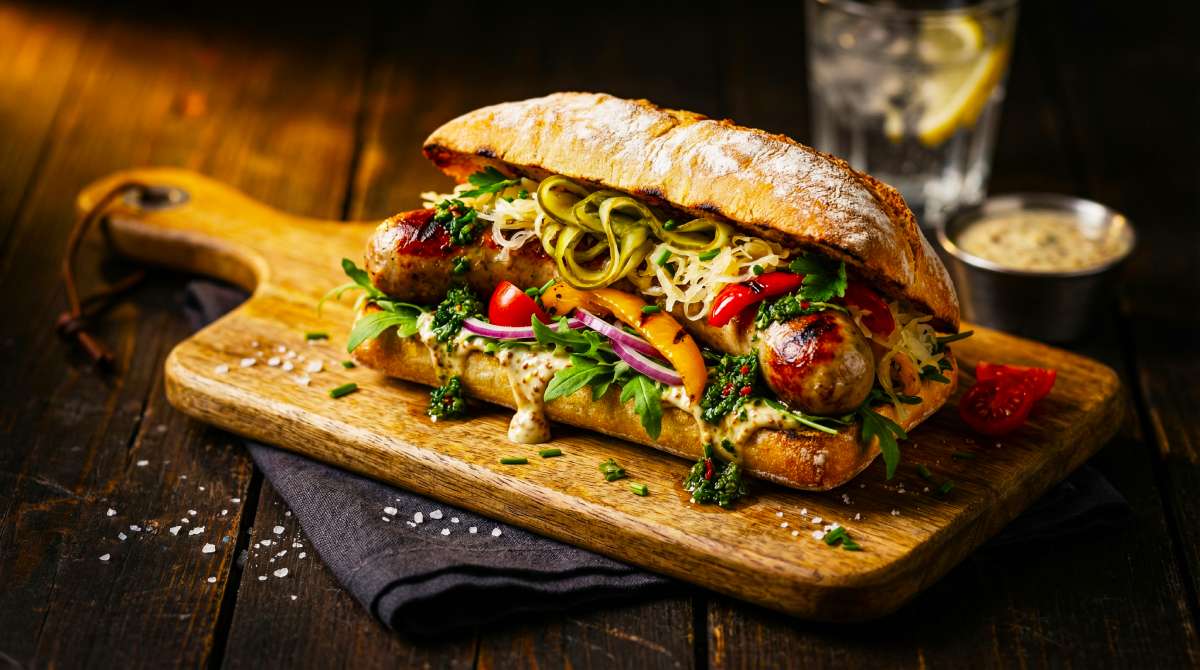
Chef-style hotdog sandwich: Bratwurst in a crusty roll with fresh, crunchy toppings and a balanced sauce finish.
Introduction
Hotdogs are easy to sell, but they are also easy to get wrong. In UK foodservice, the hotdog sandwich is often treated as a “quick win” item—something you can serve fast with minimal labour. That is true. The problem is that the same simplicity makes it easy to drift into mediocrity. If the bun goes soggy, the sausage looks pale, the sauces overwhelm the bite, or the toppings feel random, the whole thing reads as “canteen” rather than “crafted.” Customers might still buy it once, but it will not earn repeat orders, it will not photograph well, and it will not justify a premium price.
The good news is you do not need fancy ingredients to elevate a hotdog sandwich. You need a better system: a tighter build, clearer roles for each component, and a few service-friendly standards that make the result consistent every time. When you get the fundamentals right, the same hotdog sandwich becomes a high-perceived-value product: better eating experience, cleaner presentation, stronger customer confidence, and a more reliable margin.
Below are five chef-level upgrades you can apply immediately, even during busy service. They are designed to be practical: minimal extra labour, easy to train, and visibly “worth paying for” from the customer’s perspective. Where it makes sense, I reference The Sausage Haüs range—produced by Remagen in Germany and distributed in the UK by Baird Foods—because a consistent, high-performing sausage is the foundation that makes every other improvement work. Once your core product performs reliably, improvements like better buns, smarter sauces and more balanced toppings deliver predictable results rather than variable ones.
We’ll start with the biggest lever (the bun), then move through sausage finishing, sauce strategy, topping design, and finally the operational side—how to engineer a small set of variants that sell well without slowing down your line.
Upgrade the bun first: structure, toast, and steam management
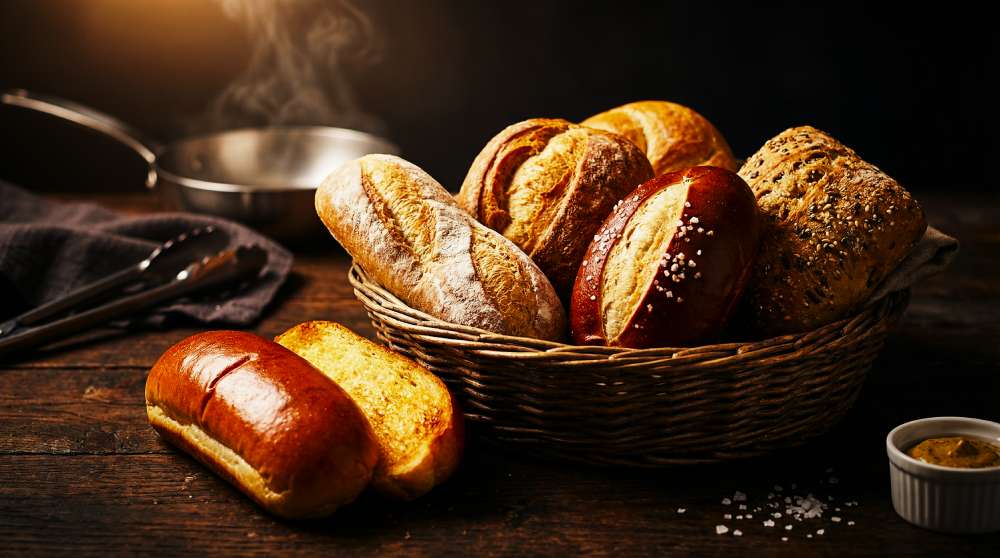
Upgrade the bun first: structure and a toasted cut face are the foundation of a premium hotdog sandwich.
Most “average” hotdog sandwiches fail at the bun. Operators can spend money on a better sausage, add more toppings, and still end up with a product that feels cheap—simply because the bun collapses, tears, or goes soggy. Once the bread loses structure, the customer experience drops fast: the sandwich becomes messy to eat, it looks poorer on the plate, and it does not travel well in a takeaway box. In practical terms, the bun is not just a carrier; it is part of the engineering.
A good bun does three jobs: it holds the sausage firmly, it resists moisture for long enough to be enjoyed, and it provides texture contrast (a little crust, a soft interior). Get those right and the whole hotdog sandwich immediately reads as more premium.
What to do (chef-standard, service-friendly)
1) Choose a bun with structure
Aim for an artisan-style roll or hotdog bun with a slightly stronger crust and tighter crumb. A German-style Laugenbrötchen (a small pretzel-style roll with a dark, glossy crust and a light salt finish) is a great option if you want something more distinctive without sacrificing structure.. It should hold shape under heat and sauce and not “split” as soon as it is handled. Soft, fluffy buns can still work, but only if they have enough surface strength to resist moisture and a cut that does not tear under pressure.
Practical buying note for foodservice: the best buns for hot service are often slightly denser than the sweetest retail-style options. Sweetness is fine, but structure matters more than sweetness when you are adding hot sausage and sauces.
2) Toast the cut faces, not the whole bun
Toasting the internal faces is one of the highest-impact upgrades you can make. You want a lightly crisp internal surface that resists fat and sauce and adds a “crafted” texture. Do not toast the exterior aggressively—if you dry the whole bun, it can feel tough and it will crack when the customer bites.
- Light buttering or a thin oil wipe improves browning and flavour.
- A flat top is ideal for consistency; a salamander works if you control time and distance.
- Standardise the toast: “light golden, not brown” is usually the right spec for hotdog sandwiches.
3) Control steam and condensation
Steam is the hidden bun killer. If the sausage goes into the bun straight from a steamer or hot-hold, and the bun is then closed and boxed, condensation forms quickly and turns the crumb soggy. This is why a hotdog sandwich can look perfect at the pass and fall apart two minutes later.
A simple control system:
- Drain briefly before building (even 15–30 seconds helps).
- If you must steam, keep the sausage hot but avoid excessive surface moisture.
- In takeaway service, avoid sealing the box immediately if the product is extremely hot—trapped steam will do damage fast.
Operational shortcut that works: the “bun barrier”
Use a barrier layer that adds value and protects the bread. The point is not garnish; it is moisture control and bite structure.
Strong options that work at pace:
- Shredded lettuce or a small bed of rocket (adds airflow + crunch)
- A thin line of mustard (creates a hydrophobic layer)
- Sauerkraut (good barrier and flavour, but portion control matters)
- A smear of thick sauce (mustard-mayo, cheese sauce, or a reduced relish)
If you run a two-sauce system, put the thicker sauce inside as the barrier and the looser sauce on top. That small switch materially improves holding performance.
Result
When the bun is right, the rest of the build has a chance to shine. You get a cleaner bite, a sandwich that travels better, fewer returns and complaints, and a more premium first impression. In customer terms, it is the difference between “a hotdog” and a hotdog sandwich that feels deliberately made.
Treat the sausage as the hero: colour, snap, and portion discipline
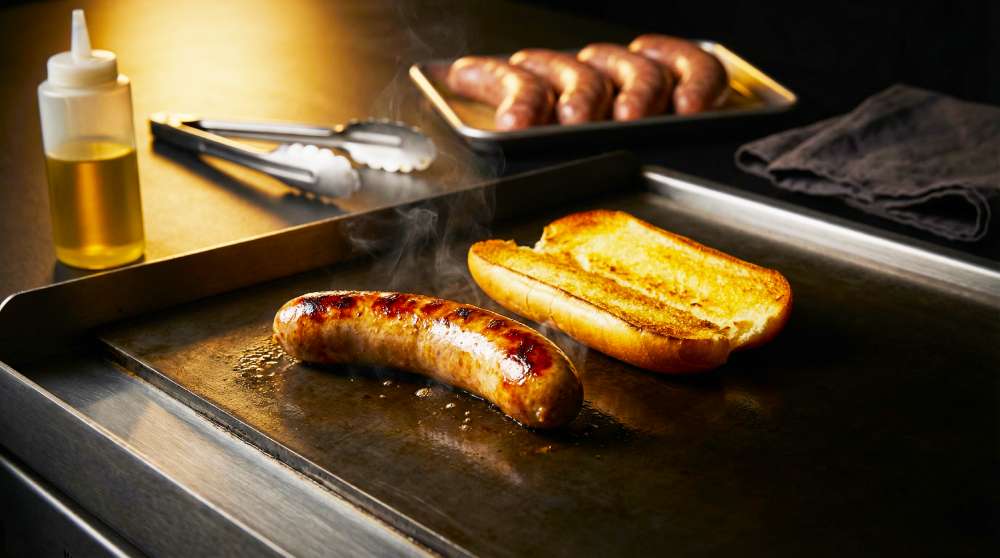
Chef-level basics: brown the sausage for colour and aroma, and toast the bun cut faces for structure.
A hotdog sandwich only feels premium when the sausage looks and tastes premium. Operators often focus on toppings first, but customers judge quality in seconds: what they can see and smell at the pass. If the sausage looks pale, wet, or “boiled,” the product reads as low effort—even if the sausage itself is good. Conversely, a properly finished sausage with appetising colour, a clean bite, and consistent portioning instantly signals care and value.
A strong sausage choice matters just as much as finishing technique. For a premium hotdog sandwich line, our best-performing options are Bratwurst (classic, high appeal and excellent browning), Bacon Frankfurter (smoky depth that reads “premium” immediately), Cheese Frankfurter (rich, indulgent, and ideal for higher-priced variants), and Chilli Beef Frankfurter (a clean, spicy lift that pairs especially well with pickles, herbs and cooling sauces). All four give you consistent portion formats and strong flavour identity—so the hotdog sandwich tastes intentional, not generic.
In practical terms, “premium” comes down to two things: a product that performs in service, and a finishing method that delivers colour and aroma without slowing the line.
Chef moves that elevate instantly
1) Add colour deliberately (browning is your cheapest premium signal)
A quick griddle or pan finish creates Maillard browning, better aroma, and a stronger visual cue of craftsmanship. Steamed-only sausages often read as “canteen” because they look soft, glossy-wet, and uniform. Browning reads as “crafted” because it shows heat work and creates natural variation in colour.
Service-friendly finishing options:
- Flat top / plancha: fastest and most consistent; you control contact and colour.
- Chargrill: high-impact aroma and visual char; best for premium positioning.
- Pan finish: ideal for small kitchens; use a wide pan, avoid crowding.
Practical standards:
- Aim for even colour with a few darker points (not scorched).
- Use a light oil film only if needed—too much oil makes sausages look fried rather than grilled.
- Finish sausages in small batches so you are not trading colour for speed.
2) Protect the snap (texture is where customers notice “quality”)
If you use natural casing products, texture is a key differentiator. The “snap” is what makes a sausage feel premium. Aggressive boiling and long hot-holds soften casings and can push fat out, leaving the sausage dull and sometimes wrinkled.
To protect texture:
- Avoid rolling boils. Use gentle heat (simmer/steam) if you need pre-heat.
- If you pre-heat, keep the time controlled, then finish on the griddle for colour.
- Keep hot-holding tight: hold hot, but do not hold forever. If you need extended holding, hold in a way that reduces moisture damage to the casing (and finish to order where possible).
A simple operational model that works well:
- Heat through (controlled) → finish for colour (fast) → serve immediately.
3) Standardise portion format (consistency builds trust and justifies price)
Customers notice inconsistency immediately. If one hotdog sandwich is overstuffed and the next looks small, trust drops—even if the price is the same. Standardisation also protects food cost and speeds up training.
What to standardise:
- Sausage length/weight: one product spec per menu item.
- Build spec: one bun length + one sausage length + defined topping volumes.
- Cut policy: decide if sausages are served whole, scored, butterflied, or cut into sections. Then enforce it.
If you want to sell a “premium” hotdog sandwich, consistency is not optional. It is what allows you to price with confidence and deliver the same experience every time.
4) Choose a sausage designed for service performance
This is where German-style manufacture tends to help: sausages engineered for consistent bite and handling under real service conditions reduce variance and make results easier to repeat. The Sausage Haüs range is produced by Remagen (Germany) and distributed in the UK by Baird Foods, supporting a more repeatable outcome for operators—especially where speed, hot-holding, and high throughput are realities rather than exceptions.
Result
Do these three things—colour, snap protection, and portion discipline—and the hotdog sandwich becomes visibly more premium without changing your station layout. You get a stronger aroma, better visual appeal, cleaner eating texture, and a clear perception of quality that customers recognise immediately.
Build flavour with a “two-sauce system” (base + top), not one heavy sauce
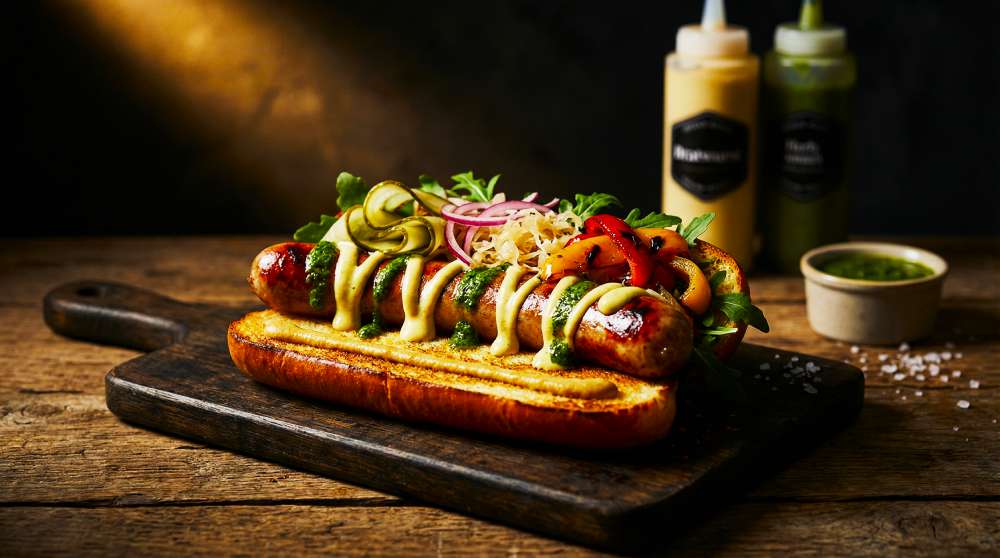
A premium hotdog sandwich build: toasted bun, browned sausage, crunchy toppings and a controlled two-sauce finish.
Most operators rely on one sauce and then over-apply it. It is understandable: sauce is quick, cheap, and it hides small flaws. The downside is predictable. The sandwich becomes wet, messy, and one-dimensional. The bun softens early, the sausage loses definition, and the customer experience turns into “sauce delivery” rather than a composed hotdog sandwich.
A better approach is a two-sauce system that creates contrast and control. It is the same principle used in well-built burgers and sandwiches: one element delivers sharpness and structure, the other delivers roundness and finish. Done properly, it makes the hotdog sandwich taste cleaner, look more premium, and hold up better in a takeaway box.
How it works
1) Base sauce (thin line): sharpness + structure
The base sauce has two jobs. First, it cuts richness and anchors the first bite. Second, it acts as a functional layer that helps manage moisture, especially if you place it on the toasted cut face of the bun.
Use something with acid and punch, applied sparingly:
- Wholegrain mustard
- Dijon mustard
- German mustard
- Mild American mustard
- A vinegar-forward sauce (e.g., pickle brine mayo, burger relish with extra acidity)
Application standard: a thin line, not a blanket. You want flavour impact without flooding the bun.
2) Top sauce (controlled finish): creaminess + cohesion
The top sauce is the “finishing” element. It rounds out heat and acidity, adds a premium visual cue, and makes toppings feel integrated rather than piled.
Use something creamy or herb-led, applied deliberately:
- Mustard-yoghurt sauce
- Herby mayo
- Light garlic sauce
- Green herb sauce (chimichurri-style, but thickened enough to sit)
Application standard: controlled stripes or dots that sit on the topping, not run through it.
Why two sauces work better than one
- Flavour contrast: sharp base + creamy finish prevents “flat” taste.
- Better bite order: the first bite is anchored and defined; later bites stay interesting.
- Moisture management: the bun holds longer because you are not saturating it.
- Premium perception: two sauces look intentional and chef-led, not improvised.
Rules for service consistency (non-negotiable if you want repeatability)
1) Standardise squeeze bottles and nozzles
Use the same bottle type, and mark them clearly. If one shift has a wide nozzle and the next has a narrow nozzle, your portion control collapses.
2) Define the build in grams
Set a clear spec, then train to it:
- 10 g base sauce + 15 g top sauce is a good starting point for most hotdog sandwiches.
If your buns are smaller or your sausage is leaner, adjust down. The important part is consistency.
3) Keep sauces thick enough to sit
If the sauce runs, it will migrate into the bun and destroy structure. Thicken where necessary:
- Use yoghurt sauces with enough body.
- Emulsify herb sauces slightly (or use a thicker herb mayo).
- Avoid watery relishes unless used sparingly as a topping, not a primary sauce.
4) Place sauces with intent
- Base sauce goes inside (toasted face).
- Top sauce goes on top (visual finish).
This simple placement improves holding performance and presentation immediately.
Why this matters commercially
Sauce is the cheapest premium signal you can add. You can make a hotdog sandwich feel “crafted” without changing protein cost, and without adding prep complexity. Two sauces also photograph better: they create contrast, gloss, and visual cues of care—exactly what supports menu pricing and social content.
It also enables a clean price ladder:
- Standard hotdog sandwich (one sauce)
- Premium hotdog sandwich (two sauces + a defined topping set)
That price step is easier to justify because it looks different at a glance.
Result
A two-sauce system delivers more balanced flavour, better presentation, and a build that stays stable in a takeaway box. It also gives you a consistent spec your team can execute at speed—so the premium result is repeatable, not occasional.
Use “healthy” toppings that still eat like comfort food: crunch + acid + freshness
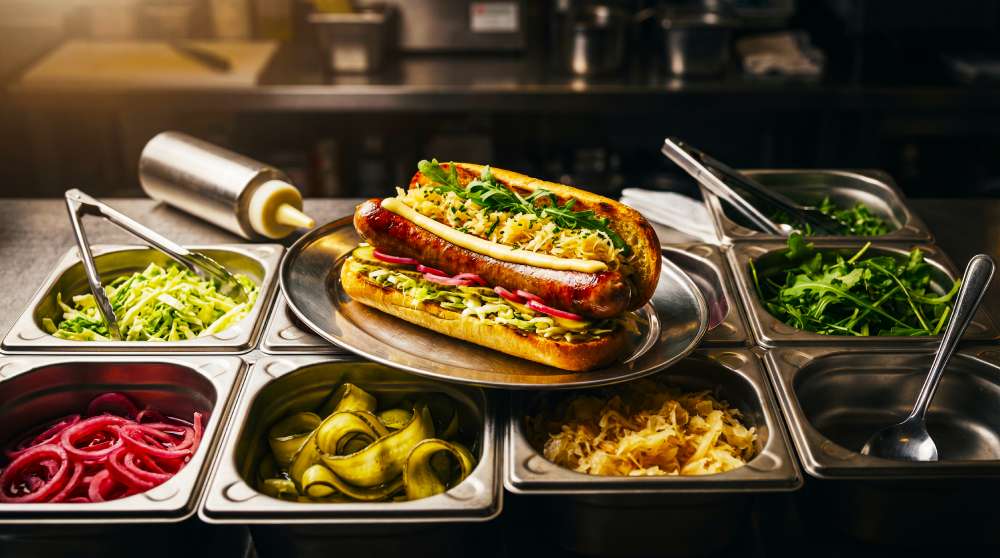
Service-ready hotdog sandwich build: portioned toppings in gastro pans for speed, consistency and a premium finish.
“Healthy toppings” do not mean a sad salad on a sausage. In a hotdog sandwich, the role of healthier components is functional and commercial: they improve the eating experience, lift perceived quality, and make the product feel less heavy without removing the comfort-food appeal people actually want. Done properly, they make the sausage taste better, the sauces taste cleaner, and the bun hold up longer.
Think of it as engineering balance. Hotdogs are naturally rich: warm bread, savoury sausage, and often a creamy sauce. If everything in the build is soft and rich, the sandwich becomes one-note. The fix is simple: add crunch, add acidity, add freshness—and keep those elements consistent in portioning and placement.
What “healthy” really means here
- Crunch gives structure and keeps the bite interesting.
- Acidity cuts fat and prevents the sandwich from tasting greasy.
- Freshness lifts aroma and makes the whole build feel lighter and more modern.
This is not a diet message. It is a quality message. Customers may not consciously identify the “why,” but they will feel the difference and they will be more likely to reorder.
A practical topping framework (fast to prep, easy to portion)
1) Crunch (texture and structure)
Choose one primary crunch element and standardise it.
- Shredded lettuce/romaine (reliable, cheap, holds well)
- Cabbage slaw (excellent structure, works with sauces)
- Sliced radish (high crunch, premium signal when used neatly)
- Crispy onions (use sparingly; great for a premium finish, but can dominate)
Operator note: Crunch also protects the bun. A thin bed of crisp topping creates a barrier between bread and wet sauces.
2) Acid (fat cutting and “Imbiss brightness”)
Acid is what stops the sandwich tasting heavy after three bites.
- Pickled cucumber ribbons (strong visual, consistent acidity)
- Pickled red onions (fast prep, strong colour contrast)
- Sauerkraut (classic German relevance; portion control matters)
- Pickled jalapeños (acid + heat; works especially well with creamy sauces)
Operator note: If you only change one thing in a heavy hotdog sandwich, add a properly portioned acid component. It makes everything else taste cleaner.
3) Freshness (aroma and modern feel)
Freshness is what makes it feel “made today,” not “assembled.”
- Rocket (arugula) (peppery lift; very effective in small amounts)
- Herbs: chives, parsley (best as a final sprinkle)
- Diced tomatoes (use drained; tomatoes can add unwanted moisture)
- Sliced spring onions (fresh bite and aroma, very service-friendly)
Operator note: Fresh elements should be added late in the build so they stay vibrant and don’t wilt under heat.
4) Optional richness (small and controlled)
A little richness is fine—it is comfort food—but it must be deliberate.
- Avocado slices (small amount; adds creaminess without extra sauce)
- A small amount of cheese (use a defined weight)
- A creamy sauce (portion controlled; do not let it become the dominant texture)
The rule is simple: if you add richness, you must also add acid and crunch, otherwise the sandwich becomes heavy again.
Placement matters (to keep it “comfort food”, not messy)
A clean build order improves both eating quality and takeaway stability:
- Bun (toasted faces)
- Base sauce (thin, sharp line)
- Crunch layer (acts as a structural bed)
- Sausage
- Acid components (pickles, kraut, onions)
- Top sauce (controlled finish)
- Freshness (herbs/rocket as final lift)
This order protects the bun, keeps the sausage central, and stops the toppings turning into a slippery pile.
Key service discipline: speed without chaos
The difference between “a nice idea” and a repeatable hotdog sandwich is preparation discipline.
- Pre-prep toppings into labelled gastro pans.
- Use portion tools (spoodles, tongs, measured scoops).
- Define a build spec in grams where possible.
- Train the team that a “handful” is not a standard.
When you standardise the topping system, you get faster service, fewer errors, and a consistent product that customers trust.
What this achieves (customer + commercial)
You keep the emotional promise of comfort food—warm bread, satisfying sausage, indulgent sauces—but the eating experience becomes lighter, brighter, and more modern. That supports repeat purchases, improves photography and menu appeal, and broadens your audience to include customers who would normally skip a hotdog sandwich because they expect it to feel heavy or greasy.
Engineer the product for throughput and margin: one base build, three variants
A menu item is only commercially strong if it can be executed reliably in peak service. The hotdog sandwich is often treated as an “easy add-on,” but the best operators treat it like any other engineered product: defined build, repeatable station, tight portion control, and clear reasons to trade up. That is how you protect margin and create something customers order on purpose, not by default.
The easiest way to elevate a hotdog sandwich without creating complexity is to design one base build and then offer two or three named variants that share 80–90% of the same prep. This keeps your mise en place stable, reduces training time, and avoids the classic trap of adding “specials” that slow down service and create waste.
The objective is simple: one station, one workflow, multiple price points.
Step-by-step menu engineering approach
1) Define the base hotdog sandwich (the non-negotiable core)
Your base build should be the version that:
- is fastest to execute,
- travels well,
- tastes balanced without extra steps, and
- sets the standard for portioning.
A strong base spec looks like:
Bun with structure + hero sausage + sharp base sauce + core topping
Examples of a core topping that performs: slaw (crunch + structure) or sauerkraut (acid + German relevance).
Make the base build the “default” hotdog sandwich on the menu. Everything else is a controlled variation, not a new product.
Operator detail that matters:
Write the base build as a short build card: bun type, sausage type/size, sauce grams, topping grams. This is what keeps the product consistent when the kitchen is under pressure.
2) Add variants that look different but share the same station
Variants should be visually distinct enough that customers immediately understand the difference, but operationally similar enough that the kitchen barely notices. This is where most menus either win or fail.
A strong framework is three variants with clear flavour identities:
- Variant A: “Herb & Pickle”
Green herb sauce + pickles + herbs (fresh, bright, modern).
Uses the same base build, just swaps the top sauce and adds a pickled element. - Variant B: “Smoky & Sweet”
Smoky paprika sauce + caramelised onions (comfort-food, premium aroma).
Caramelised onions can be batch-prepped; paprika sauce is low-cost and high impact. - Variant C: “Spicy”
Chilli sauce + pickled jalapeños + cooling sauce (heat + balance).
The “cooling” element is key—yoghurt sauce or mayo-based sauce stops it becoming harsh.
The discipline: each variant should add only one or two extra mise en place items beyond the base build. If a variant needs three extra prep containers and a new cooking step, it will fail in peak service.
3) Build a price ladder with clear value cues (not just higher pricing)
A premium version must look premium and feel engineered, not arbitrary. Customers pay more when the difference is visible and credible.
Practical cues that justify a step-up:
- two-sauce finish instead of one
- pickles/herb garnish that reads as “fresh”
- caramelised onions or a smoky sauce with clear aroma
- a named variant that signals intent (not “loaded” or “special” without meaning)
If your premium hotdog sandwich costs more but looks similar to the base, customers will question it and the team will undersell it. The visual must carry the price.
4) Engineer upsells and attachment, not just the main item
A hotdog sandwich becomes a stronger profit centre when it naturally drives:
- fries as the default side,
- a soft drink/beer attachment (where relevant),
- and a premium topping add-on (e.g., extra sauce, extra onions).
Keep upsells simple and consistent. The goal is speed and margin, not complexity.
Operator advantage
This approach gives you wider menu presence and more upsell opportunity with minimal additional labour. It also improves training: staff learn one base build and then three small variations. That is faster than teaching multiple “different” hotdog sandwiches that each have their own logic.
It also supports marketing efficiently: three builds, three photos, one prep system. You can create a consistent visual identity across menu boards, websites, social posts, and promo cards—without requiring new production every time.
Where the brand story helps (trade confidence in one line)
If you are using sausages produced by Remagen (Germany) and and provided by The Sausage Haüs, you can communicate provenance and consistency quickly. That matters for trade buyers and operators because it signals: reliable supply, repeatable performance, and a product spec designed for real service conditions.
Result
You end up with a hotdog sandwich range that feels premium but runs like a standard item: higher perceived value, better ordering confidence, faster service execution, and more reliable margins—without turning your menu into a complexity problem.
Frequently Asked Questions
Use one base build and three variants that share 80–90% of prep (e.g., Herb & Pickle, Smoky & Sweet, Spicy). You get menu range and upsell potential with minimal extra labour and a cleaner station.
Write a build spec: bun type, sausage size, sauce grams and topping grams. Use squeeze bottles with consistent nozzles and portion tools for toppings. Consistency protects margin and customer trust.
Use three controls: toast the cut faces, manage steam (don’t box when excessively steamy), and add a “bun barrier” layer such as mustard, slaw, sauerkraut or another thick sauce before the sausage.
For premium results, heat through as needed, then finish on a flat top or grill. Browning creates Maillard flavour and a more appetising look. Steamed-only sausages often read as lower quality.
Yes—toast the cut faces, not the whole bun. A lightly toasted interior adds flavour, improves structure, and slows sogginess, especially for takeaway.
For strong flavour identity and consistent performance, Bratwurst, Bacon Frankfurter, Cheese Frankfurter, and Chilli Beef Frankfurter are excellent choices. They support clear menu variants (classic, smoky, indulgent, spicy) and repeatable service execution.
Choose a bun that holds shape under heat and sauce: an artisan roll, split-top bun, or a slightly denser style with a stronger crust. For a distinctive option, a Laugenbrötchen (pretzel-style roll with a dark glossy crust and light salt finish) performs well and signals quality.
It means using a sharp base sauce inside the bun (e.g., mustard) plus a controlled top sauce finish (e.g., herby mayo or yoghurt sauce). This gives flavour contrast, better moisture control, and a more premium look—without making the sandwich messy.
A premium hotdog sandwich is defined by repeatable execution: a bun with structure (often toasted on the cut faces), a sausage finished for colour and aroma, disciplined sauce portioning, and toppings chosen for crunch, acidity and freshness rather than random “loading.”
Use functional toppings: crunch (slaw/romaine), acid (pickles, pickled onions, sauerkraut), and freshness (rocket, herbs, spring onion). They keep comfort-food satisfaction but make the sandwich feel lighter and more modern.
Conclusion
Elevating a hotdog sandwich is rarely about expensive ingredients or complicated technique. It is about disciplined execution and repeatable standards: a bun that holds its shape and resists sogginess, a sausage finished for colour and aroma, sauces built with intent rather than applied at random, and toppings chosen for function—crunch, acidity, freshness—not just decoration. When those fundamentals are controlled, the hotdog sandwich stops being “something you also sell” and becomes a product customers actively choose because it looks better, eats better, and feels worth the money.
The commercial upside is straightforward. A better build reduces waste (fewer collapsed buns, fewer messy takeaways), improves consistency (fewer complaints and refunds), and increases perceived value (more confidence to price properly and create a premium tier). It also improves marketing performance: a well-constructed hotdog sandwich photographs cleanly, holds up in a takeaway box, and looks credible on menus, websites, and social posts—especially when you are using strong, high-contrast imagery that makes the product feel crafted rather than generic.
Apply these five upgrades and you move from “basic hotdog” to a premium-format sandwich that is still fast to execute, but far more reliable as a profit line. Just as importantly, it becomes trainable: a build spec your team can follow under pressure, producing the same outcome regardless of who is on the station. That is how you protect margin and reputation at the same time.
If you want consistency at scale, start with the core component: a sausage that cooks and eats reliably, with the right bite, the right flavour, and predictable performance in real service conditions. The Sausage Haüs range—produced by Remagen (Germany) and distributed in the UK by Baird Foods—was built for exactly that reality: products that deliver repeatable results for foodservice, while still giving customers a noticeably better eating experience.
If you implement only one change this week, make it the bun-and-sausage standard (structure, toast, colour). Then layer sauces and toppings once the base build is locked. That is the fastest route to a hotdog sandwich that sells confidently, photographs well, and performs commercially.
About The Sausage Haüs
The Sausage Haüs supplies authentic German sausages for UK retail and foodservice—built for consistent quality, reliable handling, and strong customer appeal in real service conditions. Our range is produced in Germany by Remagen (founded in 1718), using heritage butchery standards and modern quality control, then distributed across the UK through Baird Foods.
We focus on sausages that help operators deliver repeatable results at pace: dependable portion formats, strong flavour, and performance that holds up on grills, flat tops, and hot-holding programmes. From classic Bratwurst and traditional Frankfurters to bolder options like our Chilli Beef Frankfurter, The Sausage Haüs range is designed to help pubs, forecourts, event caterers, wholesalers and retailers serve premium German sausage dishes with minimal complexity and maximum consistency.
To discuss availability, formats, or trade supply, contact Baird Foods or explore The Sausage Haüs range online.