Allergen menu labelling is not the glamorous part of a sausage menu, but it is one of the parts operators cannot afford to treat casually. For UK foodservice businesses, the practical challenge is making allergen information clear, current and usable during real service — not just written down somewhere in the office. Food businesses must provide accurate information on the 14 regulated allergens, and PPDS foods have stricter labelling requirements.
This industry body advice explains the 14 regulated allergens1 and practical information duties foodservice operators need to manage on sausage menus.

Build from the full dish

Keep records service-ready

Control changes fast
Overview
Sausage dishes can carry allergen risks beyond the sausage itself. Buns, mustard, sauces, toppings, sides, oils, garnishes and cooking methods can all affect what must be communicated to customers.
This guide helps UK foodservice operators think through allergen information as a live service-control task, not just a menu-writing exercise. It covers loose food, counter service, event catering and PPDS considerations where food is packed before customer selection.
The practical focus is on using current supplier specifications, documenting the full dish build and making sure staff can find and explain accurate information during busy service.
Key Takeaways
- Check the full dish build, including sausage, bread, sauces, toppings, sides, garnish and finishing ingredients.
- Keep supplier specifications and allergen records current, dated and accessible to staff during service.
- Remember the 14 regulated allergens and identify cereals containing gluten by type where relevant, such as wheat, rye, barley or oats.
- Treat PPDS foods differently: packed sausage rolls, hot dogs or lunch pots may need a food name and full ingredients list with allergens emphasised.
- Do not rely on memory or broad warnings; written allergen information should support staff conversations with customers.
- Review allergen records before selling specials, substitutions or off-site event menus, as small swaps can change the allergen position.
What UK Operators Need to Know Before Writing Allergen Information
Before writing allergen information for sausage dishes, operators need to be clear about one thing: allergen labelling is not just a menu-writing task. It is a recipe, supplier, preparation and service-control task.
In the UK, food businesses must tell customers when any of the 14 regulated allergens are used as ingredients or processing aids in food. For operators selling loose or non-prepacked food — for example plated meals, counter-served hot dogs, event food, pub dishes or café specials — allergen information must be available to the customer. Current FSA best practice is for allergen information to be easily available in writing and supported by a conversation with staff.
The practical starting point is not the menu description. It is the full dish build. A “bratwurst in a bun” is not one allergen decision. It may involve the sausage
Operators should also distinguish between loose food and prepacked for direct sale food. PPDS food is packed on the same premises before the customer orders or selects it, and requires the name of the food plus a full ingredients list with allergenic ingredients emphasised. This can affect grab-and-go sausage rolls, packed hot dogs, prepared lunch pots or event food packed before selection.
For commercial kitchens, the safest approach is simple: keep supplier specifications on file, write allergen information from the actual recipe, and make sure staff know where the current version is during service. A neat allergen sheet that nobody uses is not much help when the queue is already six customers deep.
Why Sausage Dishes Need More Care Than Operators Often Expect
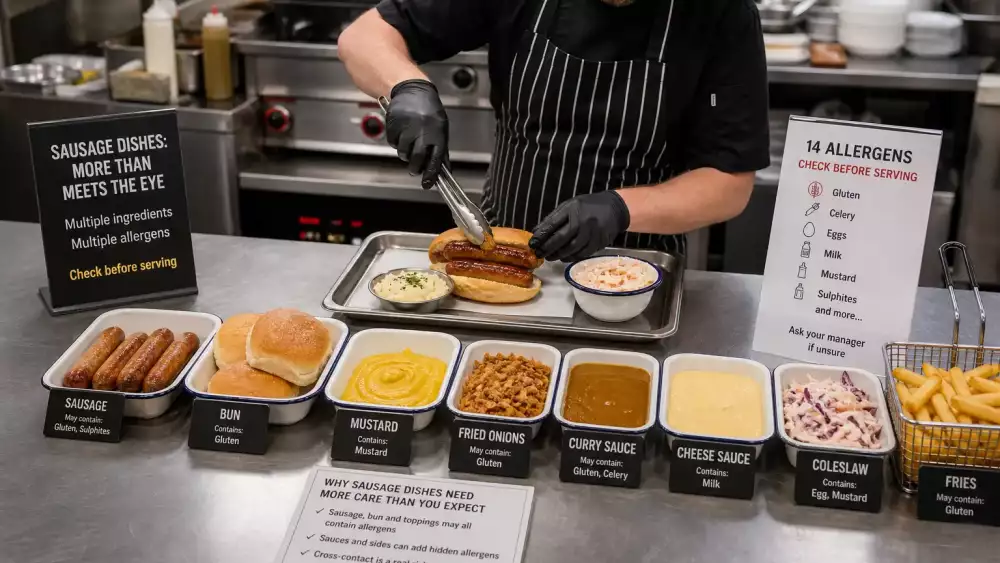
Sausage dishes can look straightforward, which is exactly why allergen mistakes happen. A burger menu often gets treated as a build with several components. A sausage menu is sometimes treated as “just the sausage”, even when the final dish is anything but simple.
A served plain may be relatively easy to document. Add a bun, mustard, fried onions, cheese sauce, curry ketchup, coleslaw, gravy, mash or loaded fries, and the allergen position changes quickly. The customer is not buying the sausage in isolation. They are buying the finished dish as served.
There is also the issue of preparation. Professional kitchens often use griddles, bratt pans, combi ovens, fryers, hot cupboards, bain-maries and shared prep benches. These are useful for speed and consistency, but allergen control depends on how ingredients move through that setup. Food allergens are not made safe by high cooking temperatures, so separation, cleaning, storage and clear handling procedures matter.
For caterers, event traders and pubs, the pressure point is usually speed. Staff may be building sausage dishes fast, switching toppings, handling buns and sauces, or adapting orders on request. That is where vague allergen notes become risky.
A commercially sensible sausage menu keeps the number of builds under control. Fewer core dishes, clearer specifications and fewer last-minute substitutions make allergen information easier to maintain. It also helps staff serve faster because they are not trying to decode the menu while the customer is waiting.
The Main Allergen Risks in Bratwurst, Hot Dogs and Loaded Sausage Dishes
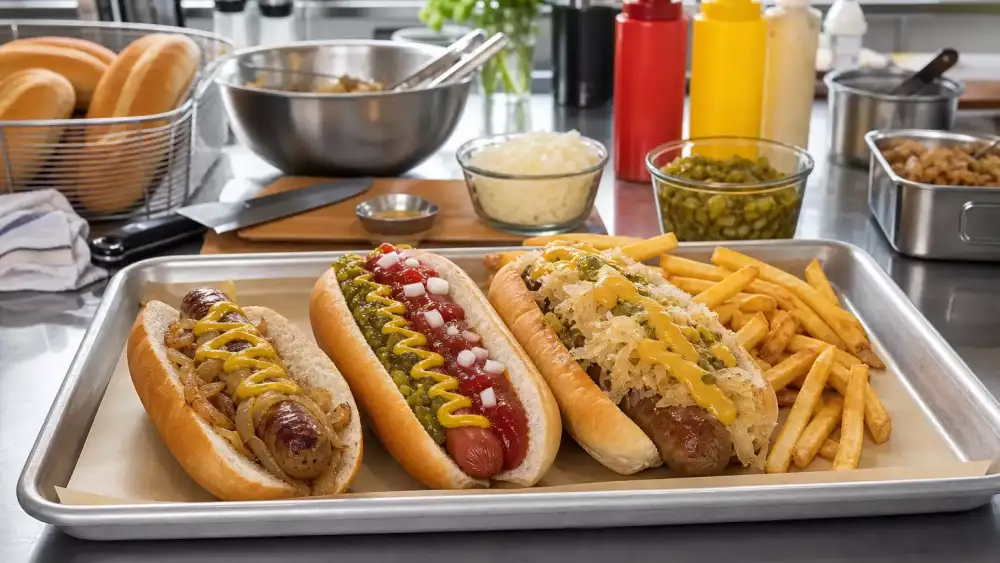
The most obvious allergen risk in many sausage dishes is cereals containing gluten, usually from buns, rolls, breadcrumbs, rusk, beer-based batters, some sauces or seasoning carriers. Operators should specify the cereal where relevant, such as wheat, rye, barley or oats, rather than using “gluten” as a vague catch-all.
This industry body guide outlines practical allergen wording and menu examples, including how to flag cereals containing gluten2 in sausage dishes and service settings.
Mustard is another common one. It may appear as a visible condiment, but also in marinades, sauces, spice blends, curry ketchup-style sauces, dressings or sausage recipes. For German-style sausage dishes, mustard is often part of the eating experience, so it deserves particular attention.
Milk can appear in cheese frankfurters
Other regulated allergens can still matter even if they seem less obvious. Celery can appear in seasonings, stocks, sauces or spice mixes. Sulphites may appear in some preserved ingredients or drinks-based sauces. Fish can appear in Worcestershire-style sauces, anchovy-based dressings or certain condiments. Nuts, peanuts, lupin, crustaceans and molluscs may be less typical in a classic sausage offer, but they still need checking when specials, sauces or guest toppings are introduced.
The FSA’s regulated allergen list includes cereals containing gluten, crustaceans, egg, fish, peanuts, soya, milk, nuts, celery, mustard, sesame, sulphur dioxide/sulphites, lupin and molluscs. A good sausage menu does not assume. It verifies each component.
| Sausage Menu Component | What Operators Should Check | Common Allergen Points to Verify | Practical Service Note |
|---|---|---|---|
| Sausage itself | Product specification, recipe, seasoning, casing and any processing aids | Cereals containing gluten, mustard, milk, soya, celery, sulphites | Do not assume two similar-looking sausages have the same allergen profile. Check each product. |
| Bun or roll | Bread type, glaze, toppings and supplier changes | Wheat, rye, barley, oats, sesame, milk, egg, soya | A bun swap can change the whole dish. Update the allergen record before service. |
| Mustard and sauces | Full ingredients list for mustard, ketchup, curry sauce, mayo, gravy or relishes | Mustard, egg, milk, soya, celery, fish, sulphites | Sauces are a common source of hidden allergens, especially when bought in or changed seasonally. |
| Cheese and dairy toppings | Cheese, cheese sauce, butter, creamy dressings and mash additions | Milk, egg, mustard, soya | Cheese frankfurters, loaded fries and mash-based dishes need particular care. |
| Fried onions and crispy toppings | Coatings, flour, seasoning, shared fryer use and supplier specification | Wheat, milk, soya, celery, mustard | Crispy toppings can look like a garnish but still change the allergen information. |
| Sides and accompaniments | Chips, mash, slaw, potato salad, pickles and garnish | Egg, milk, mustard, celery, sulphites, cereals containing gluten | The allergen answer should cover the full plate, not only the sausage. |
| Cooking and holding setup | Griddle, fryer, bratt pan, tongs, trays, boards and hot-holding areas | Cross-contact risk depends on the setup | Shared equipment may affect whether a dish can be confidently adapted for a customer. |
| Specials and substitutions | Any temporary product, seasonal topping or last-minute supplier replacement | Depends on the exact ingredient used | Specials should have their own quick allergen check before they are sold, not after the first customer asks. |
Menu Labelling, Counter Cards and Verbal Allergen Information: What Works Best?
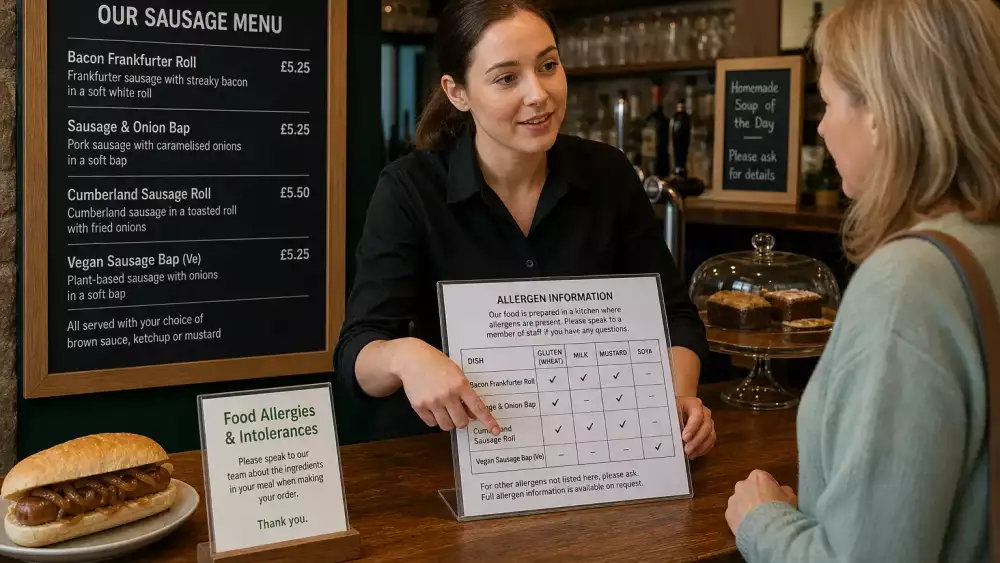
For sausage operators, the best allergen communication method depends on the service format. A pub menu, a café counter, a festival trailer and a farm shop hot food point do not work in the same way.
For a printed or digital menu, a clear allergen matrix or “contains” information can work well, especially where the menu is stable. For example: “Bacon Frankfurter Roll — contains wheat, milk, mustard.” This gives customers a useful first filter before they speak to staff.
Counter cards are useful when customers choose from a visible display, especially in farm shops, garden centres or cafés. They need to stay close to the product and must be updated when the dish changes. A counter card left from yesterday’s recipe is worse than no card because it creates false confidence.
Verbal allergen information can still form part of the process for non-prepacked food, but staff need access to accurate information. The FSA’s best-practice position is written allergen information supported by a conversation, not a conversation based on memory.
Digital allergen information can be helpful, particularly for larger menus, but it needs a backup. A QR code is not much use if the customer has no signal, the phone battery is flat, the page is out of date, or staff cannot explain what it means. FSA guidance also notes that if businesses provide allergen information digitally, they should have an alternative way to access it.
In practice, the strongest setup is usually a simple written record, clear customer signposting and staff who know when to check rather than guess.
Common Allergen Labelling Mistakes in Busy Foodservice Settings
The first common mistake is writing allergen information from the menu name instead of the recipe. “Currywurst” does not tell you enough. The allergen position depends on the sausage, sauce, powder, chips, oil, garnish and whether anything else is served with it.
This cultural overview from the Bratwurstmuseum helps explain what goes into a traditional currywurst3 and why dish names alone are not enough for accurate allergen labelling.
The second mistake is ignoring small extras. Butter on the roll, crispy onions, grated cheese, slaw, dipping sauce, pickles or a dusting of seasoning can all change the answer. Customers with allergies do not experience toppings as small details. They experience them as ingredients.
Another common issue is relying too heavily on supplier information without checking the final dish. Supplier specifications are essential, but they do not know that the kitchen finishes the sausage on a shared griddle, serves it in a sesame bun, adds mustard mayo or changes the sauce on Friday nights.
Operators should also avoid blanket statements that look helpful but are not precise. “May contain allergens” tells the customer very little. Precautionary allergen information should be used carefully and should not become a substitute for proper ingredient checks and sensible risk assessment. FSA guidance on precautionary allergen labelling stresses the importance of considering cross-contamination risk rather than using generic warnings as a catch-all.
The final mistake is letting the allergen record drift away from the live menu. This often happens with specials, event menus, supplier swaps or emergency substitutions. If the bun changes, the sauce changes or the cheese topping changes, the allergen information may change too. That update needs to happen before service, not after someone asks.
A Practical Allergen Checklist for Sausage Menus
A good allergen checklist should be short enough to use, but complete enough to catch the real risks. For sausage dishes, it should follow the dish from supplier to service.
Start with the bought-in products. Check the specification for each sausage, bun, sauce, topping and side. Keep current supplier documents where staff can access them, not buried in an inbox. If a supplier changes recipe, pack size, label or substitute product, review the allergen record.
Then check the full dish build. Record allergens for the sausage, bread, condiments, toppings, garnish, side dishes and any cooking or finishing ingredients. Do not forget oil, butter, sprays, glazes, seasoning blends, gravy granules, curry powders, stock bases and ready-made sauces.
A practical sausage menu checklist should include:
- the exact sausage used for each dish
- the bun or bread type, including sesame or other toppings
- all sauces, mustards, relishes and dressings
- cheese, dairy toppings, butter or milk-based additions
- sides such as chips, mash, slaw or potato salad
- shared fryer, griddle, tong, board and prep-area risks
- current supplier specifications
- the date the allergen record was last checked
- who is responsible for updating it
For event traders and temporary catering setups, add one more check: what changes when the menu is served off-site? A dish that is easy to control in a fixed kitchen may behave differently in a trailer, marquee or outdoor service line.
The goal is not paperwork for its own sake. The goal is to make the right answer easy to find during a busy service.
How to Keep Allergen Information Accurate When Menus Change
Allergen information is only useful while it matches the food being served. That sounds obvious, but in real kitchens menus change constantly. Suppliers run short, specials are added, sauces are swapped, staff use a different bun, or a garden centre café adjusts the garnish because the usual one did not arrive.
The safest habit is to treat allergen information as part of menu development. When a new sausage dish is created, the allergen record should be created at the same time as the recipe card, costing and prep method. If the dish is not ready to document, it is not ready to sell.
Supplier substitutions need particular care. A different bratwurst, hot dog roll, mustard, cheese sauce or crispy onion may look similar on the plate but have different allergens. Operators should avoid approving substitutes during service without checking the specification first.
Menu changes should also be version-controlled in a simple way. This does not need to be complex software. A dated allergen matrix, a controlled recipe folder or a shared digital document can work if one person owns the update process.
For operators with rotating specials, it is often cleaner to create a short allergen sheet for each special rather than trying to squeeze everything into the main menu. This is especially useful for pubs, event caterers and cafés with seasonal dishes.
The commercial benefit is straightforward. Accurate allergen information reduces staff uncertainty, avoids awkward customer conversations and prevents the “I think it’s fine” culture that should never exist around allergens.
Making Allergen Communication Part of Everyday Service
Good allergen control depends on staff behaviour as much as written information. The best allergen matrix in the world will not help if front-of-house staff guess, kitchen staff improvise or nobody knows where the current sheet is kept.
This hospitality resource explains why allergen control depends on staff behaviour as well as written information4, which is worth checking for sausage service teams.
For sausage operators, the conversation should be simple and repeatable. Staff should know how to respond when a customer mentions an allergy, where to check the written information, who to ask in the kitchen, and when to say that a dish cannot be safely adapted. “Let me check that properly” is always better than a confident guess.
Training should include the real menu, not just general allergen theory. Staff need to know, for example, that the cheese frankfurter contains milk, that the bun may contain sesame, that mustard can appear in more than one sauce, and that removing a topping does not automatically remove cross-contact risk.
Food Standards Scotland notes that businesses must provide allergen information, manage allergens effectively when preparing and serving food, and make sure staff are trained on allergens. It also highlights that effective cleaning, separation, storage and labelling are important because allergens cannot be removed by cooking.
For commercial service, build allergen communication into the rhythm of the shift. Keep the allergen folder or digital matrix in the same place. Brief staff when a supplier or special changes. Make sure new staff know the difference between “not an ingredient” and “safe for that customer”. Those are not the same thing.
Handled well, allergen communication does not slow service down. It prevents confusion, gives customers confidence and makes the sausage offer feel professionally run.
Frequently Asked Questions
Yes. The duty to provide accurate allergen information does not disappear because the business is small, seasonal or mobile. A festival unit, food trailer, pop-up counter or garden centre kiosk still needs to tell customers when any of the 14 regulated allergens are used in the food it provides. The Food Standards Agency states that food businesses must inform customers if products contain any of the 14 regulated allergens as ingredients.
The practical setup can be simpler than in a large kitchen. A short printed allergen matrix, current supplier specifications, a clearly marked staff folder and a service briefing before opening can be enough for many small menus. The key is that the information must match what is actually being sold that day.
It is a useful signpost, but it should not be the whole system. Staff need accurate information to check, not just memory or guesswork.
For loose or non-prepacked foods, businesses can choose how to provide allergen information, but FSA best practice is to make it available in writing and support it with a staff conversation. That is especially sensible for sausage dishes because a small change in bun, sauce, topping or garnish can change the allergen position.
better approach is: clear signposting, written allergen information nearby, and staff trained to check before answering.
PPDS rules matter when food is packed before the customer orders or selects it, on the same premises from which it is sold. For example, a wrapped sausage roll, boxed lunch portion or pre-packed hot dog prepared for a grab-and-go display may fall into this area.
PPDS food needs the name of the food and a full ingredients list, with any of the 14 regulated allergens emphasised in that list. This is different from a sausage dish cooked or assembled after the customer orders.
The safest habit is to ask a simple question before packing food ahead of service: “Will the customer choose this already packed?” If yes, check whether PPDS labelling applies before putting it out for sale.
Use a component-based system. List the allergen information for the sausage, bun, sauces, toppings and sides separately, then make sure staff understand that the final dish depends on what the customer chooses.
This is more practical than trying to write every possible combination. For example, a base bratwurst roll may contain wheat and mustard, while a cheese topping adds milk and crispy onions may add wheat or other ingredients depending on the supplier.
For busy service, keep the build simple. Too many toppings can make allergen control harder, slow staff down and increase the chance of mistakes. A tighter menu is usually easier to sell and easier to manage.
Not automatically. Removing the bun may remove one obvious source of cereals containing gluten, but it does not prove the dish is gluten-free.
The sausage recipe, seasoning, sauces, mustard, chips, fryer use, toppings and handling setup all need checking. Shared griddles, tongs, boards or holding trays may also create cross-contact concerns. Food Standards Scotland notes that allergens cannot be removed by cooking, so separation, hygiene, storage and labelling all matter.
Commercially, it is better to be precise than optimistic. If the dish can be served without the bun but cannot be confidently managed as gluten-free, say so clearly.
Only where there is a genuine, assessed risk that cannot be reasonably controlled. A broad “may contain allergens” statement is not very helpful for customers and can make the business look less in control.
Precautionary wording should never be used as a shortcut for checking ingredients, supplier specifications and kitchen handling. It should reflect the real risk in that operation, not act as a blanket disclaimer.
For a sausage menu, it is usually better to separate two things: allergens deliberately present as ingredients, and possible cross-contact risks from shared equipment or preparation areas. Customers need both pieces of information to make a sensible decision.
They should avoid guessing. A good answer starts with: “Let me check that properly.” Staff should then check the written allergen information, confirm the dish build with the kitchen if needed, and explain any cross-contact concerns clearly.
If the kitchen cannot safely adapt the dish, staff should say so. That may feel awkward in the moment, but it is better than offering false confidence.
simple staff rule works well: check the record, check the actual dish, then answer. If either part is uncertain, do not promise that the dish is suitable.
llergen information needs to be available before the customer completes the order and again when the food is delivered. The FSA explains that takeaway ordering is distance selling and allergen information must be available at two stages.
For a sausage operator, this means the online menu, ordering platform or phone-order process needs to support allergen questions before payment. The delivery stage also needs thought, such as labelled packaging, enclosed information or another clear method.
Do not assume the delivery platform has solved this for you. Check how your menu appears online, how allergen questions are handled, and whether staff can still access accurate written information during service.
Formal certificates can be useful, but the more important point is whether staff understand the actual menu and know the business procedure. A team member who has passed a generic course still needs to know where the current allergen sheet is, which sausage is used in each dish, and what to do when a customer asks a specific question.
Food Standards Scotland describes allergen management as identifying allergens, managing allergen risks, and communicating and training staff. That is a practical service issue, not just a training-file issue.
For sausage businesses, short menu-specific refreshers are often valuable. Brief staff when suppliers change, when a seasonal special is added, or when the service setup changes for an event.
Start with the top-selling dishes, not the whole business at once. For many operators, that means the core bratwurst, hot dog, currywurst, loaded fries or sausage roll offer.
For each dish, write down the exact product, bun, sauce, topping, side and cooking method. Then match each component to current supplier specifications and check the 14 regulated allergens. Once the main sellers are controlled, work through specials, sides and lower-volume dishes.
This is commercially realistic because it tackles the highest-risk and highest-volume items first. It also gives staff a clear system they can use straight away, instead of waiting for a perfect allergen project that never quite gets finished.
Conclusion
Good allergen menu labelling is not about making a menu look more complicated. Done properly, it makes the operation cleaner, the service calmer and the customer conversation more confident.
For sausage dishes, the risk is rarely just the sausage itself. The bun, mustard, sauces, cheese, fried onions, toppings, sides, garnish, cooking process and holding setup can all change the allergen picture. That is why a practical system matters more than a one-off menu note. Operators need supplier information they trust, recipes that staff actually follow, and allergen records that are updated when ingredients, specials or service formats change.
The safest approach is to keep allergen information written, accessible and easy for staff to explain. Oral information may form part of the process for non-prepacked food, but it should be backed by something reliable, especially in a busy pub, catering trailer, event unit or garden centre café. The Food Standards Agency also treats written allergen information as best practice for loose and non-prepacked food.
For operators, this is also a commercial issue. Clear allergen handling helps customers feel taken seriously, reduces awkward service moments and protects the reputation of the business. A strong sausage menu should be enjoyable, efficient and well controlled. Allergen labelling is part of that control.
If you are building or refreshing a sausage offer, start with the product specification, then build the menu information around the full dish as it is actually served.
The Sausage Haüs
The Sausage Haus brings authentic German-style sausages to the UK market through a partnership between Hardy Remagen and Baird Foods.
Hardy Remagen is a long-established German producer with deep experience in traditional sausage making, continental meat products and modern food manufacturing. The range reflects the kind of products German shoppers already understand and enjoy: Bratwurst, Frankfurters, smoked hotdogs, cheese-filled sausages, Bockwurst, Weisswurst and other classic German-style lines.
In the UK, the range is represented and distributed by Baird Foods, giving retailers, wholesalers, caterers and foodservice operators access to German sausage products with a practical UK supply route. This combination is important: German manufacturing knowledge on one side, UK market understanding and distribution on the other.
For retail buyers, The Sausage Haus range offers a clear way to add something different to both chilled and frozen sausage fixtures. The products are built around real eating occasions: BBQs, premium hotdog nights, family meals, German street food, Oktoberfest promotions, Christmas market food and quick comfort meals at home.
The result is a range that gives shoppers something more distinctive than ordinary sausages and standard hotdogs, while giving buyers a compact, commercially useful product story with strong fresh and frozen potential.
References
1. DEHOGA Bundesverband: Allergeninformationen.
2. Gute Gastgeber für Allergiker.