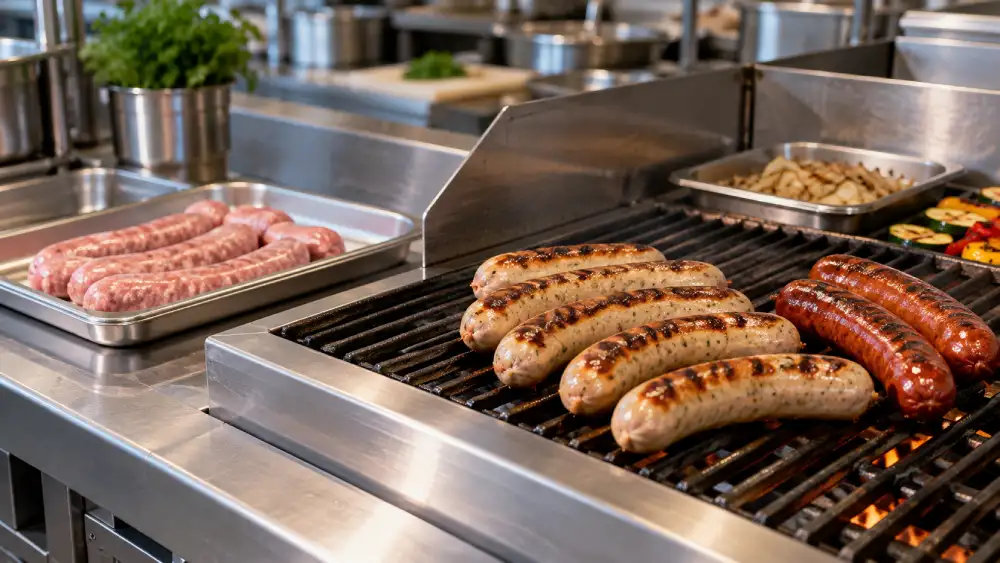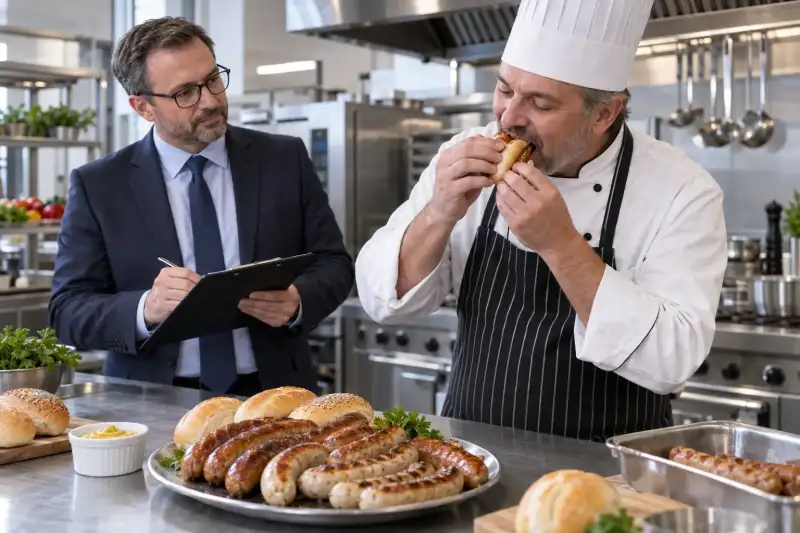
German sausage buffet ideas work best when they are built for service, not just for looks. For weddings, private functions, and catered events, the right buffet sausages need to hold well, plate easily, and still feel a bit special. This guide looks at practical options for UK operators who want a buffet that runs smoothly, sells confidently, and does not turn into a tray of regret after twenty minutes.
Introduction
German sausage buffet ideas are useful because they sit in a very practical middle ground. They feel more interesting than a standard beige buffet, but they are still familiar enough for British guests to understand immediately. That matters at weddings, functions, and private catering jobs, where people want food that looks generous, tastes clear and satisfying, and does not need a speech before serving.
For operators, buffet service has its own pressures. You need food that can be organised cleanly, replenished without drama, and matched to the pace of the event. A wedding buffet sausage idea might look great in a planning meeting, but on the day it still has to survive real service, real holding conditions, and real guests who turn up all at once after the speeches finish late.
That is where a good German catering sausages UK approach becomes valuable. The format can be dressed up for weddings, simplified for private parties, or scaled for larger event catering without losing its character. You can go rustic, premium, or fast-moving, depending on the venue and the client brief.
In practice, the strongest setups usually have a few things in common:
- sausages with clear flavour differences, not six versions of roughly the same thing
- side dishes that support the buffet rather than crowd it
- service equipment and holding plans suited to the venue
- portions that look generous without creating chaos or waste
The aim is not to make buffet sausages for private catering look overcomplicated. It is to make them reliable, attractive, and easy to run under pressure, which is often far more valuable than trying to impress people with fussy food that collapses halfway through service.
Key Takeaways
- German sausage buffet ideas work well for weddings and functions because they feel distinctive without being difficult for guests to understand.
- The best buffet sausages for private catering are the ones that hold well, carve or portion cleanly, and can be replenished quickly.
- A strong German sausage buffet for weddings usually needs contrast: one classic option, one smoked or richer option, and one more adventurous choice.
- Side dishes should support speed and consistency; think potato salads, breads, sauces, and easy hot accompaniments rather than fragile presentation pieces.
- Venue setup matters. Always verify site rules, service space, power or gas arrangements, and any local authority or event licensing requirements where relevant.
- German catering sausages UK menus tend to work best when the food looks premium but the workflow stays simple.
- A buffet should not just photograph well; it should still look good after the first wave of hungry guests has arrived.
Why German Sausages Work So Well on Wedding and Function Buffets
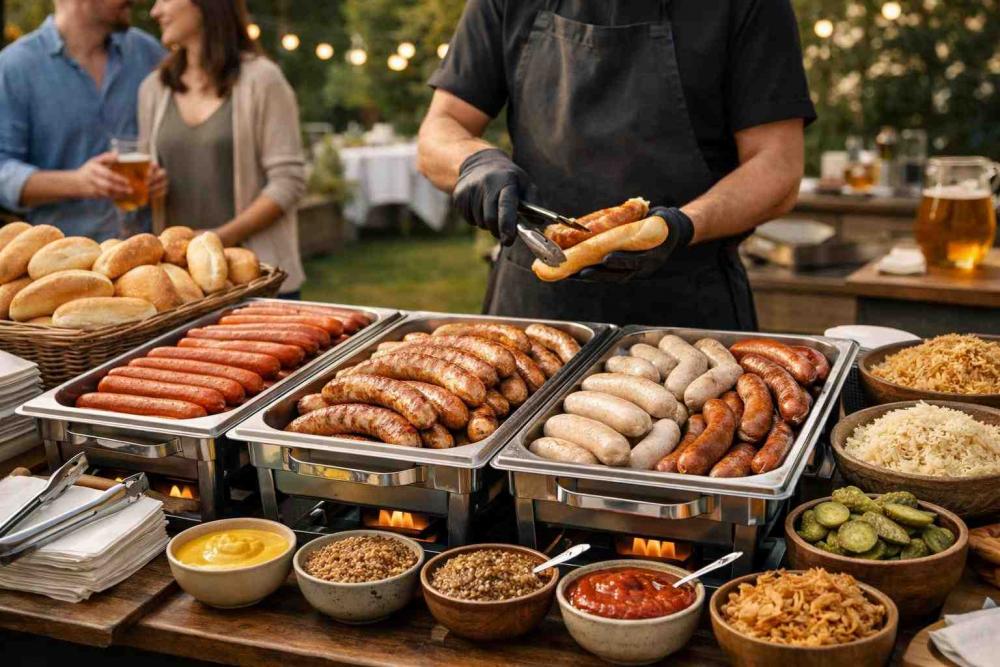
German sausage buffet ideas work well because they solve two problems at the same time. They give the client something that feels more distinctive than a standard mixed buffet, but they also give the operator a format that is relatively stable, portionable, and easy to explain. That combination is rare. A lot of buffet food is either too generic to feel memorable or too delicate to survive a busy service window with any dignity left.
For weddings and private functions, guests want food that feels generous and recognisable. They are usually not looking for a complicated tasting menu on a buffet table. They want to see something they understand, choose quickly, and enjoy without needing a description card longer than the sausage itself. That is where German sausage buffet ideas are especially useful. The products have clear identity, strong visual appeal, and enough variation in flavour to make the buffet feel considered rather than repetitive.
They also sit comfortably across different event styles. A relaxed evening wedding, a village hall celebration, a corporate function, or a private garden party can all carry the format well. The same basic approach can be dressed up or down depending on the venue, the table presentation, and the side dishes. That makes a German sausage buffet for weddings more flexible than many caterers first assume.
From an operator’s point of view, buffet sausages for private catering are attractive because they can support service rather than fight it. Good sausages hold their shape, portion neatly, and can be replenished in sensible batches. They are not as fragile as many plated items, and they do not collapse the moment guests arrive slightly later than promised, which does happen now and then in the event world.
A useful part of the appeal is the balance between familiarity and difference:
- Bratwurst and frankfurters feel accessible to British guests
- smoked or cheese-filled varieties add interest without confusion
- the buffet can look premium without requiring fussy assembly
- sides and sauces can be adjusted to suit formal or casual service
Another reason German catering sausages UK operators appreciate this format is that it avoids false theatre. The food can look warm, hearty, and substantial without needing ten decorative garnishes that nobody asked for. On a real buffet, that matters. A tray that still looks good after the first thirty guests is often more valuable than one that looked impressive for a photograph at the start.
German sausage buffet ideas also support better menu contrast. You can create range through sausage type, bun or no bun service, salad choices, sauces, and hot sides without having to build six completely different dishes. That is efficient, and it helps with stock planning as well. Instead of a buffet full of disconnected items, you have a menu that feels joined up.
That is why these menus keep making sense for weddings, functions, and event catering. They are appealing to guests, practical for staff, and flexible enough to suit different kinds of venues. In buffet terms, that is already doing quite a lot of heavy lifting.
How to Build German Sausage Buffet Ideas That Are Easy to Serve
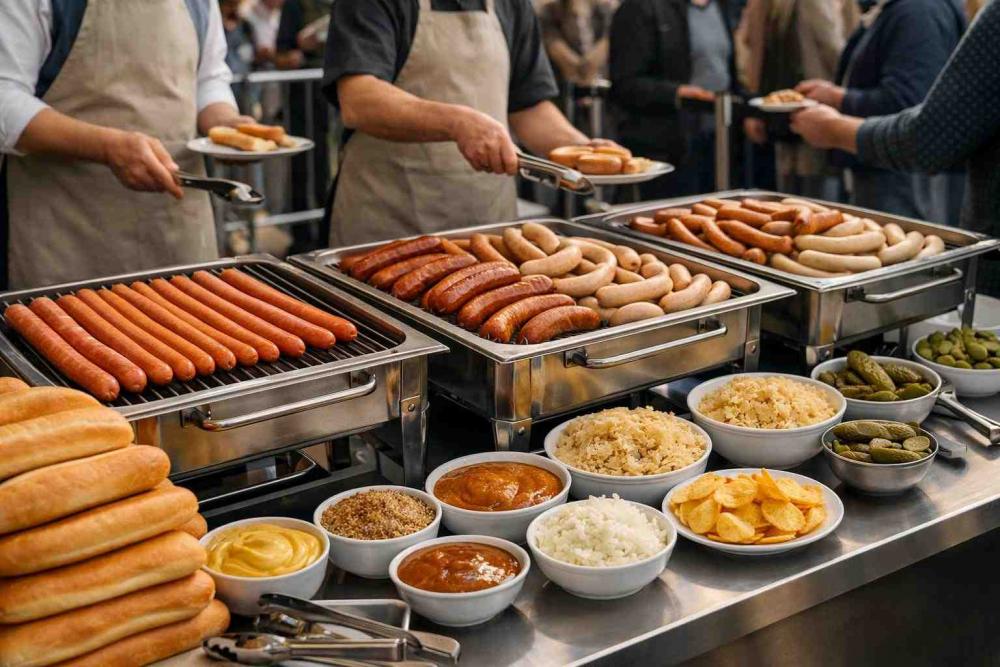
The best German sausage buffet ideas are not built by starting with the most exciting sausage and hoping the rest sorts itself out. They are built around service. That means thinking first about how the food will be held, how guests will move, how quickly items can be replenished, and what the team can manage without turning the buffet into a traffic experiment gone wrong.
This Food & Wine recipe article shows how beer-cooked brats are handled with service flow and replenishment in mind, which is useful when planning a sausage buffet for a crowd.
A simple mistake in buffet planning is to treat variety as the main goal. Variety matters, but only after the service format makes sense. A buffet with six clever options is not better than one with three strong options if the trays empty too fast, the sauces are in the wrong place, or the staff need to dismantle the whole setup every time they top something up. German sausage buffet ideas work best when the menu looks generous but the workflow stays calm.
Start with the sausage mix itself. In most cases, three sausage styles are enough for a strong buffet line. One classic option such as Bratwurst gives familiarity, one richer or smoked option adds depth, and one more distinctive option such as cheese or chilli adds character. That is usually more effective than offering too many similar products that blur together. For buffet sausages for private catering, clear contrast is more useful than sheer quantity.
Then build the rest of the buffet around that structure. The side dishes should support the sausages, not compete with them. Potato salad, warm onions, sauerkraut, breads, relishes, and a sensible mustard selection tend to do more practical work than a complicated spread of side items that all need separate handling. A wedding buffet sausage idea often becomes much stronger once the menu is trimmed slightly and organised better.
There are a few practical questions worth answering early:
- Will guests serve themselves fully, or will staff portion the sausages?
- Are you serving as a formal buffet, a relaxed grazing line, or a faster event queue?
- Can the venue support your chosen hot holding method and replenishment pattern?
- Do you need signage for flavours, allergens, or simple menu guidance?
For a German sausage buffet for weddings, presentation still matters, but it should be robust presentation. Use trays and serving vessels that can be topped up quickly. Keep sauces tidy and easy to reach. Separate hot and cold elements clearly. Avoid layouts that force guests to cross over each other or hover awkwardly while deciding between three mustards and an onion garnish station the size of Belgium.
It is also worth verifying the venue basics before promising too much. Check site rules, access, setup timing, service space, electrical load, gas use where relevant, and any local authority or event licensing requirements attached to the job. German catering sausages UK menus are straightforward in many ways, but the event setting still shapes what is sensible.
In the end, easy-to-serve German sausage buffet ideas usually look quite disciplined. They offer enough choice, enough visual warmth, and enough personality, but they never ask the buffet line to do more than the service team can realistically support. That is often the difference between a buffet that feels effortless and one that becomes memorable for the wrong reasons.
The 6 Proven German Sausage Buffet Ideas for Weddings, Functions and Private Catering
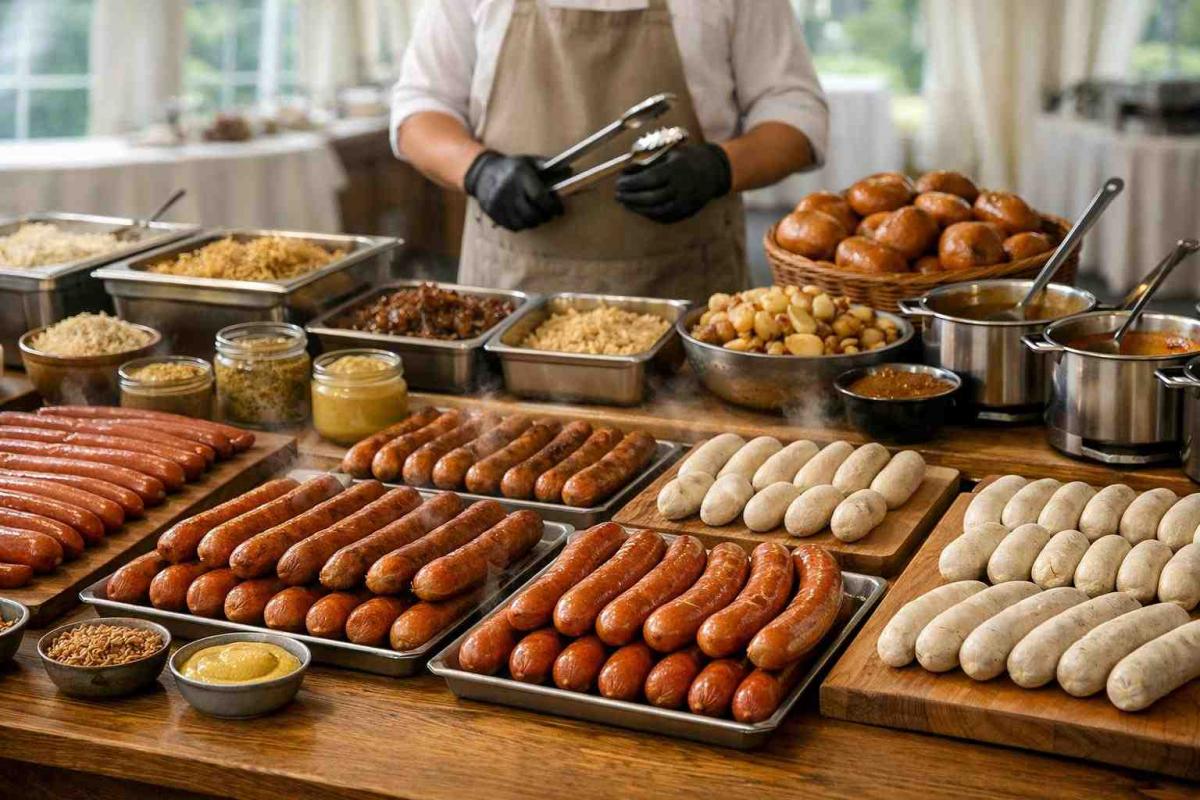
German sausage buffet ideas become far more useful when they are designed as full buffet combinations rather than as a sausage line with a few random extras pushed to the side. In real catering, the side dishes and sauces do much of the hard work. They shape the mood of the buffet, help the sausages feel more complete, and make the difference between a tray that looks inviting and one that feels a bit bare after the first ten guests have been through.
That is especially true for weddings, functions, and private catering. Guests usually want food that feels generous, easy to understand, and worth going back for. They do not want a buffet that makes them build their own engineering project. The best German sausage buffet ideas therefore use sausages, sides, and sauces in combinations that are clear, balanced, and easy to serve.
Below are six buffet-ready concepts built around your actual range, with concrete pairings and the reasons they work.
1. The Classic Wedding Evening Buffet
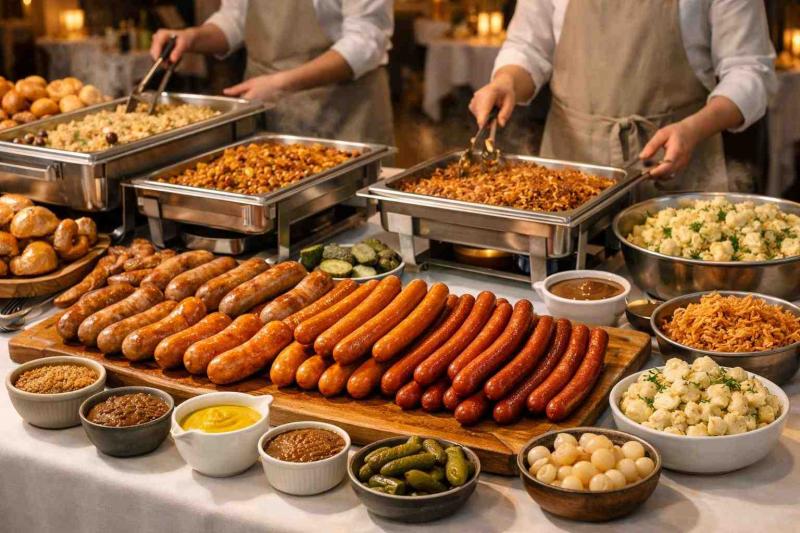
This is one of the safest and strongest German sausage buffet ideas for evening wedding service. It should feel familiar enough for everyone to approach confidently, but still different enough from a standard British buffet to feel like a proper feature rather than an afterthought.
This BBC Good Food recipe guide shows how choucroute garni can be assembled as a hearty, sausage-friendly buffet dish with traditional accompaniments.
A strong version uses Pork Bratwurst, Cheese Frankfurter, and Vienna Beef Frankfurter. That combination works because the three sausages each bring a different role. Pork Bratwurst is the dependable centre. Cheese Frankfurter feels richer and more indulgent. Vienna Beef Frankfurter gives a slimmer, slightly neater contrast that stops the buffet feeling too heavy.
The side structure should stay simple but generous:
- warm fried onions
- sauerkraut
- German-style potato salad or a lighter chive potato salad
- bread rolls or sliced rustic rolls
- gherkins or pickled cucumbers
For sauces, the most useful trio is German mustard, a mild honey-mustard style sauce, and curry ketchup. The mustard gives sharpness and tradition. The honey-mustard style option softens the sharper edges and works especially well with Cheese Frankfurter. Curry ketchup adds a sweeter, spiced note that suits Pork Bratwurst and makes the buffet more approachable for guests who are less enthusiastic about mustard.
Why this works is quite practical. The cheeses, onions, kraut, and mustard all reinforce the savoury depth of the sausages, while the pickles and lighter potato salad stop the buffet becoming too dense. It feels satisfying, but not leaden. For a German sausage buffet for weddings, that balance matters. Guests often arrive at the evening buffet after cake, drinks, and a long day, so you want comfort without total exhaustion on a plate.
2. The Rustic Barn and Country Venue Buffet
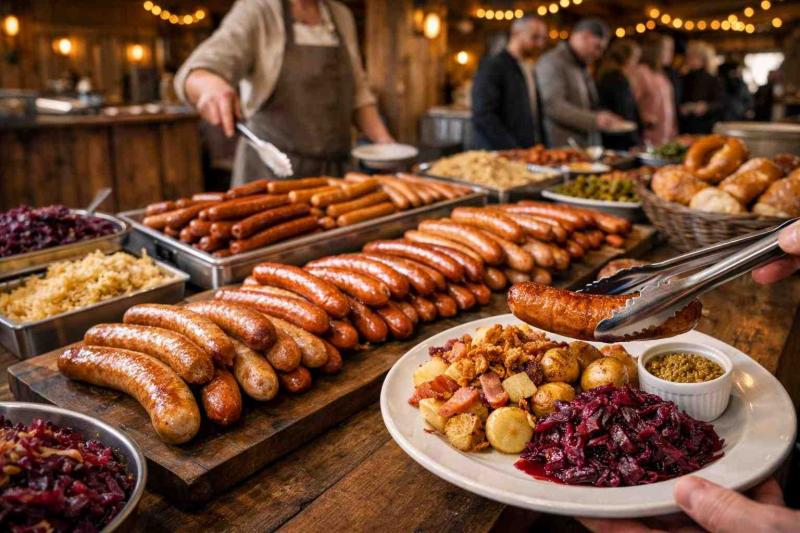
Some German sausage buffet ideas need more warmth and weight, especially in barns, country venues, autumn weddings, and winter functions. Here the buffet should feel more rustic, more substantial, and slightly more traditional.
A very strong mix is Pork Bratwurst, Bacon Frankfurter, and Bockwurst. Pork Bratwurst gives the familiar base. Bacon Frankfurter adds a smoky, more indulgent note. Bockwurst brings a smoother, gentler texture that rounds out the selection and stops the buffet from leaning too hard into smoke and richness.
The best side dishes here are the ones with proper substance:
- warm bacon potato salad or roast baby potatoes
- braised red cabbage or sauerkraut
- fried onions
- pickled red cabbage or cornichons
- crusty bread or pretzel rolls if the event format suits them
Sauces should reflect the heavier character of the menu. A strong wholegrain mustard is useful with Bacon Frankfurter because the mustard cuts through the richness without fighting it. A mild creamy mustard sauce works well with Bockwurst, whose softer flavour can carry a gentler sauce nicely. A darker onion relish also works well here, especially with Pork Bratwurst and roast potatoes.
This buffet works because the contrasts are controlled. You have smoke, salt, acidity, creaminess, and warmth, but they are all moving in the same direction. Nothing feels random. For buffet sausages for private catering, that is important. A buffet looks much more premium when the flavours appear planned rather than assembled from whatever happened to be available in the kitchen.
3. The Lighter Summer Garden Party Buffet
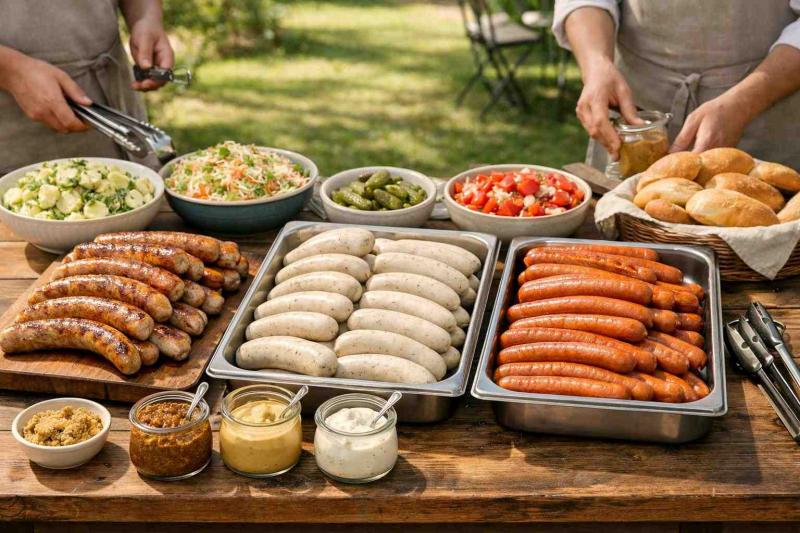
Outdoor summer events need German sausage buffet ideas that feel relaxed and fresh rather than too heavy. This is where side dishes become especially important, because they can stop the buffet from turning into an all-beige exercise in hot bread and regret.
The best sausage mix here is Pork Bratwurst, Munich Weisswurst, and Cheese Frankfurter. Pork Bratwurst gives familiarity. Munich Weisswurst brings a lighter, softer character that suits daytime and summer events well. Cheese Frankfurter adds one richer choice so the buffet does not become too gentle overall.
The side combination should lean brighter:
- cucumber and dill potato salad
- crisp slaw with a light dressing
- pickled cucumber ribbons or gherkins
- soft rolls
- a tomato and onion salad if the service window allows it
Sauces are where this buffet can become much more distinctive. A sweet Bavarian-style mustard works particularly well with Munich Weisswurst because that soft sausage profile benefits from something mildly sweet and rounded rather than aggressive. A herb yoghurt-mustard sauce can also work very well in summer, especially with Pork Bratwurst. For Cheese Frankfurter, a lighter honey-mustard or mild curry ketchup keeps the richness in check without making the whole line feel too sharp.
Why this works is simple. The lighter salads and pickles freshen the palate, Munich Weisswurst keeps the range from feeling too smoky or dense, and the sweeter mustard styles make the whole buffet feel more relaxed and daytime-friendly. These German sausage buffet ideas suit garden weddings and private summer functions because they feel generous without dragging the guest into an afternoon nap immediately afterwards.
4. The Late-Night Wedding Revival Buffet
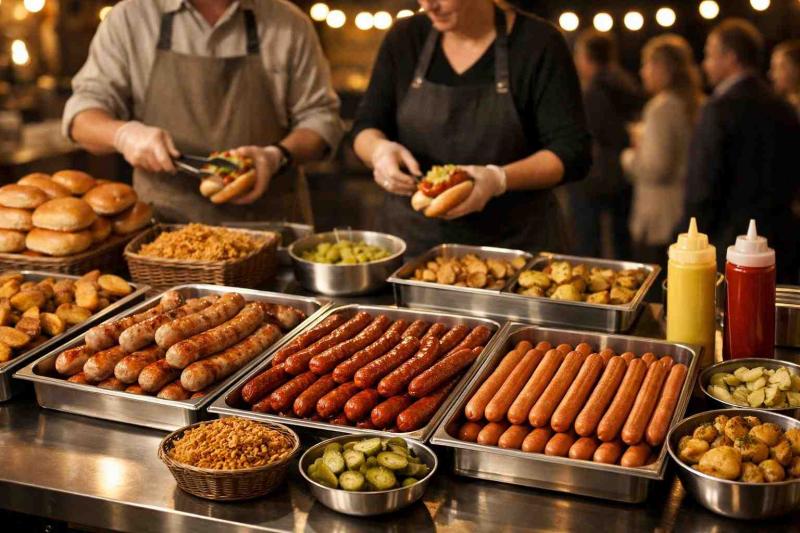
Late-night service needs German sausage buffet ideas with more directness. Guests want hot, savoury, satisfying food. They are not looking for an educational experience. They want something that tastes excellent, is easy to carry, and revives morale after several hours of dancing and drinking.
A very effective pairing is Pork Bratwurst, Chilli Beef Frankfurter, and Pork Hotdog. Pork Bratwurst keeps the line familiar. Chilli Beef Frankfurter gives one bolder choice. Pork Hotdog makes bun service easy and fast, which is useful when the evening crowd hits the buffet all at once.
The best side and topping structure here is much tighter than on a formal buffet:
- soft rolls or brioche-style buns
- fried onions
- crispy onions for texture
- sliced gherkins
- one warm potato side or skin-on wedges if the venue setup supports it
Sauces should be chosen for clarity and speed. German mustard is essential. Curry ketchup works especially well with Chilli Beef Frankfurter because it echoes the spice without pushing the heat too far. A smoky barbecue-style sauce can also work with Pork Hotdog and Pork Bratwurst, though it should stay as one optional extra rather than becoming the whole identity of the buffet.
This works because the buffet is built around comfort and pace. The onions, pickles, and sauces let guests customise easily, but the whole setup still runs quickly. For a German sausage buffet for weddings, that is exactly what late-night service needs. It should feel generous and lively, not fiddly.
5. The Premium Small-Plate Function Buffet
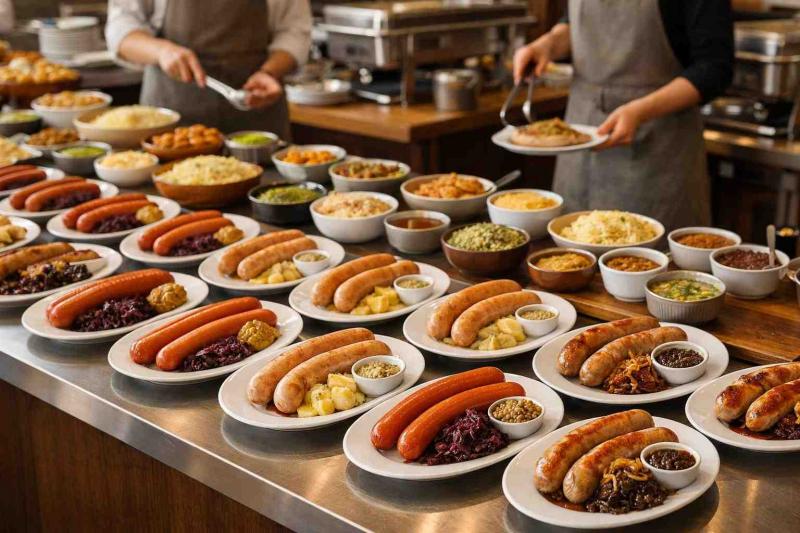
Some clients want buffet food, but they do not want the visual language of hotdogs in buns. They want something tidier and more polished. This is where German sausage buffet ideas can shift into a small-plate format without losing their practicality.
The best sausage combination here is Vienna Beef Frankfurter, Bockwurst, and Pork Bratwurst, usually cut into smart serving portions rather than left whole. Each sausage can then be paired more deliberately with sides and sauces.
This official food safety guidance explains how to portion buffet foods safely and keep service controlled in busy catering setups.
A strong trio of combinations would be:
- Vienna Beef Frankfurter with braised red cabbage and wholegrain mustard
- Bockwurst with warm potato salad and a mild creamy mustard sauce
- Pork Bratwurst with fried onions and a dark onion relish or mustard jus-style dressing
These pairings work because each sausage gets a side and sauce that suits its character. Vienna Beef Frankfurter is slimmer and slightly firmer, so red cabbage and wholegrain mustard give it sharpness and structure. Bockwurst is softer and more delicate, so warm potato salad and creamy mustard keep it balanced. Pork Bratwurst is robust enough for onions and a deeper savoury dressing.
For German catering sausages UK operators, this is a useful model for corporate functions, smarter private events, and weddings where the hosts want buffet service but with a more composed appearance.
6. The Broad-Appeal Private Catering Buffet
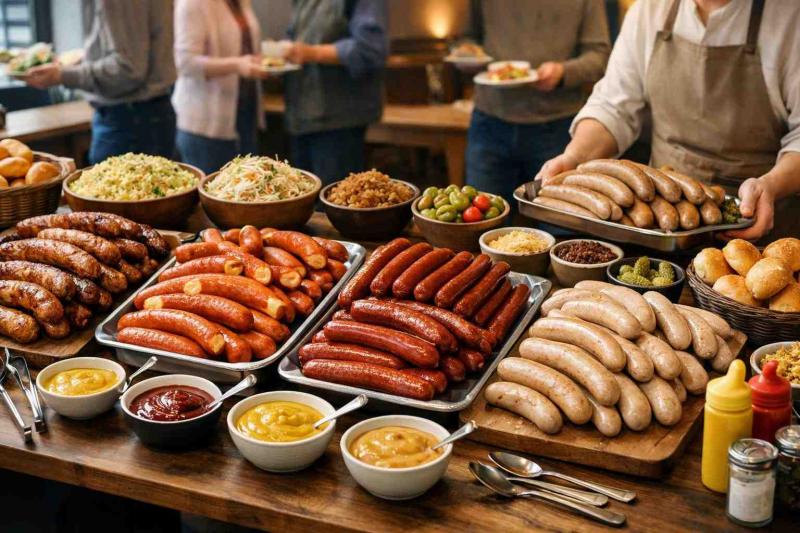
Private catering often means mixed guests, mixed ages, and mixed expectations. That calls for German sausage buffet ideas that are broad in appeal but still feel distinctive. The trick is not to offer everything. It is to offer enough contrast that most people find a clear favourite.
A very reliable selection is Pork Bratwurst, Cheese Frankfurter, Beef Hotdog, and Bockwurst. That gives you one classic, one indulgent, one familiar bun-friendly beef option, and one softer traditional choice. It is an excellent spread for birthdays, anniversaries, family parties, and larger private functions.
The supporting buffet should be built for recognisability:
- potato salad
- slaw
- fried onions
- sauerkraut
- mixed pickles
- rolls and buns
Sauce choice matters here because it helps different guests find their comfort zone. German mustard covers the traditional end. Curry ketchup keeps things accessible. A mild burger-style mustard mayo or honey-mustard style sauce helps bridge the gap for guests who are not naturally reaching for kraut and mustard.
Why this works is that the buffet never feels too niche. It has enough German identity to stand out, but the sides and sauces keep it welcoming. For buffet sausages for private catering, that is often the most commercial position of all. Guests can keep it traditional, build something more indulgent, or stay very simple, and the buffet still feels coherent.
What makes these German sausage buffet ideas effective is not just the sausage selection. It is the relationship between sausage, side dish, sauce, and service style. When those pieces support each other, the buffet feels complete. When they do not, even very good sausages can end up looking oddly unsupported. In catering, that supporting detail is often where the real quality shows.
Hot Holding, Replenishment and Buffet Flow Without the Mess
German sausage buffet ideas can look excellent in a planning document and still fall apart in real service if the holding and replenishment plan is weak. In buffet catering, the problem is rarely the first tray that goes out. The problem is what happens twenty minutes later, when one sausage has dried slightly, one side dish has been overfilled, one sauce bottle is blocked, and guests are now queuing from three directions at once. That is where buffet flow starts to matter more than menu theory.
The first rule is to build the German sausage buffet ideas around smaller, more frequent replenishment. A full buffet always looks reassuring to the client at the start, but overloading trays often makes quality worse and the table messier. Sausages hold better when they are topped up in sensible batches, not left sitting for too long while everyone admires the initial abundance. The same goes for fried onions, warm kraut, potatoes, and buns. Fresh-looking replenishment nearly always beats heroic overloading.
This is especially important for buffet sausages for private catering, because the service pattern can be uneven. Guests do not arrive in perfect sequence. They arrive after speeches, after photos, after one last drink, or all at once because someone announced the buffet a bit too enthusiastically. Your system has to cope with that without looking frantic.
A clean buffet flow usually comes from simple layout decisions. Put sausages first, then hot sides, then cold sides, then sauces and garnishes, with buns or bread placed where they do not cause a bottleneck. Do not make guests reach across the hot line to find mustard. Do not place pickles in a corner that forces everyone to turn back upstream. These things sound small until forty people try to navigate them at once.
A practical service layout should aim for:
- clear movement from main item to side dish to sauce
- replenishment access for staff without interrupting guests
- separate space for messy toppings such as onions and kraut
- enough room around buns, plates, and cutlery to avoid congestion
For a German sausage buffet for weddings, visual neatness also matters. Clients notice whether the buffet still looks orderly after the first rush. Use serving vessels that are easy to wipe down, keep sauces in controlled dispensers or tidy bowls with proper spoons, and assign someone to watch the line rather than only reacting once something is empty or splashed everywhere.
Hot holding itself needs realism. The aim is not to keep everything sitting for ages. The aim is to keep quality stable through rotation. Sausages should be held in a way that protects texture and appearance, sides should not dry out or split, and the team should know which items are replenished first and in what order. German catering sausages UK operators often do better when they treat the buffet as a managed live service rather than a static display.
In practice, the neatest buffets are not the ones with the fanciest presentation. They are the ones where someone has thought clearly about movement, topping-up, and how guests actually behave. That is why the strongest German sausage buffet ideas do not stop at flavour. They include a workflow that keeps the buffet looking calm, full, and edible from start to finish.
German Sausage Buffet for Weddings - What Clients Actually Want
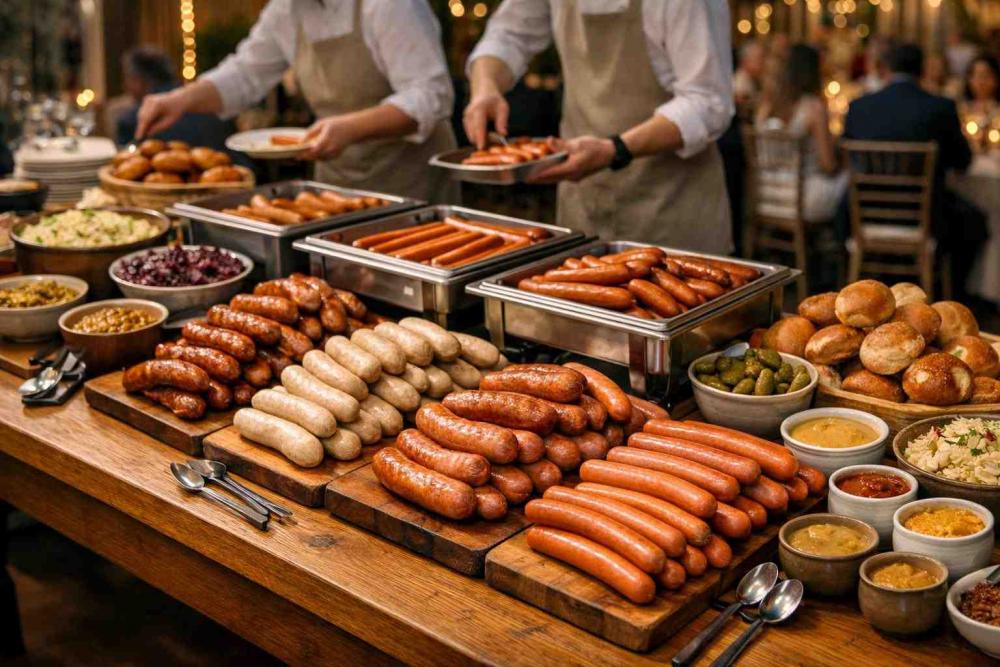
A German sausage buffet for weddings is often more appealing to clients than caterers first assume, but only when it is positioned correctly. Most couples are not asking for a history lesson or a themed Oktoberfest parody unless that is explicitly the brief. What they usually want is evening food that feels warm, generous, slightly different, and easy for guests to enjoy. They want something memorable in a good way, not something that needs explaining table by table.
That is why German sausage buffet ideas work well in the wedding market. They feel more distinctive than standard buffet trays, but they are still accessible. Guests know what sausages, potato salads, onions, and sauces are. The menu can carry a bit of German identity without becoming niche. In practical terms, it gives the couple a buffet that feels more interesting than the usual options, while still being very serviceable.
Clients also tend to care about a few things very consistently. First, they want the buffet to look inviting. That means a good spread of sausage styles, attractive sides, tidy breads or buns, and sauces that feel deliberate rather than random. Second, they want guests to find something they like quickly. A wedding buffet sausage idea should not make people hesitate too long. Too much complexity slows service and weakens the overall impression.
Third, clients want value to feel visible. A German sausage buffet for weddings usually performs well here because it can look abundant without becoming wildly complicated. Pork Bratwurst, Cheese Frankfurter, Vienna Beef Frankfurter, good breads, kraut, onions, potato salad, pickles, and mustard can already create a buffet that feels full and well considered.
Clients often respond well when the buffet offers:
- one familiar classic choice
- one richer or more indulgent option
- one side combination that feels slightly premium
- enough flexibility for formal or informal evening service
What they do not usually want is unnecessary fuss. A lot of wedding clients like the idea of buffet food that feels relaxed but still polished. That means clear menu names, sensible presentation, and flavour combinations that sound appealing at first read. “Pork Bratwurst with fried onions, warm potato salad and German mustard” is easier to sell than a buffet description trying too hard to sound theatrical.
For buffet sausages for private catering in the wedding space, reassurance matters as much as creativity. Couples want to know that the setup will run cleanly, that the food will still look good when service starts properly, and that the menu can suit a mixed crowd. German catering sausages UK menus do well here because they can bridge different tastes. Some guests stay very classic with Bratwurst and mustard. Others go for Cheese Frankfurter, Chilli Beef Frankfurter, or richer sauces. Everyone feels they have a route through the buffet.
In the end, what wedding clients actually want is quite straightforward. They want food that looks generous, tastes good, feels a bit special, and does not create stress on the day. The better German sausage buffet ideas deliver exactly that. They give the client identity without risk, warmth without mess, and enough individuality to feel memorable without turning the evening buffet into a novelty act.
How to Price Buffet Sausages for Private Catering Without Guesswork
Pricing buffet sausages for private catering goes wrong when operators either undercharge because “it’s only sausages” or overcomplicate the quote until nobody, including the caterer, can quite see where the margin lives. The reality is that German sausage buffet ideas can be very commercially sound, but only when pricing reflects the whole service, not just the protein cost.
This official business guidance explains how to factor disposal and waste costs into pricing so sausage buffet menus reflect the full service, not just the food itself.
The first thing to remember is that clients are not buying a box of sausages. They are buying a buffet setup, menu design, prep time, side dishes, sauces, bread, transport, setup, service handling, replenishment, clearing, and the confidence that the evening food will actually work. Once that is clear in your own mind, pricing becomes more rational. A German sausage buffet for weddings or functions is not cheap food by default. It is structured catering.
Start by costing the buffet in layers. Work out the sausage mix per head, then the side dishes, breads, sauces, and garnishes. After that, include labour, travel, equipment use, fuel or power implications where relevant, wastage allowance, and the time needed for setup and pack-down. This is where many operators lose margin. They price the food and vaguely hope the rest behaves itself.
For buffet sausages for private catering, portion logic matters. It is better to quote from a sensible service model than from optimism. Will guests take one sausage and sides, or will the event pattern suggest heavier evening eating? Are buns included? Are you offering two sausage choices or four? Is the buffet intended as a full meal or as late-night support food? The answer changes the numbers materially.
A useful pricing structure often includes:
- a per-head rate based on the agreed sausage and side combination
- a minimum total for smaller events so setup time is covered
- clear add-ons for premium sausage choices or extra sides
- separate treatment for staffing, venue constraints, or difficult access
German sausage buffet ideas can actually help pricing because they allow tiered offers without changing the whole service model. For example, one package might include Pork Bratwurst, Pork Hotdog, potato salad, kraut, onions, and two sauces. A step-up package might add Cheese Frankfurter, Bockwurst, a second premium side, and a broader sauce selection. The workflow remains similar, but the perceived value increases. That is good commercial design.
For a German sausage buffet for weddings, presentation can also justify pricing. Couples are not only paying for the ingredients. They are paying for a buffet that looks appealing and feels like part of the event rather than a last-minute feeding exercise. Menu wording, signage, serving pieces, and neatness all contribute to perceived value, which supports the rate far better than apologising for it.
The key is to stop guessing and start modelling. Know your cost per head, know your minimum viable event size, know the operational extras that change the quote, and know which upgrades are genuinely profitable. German catering sausages UK menus work best when the operator is just as deliberate about the numbers as about the flavour combinations. That is what turns buffet service from “probably fine” into something properly dependable.
Common Mistakes That Make Buffet Service Slower and Less Profitable
German sausage buffet ideas are often commercially attractive because they can be served efficiently, but that advantage disappears quickly when the buffet is built on weak operational decisions. Most slow, messy, low-margin buffet service is not caused by the sausages themselves. It is caused by avoidable mistakes in menu design, layout, replenishment, and client communication.
One of the most common problems is too much choice without enough contrast. Operators sometimes think a longer buffet automatically looks more generous, so they add more sausage types, more sauces, more toppings, and more side dishes. In reality, this often makes service slower and the menu less clear. If three sausage options already cover classic, indulgent, and slightly bolder, a fourth or fifth only helps if it adds a genuinely different role. Otherwise it just creates hesitation, extra stock pressure, and a messier line.
Another mistake is building German sausage buffet ideas around items that are awkward to hold or replenish. A side dish may sound attractive, but if it deteriorates quickly, splits, wilts, or requires constant attention, it steals labour from the rest of the buffet. The same is true of toppings that look good in theory but become sloppy under real guest traffic. Buffet sausages for private catering work best when the supporting items are stable and forgiving.
This TasteAtlas guide lists popular cooked sausages in Germany, which is useful for spotting regional styles that could add variety to a catering menu.
Layout errors also slow everything down. Buns placed in the wrong position, sauces causing cross-traffic, cutlery appearing too late in the line, or a topping station that forces guests to turn back on themselves all reduce throughput. The buffet feels chaotic even when the food is good. For a German sausage buffet for weddings, this matters even more because the client sees the confusion immediately.
The usual profit-killing errors include:
- overfilling trays instead of replenishing in smaller clean batches
- offering too many similar options that blur together
- underpricing labour, setup, and replenishment time
- choosing sides for appearance rather than service performance
- failing to define portion logic before quoting
There is also the client-facing mistake of promising too much flexibility without enough structure. If the quote is vague, the client may assume more variety, more service, or more premium components than the price really supports. That creates margin pressure later. German catering sausages UK menus benefit from being presented clearly. State what is included, how many sausage choices there are, which sides and sauces are part of the package, and what counts as an upgrade.
A quieter but equally expensive mistake is ignoring the second half of service. Many buffets look fine at the start because all the attention went into the opening display. Then quality drops, sauces smear, one side empties, and the line loses shape. Guests do not remember the perfect first five minutes. They remember what the buffet looked like when they used it.
That is why the strongest German sausage buffet ideas are not simply about flavour combinations. They are designed to stay clear, quick, and profitable under live conditions. When service slows down, margin usually follows. When the buffet remains easy to navigate and easy to replenish, the operator has a much better chance of making the event feel smooth for the client and worthwhile for the business.
What to Verify at Venues Before You Promise a Buffet Setup
German sausage buffet ideas may be flexible, but venue reality still decides what is sensible. A buffet that would work beautifully in one setting can become awkward, slow, or unnecessarily risky in another if the site conditions were not checked properly. That is why promising a buffet setup too early is one of the easier ways to create problems later. Before confirming the service format, it is worth verifying the operational basics that shape how the buffet can actually run.
This official event-safety guidance explains why venue and site conditions need checking before you commit to a buffet setup.
Space is the first obvious point, but it needs thinking about in more detail than “yes, there is room for a table”. You need to know where the buffet will sit, how guests will approach it, where staff can replenish from, and whether there is enough circulation space to prevent bunching and backflow. A German sausage buffet for weddings needs room not only for display, but for movement. A beautiful setup tucked into a narrow corner can become a traffic jam very quickly.
Access matters just as much. How far is the service point from unloading? Are there stairs, gravel paths, long corridors, or awkward doorways? Can equipment and food be moved in safely and quickly? For buffet sausages for private catering, difficult access changes labour time, setup time, and sometimes the whole service model. It should be reflected in the plan, not discovered on the day with tired arms and new vocabulary.
Utilities and site rules also need checking early. If the setup depends on electrical equipment, verify the available supply and load expectations with the venue. If any gas equipment is relevant to the broader service plan, verify what is permitted on site and what safety requirements apply. If the event is outdoors, confirm what shelter, flooring, and weather protection are available. German catering sausages UK service can be highly adaptable, but the venue still sets the boundaries.
The venue checklist should usually cover:
- buffet location and guest flow
- access route, unloading distance, and setup timing
- electrical availability and any site restrictions
- gas rules where relevant
- local authority, venue, or event licensing requirements that need verifying
For a German sausage buffet for weddings, it is also worth confirming the softer details that affect service quality. When exactly will the buffet open? How many guests are expected at once? Is there a separate late-night crowd arriving after evening guests have already eaten and drunk for several hours? Will there be speeches, entertainment, or room changes that delay or compress the service window? These details influence holding strategy, replenishment rhythm, and staffing pressure far more than many clients realise.
Another important point is tableware and waste handling. Are plates, cutlery, napkins, and disposal arrangements clear? Will the venue provide anything, or is everything your responsibility? German sausage buffet ideas often look simple on paper, but operational gaps around serviceware can create disproportionate hassle.
The better approach is to verify first, promise second. That protects quality, protects margin, and makes the client conversation more confident. Instead of saying yes to a buffet in the abstract, you are saying yes to a setup that has been thought through for that specific venue. In practical catering terms, that is usually the difference between a service that feels composed and one that spends half the evening improvising.
Conclusion
German sausage buffet ideas make sense for operators who want food with a bit more identity but without unnecessary complexity. For weddings, functions, and private catering, they offer a strong balance between familiarity, flavour, and service practicality. Guests understand the format quickly, clients feel they are getting something more memorable than a standard buffet, and the kitchen or service team can keep control if the menu is planned properly.
The main advantage is not that sausages are magical. It is that they are flexible. They can be plated more neatly for formal events, served more generously for relaxed parties, or built into a faster buffet system for larger numbers. That makes them a useful tool for caterers who need food that looks substantial, holds reasonably well, and can be explained in one sentence rather than one paragraph.
This official food safety guidance explains the hygiene checks and hot-holding basics caterers need when serving sausages at scale.
The better German sausage buffet ideas also help with menu design. Different sausage styles let you create contrast without reinventing the entire buffet. A classic Bratwurst, a smoked option, and something with cheese, chilli, or bacon can already give the table enough range to feel considered. Add sensible sides, clear signage, and a realistic replenishment plan, and you have a buffet that feels organised rather than improvised.
If you are reviewing your wedding buffet sausage ideas or looking for buffet sausages for private catering that can run more smoothly, German sausages are well worth a closer look. Done properly, they bring character to the event without making service harder than it needs to be.
About The Sausage Haus
The Sausage Haus is focused on helping UK operators run a faster, cleaner, and more reliable German sausage offer. We work with caterers, showmen, festival traders, street food operators, pubs, and foodservice buyers who want authentic products that are practical in real service, not just attractive on paper. That means thinking about flavour, yes, but also speed of service, holding performance, menu fit, and how a setup works when the queue is real and the pressure is on.
Our sausages are produced by Remagen in Germany, a maker with more than 300 years of sausage-making tradition behind it. In the UK, they are distributed by Baird Foods, whose long experience in the market helps bring that product quality into a format that suits British operators and service environments.
The result is a range built for businesses that want proper German sausages and a more dependable system around them. Whether the job is a wedding buffet, a private function, a festival line, or a pub menu, the aim is the same: authentic flavour, simpler workflow, and fewer avoidable headaches during service.