Wurstsalat might sound strange to UK readers. Sausage, sliced up, served cold, with onions and a sharp dressing? But in Germany it’s a proper classic – widely loved, genuinely delicious, and surprisingly useful for service. This Wurstsalat recipe is the Bavarian-style version adapted for UK operators, using Bockwurst or our Pork Hotdog for clean slicing, quick prep, and reliable results.
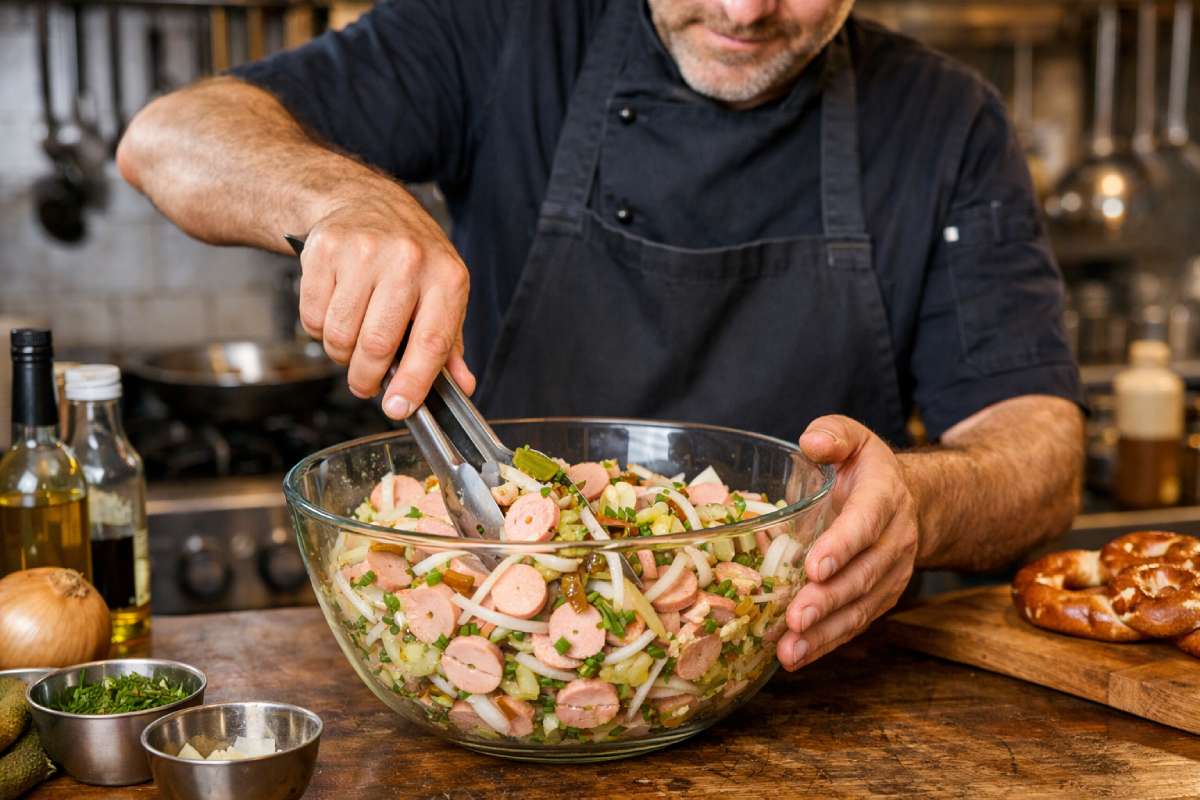
Final mix before service: Wurstsalat in a large glass bowl, ready to portion and chill.
Introduction
If you run festivals, events, a wet-led pub, or a street food pitch, you already know the pressure points: speed, waste, and consistency. A Wurstsalat recipe won’t replace your core hot service, but it can add margin and calm to the operation – especially when you need something that sells without another cook step.
Think of Wurstsalat as a German answer to “quick-service deli salad”, but with more bite. It’s tangy, salty, a little sweet, and it pairs naturally with beer, pretzels, chips, or a simple bread roll. For UK service, it also gives you a smart option for early trade (before grills are fully rolling), quieter moments, or customers who want “something lighter” without going vegetarian.
This Wurstsalat build works especially well with Bockwurst (firm, classic, easy to portion) or our Pork Hotdog (meaty, familiar format, still authentically German in flavour). You slice, dress, and hold it chilled. The key is getting the German Wurstsalat recipe balance right so it stays fresh and crisp, not soggy and tired.
You’ll see it called Bavarian Wurstsalat on menus. Same idea. Same sharp dressing. Done properly, it’s simple, fast, and very repeatable – exactly what busy service needs.
Key Takeaways
- Wurstsalat is a credible German classic; it sells well in pubs, festivals, and street food when positioned as a sharp, “beer food” side.
- Use Bockwurst or Pork Hotdog for consistent slicing and portions (avoid soft sausages that smear).
- The Wurstsalat dressing vinegar and oil ratio matters; too much vinegar and it turns harsh, too little and it tastes flat.
- Prep it as a German Wurstsalat recipe you can batch: slice sausage + onions, mix dressing separately, combine close to service.
- Keep it cold and crisp; Wurstsalat for catering works best when you protect texture (onions and gherkins should still bite).
- Put it where it fits the flow: a fast add-on for hotdogs, a snack pot for queues, or a pub side – Wurstsalat for pubs is an easy upsell.
What Wurstsalat Is (and why it sells in the UK)

Bavarian Wurstsalat served the classic way: Bretzeln on the table, cold sausage salad, and proper beer steins.
Wurstsalat is Germany’s no-nonsense sausage salad: sliced sausage, onions, gherkins, and a sharp dressing that’s meant to wake up your palate, not sit quietly in the corner. For UK customers it can sound odd at first – “salad” and “sausage” don’t naturally belong in the same sentence over here – but once people taste it, the logic is immediate. It’s tangy, savoury, and properly snackable.
From an operator point of view, Wurstsalat sells because it’s fast, flexible, and doesn’t compete with your core hot line. You can prep it in advance, portion it cleanly, and serve it as a side, snack pot, or light meal. It pairs brilliantly with beer, chips, pretzels, or a bread roll – all familiar UK add-ons – and it gives you something that feels “authentic German” without needing another piece of kit.
A well-built Wurstsalat also handles service reality. It’s not fragile like leafy salads, and it doesn’t rely on perfect timing like fried items. Get the Wurstsalat dressing vinegar and oil balance right and it stays lively, not greasy, not harsh. That’s why this format fits pubs, festivals, and street food: it’s a German Wurstsalat recipe that behaves itself when you’re busy.
Where it tends to perform best in the UK
- As a bar snack / side pot (easy upsell alongside hot service)
- As a quick “lighter” option that still feels filling
- As a prep-ahead item for events where speed matters
Bavarian vs Swiss Wurstsalat (with and without cheese)
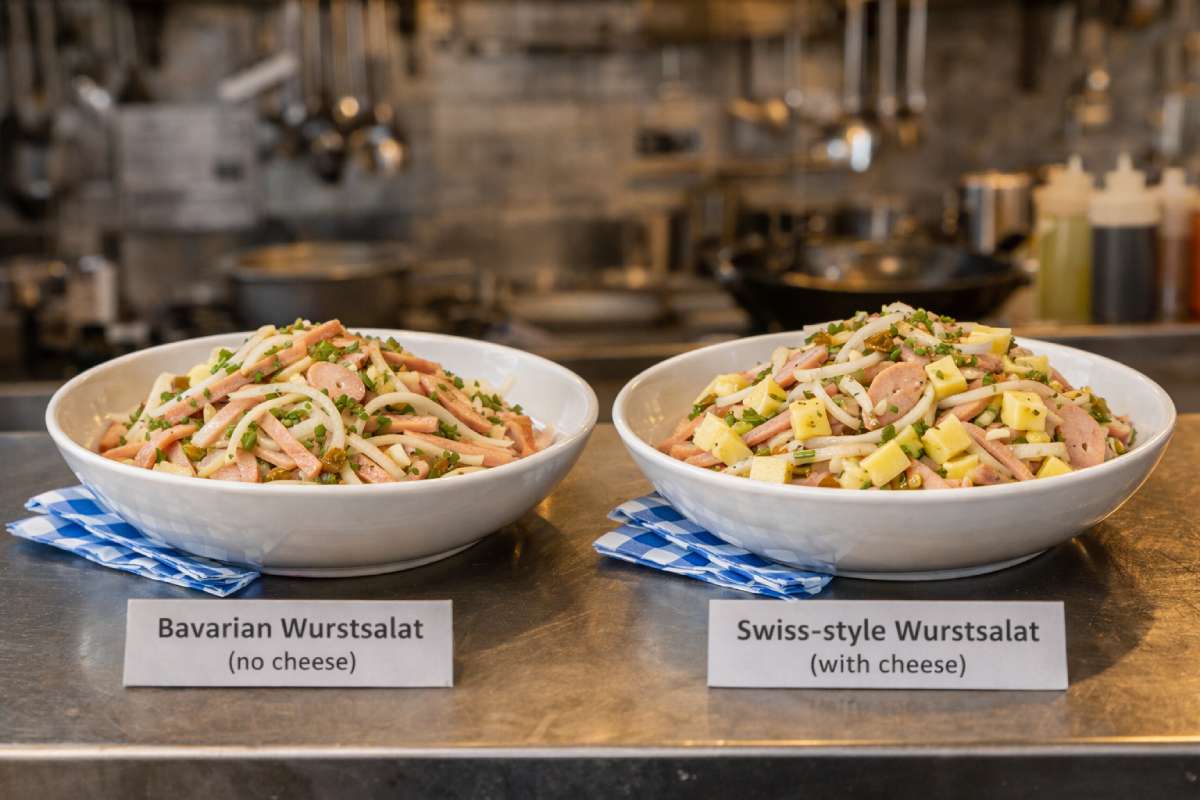
Two classic styles of Wurstsalat for service: Bavarian (no cheese) and Swiss-style (with cheese), both made with sausage cut into traditional strips.
Most people mean one of two things when they say Wurstsalat. The Bavarian version is the classic: sausage, onions, gherkins, and a clean vinegar-oil dressing. The Swiss-style version usually adds cheese (often Emmental) and can feel richer and slightly heavier.
For UK service, Bavarian Wurstsalat is usually the safer starting point. It’s simpler, it’s cheaper to run, and it stays sharper and cleaner over time. Swiss-style can sell very well too, but it introduces another ingredient that needs consistent portioning and good storage, and it can push the dish into “meal salad” territory rather than “snackable side”.
If you’re building your first Wurstsalat offer, start with Bavarian. Once it’s moving, add the Swiss-style as an optional variation rather than a separate process. That way you keep one core German Wurstsalat recipe and one extra add-in.
Bavarian Wurstsalat (no cheese) – best when you want:
- Fast prep, minimal ingredients, low waste
- A sharp, beer-friendly side that cuts through rich foods
- Simple batch control for Wurstsalat for pubs and events
Swiss-style Wurstsalat (with cheese) – best when you want:
- A more filling option that can sit as a light lunch
- A slightly softer, richer flavour profile
- A premium “loaded” variation without extra cooking
The Sausage Choice: why Bockwurst and Pork Hotdog work best
Not every sausage behaves well in a Wurstsalat. You need something that slices cleanly, holds its shape, and doesn’t smear fat into the dressing. That’s why Bockwurst and the Pork Hotdog are ideal service sausages for this job.
Bockwurst is the traditional workhorse for a Bavarian-style Wurstsalat. It’s firm, it portions well, and it gives you that classic German bite. It also stays consistent when chilled, which matters if you’re prepping ahead for a busy pitch. The flavour is familiar but distinct enough to feel “proper German” on a UK menu.
The Pork Hotdog is the smart alternative when you want a slightly more familiar name on your board while still delivering the right eating experience. It slices reliably, it stays meaty, and it bridges the gap for customers who aren’t ready to order something they can’t pronounce. In practice, it lets you sell Wurstsalat without spending your whole day explaining what it is.
Operationally, both options support a clean, repeatable Wurstsalat process: consistent diameter, consistent slices, consistent mouthfeel. That consistency is what makes a German Wurstsalat recipe actually workable at volume – especially when your team changes, the weather changes, and the queue doesn’t stop.
Quick selection rule (keep it simple)
- Choose Bockwurst when you want the most traditional Bavarian cue and a classic bite.
- Choose Pork Hotdog when you want maximum UK menu clarity with the same fast build.
If you later add a Swiss-style option, both sausages still work – just keep the cheese portion disciplined so the Wurstsalat dressing vinegar and oil remains the star, not an afterthought.
The Core Dressing: vinegar, oil, salt, sugar – getting the balance right
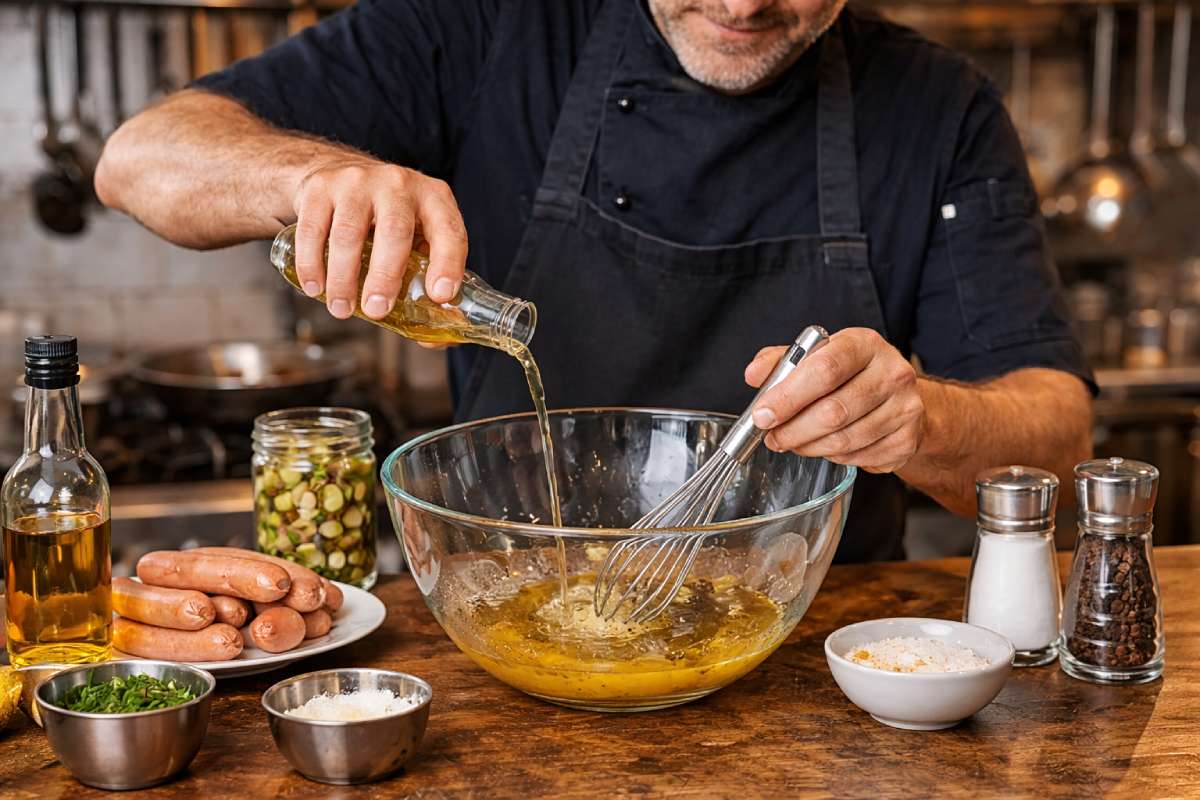
The base dressing for Wurstsalat: vinegar, oil, seasoning and a touch of sugar, whisked smooth before mixing through the sliced sausage and onions.
A good Wurstsalat lives or dies on the dressing. The sausage can be perfect, the onions can be crisp, the gherkins can be spot on – but if the dressing is harsh, flat, or greasy, the whole Wurstsalat reads as “odd” to UK customers instead of “moreish”.
The Bavarian baseline is simple: vinegar + oil + seasoning, with a small amount of sugar to round the edges. The point of sugar isn’t to make Wurstsalat sweet. It’s to stop the vinegar from feeling aggressive, especially when the salad has been sitting chilled for a while. In service terms, it’s what keeps your German Wurstsalat recipe tasting balanced at 12:00 and still balanced at 16:00.
Oil is the other common mistake. Too much and the Wurstsalat feels heavy, and the onions taste dull. Too little and it tastes sharp but thin. You want just enough oil to carry flavour and lightly coat the sausage, not pool at the bottom of the pot. This is why operators should treat Wurstsalat dressing vinegar and oil as a ratio problem, not a “glug until it looks right” problem.
Salt matters more than people expect because cold food mutes seasoning. A Wurstsalat that tastes “fine” at room temp can taste bland straight from the fridge. Start conservative, then adjust once the salad has rested (more on that below), because the onions and gherkins will move flavour into the dressing.
Practical dressing rules (easy to remember)
- Vinegar should taste sharp but not painful; sugar should round, not sweeten.
- Oil should coat, not puddle; if you see a slick at the bottom, you’ve overdone it.
- Taste cold, not warm; Wurstsalat for pubs is nearly always served chilled.
The Build Method: slicing spec, mixing order, resting time
The build method is where a Wurstsalat becomes serviceable. Most “bad Wurstsalat” isn’t about ingredients – it’s about slicing and mixing. If your slices are uneven, the pot eats inconsistently: some bites are all onion, some are all sausage, some are pure vinegar. If you mix everything too early, onions soften, gherkins lose snap, and the whole thing turns watery.
Start with slicing discipline. With Bockwurst or a Pork Hotdog, aim for clean, consistent rounds that don’t tear. Thick slices feel clumsy in the mouth and don’t take dressing well. Paper-thin slices disappear and can go rubbery when chilled. You’re looking for that “deli salad” bite where every forkful feels the same.
Mixing order matters because onions are powerful. If you dump onions straight onto dressed sausage and leave it overnight, you can end up with an onion-dominant salad that’s too pungent for a UK audience. The cleaner approach for a German Wurstsalat recipe is: slice first, dress separately, combine, then rest briefly so flavours marry without texture collapsing.
Resting time is the final lever. Freshly mixed Wurstsalat can taste sharp and slightly disconnected. A short rest lets the sausage take up seasoning and the onions mellow. The key is “short” – you want integration, not pickling. In most real-world setups, you can build it during prep, chill it, then portion through service with predictable flavour.
Operator slicing and mixing spec (quick, repeatable)
- Slice sausage into even rounds (aim for “forkable”, not chunky).
- Keep dressing separate until close to service for best texture.
- Combine, mix gently, then rest chilled so the Wurstsalat tastes joined-up.
- Re-taste cold before service; adjust salt and a touch of sugar if needed.
- If it goes watery, drain lightly and refresh with a small splash of dressing (don’t drown it).
Done this way, Wurstsalat stops being a novelty and becomes a reliable menu tool: a German Wurstsalat recipe you can prep calmly, portion cleanly, and sell confidently alongside your hot line.
Batching for Service: small batch vs big batch ratios
If you want Wurstsalat to work in the real world, you need batching that matches your trade pattern. The biggest mistake is building one massive tub in the morning and hoping it behaves until close. A Wurstsalat can hold well, but texture and balance drift as onions soften and gherkins release liquid. The fix is simple: batch in a way that protects crunch and lets you adjust seasoning as you go.
For small-batch Wurstsalat, think “freshness and control”. This is ideal for pubs, smaller events, and any pitch where you want to react to demand without waste. You build enough for a short service window, then refresh. Your second batch is usually better than your first because you’ve tasted it cold and corrected the dressing.
For big-batch Wurstsalat, the priority is “repeatability and speed”. This makes sense for festivals, showmen, and busy street food operators where you know you’ll sell volume. The trick is not making one giant finished salad. Instead, batch the components and combine in stages. Keep sliced sausage and sliced onions ready, keep the Wurstsalat dressing vinegar and oil mix ready, then assemble in manageable tubs through the day. That approach keeps your German Wurstsalat recipe consistent without turning it into a soggy, over-marinated mess.
Practical batching approach (works for both)
- Prep “dry mix” tubs: sliced Bockwurst or Pork Hotdog, onions, gherkins.
- Prep dressing separately (your base Wurstsalat dressing vinegar and oil mix).
- Combine in smaller service tubs, rest chilled, then portion.
That’s how operators keep Wurstsalat sharp at 2pm, not tired by 6pm. It’s also how Wurstsalat for catering stays clean when you’re serving from chilled storage and don’t want to remix and re-taste every ten minutes.
Menu Placement: add-on, side pot, bar snack, lunch tub
In the UK, Wurstsalat sells best when it has a clear role. It’s not trying to be “health food”. It’s trying to be tasty, quick, and German-authentic. If you position Wurstsalat as a proper beer snack or a sharp side that cuts through rich foods, customers get it immediately.
For hotdog-heavy menus, Wurstsalat is an easy add-on: it’s cold, it’s fast, and it gives the customer something with crunch and acidity. In pubs, Wurstsalat for pubs works as a bar snack the same way pickles, pork scratchings, or a bowl of chips works – but with a stronger “German” identity and a better story.
For events and festivals, the “side pot” format often wins. It’s quick to portion, easy to carry, and it encourages a higher average ticket without slowing the line. And if you want a slightly bigger sale, Wurstsalat can be a lunch tub – but only if you keep the portion disciplined and the texture crisp, otherwise it becomes a heavy, oily tub that people don’t finish.
Where it fits best (choose one or two, don’t do everything)
- Add-on side: alongside hotdogs/bratwurst, quick upsell.
- Side pot: “sharp German sausage salad” in a lidded pot for queues.
- Bar snack: smaller portion, served chilled, easy repeat orders.
- Lunch tub: slightly larger portion; best when you’ve already proven demand.
Common Failures and Fixes (soggy, harsh, bland, watery)
Most Wurstsalat problems are predictable. The good news: they’re also fixable, and you can fix them without turning your prep into a science project. Treat your German Wurstsalat recipe like a repeatable system: taste cold, control liquids, and don’t over-marinate.
Soggy (soft onions, limp texture)
A soggy Wurstsalat usually comes from mixing too early and letting it sit fully dressed for too long. Gherkins and onions release water, the dressing thins, and the whole thing loses bite. If you’re batching for a long day, build in stages and keep dressing separate until you need it.
Fix it by refreshing texture. Drain lightly if you must, then re-dress with a small amount of concentrated Wurstsalat dressing vinegar and oil (not a flood). If you’ve got fresh gherkins or onions prepped, add a small handful to bring the crunch back.
Harsh (too much vinegar, too aggressive)
Harsh Wurstsalat is the fastest way to lose UK customers who are already unsure about “sausage salad”. This happens when vinegar is heavy-handed or the salad hasn’t had time to settle. A short chill rest often smooths it out.
If it’s still harsh after resting, add a tiny amount of sugar to round the edge, and a touch more oil to soften the attack. Then taste again cold. Don’t “fix” harshness by adding loads more sausage; you’ll just dilute everything and lose balance.
Bland (flat, dull, “why bother?”)
Bland Wurstsalat is usually under-salted, especially when served cold. Remember: cold food needs slightly stronger seasoning. It can also happen if you’ve overdone oil and muted the sharpness.
Fix it by adding salt in small steps, tasting cold between. If it’s still flat, you likely need a small lift in acidity – a controlled splash of vinegar in the dressing, not directly into the tub.
Watery (puddle at the bottom)
Watery Wurstsalat is nearly always gherkins and onions dumping liquid into the mix, especially if they’ve been cut too far ahead or stored poorly. It can also happen when dressing is too thin to begin with.
Fix it by draining the excess liquid (don’t rinse), then re-dress lightly with your base Wurstsalat dressing vinegar and oil mix. For future batches, keep sliced components in a “dry mix” tub and assemble closer to service. That one change alone makes Wurstsalat for catering far more reliable.
Quick troubleshooting checklist
- Taste Wurstsalat cold, not warm.
- If it’s soggy or watery: build smaller tubs more often.
- If it’s harsh: rest, then adjust sugar/oil in tiny steps.
- If it’s bland: salt first, then a controlled lift of vinegar.
Run it like that and Wurstsalat becomes what it’s meant to be: a clean, fast-selling German classic that supports the line, not another thing that needs babysitting.
Reliable Wurstsalat (Bavarian Sausage Salad) - Bockwurst or Pork Hotdog
Ingredients
Method
- Slice the sausage (German-style): Cut the Bockwurst or Pork Hotdog into long strips (julienne-style). Keep slices consistent so every portion eats the same.
- Prep the veg: Finely slice the onions and gherkins.
- Make the dressing: In a large bowl, whisk vinegar, oil, mustard (if using), sugar, salt and pepper. Taste it - sharp but rounded, not sweet, not oily.
- Combine: Add sausage strips, onions and gherkins to the bowl. Mix gently but thoroughly so everything is lightly coated.
- Rest chilled: Cover and chill for 20–30 minutes to let flavours settle.
- Too sharp: a small pinch more sugar or a touch more oil
- Too bland: a pinch more salt
- Needs more tang: a splash of vinegar or 1–2 tbsp gherkin brine
- Serve: Portion into 4 bowls. Add herbs if using. Serve chilled with pretzels, crusty rolls, or chips.
Frequently Asked Questions
Yes, but for best texture, prep components (sliced sausage/onion/gherkin) and dressing separately, then combine in smaller service tubs closer to service. If it sits fully dressed too long, it can go watery.
In Germany, strips are very common and give a more “proper” Wurstsalat texture. Rounds are fine too, but strips tend to coat better with dressing and eat more evenly in a pot.
A short rest helps. Chill for 20–30 minutes so the dressing settles and the onion edge softens. Taste it cold before serving and adjust seasoning.
Best formats are a side pot, bar snack, or add-on alongside hotdogs/bratwurst. Keep it clearly positioned as “German sausage salad” and pair it with pretzels, chips, or a roll to make the choice easy.
Treat it like any chilled ready-to-eat salad: keep it properly refrigerated, portion with clean utensils, and don’t leave it sitting out in warm service areas. Follow your site rules and local authority guidance, and use your normal HACCP approach for cold holding.
Wurstsalat is a German sausage salad served cold, usually made with sliced sausage, onions, gherkins, and a sharp vinegar-and-oil dressing. It’s common in Bavarian pubs and beer gardens and works well as a bar snack, side, or light meal.
Bavarian Wurstsalat is the simpler classic: sausage, onions, gherkins, and dressing (no cheese). Swiss-style Wurstsalat adds cheese (often Emmental) and feels richer and more “meal-like”.
Choose a sausage that slices cleanly and holds shape when chilled. Bockwurst is the traditional option. A Pork Hotdog is a strong UK-friendly option that still eats “German” and keeps menu wording simple.
Usually too much vinegar or not enough rounding. Let it rest chilled first, then correct with a small pinch of sugar and/or a touch more oil. Avoid “fixing” harshness by adding loads more sausage – it dilutes the balance.
Onions and gherkins release liquid, especially if mixed too early or stored too long fully dressed. Drain lightly if needed, then refresh with a small amount of dressing. Next time, assemble in smaller tubs and keep dressing separate until needed.
Conclusion
If you’ve never tried Wurstsalat, it can sound like a strange idea in a UK context. But once you treat it as what it is – a sharp, deli-style German classic – it becomes a very practical menu tool. A good Wurstsalat gives you something you can prep calmly, portion quickly, and sell without adding pressure to the hot line. Done properly, it’s crisp, tangy, and properly moreish, not soggy or harsh.
Operationally, the wins are simple: consistent slicing, a controlled Wurstsalat dressing vinegar and oil balance, and batching that matches your trade pattern. Use Bockwurst or the Pork Hotdog for clean portions, keep the dressing disciplined, and assemble in service-sized tubs so the texture stays right. That’s how a German Wurstsalat recipe becomes repeatable across staff changes, busy weekends, and long festival days.
If you want to add Wurstsalat to your offer, start with one format (side pot or bar snack), keep it simple, and let customers discover it. If it moves, you can layer in a Swiss-style option later without rebuilding the whole system. And if you’d like help choosing the best sausage for your setup, The Sausage Haus can point you to the right product and portion approach for your operation.
About The Sausage Haus
The Sausage Haus helps UK caterers, showmen, festival traders, street food operators, and foodservice buyers run a faster, cleaner, more profitable German sausage operation. We focus on authentic German sausages that slice, hold, and serve reliably – built for real-world service, not just photos.
Our sausages are produced in Germany by Remagen, with consistent specs designed for commercial kitchens and high-throughput event trade. In the UK, distribution is handled by Baird Foods, so operators can order with confidence and keep supply dependable.
Beyond the product, we publish practical systems: how to build menus that run fast, how to batch for service, and how to keep quality consistent under pressure. If you’re aiming to upgrade your German sausage offer – or simplify it so it actually works on a busy pitch – The Sausage Haus is built for that.