This post breaks down a festival food stall setup designed for very high volume service: a 6x3m tent, one large 30kW gas grill, four 30kW American-style gas fryers, and a 12-person team to keep every station running without delays. It’s a practical “speed system” example you can adapt for UK music festivals, showmen circuits, stadium events, and other peak-demand catering.
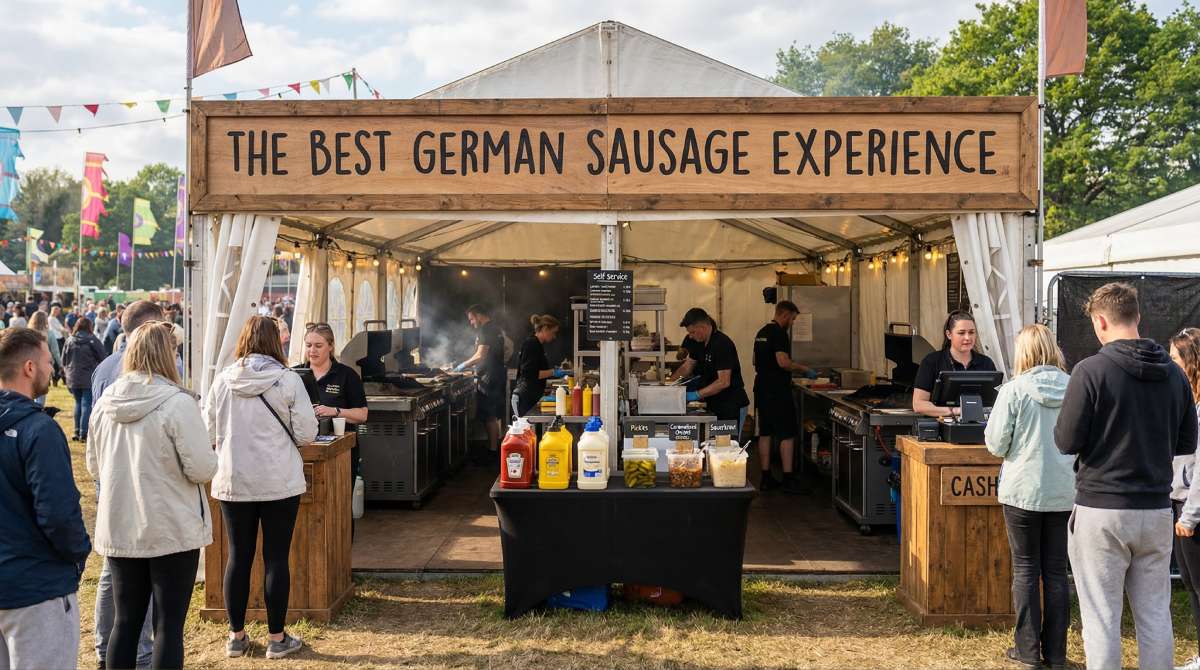
A high-throughput 6x3m festival food stall setup built for fast service – clear branding, two queues, and a busy cookline inside.
Introduction
If you’ve ever catered a UK music festival, you’ll know the truth: customers don’t queue for your menu – they queue for speed and certainty. When the crowd surge hits between sets, you either push clean, consistent portions at pace, or you lose the hour to indecision, bottlenecks, and a line that stops moving. That’s where a festival food stall setup becomes a system, not just “a grill and a fryer”.
This article is written by Jorg Braese, and it’s based on a real 6x3m tent setup he ran himself – successfully, consistently, and profitably – on large festivals. The target was simple: up to 500 portions per hour with two core offers that customers instantly understand: sausage in a bun, or sausage and chips. The output came from deliberate over-capacity on the hot side: a very large 30kW gas grill for continuous sausage production, plus four large American-style gas fryers (30kW each) so chips never became the bottleneck when the rush hit.
Just as important as equipment is labour design. The stall was run with 12 people in total, not because it looks impressive, but because it protects speed. With enough cover for breaks, cleaning, restocking, and every station working in sync, the line keeps moving at full pace instead of slowing down every time something needs doing.
In UK trade terms, this is about repeatable performance under pressure. A fast, disciplined line reduces waste, increases portion consistency, protects margins, and turns a small footprint into serious hourly revenue.
Key Takeaways
- Design for throughput first: a festival food stall setup is a workflow problem – equipment and menu are chosen to keep the line moving.
- Over-capacity beats recovery time: multiple high-power fryers prevent the “chips gap” that kills speed when baskets drop back-to-back.
- One grill, continuous output: a large 30kW grill is about maintaining steady sausage volume without batch waiting.
- Menu discipline drives pace: two core offers (bun or chips) minimises decisions, reduces errors, and speeds assembly.
- Staffing is a system, not a headcount: 12 people allows breaks, cleaning, restock, and surge cover without station slowdown.
- Bottlenecks usually aren’t cooking: the real speed limit is often wrapping, boxing, sauces, payments, and handover.
- Square-metre profitability: high volume per hour in a 6x3m footprint improves return on pitch fees, labour, and gas.
The Speed System Concept: Why This Festival Food Stall Setup Works
When people say “speed” at a festival, they usually mean “serve fast”. In practice, speed is a system with three parts: throughput, consistency, and zero pauses.
Throughput is the obvious metric – how many portions you can push out per hour when the rush hits. But throughput alone is meaningless if it arrives in bursts. A stall that can do 200 portions in 20 minutes, then stalls for 10 minutes because chips are recovering or the grill is waiting on the next batch, will still feel slow to customers and will bleed revenue in the peak window.
That’s why consistency matters as much as raw power. Consistency means every order looks the same, weighs the same, and takes roughly the same time to hand over. When portions vary, staff start discussing, remaking, apologising, and queue management collapses. Consistency keeps decisions out of the line. It also protects margin – every “slightly bigger scoop” multiplied by hundreds of portions is real money.
The third piece is the one most operators underestimate: no pauses. Pauses come from predictable places – fryer recovery time, running out of buns, sauces not prepped, a single person becoming the choke point, or a payment/handover station that can’t keep up. The showmen approach is to design the stall so no single micro-failure stops the line. That’s why this festival food stall setup uses over-capacity on the hot side and enough staffing to cover cleaning, restocking, and breaks without stations slowing down.
A key part of removing pauses is two-product discipline:
- Sausage in a bun is the fast lane. It’s minimal assembly, minimal packaging complexity, and very predictable timing.
- Sausage and chips is the “volume builder”, but only works at high speed if chips output is engineered for it (hence multiple high-power fryers) and the build station is streamlined.
Everything else is noise. The more variants you add – extra toppings, multiple portion sizes, “can I swap…” requests – the more you convert a production line into a discussion. This system stays profitable because it stays simple: two core offers, built to be repeatable at pace, hour after hour, without the line ever stopping.
Menu Engineering for 500 Portions/Hour
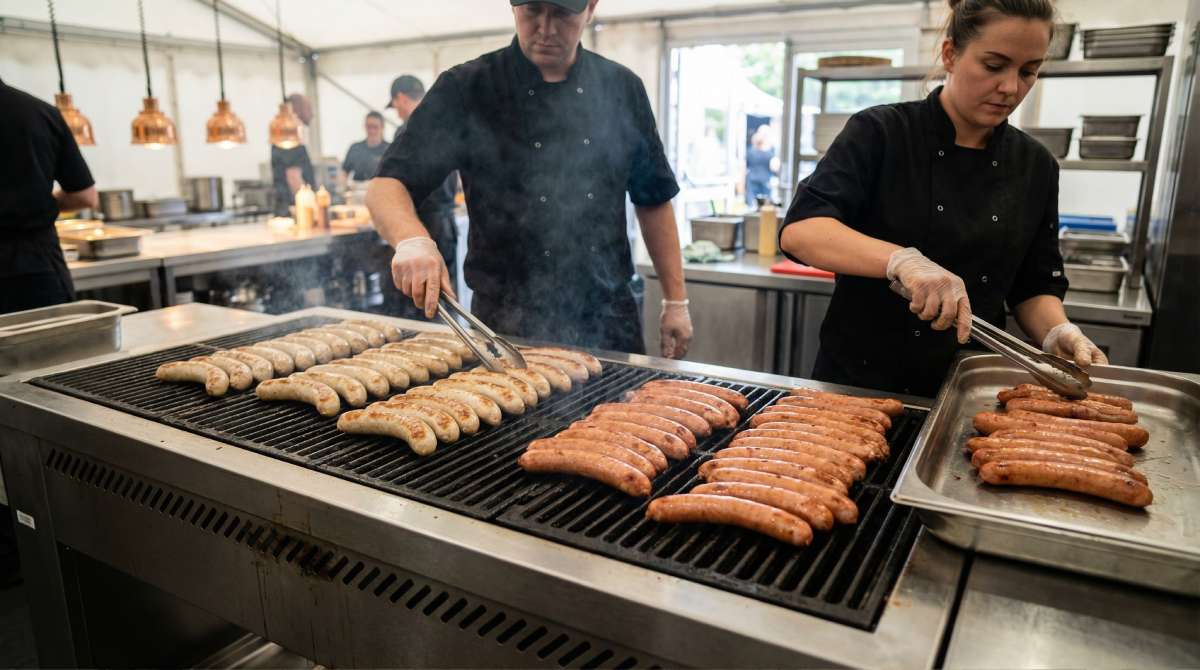
A 180x80cm gas grill running as a sausage pipeline – around 100 thick 25cm bratwursts and bacon frankfurters, handled by two staff for continuous festival service.
Sausages: two SKUs that cover 90% of demand
Customers want choice – but they mainly want to feel that your stall is “for them”. You can deliver that without running five different sausages. The author ran this setup with two sausages only:
- 150g Bratwurst
- 150g Bacon Frankfurter
That’s a smart pair: one is the classic, satisfying “proper sausage” option; the other is a familiar, high-conversion hotdog-style choice. Operationally, two SKUs simplifies everything: grill management, hold strategy, call-outs, portioning, allergen control, and forecasting. You get speed because staff aren’t mentally switching between products and procedures all the time.
At 500 portions per hour, menu design is not a creative exercise – it’s production engineering. The rule is simple: give customers choice, but don’t let choice slow the line. In this setup, that meant controlling three variables that usually kill festival speed: chip timing, sausage range, and bread handling.
Chips: two-stage frying to remove the bottleneck
Chips are the most common reason a “sausage & chips” stall stalls. If you only cook chips from frozen to finish during peak, you’re fighting fryer recovery, basket capacity, and staff panic all at once. The solution here was a two-stage process:
- Pre-cook frozen chips at 150°C hours before the busy period.
- During service, finish them in around 3 minutes in large batches.
That shift is massive. Instead of waiting on a full cook cycle during the rush, you’re using the fryers as a finishing tool. It gives you predictable timing, lets you build buffer without quality dropping off a cliff, and means the fryers can handle surges without the queue feeling the pain. It also stabilises portion consistency, because the team isn’t tempted to undercook chips just to keep the line moving.
Bread: reduce handling and protect flow
Bread is another hidden bottleneck. Slicing, toasting, and “finding the right bun” all add seconds that become minutes. Instead of standard buns, the setup used pre-baked small baguettes, reheated for a few minutes in an oven. That gives you:
- A consistent “premium” look without extra prep
- Fast warm-through in batches
- Less crushing and splitting than soft buns in high-volume handling
- Easier portion control and fewer remakes at the pass
Put together, this menu engineering creates a line that behaves predictably: chips are always available to finish fast, sausages are simple to cook and hold at pace, and bread is warmed in batches without turning assembly into a craft project. That’s the difference between being “busy” and being profitable at peak.
Condiments and Toppings: Keep Choice Off the Production Line
Condiments are where festival stalls quietly lose speed. If every customer asks for ketchup, mustard, onions, pickles, and “a bit more of that”, your build station turns into a conversation – and your throughput collapses. The solution in this festival food stall setup was to separate choice from assembly.
This setup offeres a strong but controlled range of toppings using large self-service containers: ketchup, mustard, mayonnaise, pickles, caramelised onions, and sauerkraut. These sat in a dedicated self-service area beside the stall, clearly visible, well signed, and positioned so customers could finish their food without blocking the handover point.
Operationally, this does three important things:
- Protects the line: the build station stays focused on portioning, wrapping/boxing, and handover – not bespoke topping requests.
- Gives “choice” without complexity: customers feel looked after, but you don’t add extra SKUs or decision points inside the workflow.
- Improves queue behaviour: people move away from the counter after receiving food, which reduces congestion and makes the stall look faster.
A practical detail: with high throughput, self-service only works if it’s treated like a station. Someone needs to top up containers, wipe spills, and reset the area on a rotation, so it stays fast, clean, and attractive even during peak rush.
Equipment Stack: Power, Redundancy, and Recovery Time
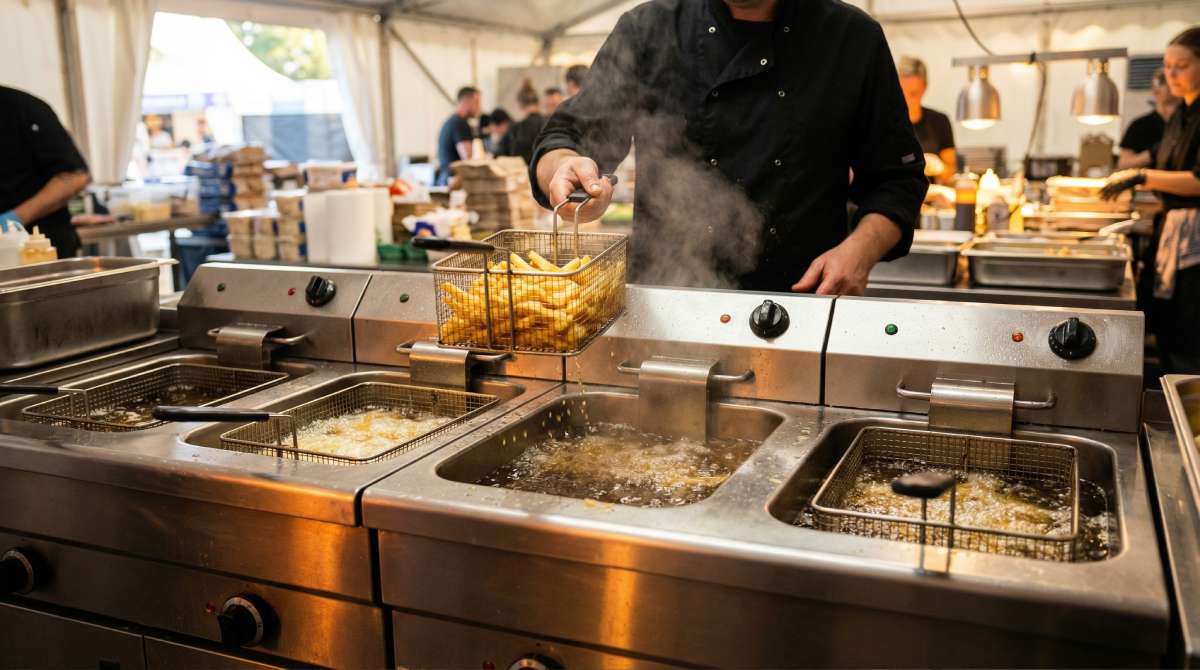
Four large American-style gas fryers keep chips moving at speed – a chef lifts a full basket to drain as the station runs at peak festival throughput.
At festival volume, equipment choice is less about “what’s nice to have” and more about recovery time and continuous flow. This festival food stall setup was built to avoid pauses: enough hot-side capacity to keep output steady, and a gas supply system designed so nothing drops off a cliff mid-rush.
30kW grill: a continuous sausage pipeline
The core engine was a 30kW gas grill measuring 180cm wide and 80cm deep. That footprint matters: it provides enough surface area for hundreds of sausages across a service cycle, which is what you need when you’re targeting 500 portions per hour.
The process on the grill was deliberately linear. Sausages started on the right-hand side and, as they cooked, they were rolled and moved progressively to the left. By the time they reached the left side, they were finished and ready for serving. This right-to-left “conveyor” method does two things:
- It removes decision-making (“Is this one done?”) because position on the grill indicates cook stage.
- It creates predictable handover for the assembly team: finished sausages arrive at the same place, in the same rhythm, all shift long.
With only two SKUs (150g Bratwurst and 150g Bacon Frankfurter), this pipeline stays clean and repeatable, which is exactly what you want under pressure.
4x 30kW fryers: preventing the “chip gap”
Chips can kill throughput because fryer recovery punishes you when baskets go down repeatedly. That’s why the setup used four large American-style gas fryers at 30kW each. Combined with the two-stage chip approach (pre-cook earlier at 150°C, then finish fast in service), multiple high-power fryers stop the classic “chip gap” where the entire line waits on one constrained station.
In practice, this gives you operational freedom: you can finish large batches quickly, rebuild buffer without panic, and handle surges without stretching cook times or degrading quality.
Gas oven for bread: batch reheating without slowing the line
Bread handling was kept fast with a gas oven for reheating pre-baked small baguettes in batches. That means warm bread is available on demand without stealing grill space or turning assembly into a bottleneck. It’s a small detail, but it protects rhythm at peak.
Gas system: 5 large propane bottles in parallel + live switching
High kW festival rigs live or die by gas stability. This setup used a gas system with five large propane bottles working in parallel to deliver the required flow rate reliably. The critical part wasn’t just “having enough gas”, but how it was managed:
- A sophisticated switchover system prevented individual appliances from starving if one bottle ran low.
- Live bottle switching was built into operations, so cylinders could be changed without interrupting service or causing pressure dips that slow recovery on grills and fryers.
This is the difference between a stall that’s theoretically capable of 500 portions per hour and one that actually holds that pace in real conditions.
Redundancy plan: what happens when one unit fails
With this kind of stack, redundancy is designed in, not hoped for. If one fryer drops out, you shift to a “3-fryer mode” by tightening batch cadence and briefly pushing bun orders harder while chips buffer rebuilds. If the grill has an issue, the right-to-left pipeline still provides a clear operating method across remaining zones: keep flow, simplify temporarily, and protect queue speed. The priority is always the same: keep the system moving rather than letting one failure turn into a full stop.
6x3m Tent Layout and Station Design
A high-output festival food stall setup is won or lost on flow. In a 6x3m tent you don’t have the luxury of “space”, so the layout has to behave like a professional kitchen line: clear stations, short movement paths, and a handover process that never blocks.
Front-of-house: two cashiers, two corners, one direction of travel
Service started with two high-speed cashiers, positioned at each front corner of the tent. This does two things immediately: it doubles payment capacity at peak and prevents one queue from becoming a single-point failure.
From the cashpoints, customers were directed to the left side of the tent, where the system was designed so that food was already ready by the time they arrived. That is a key speed principle: customers should move away from payment and toward handover, not hover in front of the till while waiting for cooking to happen.
Call-and-response ordering: remove ambiguity, create rhythm
The cashpoint team didn’t “quietly pass tickets”. They shouted orders clearly to the production team, and the team answered clearly. This call-and-response approach is exactly how high-performance commercial kitchens run under load:
- it confirms the order was heard correctly
- it creates tempo across stations
- it reduces errors that cause remakes and slowdowns
It also helps new staff lock into the system quickly, because communication is structured, not ad hoc.
Back-of-house positioning: show the theatre, control the risk
At the left rear sat the grill. It was placed far enough from customers to keep the working zone safe and controlled, but still visible enough that customers could see the “drama” – the heat, the volume, the movement. That visibility increases perceived value and trust without letting the public interfere with the workflow.
On the far right were the fryers, positioned as far away from customers as possible. That’s deliberate: fryers are the highest burn risk, the highest spill risk, and the station most likely to need urgent movement (baskets, draining, oil handling). Keeping that on the customer-opposite side reduces hazard and keeps the front clear.
The centre piece: prep and assembly as the control tower
The central station was the prep/assembly area for finished products. Think of it as the “control tower” of the stall:
- Grill delivers cooked sausages to the centre.
- Fryers deliver finished chips to the centre.
- Bread and packaging are managed at the centre.
- Orders are assembled fast and handed to the customer service area on the left.
This is the important design choice: cooking stations do not serve customers. They deliver components to assembly. Assembly is where speed is protected, because it’s the one place you can standardise portioning, wrapping/boxing, and handover.
Why this layout scales
This layout works because it creates a straight, repeatable system: pay fast → move left → order called → components flow in → assemble centrally → hand over. Customers experience it as effortless speed, while the team experiences it as a professional line with clear boundaries, clear communication, and minimal cross-traffic inside a tight 6x3m footprint.
Staffing Model: 12 People Without Chaos
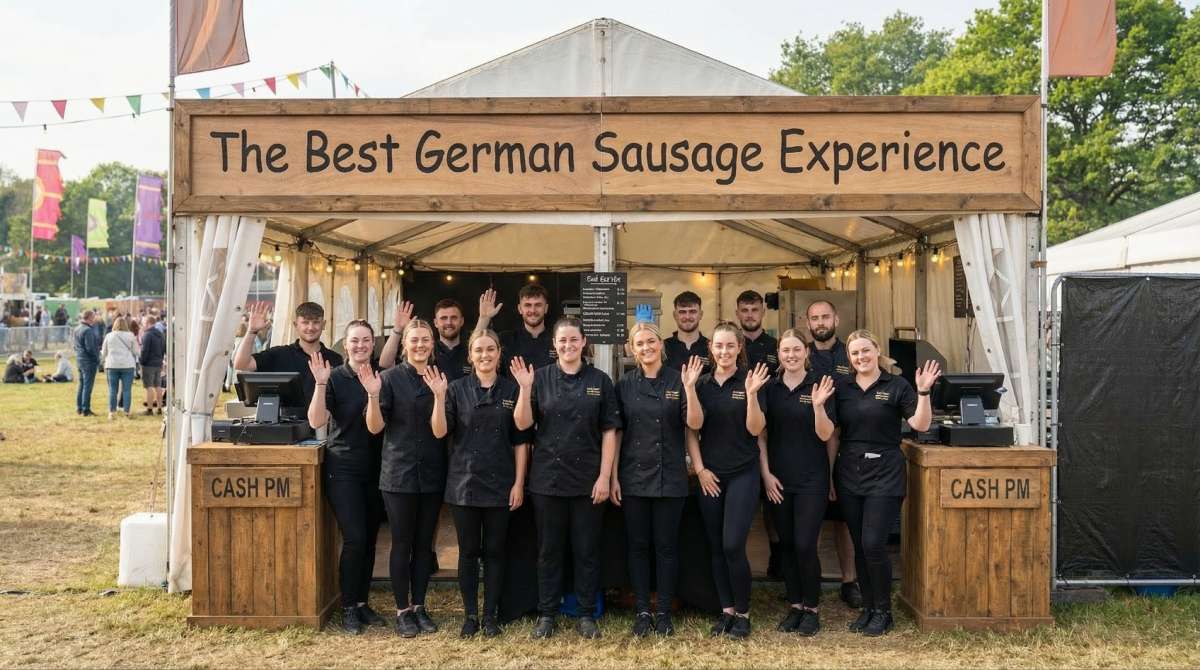
Our 12-person team ready for service in a 6x3m festival food stall setup – set up complete, calm before opening, and built for high-speed throughput.
At 500 portions per hour, labour is not “extra hands”. It’s capacity insurance. The goal is that every station runs at full speed all the time – while breaks, cleaning, restocking, and sudden surges are covered without the line slowing down. This is why the team was structured like a high-performance kitchen, with clear roles and a simple chain of communication.
Core positions by station
Front of house
- 2 cashiers (front corners): fast payment, clear queue control, and loud, clean order call-outs to production.
Grill
- 2 on the grill:
- Grill feeder + rolling: loads sausages on the right, manages spacing, keeps the rolling flow moving across the grill.
- Finisher + runner: pulls finished product on the left, checks finish by position and timing (not debate), and delivers sausages to the assembly/prep centre.
This split matters. One person keeps the grill “fed and flowing”; the other keeps finished output leaving the grill continuously so the surface never clogs.
Fryers
- 1 on the fryers: runs the finishing cycles, manages basket cadence, drains well, and delivers chips in consistent batches to the assembly centre. This role is about rhythm and temperature discipline – not multitasking.
Assembly / pass
- 3 on the assembly line: these are your throughput multipliers. Typically:
- one handles bread and packaging (baguettes/boxes/trays)
- one builds sausage buns and plates chips
- one finishes, checks, and hands to the customer service side (and keeps the pass clean and moving)
The assembly team is where seconds are won. Their job is to keep handover constant and prevent “micro-pauses” from stacking up.
Hygiene + stock
- 1 dedicated cleaning and restocking: keeps self-service condiments topped up, wipes spills, reloads bread/packaging, manages bin flow, and resets stations before they become problems.
This role protects speed because it prevents the classic failure mode: the line stopping for “just a minute” to fetch something or clean a mess.
Floaters, jumpers, and breaks (the hidden secret)
- 1–3 as jumper / break cover: these people plug gaps instantly – cover a cashier, take over fryers for five minutes, run stock, manage queue direction, or step into assembly when orders spike.
This is what stops the system from wobbling. Without jumpers, breaks and small issues turn into slowdowns. With jumpers, the stall stays smooth and professional, and the customer experience stays “fast” even during the busiest 5 hours of the day.
In short: this staffing model works because it’s designed around continuous output, not “everyone helping everywhere”. Clear stations, clear handoffs, and enough cover so the line never pauses.
Prep, Holding, and Replenishment
At this volume, prep and replenishment are not “background tasks”. They are what keeps the speed system stable. The key principle in this setup was clear: hot holding was kept to an absolute minimum. The stall didn’t try to look like a buffet. It ran like a controlled production line, flexing output up or down based on real-time demand.
Pre-festival mise en place that actually matters
The prep that moves the needle is the boring stuff that prevents pauses:
- Chips staged for two-step frying (pre-cooked earlier at 150°C so service finishing is fast and predictable).
- Bread ready for rapid oven cycles (pre-baked small baguettes staged so the gas oven can reheat in batches without hunting for stock).
- Packaging pre-positioned at the assembly line (trays/boxes/bags/napkins in reach, not “somewhere in the van”).
- Self-service condiments fully loaded before peak (ketchup, mustard, mayo, pickles, caramelised onions, sauerkraut), with refill stock staged underneath.
None of this is glamorous, but it eliminates the “just a second” moments that wreck throughput.
Hot holding strategy: minimal buffer, maximum quality
Hot holding was treated as a short buffer only, not a storage method. The system was actively managed by the cashiers: when they recognised queues growing or shrinking, they told the team to maximise or reduce throughput. That meant production matched demand rather than guessing.
Where items were held
- Sausages: held warm on the left, cooler side of the grill – close to service but not sitting in the hottest zone where they’d dry out.
- Chips: held under warming lamps, again as a short buffer to smooth the rush rather than a long hold.
The rule: maximum hot hold of 10 minutes. After that, product was discarded. This sounds harsh, but it protects two things that make or break festival trade:
- Taste and repeat sales: chips and sausages deteriorate quickly when held too long. Once quality drops, complaints rise and queue time feels longer.
- Food safety discipline: a tight holding window keeps the team honest and reduces risk under pressure.
The result is counterintuitive but real: discarding small amounts at the right time is cheaper than serving tired product that damages reputation, slows the line, and increases refunds.
Restock cadence: buns, chips, onions, sauces, packaging
Restocking was run as a rhythm, not an emergency.
- Bread: reheated in short oven cycles, topped up before the last batch is used – never after.
- Chips: buffer rebuilt continuously in small waves so the fryer station isn’t forced into panic batches.
- Condiments/toppings: refilled on rotation by the cleaning/restocking role, keeping the self-service zone clean and fast.
- Packaging: treated like a production input; if packaging runs out at the assembly point, throughput collapses immediately, so it must be replenished proactively.
In short: this prep/holding strategy keeps the system fast without turning quality into a casualty. Production flexes with the queue, buffers stay short, and replenishment happens before it becomes visible to the customer.
Speed + Quality Control Under Pressure
High throughput only stays profitable if quality is controlled. Under festival pressure, the easiest way to lose money is to “go faster” by getting sloppy – which usually creates remakes, complaints, refunds, and waste. In this festival food stall setup, speed and quality were treated as the same goal: tight temperature discipline, repeatable portions, and ruthless waste control.
Temperature discipline and “don’t break the chain”
Temperature control starts long before service. The system works because every hot component has a defined process and a defined holding window:
- Grill discipline: the right-to-left grill flow is not just for speed – it creates consistent finish. Sausages move through zones rather than being cooked “by opinion”. Finished product sits on the cooler left side only briefly, so it stays hot without drying out.
- Fryer discipline: chips are pre-cooked earlier and then finished fast during service. That reduces the temptation to cut corners when the queue grows. Oil temperature is protected by using multiple fryers and keeping basket loads consistent.
- Short hot-hold rule: sausages and chips are held warm only as a small buffer (chips under heat lamps; sausages on the cooler side of the grill) with a hard maximum of around 10 minutes, then discarded. That protects food safety and customer perception.
“Don’t break the chain” in practical terms means this: don’t let product sit in the danger zone, don’t let oil temperature collapse, and don’t let holding become storage. Once you allow those habits, quality drops fast and your line slows from rework and complaints.
Portion consistency as profit protection
Consistency is a financial control, not just “presentation”. At festival scale, tiny deviations become big losses:
- A slightly overfilled chip portion repeated 300 times is a serious cost.
- A sausage that’s served too early creates complaints; served too late, it dries out and gets rejected.
- Variable builds slow the assembly line because staff hesitate, re-check, and get pulled into topping negotiations.
The fix is simple: standard portions, standard packaging, standard build steps. Two sausage SKUs, one clear bun format, a defined chip scoop/pack format, and self-service toppings off the production line keep both speed and margin stable.
Waste control: oil, chips, sausages, buns
Waste isn’t only what you throw away. Waste is also what you “leak” through inconsistency and poor station discipline.
Key controls that matter at 500 portions/hour:
- Oil: maintain clean working habits at the fryer station (shake/drain properly, avoid overloading baskets, skim debris as part of routine). Poor oil management reduces quality and forces premature oil changes.
- Chips: manage buffer size deliberately. Too little buffer and you stall. Too much buffer and you start serving tired chips or discarding excess. The cashiers’ queue feedback is the trigger for adjusting output.
- Sausages: keep the grill pipeline flowing so you don’t end up with a pile that sits too long. The short hot-hold rule prevents “selling leftovers”.
- Buns/baguettes: reheated in batches, not as a constant open-ended warm pile. Bread goes stale fast under heat; batch control reduces discard and keeps the product looking premium.
The core idea is disciplined, repeatable operations: protect temperatures, standardise portions, and keep buffers small and controlled. That’s what lets you run very fast while still serving food people actually want to buy again.
Commercial Numbers That Matter
The biggest pricing mistake on festivals is thinking “maximum price” equals maximum profit. On large events the food choice is massive. Customers compare quickly, queues are visible from a distance, and price is part of perceived fairness. In this setup, pricing was kept deliberately competitive – even when competitors complained we were “too cheap”. The result was exactly what matters commercially: large queues, repeat customers, and volume that stayed strong all day. Some people ate with us two or three times a day because the offer felt good value, fast, and consistent.
The key is not the sticker price. The key is the calculation: knowing your true cost per portion down to the last detail, so you can price confidently and still protect margin.
Portions/hour → revenue/hour logic (simple framework)
A simple way to think about festival economics is:
- Revenue/hour = portions/hour × average selling price
- Gross profit/hour = portions/hour × (selling price – total cost per portion)
At high volume, small improvements matter more than big “marketing ideas”. If you improve speed by 10%, or reduce cost per portion by a few pence without harming quality, that compounds across hundreds of portions per hour.
Labour cost reality at peak load
Labour feels expensive until you measure it correctly. The question isn’t “How many staff can we afford?” It’s:
- How many portions per labour-hour are we producing?
- Does staffing prevent slowdowns, errors, and quality drops that kill throughput?
At 500 portions/hour, the cost of being under-staffed is brutal: queues slow, mistakes rise, wastage increases, and you lose the most valuable selling window. A properly staffed line is often cheaper than a “lean” team that can’t hold pace.
Gas consumption as a line item
With a hot-side stack like this (30kW grill + four 30kW fryers + gas oven), gas is not a background cost – it’s a measurable input. Treat it like you treat sausages and chips:
- estimate consumption per service hour at operating load
- convert it into cost per portion
- include it in your pricing model
The same applies to everything that quietly eats margin: packaging, napkins, cleaning supplies, waste disposal, card fees, and spoilage.
How to price bun vs chips for margin + speed
Two core products lets you price strategically:
- Sausage in a bun should be your fast, high-throughput anchor: simple build, low friction, strong margin when portion control is tight.
- Sausage & chips is the higher ticket item, but it must be engineered so it doesn’t slow the line (two-stage chips, warming lamps, efficient assembly).
Pricing should reflect not only ingredient cost, but the time and capacity cost. If chips create more station load, they must carry enough margin to justify that load. If bun orders fly out quickly, they can be competitively priced to pull the queue in and keep volume high.
Bottom line: competitive pricing wins on festivals when it’s backed by precise costing. Don’t “guess a high number”. Build a proper cost model – from the last drop of ketchup to gas costs – and then choose prices that attract queues, drive repeats, and turn throughput into reliable profit.
Festival Ops: Set-Up, Close-Down, and Compliance (UK Angle)
High-volume festival catering lives and dies on two things that don’t show in Instagram photos: how fast you can become operational, and how reliably you can pass scrutiny at close-down. The goal is a set-up and close-down routine that is quick, calm, and repeatable – while staying aligned with UK expectations around food safety and public protection.
Set-up checklist for a 6x3m tent
A practical set-up checklist (ordered for speed and safety):
Site + structure
- Confirm pitch boundaries, customer queue direction, and emergency access stays clear.
- Tent up, weights/anchoring secure, flooring down (anti-slip if possible), trip hazards removed.
- Define “public line” vs “staff line” with barriers/tables – don’t let customers drift into working space.
Power + heat
- Position grill left-back, fryers far right, gas oven accessible to assembly.
- Gas system connected and leak-checked; regulators/hoses tidy and protected.
- Confirm the cylinder bank and switchover system is live and accessible for safe bottle changes.
- Fire safety basics in place: extinguishers appropriate for the risk (and accessible), staff know where they are.
Food safety + service readiness
- Handwash station set up and stocked (water, soap, disposable towels).
- Sanitiser buckets/spray, cloth system, bin stations, spare liners staged.
- Allergen and menu signage visible at ordering point.
- Condiment self-service station stocked and separated from the pass.
- Packaging, napkins, and “grab items” staged at assembly, not in storage boxes.
Production readiness
- Start chip pre-cook plan early enough to build buffer before peak.
- Oven pre-heat and first bread batch schedule defined.
- Grill pipeline set (right-to-left flow), tools ready (tongs, trays, probes if used).
- Quick team brief: roles, call-and-response order system, and hot-hold rules.
Cleaning close-down flow (fast + passable + repeatable)
Close-down is easier if you run clean all day. The aim is “passable and repeatable” – not a deep clean that destroys the team at midnight.
A simple close-down flow
- Stop-the-line decision: reduce throughput, sell down buffers, and stop creating new hot-hold.
- Secure food safely: dispose of product held beyond your rule; cool/store what is permitted by your system and event plan.
- Oil and fryer control: shut down safely, strain/handle oil according to your process, wipe externals, clear floor splashes.
- Grill shut-down: burn-off, scrape, wipe down, remove waste safely.
- Surfaces and touchpoints: assembly, pass, tills, condiment station – wipe, sanitise, reset.
- Floor and bins: bag waste, remove grease risk spots, final sweep/mop, replace liners for next day.
- Pack in zones: FOH gear, then assembly, then cookline – so you don’t block yourself.
Make it a routine. The same steps, the same order, every time.
Practical compliance touchpoints (UK: food safety, allergen signage, handwash)
Without getting lost in paperwork, these are the practical touchpoints that most often matter on UK events:
- Handwashing must be real, not symbolic: accessible, stocked, used. If staff can’t wash hands quickly, standards slip under pressure.
- Allergen information must be visible and usable: clear signposting at the cashpoints so customers can ask or decide before ordering. Keep ingredient/allergen info accessible to staff.
- Temperature discipline and hot-hold limits: if you choose a “max 10 minutes then discard” rule, that’s a strong operational control – but it must be trained, followed, and owned.
- Cross-contamination control: separate tools/areas if you introduce any higher-risk items; keep raw handling and ready-to-eat handling clearly separated in practice.
- Cleaning schedule during service: wiping, bin control, condiment station hygiene, and floor safety are part of compliance, not “nice to have”.
In UK terms, the best strategy is to operate like a professional kitchen: clear stations, visible hygiene, simple documented routines, and staff who can explain what they’re doing. That combination keeps you fast, keeps you safe, and keeps you credible with event organisers and inspectors.
Transport and Storage: The Hidden Capacity Limiters
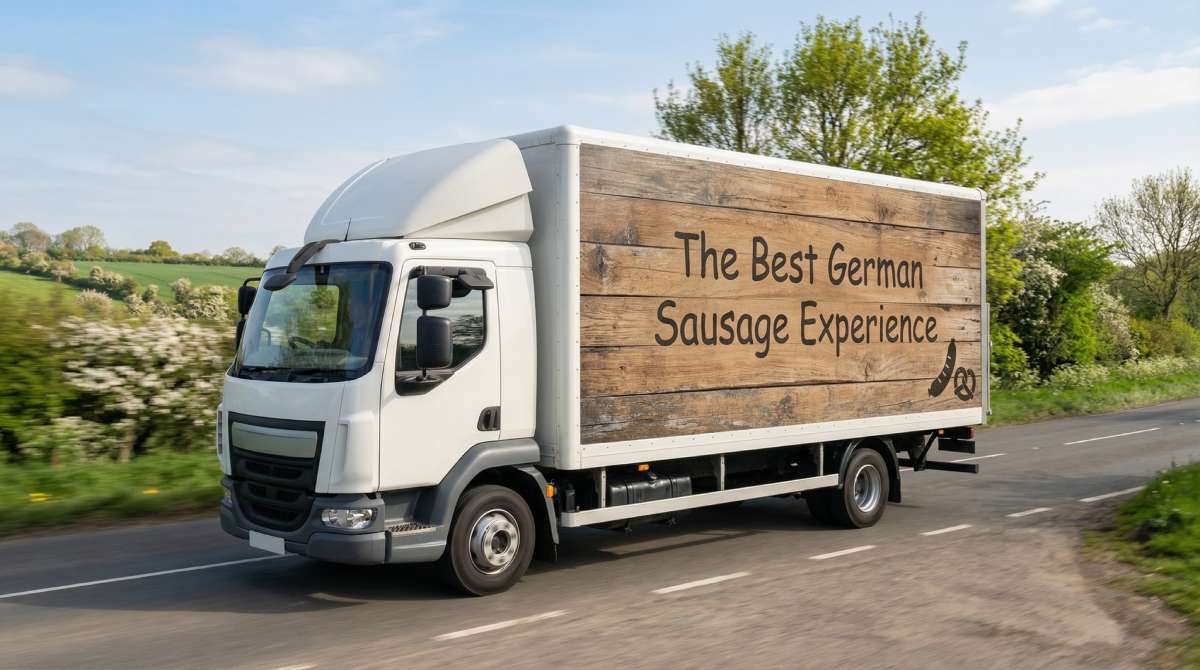
A 7.5t truck supports high-throughput festival food stall setup logistics – fast transport and reliable restocking for large-scale German sausage operations.
At 500 portions per hour, transport and storage stop being logistics – they become throughput constraints. You can have the perfect festival food stall setup on paper, but if you cannot move equipment and stock efficiently, the line will still stall.
Transport: plan for a truck, not a van
For a rig of this scale (large grill, four heavy-duty fryers, gas oven, cylinder bank, barriers, tables, signage, packaging, handwash kit, condiments, and spare parts), a standard van setup is often the wrong tool. You need serious transportation capacity, and in practical terms that often means thinking in the direction of a 7.5 tonne truck rather than “one more trip in the van”.
Why it matters:
- Fewer trips, fewer failures: arriving in multiple loads increases the chance of missing critical items and delays set-up.
- Safer handling: heavy appliances and gas systems need proper loading, securing, and unloading.
- Faster set-up and close-down: equipment comes out in the right order and goes back in systematically, which is essential on multi-day festivals.
Cold storage: close enough to restock at speed
High-volume service burns stock quickly. If your cold storage is “somewhere across the site”, your restocking becomes a time tax and your staff start improvising. The requirement is simple: you need cold storage not too far away from the tent, so replenishment can happen in a reasonable amount of time without pulling key people off stations.
Practical principles:
- Short restock loops: restocking should be predictable and fast, not a 15-minute mission that creates gaps on the line.
- Staged stock near the tent: keep a controlled “working buffer” close by (in safe temperature control), so you’re topping up little and often rather than doing emergency runs.
- Dedicated restock responsibility: the cleaning/restocking role (or a jumper) should run storage and replenishment, so the grill, fry, and assembly stations stay locked in.
In short, transport and cold storage are part of the production system. If you size them correctly – truck-scale transport and nearby cold holding – the stall can maintain pace. If you don’t, no amount of grill power will save you when you run out of stock at the wrong moment.
Lessons Learned: What Jorg Would Do Differently Next Time
This speed system did not appear fully formed on day one. It started as a small, one-person festival stall and then grew continuously as demand, confidence, and operational learning increased. That evolution is the real reason the final setup worked so well. Each festival added new data: where the bottleneck really was, what customers actually bought, what slowed the line, what created waste, and what caused stress. Over time, we weren’t guessing anymore – we were refining.
The biggest lesson is that the “perfect system” is rarely designed in a spreadsheet. It’s built in increments, with real queues, real failures, and real constraints. When you scale step-by-step, you can make changes that are proven rather than theoretical: add a fryer because chips are holding you back, not because it looks impressive; introduce a second cashier because payment is the choke point; simplify the sausage range because choice is slowing assembly; move toppings into self-service because custom requests are killing tempo.
If Jorg did it again, the priority would be even more explicit: scale only what removes a measured bottleneck, and keep everything else deliberately simple. The strongest advantage of this approach is that it creates a system that is both high-output and calm. You know what to do, your team knows what to do, and your customers feel it instantly in the speed of the line.
The second lesson is cultural: the stall worked because it ran like a professional kitchen. Clear roles, loud communication, disciplined holding rules, and relentless portion control are not “nice extras”. They are what turn a busy festival pitch into a consistently profitable operation.
And finally, the most practical lesson: the system is never finished. The best results came from treating every event like a test – review what slowed you down, update the process, and carry the improvement into the next festival. That’s how a one-person stall becomes a highly effective, high-volume speed system over time.
Conclusion
A high-output festival food stall setup is not about fancy menus or chasing maximum prices. It’s about building a repeatable system that holds up when the queue is longest. In this real-world showmen example, the combination of a tight menu (two sausages, bun or chips), a deliberate 6x3m festival tent layout, and serious hot-side capacity created predictable throughput without compromising quality. Chips were engineered to avoid the classic “chip gap” using a two-stage process, sausages ran through a clear grill pipeline, and toppings were moved into a self-service area so choice never slowed the line.
Just as important as equipment was process: call-and-response order communication, defined stations, and active control of output based on queue length. Hot holding was kept minimal, with a strict discard rule to protect taste and food safety. Commercially, the biggest lesson is simple: competitive pricing plus tight costing wins on festivals. When you know your portion costs – including packaging, condiments, oil and gas – you can price confidently, pull the biggest queues, and earn repeat customers.
If you’re building or refining your own high throughput festival catering operation, use this framework as a starting point. Strip the menu back, map the workflow, and upgrade only what removes a proven bottleneck. If you want help choosing the right sausage formats for speed service, get in touch with Sausage Haüs.
About Sausage Haüs
Sausage Haüs supplies authentic German sausages for UK trade, built for real-world service in festivals, pubs, street food, and catering. Our range is designed to perform under pressure – consistent size, reliable cooking behaviour, and the kind of flavour that drives repeat orders. We focus on products that work operationally, from Bratwurst to frankfurters and other showmen-ready favourites, with formats that suit high-speed assembly and controlled portion costs.
Our sausages are produced by Remagen in Germany, bringing traditional know-how and robust manufacturing standards to every batch. In the UK, distribution is handled through Baird Foods, supporting cold-chain delivery and trade supply reliability. If you’re planning a festival season, building a new sausage and chips festival stall, or upgrading an existing festival food stall setup, Sausage Haüs can help you choose the right products and service formats for speed, consistency, and margin.