Hot-hold sausages are where good kitchens quietly win. Get it right and service becomes fast, consistent, and low-drama. Get it wrong and you end up with split casings, wrinkled skins, dry centres, and that sad “we’ll have to cook a fresh one” delay. This 2026 guide compares bain-marie vs steamer vs hot cabinet, with practical temperatures, texture outcomes, and buyer-friendly kit logic.
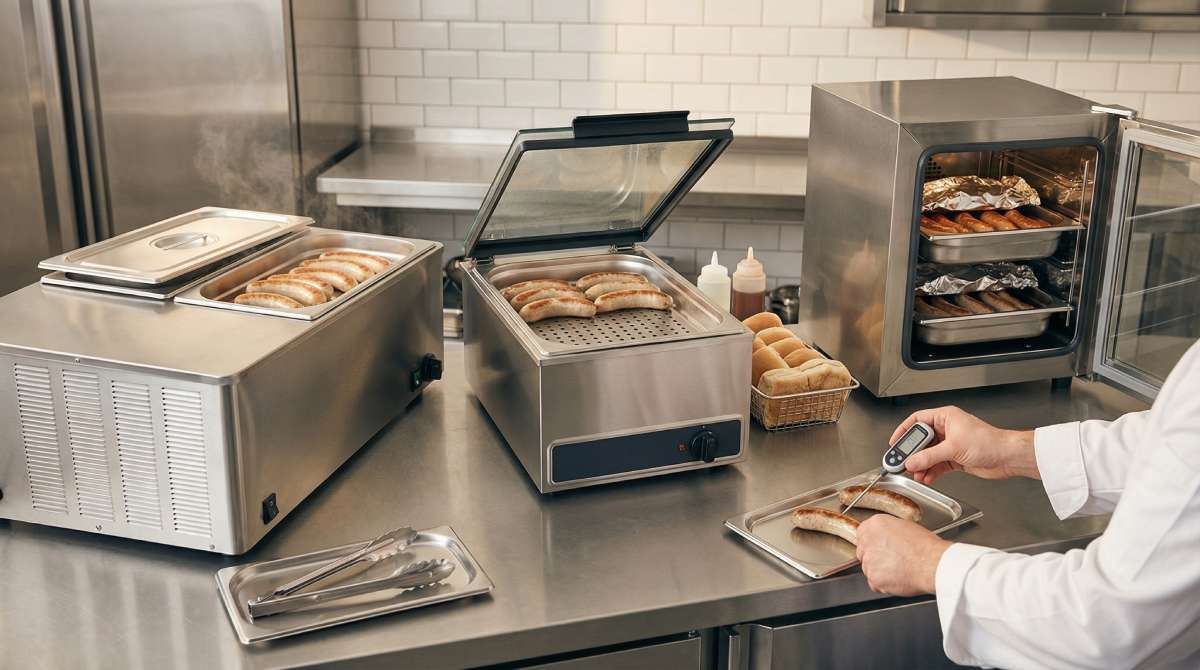
Three practical ways to hot-hold sausages in a UK kitchen: bain-marie, steamer and hot holding cabinet (2026).
Introduction
In UK foodservice, hot-hold is not a “nice to have”. It is the difference between a smooth Saturday rush and a queue that starts asking for refunds. Hot-hold sausages sit right on that awkward line: too dry and customers notice; too wet and buns collapse; too hot and casings can split; too cool and you have a food safety headache.
Most kitchens do not fail because staff are careless. They fail because the system is unclear. One person treats hot holding like storage, another treats it like cooking, and the sausage gets punished for both. The right approach depends on what you are serving (bratwurst vs frankfurter), how you finish (grill marks vs none), and what your queue looks like. That is why bain-marie hot holding sausages can be perfect for gentle, steady service, while steamer hot holding sausages can be a throughput weapon, and a hot holding cabinet for sausages can be the most controlled option for plated service or longer holds.
This matters for buyers as much as chefs. Choosing the wrong hot-hold set-up creates avoidable waste, slower service, and inconsistent quality, even if the product is excellent. With The Sausage Haüs range produced by Remagen (Germany) and distributed in the UK by Baird Foods, the goal is simple: make hot-hold sausages predictable, fast, and consistently good – without turning the pass into a science project.
Key Takeaways
- Hot-hold sausages work best when you decide the method first: gentle hold (bain-marie), fast hold (steamer), or controlled hold (hot cabinet).
- Bain-marie hot holding sausages is usually the safest “don’t ruin it” option for steady pub service and shorter holding windows.
- Steamer hot holding sausages is strong for hot dogs and high throughput, but you must manage moisture so buns and toppings do not turn tragic.
- A hot holding cabinet for sausages gives stable results for plated service, but only if you control humidity and avoid over-holding.
- If your aim is to keep sausages warm without drying out, protect the casing: avoid aggressive heat spikes and long exposed holds.
- Set a clear operating rule: hot-hold is holding, not cooking. Finish for colour separately, then return to hold if needed.
- Buyer logic: choose kit based on peak-hour volume and holding time, not on what was cheapest on a catalogue page.
Hot-hold sausages in 2026: what “done right” actually means
Hot-hold sausages done right is not about chasing the highest temperature or keeping everything “piping” at all costs. It is about running a repeatable holding system that protects texture, keeps service fast, and stays comfortably inside food safety expectations. In practice, “done right” means your hot-hold sausages come out looking and tasting like the product you chose, not like a compromise you had to apologise for.
The biggest shift in 2026 is that kitchens are more honest about what hot-hold is for: it is a service tool, not a cooking method. Your finish step (colour, snap, grill marks) can happen before hold, after hold, or both – but hot-hold sausages should spend most of their time in a stable, gentle environment.
What “done right” looks like on the pass
- Hot-hold sausages stay plump, not wrinkled, split, or leathery.
- The casing still has some bite, not a tough chew or a “wet skin” feel.
- The interior is consistently hot, without overcooking the ends.
- Portions are ready when the ticket lands, not 4 minutes after the queue loses patience.
- The holding method matches the menu: hot dogs need speed; plated bratwurst needs control.
What “done wrong” usually looks like
- Hot-hold sausages are held too hot, too dry, or too long – and the casing takes the hit first.
- Staff keep “topping up heat” instead of fixing the holding environment.
- Different team members do different things, so the product is inconsistent shift to shift.
- The kitchen wins the temperature battle but loses the eating quality war.
The three decisions that make hot-hold sausages predictable
- Decide your holding target, not your guess
For hot-hold sausages, pick a realistic holding window (for example: short hold for rush periods, longer hold for events) and set your method around it. This is where bain-marie hot holding sausages, steamer hot holding sausages, and a hot holding cabinet for sausages each earn their place. - Separate “finish” from “hold”
If you need colour, do a quick finish on grill or pan, then move hot-hold sausages into the holding unit. If you do not need colour (many frankfurter/hot dog set-ups do not), keep the workflow simple and consistent. - Protect moisture in the right way
The goal is to keep sausages warm without drying out, but “more moisture” is not always better. Too much steam can soften casings and create soggy buns; too little can wrinkle and dry. “Done right” means controlled humidity for the product and the service format, not accidental humidity from whatever the equipment happens to do that day.
For The Sausage Haüs range produced by Remagen (Germany) and distributed in the UK by Baird Foods, this matters because the product can only perform as well as the holding system allows. When hot-hold sausages are managed properly, you get the real benefit buyers care about: consistent quality at speed, with less waste, fewer remakes, and a calmer kitchen during peak service.
The 3 hot-hold options at a glance: bain-marie vs steamer vs hot cabinet
When you strip the marketing out of hot-hold equipment, you are left with three workable ways to hot-hold sausages: gentle wet heat (bain-marie), high-speed steam heat (steamer), or controlled dry-to-managed humidity heat (hot cabinet). None is “best” in isolation. The best choice is the one that matches your service format, your holding window, and what the sausage needs to stay enjoyable.
A simple way to decide is to ask two questions:
- Do I need maximum speed (hot dogs, queues, events), or maximum control (plated service, quality consistency)?
- Am I holding hot-hold sausages for minutes during a rush, or for longer windows across a service?
Quick comparison (kitchen reality, not brochure reality)
- Bain-marie: forgiving, steady; best for short holds and gentle control.
- Steamer: fastest and hottest; best for volume, but moisture management is everything.
- Hot cabinet: most consistent; best for planned holding and plating, but requires discipline on time and set points.
Bain-marie hot holding sausages: best use cases, setup, and limits
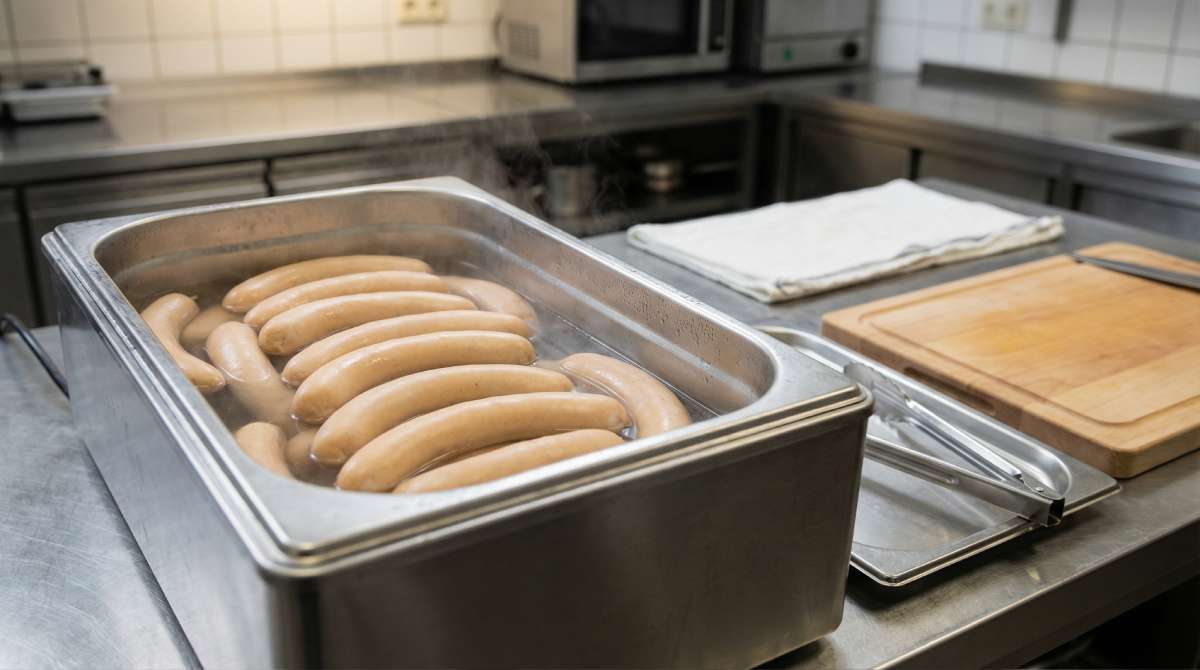
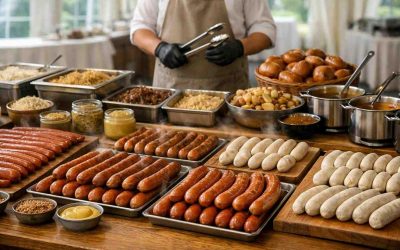
Hot-hold sausages using a deep bain-marie – thick 20 cm bockwursts held gently in hot water for fast, consistent service.
Bain-marie hot holding sausages is the “keep it calm” method. It uses indirect heat via hot water, which tends to reduce temperature spikes and helps hot-hold sausages stay plump. In busy pub kitchens, that stability is often more valuable than raw speed.
Best use cases (where bain-marie wins)
- Pub service where tickets come in waves, not constant lines.
- Bratwurst and thicker sausages that benefit from gentle, even heat.
- Kitchens that want a simple holding lane without training everyone on a complex unit.
- Short-to-medium holds where you want to keep sausages warm without drying out.
Practical setup that works
- Use covered gastronorm pans where possible; open pans lose heat and invite drying at the surface.
- Hold hot-hold sausages in a single layer when you can; deep piles create uneven temperature and texture.
- Keep a small “working” pan on the line and a larger replenishment pan behind; it stops constant lid-off heat loss.
- Treat bain-marie as holding, not reheating from cold. If product goes in cold, you force higher heat and you lose the gentle advantage.
Limits (what bain-marie is not great at)
- Very high throughput hot dog service. It can keep up, but it rarely feels effortless.
- Long holding windows. You can do it, but you risk softening casings and dulling texture.
- Situations where staff keep topping up water/heat inconsistently – bain-marie is forgiving, not magic.
If you are choosing between methods and you mainly care about “less damage”, bain-marie hot holding sausages is usually the safest default.
Steamer hot holding sausages: speed, moisture control, and hot dog workflow
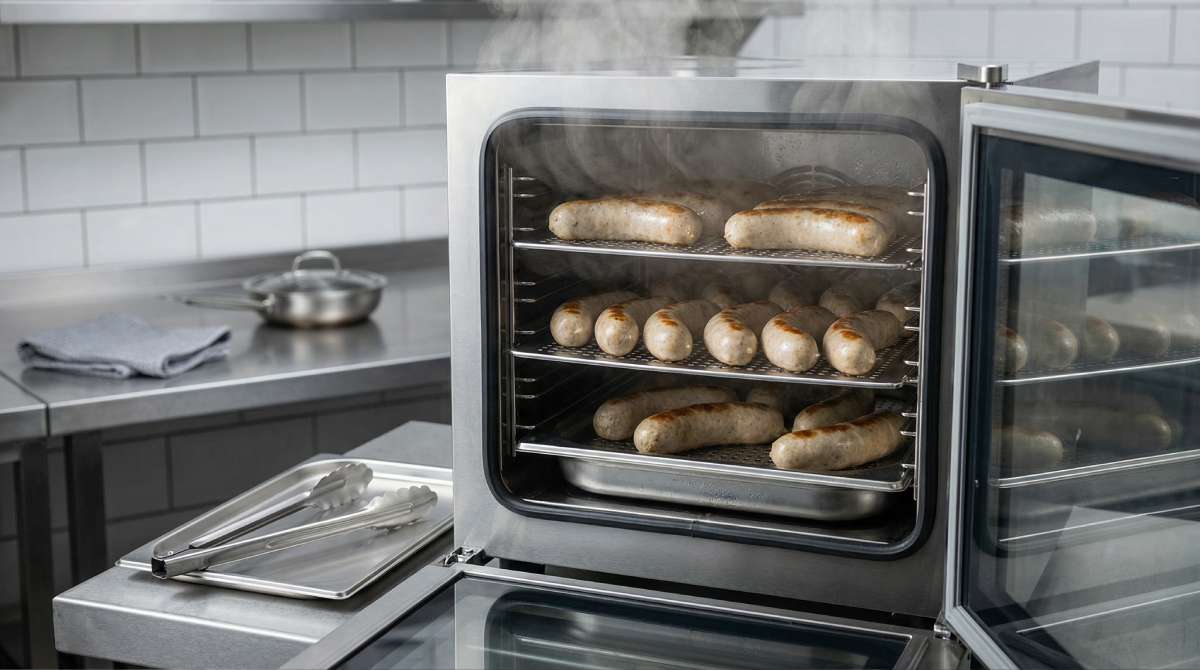
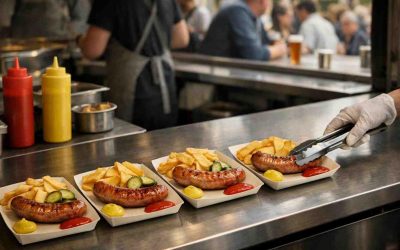
Hot-hold sausages in a steamer: pre-browned bratwursts held hot on a rack for fast service without sitting in condensation.
Steamer hot holding sausages is the volume tool. If you run hot dogs, festival service, or fast counter trade, steam can make hot-hold sausages feel almost instant. The trade-off is that steam exaggerates whatever you get wrong: too much moisture and the casing can soften, buns can collapse, and toppings slide; too much heat and you can push texture into “overheld”.
Where steamers shine
- Hot dog and frankfurter service where speed is the main KPI.
- Peak periods where you need predictable recovery after opening the lid/door repeatedly.
- Operations with a clear workflow: load, hold, serve, rotate.
Moisture control rules that prevent soggy outcomes
- Separate the “sausage hold” from the “bun hold”. Keep buns away from steam unless you want them soft on purpose.
- Use a rotation habit: first in, first out. Steam hides age until the texture gives up.
- Keep hot-hold sausages out of pooled condensation. If your unit design allows water to collect, use racks or perforated pans.
- Do not chase speed by increasing heat endlessly. Over-hot steam can make hot-hold sausages split or lose snap faster than you expect.
A hot dog workflow that actually works in service
- Hold hot-hold sausages in the steamer for rapid pick-up.
- Build buns and toppings on a separate dry station.
- If you want colour, finish to order quickly on grill/pan (or pre-finish and refresh), then return to steam only briefly.
- Keep the “front” batch small and replenished. Huge loads look efficient but usually create overholding at the bottom.
If your business model is queue-based, steamer hot holding sausages is hard to beat – as long as you run it like a system, not a mystery box.
Hot holding cabinet for sausages: consistency, holding windows, and plating
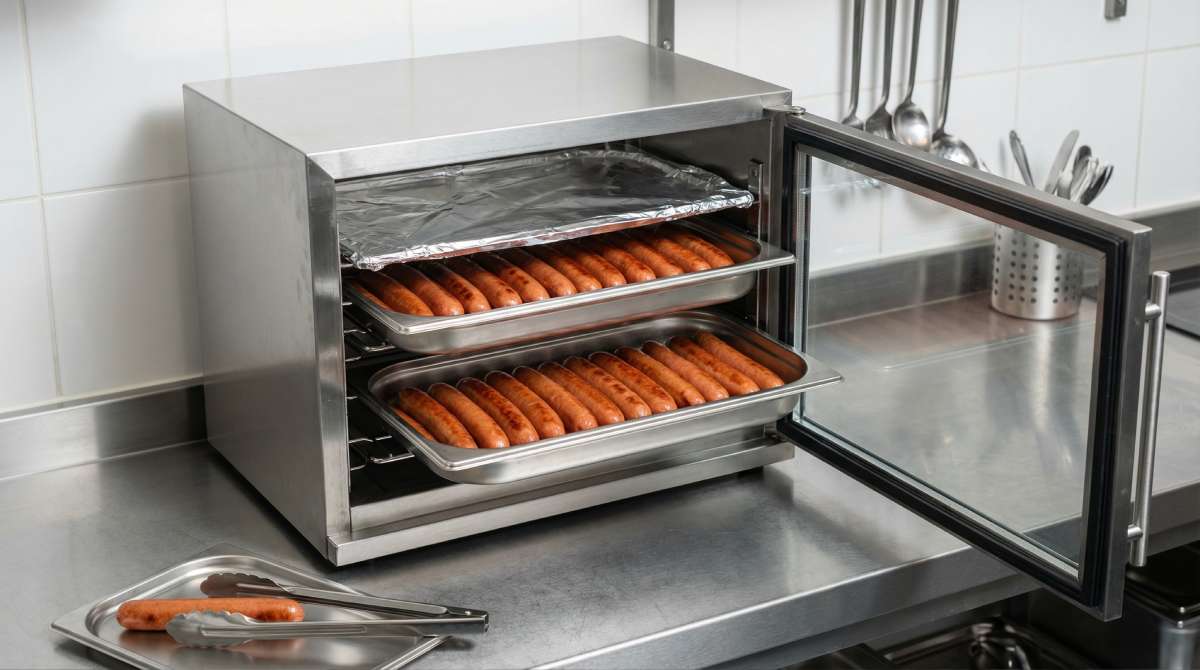
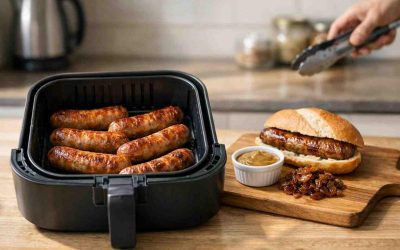
Hot-hold sausages in a hot holding cabinet: thick 25 cm Bacon Frankfurters held ready for plated service and steady throughput.
A hot holding cabinet for sausages is about control. It is the best option when you want hot-hold sausages to be consistent over longer windows, especially for plated service, catering trays, or kitchens that need a predictable pass standard across shifts.
Where hot cabinets win
- Plated bratwurst or premium sausage dishes where texture matters and you want repeatability.
- Catering and function work where holding windows are planned.
- Multi-staff kitchens where a stable set point reduces “everyone does it differently” outcomes.
How to use a hot holding cabinet for sausages without ruining the product
- Time discipline matters more than anything. Even the best cabinet will not save hot-hold sausages held too long.
- Use covered trays when holding for longer windows; uncovered trays dry the casing and ends first.
- Avoid stacking trays too tightly; airflow matters for stable holding.
- If your cabinet has humidity control, set it deliberately. Too dry equals wrinkled skins; too humid equals softened casings and dull bite.
Plating logic
- Hot-hold sausages should leave the cabinet ready to plate, not needing “one more blast” because someone panicked about heat.
- If you need a visual finish (grill marks), do it as a planned step either before holding (then refresh briefly) or as a quick final touch to order.
- Treat the cabinet like a controlled landing zone for service, not a place to forget product until someone remembers it exists.
If you are buying for quality consistency and predictable service, a hot holding cabinet for sausages is usually the most professional choice. It is also the method that exposes weak discipline fastest, which is why it often delivers the best results in well-run kitchens.
Hot holding temperature sausages UK: practical ranges and safety logic
“Hot enough” is not a vibe – it is a control point. In UK kitchens, the goal with hot-hold sausages is to hold them at a safe temperature consistently, without turning the casing into boot leather. The trick is to treat hot holding as a steady state, not a constant cycle of cooling down and reheating.
The practical temperature mindset (what good looks like)
A useful way to think about hot holding temperature sausages UK is this:
- Safety first: keep product reliably hot throughout, not just “warm on the outside”.
- Quality second: use the lowest stable hot-hold setting that still keeps you safe and service-ready.
- Stability always: a slightly lower, stable hold is often better than wild swings.
Practical ranges you can actually run with
Exact numbers depend on your HACCP, equipment accuracy, batch size and lid/door opening frequency – but for most pub kitchens, caterers and hot dog operations these ranges are workable starting points:
- Target holding range: around 63°C+ at the core as the safe baseline for hot holding in UK-style service.
- Common working band: mid-60s to low-70s °C for hot-hold sausages, depending on method and service speed.
- Quality red flag zone: once you push too hot for too long, you’ll see split skins, wrinkling, and dry ends even if “temperature looks great”.
If you want hot-hold sausages to stay enjoyable, avoid “cranking it” just because the unit was opened a lot. Instead:
- keep batches smaller and rotate more often
- keep lids/doors closed whenever possible
- use a back-up holding pan/tray so the front pan is not constantly abused
Method-specific notes (why the same set point behaves differently)
- Bain-marie: gentler heat transfer, fewer spikes, but it can drift if water level and lids are not managed. Great for steady pub service.
- Steamer: very fast heat transfer. Brilliant for speed, but it can over-soften casings if you run it too hot or hold too long.
- Hot holding cabinet: stable and predictable, but can dry product if airflow is high and trays are uncovered.
The safety logic buyers and chefs should agree on
- Hot-hold sausages should go into holding already fully cooked and properly heated through. Holding is not the place to “bring it up from cold” unless your process is designed for it.
- Use a probe and record checks at sensible intervals – not because paperwork is fun, but because equipment thermostats lie and service pressure makes people guess.
- If temperature drops below your safe threshold, your plan should be clear: reheat properly once, or discard, depending on time and process.
This is where a reliable system matters commercially. Fewer temperature swings means fewer returns to grill, fewer remakes, less waste, and a calmer line.
How to keep sausages warm without drying out: the texture checklist
If you are trying to keep sausages warm without drying out, focus on what the casing is telling you. The casing is the early warning system. The inside goes wrong later.
The texture checklist (quick pass/floor check)
Use this as a fast diagnostic for hot-hold sausages:
- Plump, slight sheen, good bite = you’re in the zone
- Wrinkled skin = too dry, too long, or too much airflow
- Split casing = too hot, too aggressive a reheat, or rough handling
- Soft, “wet” casing = too much steam/condensation or holding in pooled moisture
- Dry ends = uncovered trays, airflow, or long holding window
- Uneven heat (hot outside, cooler inside) = batch too large, stacked too deep, or poor rotation
The fixes that work (without changing your whole kitchen)
- Cover smartly: lids or foil reduce drying, especially in a hot holding cabinet for sausages. (Leave a small vent if condensation is drowning the casing.)
- Avoid deep piles: hot-hold sausages stacked too high heat unevenly and overhold at the edges. Single layer wins.
- Rotate in smaller batches: holding a mountain feels efficient, but it usually creates old stock hiding at the bottom.
- Keep sausages off standing water: in steam environments, use racks/perforated pans so hot-hold sausages don’t sit in condensation.
- Separate bun management: steam and buns together is how you create instant disappointment. Keep buns dry unless softening is the deliberate goal.
- Finish with intent: if you need colour, do a quick planned finish, then return hot-hold sausages to holding briefly – do not keep “re-finishing” the same sausage repeatedly.
The one habit that saves most kitchens
Stop treating hot-hold sausages like they can live there indefinitely. Put a simple rule in place:
- If it wouldn’t be nice to eat yourself, it doesn’t go out.
Slightly funny, annoyingly effective. It forces the only two actions that matter: rotate or reduce holding time.
Brand note: with The Sausage Haüs range produced by Remagen (Germany) and distributed in the UK by Baird Foods, you can get excellent results with bain-marie, steamer, or cabinet. The difference is whether the holding method matches your service reality – and whether you run it like a system.
Workflow blueprints: pub service, event service, and catering trays
Hot-hold sausages only become easy when the workflow is boring in the best possible way. The goal is not to create a clever system; it is to create a repeatable one that still works when the kitchen is loud, the printer is angry, and someone has just asked for “no onions but extra onions”.
In a pub kitchen, service usually comes in waves. That’s why the most reliable blueprint is a two-lane approach: one lane for holding, one lane for finishing. Your holding lane keeps hot-hold sausages stable and ready without punishment; your finishing lane adds colour only when the ticket requires it. The key is to avoid constant heat swings that turn a good sausage into a wrinkled one by 8pm. If you’re running bain-marie hot holding sausages, keep the working batch small and lidded, then top up from a back pan rather than holding everything on the line for hours. If you’re using a hot holding cabinet for sausages, treat it like a controlled “buffer” and only pull forward what you realistically need for the next rush window.
For event service, the queue is the boss and speed is the KPI. The blueprint shifts from “finish and plate” to “hold and assemble”. Steamer hot holding sausages is often the right tool here because it recovers quickly even when the lid opens constantly. The common failure mode at events is trying to steam everything: sausages, buns, and sometimes the will to live. Keep buns and toppings dry and organised so the build is fast and tidy. If you need colour, you can still do it, but it has to be designed into the station rather than improvised mid-queue.
Catering trays are a different discipline again. You’re planning for a longer window and you want consistency across batches, not hero moments. A hot holding cabinet for sausages usually shines here, provided you cover trays and manage time properly. The job is to keep hot-hold sausages stable, not to keep them in there indefinitely because “they’re still warm”.
A practical way to lock the blueprint into staff behaviour is to make three decisions explicit:
- where hot-hold sausages live during service (which unit, which pan/tray, covered or not)
- where finishing happens (grill/pan) and when it happens (before hold, after hold, or both)
- what the rotation rule is (how you avoid “topping up” old product forever)
Buying guide: choosing commercial hot hold equipment for pubs
Buying kit for hot-hold sausages is often where operators accidentally purchase stress. The wrong unit forces constant fiddling, creates inconsistent results across shifts, and turns service into a string of small recoveries. The right unit does the opposite: it makes the process predictable, which is exactly what trade buyers and chefs value.
Start by matching equipment to service reality, not to catalogue promises. If your pub service is steady with peaks, bain-marie hot holding sausages can be an excellent fit because it’s forgiving and tends to reduce temperature spikes. If you sell hot dogs or run a counter format where speed matters, steamer hot holding sausages can be the better choice because recovery time is everything. If you care most about consistent plated quality, planned holding windows, or function work, a hot holding cabinet for sausages usually offers the most control, especially when you can cover trays and manage airflow.
Then move from “type” to “behaviour”. A unit is only as good as how it behaves on a real pass:
- does it hold a stable set point when doors/lids are opened repeatedly
- can you use covered gastronorm pans or covered trays without losing control
- does condensation collect where sausages sit (especially in steam units)
- is it quick to clean and simple to explain to new staff
If your goal is to keep sausages warm without drying out, be suspicious of any set-up that forces uncovered holding with high airflow. That combination is excellent at drying the ends first, which is exactly what customers notice.
Finally, bake in measurement and routine. The probe thermometer and the holding routine are part of the “equipment choice”, even if they are not listed on the invoice. Decide your hot holding temperature sausages UK approach, agree your holding window, and document the station set-up so you get the same outcome on a Tuesday as you do on a Saturday.
The Sausage Haüs practical notes: product types, finishing, and service tips
Different sausages tolerate hot-hold differently, and the fastest quality upgrade is to match product type to holding method. Frankfurter-style service and hot dog formats usually play well with steam-led holding because the goal is quick pick-up and consistent heat. Bratwurst and thicker sausages often benefit from gentler holding and a deliberate finish, because texture and casing bite are part of why people order them in the first place. The point is not that one method is “right”; it is that the holding environment should protect the eating quality you’re selling.
Finishing is where kitchens often lose time and quality at the same time. If you need colour and grill character, treat it as a planned step. You can finish first, then hold, and refresh briefly to order; or hold first, then finish quickly for service. What usually fails is repeated finishing, where the same hot-hold sausages go back to aggressive heat again and again because someone is chasing “freshness” through force. That approach dries the casing, splits skins, and creates inconsistent portions, even when your temperatures are technically safe.
A few service habits tend to deliver outsized results, mostly because they reduce the small mistakes that compound over a shift:
- rotate in smaller batches so hot-hold sausages don’t overstay their welcome
- keep sausages off pooled condensation in steam environments (racks and perforated pans help)
- keep buns away from steam unless softening is the deliberate choice
- cover trays during longer holds, especially in cabinets where airflow can dry the ends
Frequently Asked Question
They’re best known for that use case because speed is excellent, but steamers can hold other sausages too. The key is moisture control and holding time. If the casing softens or the texture dulls, reduce time held or adjust your workflow (finish separately, hold briefly).
You can, but it often causes soggy buns and messy builds unless you deliberately want a softened bun. Most operators get better results by holding hot-hold sausages in steam and keeping buns dry at a separate station.
Stability and protection are the two levers. Keep hot-hold sausages covered where appropriate, avoid high airflow drying, rotate in smaller batches, and don’t hold them “just in case” for hours. In steam units, keep sausages off pooled condensation using racks or perforated pans.
It depends on temperature, humidity, and the sausage type, but quality usually drops because of time, not because of a single moment. Short holds during rush periods are generally fine; long holds without rotation often lead to wrinkling, softened casings, or dry ends. Set a site rule and stick to it rather than guessing.
It can work, but it’s not ideal for long holds because texture can drift over time. If you need longer holding windows, a hot holding cabinet for sausages with covered trays and disciplined timing is often more consistent.
Hot-hold sausages are fully cooked sausages held at a safe serving temperature so they’re ready to serve quickly during service. It’s a holding step, not a cooking method. The goal is stable heat without drying, splitting, or softening the casing.
Look for stability under real service conditions: consistent set point when doors open, compatibility with covered gastronorm pans, good condensation control, easy cleaning, and simple operation for staff. Choose based on peak-hour volume and holding window, not just initial price or headline features.
Most UK kitchens use a safe baseline of holding hot food at 63°C or above, with regular checks as part of your HACCP plan. In practice, many operations run hot-hold sausages in the mid-60s to low-70s °C depending on equipment, batch size, and how often lids/doors open.
For many pubs, bain-marie is the most forgiving for short holds and wave-style service. A hot cabinet suits sites that want controlled consistency and planned holding windows. Steamers are best when speed and throughput matter most, especially for hot dog service.
Splitting is usually caused by holding too hot, aggressive reheating, or repeated heat cycling (finishing, re-holding, finishing again). It can also happen when sausages are handled roughly or when the holding environment creates spikes rather than steady heat.
Conclusion
Hot-hold sausages are not complicated, but they are unforgiving when the system is vague. The choice between bain-marie, steamer, and hot cabinet is really a choice between three priorities: gentle stability, maximum speed, or controlled consistency. If you match the method to your service format, set a sensible hot holding temperature sausages UK routine, and rotate in realistic batches, you get the outcome every pub kitchen and caterer wants – fast service without the quality wobble.
In practical terms, bain-marie hot holding sausages suits steady pub waves and short holds; steamer hot holding sausages suits queues and hot dog throughput; and a hot holding cabinet for sausages suits planned holding windows and plated or catering tray service. None of these is “best” universally, but one of them will be best for your site once you decide what matters most during peak hour.
If your current challenge is trying to keep sausages warm without drying out, start with the basics before buying new kit: stabilise the holding environment, keep product covered where appropriate, reduce heat swings, and make rotation non-negotiable. Most problems vanish when the workflow stops improvising.
If you’d like, we can help you choose the right hot-hold sausages set-up for your venue, and suggest which products in The Sausage Haüs range fit your service style best. A quick conversation upfront usually saves a lot of trial and error on the line.
About Sausage Haüs
The Sausage Haüs is a UK-focused foodservice range built for kitchens that need quality, speed, and consistency – from pubs and caterers to wholesalers and retail partners. We specialise in German sausage formats that work in real-world service, including hot dog and plated menu applications, with practical guidance on cooking, holding, and serving.
Our sausages are produced by Remagen in Germany and distributed in the UK by Baird Foods as part of The Sausage Haüs range. That combination gives UK buyers a reliable supply route, consistent specifications, and products designed to perform across different kitchen set-ups – whether you run a small pub pass, a high-volume event station, or catering trays for functions.
If you’re a buyer or chef looking for dependable products and clear, non-fluffy operational advice, our goal is simple: make your sausage service easier to run and easier to repeat, week after week.