Easter catering starts before Easter weekend. For UK traders, showmen, caterers and street food operators, the real advantage comes from early planning, a tight menu, sensible stock, and a setup that serves fast without turning messy. This guide to Easter catering focuses on practical decisions that help you prepare for Easter 2026 with fewer surprises and a stronger event weekend.
Introduction
Easter catering can look straightforward from the outside. In reality, it often sits in that awkward space where demand can be strong, but the conditions are not always fully settled. Weather can swing quickly, footfall can vary by site, and some Easter bank holiday events feel busy from the first hour while others take time to build. That is exactly why preparation matters.
For UK caterers, festival traders, showmen and street food operators, Easter is less about doing something wildly different and more about getting the basics right before the rush starts. A good Easter weekend operation is usually not the one with the biggest menu or the fanciest kit. It is the one that is ready. Stock is sensible, staffing is realistic, service is clean, and the offer fits the site.
That is where Easter catering becomes commercially interesting. Families are out, seasonal events return, local shows start waking up again, and many operators use Easter as an early read on the wider event season. If the setup works here, it often tells you a lot about what will work in spring and summer more broadly.
This is also the point where traders can get caught out. Ordering too late, overcomplicating the menu, guessing at site requirements, or assuming Easter weekend food stall preparation will somehow sort itself out are all classic ways to make life harder than it needs to be. A sausage operation in particular should feel fast, controlled and easy to buy from – not like a public experiment in buns, onions and regret.
So this guide looks at Easter catering in a practical way: what to prepare, what to check, where to keep things simple, and how to make Easter 2026 catering preparation work for real trading conditions in the UK.
Key Takeaways
- Start Easter catering preparation early; leave enough time for stock planning, staffing, equipment checks and site paperwork.
- Keep the menu tight; Easter event catering UK works better when service is fast, clear and easy to repeat.
- Verify the practicals before trading; check site rules, gas safety, electrical load, local authority requirements and event licensing where relevant.
- Plan for mixed weather; Easter bank holiday catering often needs a setup that still runs cleanly in cold, wind or light rain.
- Order with discipline; build around proven sellers rather than speculative extras that slow service and increase waste.
- Treat Easter weekend food stall preparation as a test for the wider season; what works here can shape spring and summer trading.
- For Easter street food trading, speed, visibility and queue confidence matter; customers buy more easily when the offer is obvious and the line moves.
Why Easter Catering Matters for UK Operators
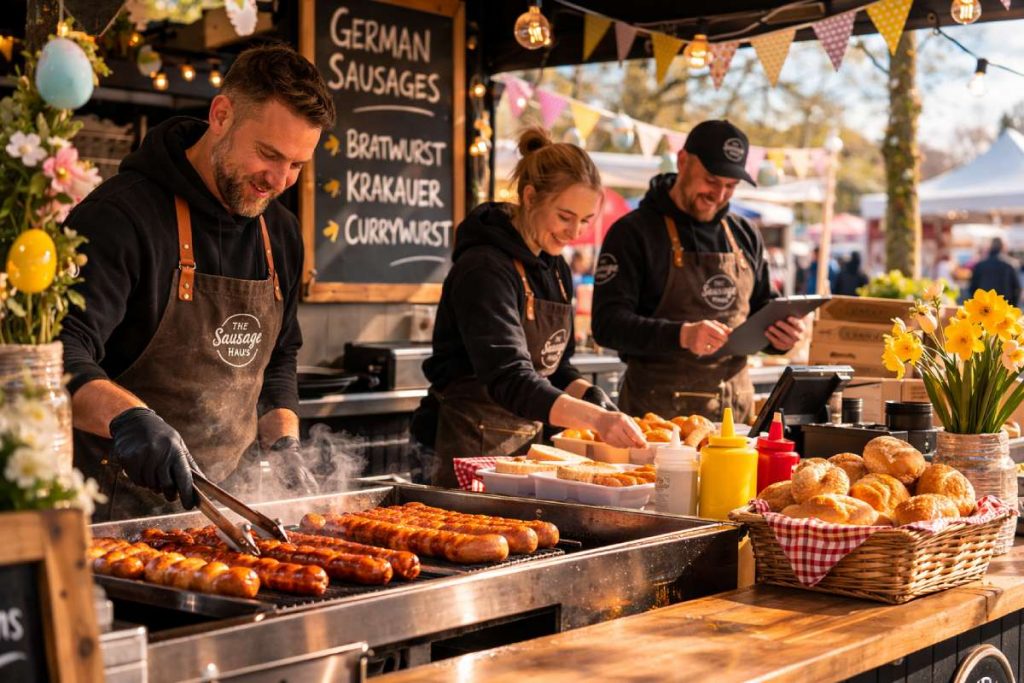
Easter catering matters because it often marks the point where the season starts to feel real again. Winter trading is behind you, spring events begin to open up, and customers are more willing to spend time and money at markets, outdoor attractions, food festivals and family events. For many operators, Easter is the first proper test of how ready the business really is.
That makes Easter catering more than just another date in the calendar. It is often an early indicator of what the wider season may look like. If the menu works, the service flow holds up, and the team can cope with the pace, you learn something useful before the bigger bank holidays and summer events arrive. If things go wrong, Easter usually reveals where the weak points are while there is still time to fix them.
For UK traders, Easter also tends to bring a slightly different crowd mix. You may get more families, more daytime footfall, more destination visitors and a broader age range than at some standard weekend events. That changes what people buy and how they buy it. Easter event catering UK is often less about novelty for its own sake and more about visible, reassuring, easy-to-order food that suits mixed groups.
For sausage traders in particular, this can be a very good trading environment. The products are familiar, they serve well in cool spring weather, and they can be presented in a way that feels both substantial and approachable. But Easter catering only works well when the operation stays simple enough to cope with uneven rushes, weather changes and the slightly unpredictable rhythm that Easter weekend can bring.
There is also a timing issue that catches people out. Easter 2026 catering preparation is not something to start when everyone else has already begun ordering stock and chasing event details. Good operators tend to use the weeks before Easter to tighten the menu, check equipment, confirm event requirements and make realistic buying decisions. That is far less exciting than posting spring graphics, but usually far more profitable.
A practical way to think about Easter catering is this: it sits between winter caution and full-season momentum. It is early enough that not everything is settled, but important enough that poor preparation can be expensive. If you get it right, Easter bank holiday catering can generate revenue, sharpen your systems and give you confidence for the months ahead.
A few reasons Easter catering matters commercially:
- It often acts as the first serious trading test of the spring season
- Easter street food trading can attract broad daytime footfall, especially families
- It helps expose weaknesses in staffing, stock planning and service flow
- A strong Easter weekend can shape decisions for later events and summer trading
Who This Easter Catering Guide Is For
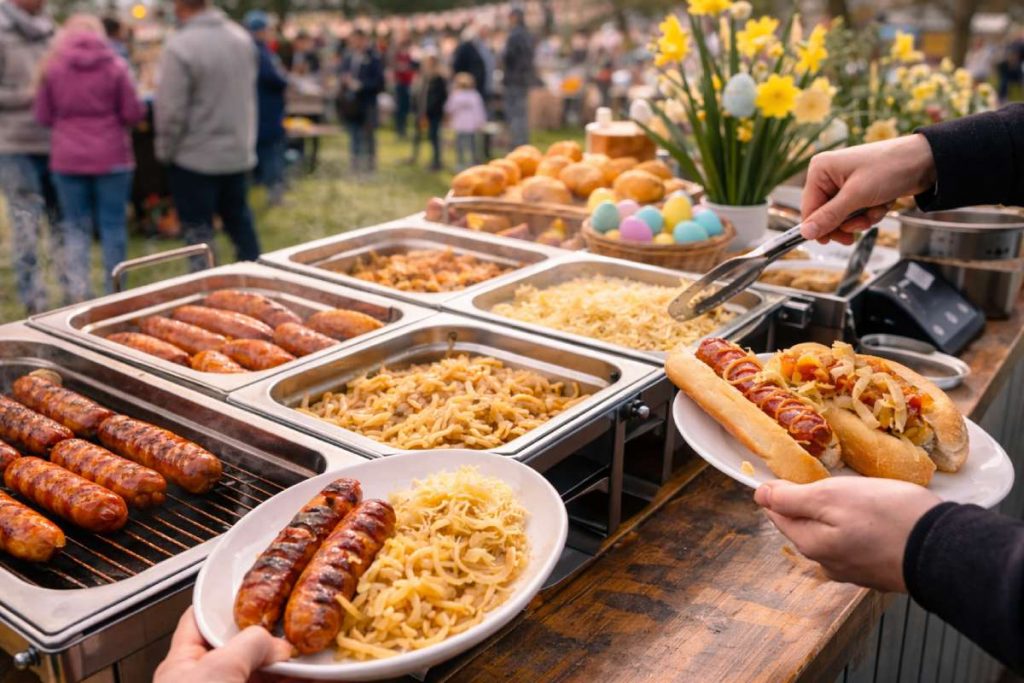
This guide is for operators who need Easter catering to work in the real world, not just on paper. It is written for people who have to serve customers quickly, manage stock properly, keep the setup tidy and still make the numbers stack up by the end of the day. That includes a fairly wide group, but they tend to share the same practical pressures.
First, it is for mobile caterers and street food operators trading at Easter markets, town-centre events, roadside pitches, farm attractions or local festivals. These businesses often need a menu that is easy to understand, fast to serve and robust enough to cope with weather, queue spikes and variable footfall. In that setting, Easter catering is less about theatre and more about running a reliable offer that customers trust immediately.
It is also for showmen and event traders who are preparing for an early-season return to busier public events. In that world, Easter weekend food stall preparation is often the first moment when equipment, staffing routines and buying habits are tested under proper trading pressure again. A messy Easter can lead to a messy spring. A well-run one can put you in a much stronger position.
Foodservice buyers and operators with a more structured commercial setup should find this useful as well. If you are building a temporary Easter menu for a venue, outdoor activation, pub garden, farm shop event or seasonal catering pitch, the same core questions still apply. What will sell? What will hold? What can staff execute consistently? What looks good without slowing the line down?
The guide is especially relevant for businesses selling German sausages, hot dogs, bratwurst or other simple hot food with a quick decision path. That kind of offer fits Easter catering well because customers can see it, understand it and buy it without needing a long explanation. But the operational advantage only holds if the setup stays disciplined.
This guide is probably less useful for operators planning highly formal dining, large plated banqueting, or very specialist niche concepts that rely on a slower customer journey. The focus here is Easter catering in practical UK trading conditions, especially where speed, visibility and consistency matter more than culinary showmanship.
This post is mainly for:
- caterers running Easter bank holiday catering at public events
- showmen and festival traders preparing for spring trading
- street food operators who need a tight, fast Easter menu
- foodservice buyers looking for a cleaner, easier hot food offer
- venues testing seasonal Easter event catering UK concepts
Start with the Event Type, Not Just the Date
One of the easiest mistakes in Easter catering is treating Easter itself as the plan. Easter is only the timing. The real question is what kind of event you are actually serving. A farm park Easter trail, a town market, a family fun day, a food festival and a private venue booking may all happen over the same weekend, but operationally they are very different jobs.
That matters because Easter catering should be built around customer behaviour, site conditions and event rhythm, not just seasonal optimism. At a family attraction, people may want something warm, familiar and easy to carry while moving around with children. At a town-centre market, they may buy more on sight and more quickly, especially if the queue looks manageable. At a food-focused event, customers may be slightly more open to a premium variation, but only if it still looks straightforward and worth the wait.
The same applies to setup decisions. Some sites reward a compact, high-speed menu with minimal build complexity. Others allow a slightly broader range because dwell time is longer and customers are not all arriving in one rush. Easter event catering UK tends to work best when the format matches the event, rather than when the operator tries to force the same exact system into every pitch.
This is where a sausage operation often has an advantage. It can be adapted without losing its identity. A straightforward bratwurst-in-a-bun offer can suit a high-throughput public event. A slightly more dressed version may work at a premium market or venue-led Easter event. But the base logic remains the same: keep the buying decision easy, keep service moving, and do not turn Easter catering into a slow assembly exercise.
It is also worth looking carefully at what the organiser is really promising. Big language on an event page does not always translate into strong footfall or the right audience for your product. Easter 2026 catering preparation should include checking how family-oriented the event is, how long people are likely to stay, whether food is central or secondary, and what restrictions may shape the trading day. Site rules, gas safety expectations, electrical load, local authority requirements and event licensing should all be verified in advance where relevant.
A good way to frame it is this: do not ask, “How do we cater at Easter?” Ask, “What kind of Easter event is this, and what sort of operation fits it best?” That question usually leads to much better decisions on menu, stock, staffing and layout.
A few examples:
- Family attractions and farm events: simple, visible, child-friendly options usually perform best
- Town markets and community events: speed, queue confidence and clear signage matter most
- Food festivals: a slightly stronger premium angle may work, but only if service stays tight
- Private or venue-led Easter jobs: consistency, timing and presentation often matter more than volume alone
That is why strong Easter weekend food stall preparation starts with the event model first. Once that is clear, the rest of the Easter catering plan becomes far easier to build.
Build an Easter Menu That Sells Fast
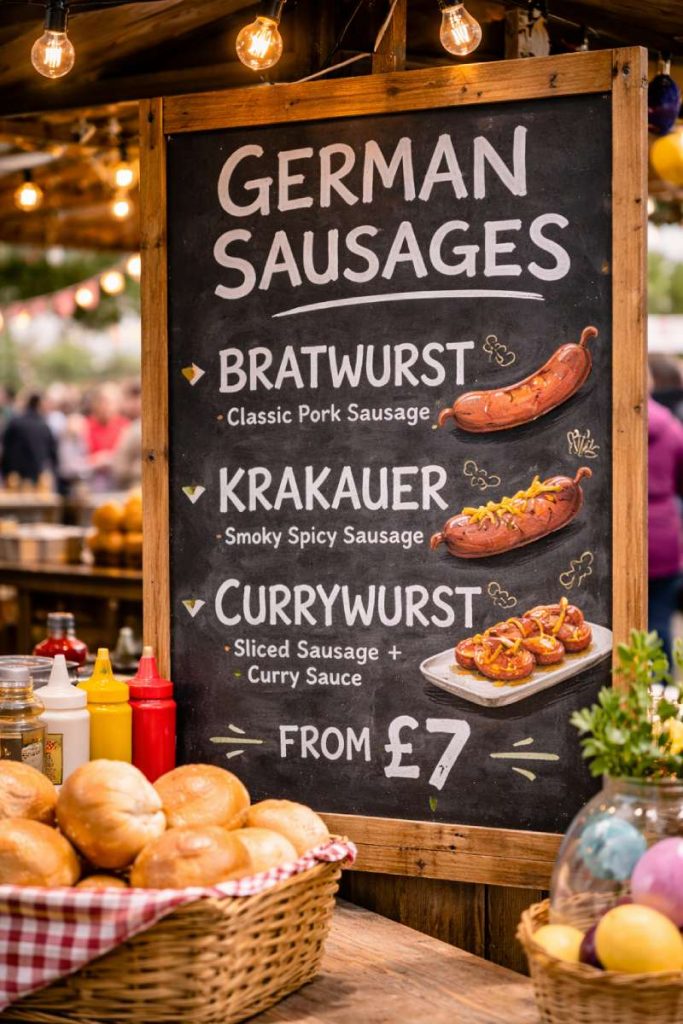
A strong Easter catering menu is usually a controlled menu, not a long one. At Easter events, customers often decide quickly. They are standing outside, moving with family or friends, and they want to understand the offer in a glance. That means your menu should do two jobs well: make buying easy and keep service moving.
For most operators, Easter catering works best when the range is built around a few proven core items rather than too many variations. This is especially true for sausage traders, hot dog stands and German-style street food setups. A short menu reduces ordering hesitation, simplifies prep and helps staff stay consistent during rush periods. It also makes stock planning far easier, which matters when Easter weekend is busy but not always perfectly predictable.
The best Easter catering menus tend to feel reassuring rather than over-designed. Customers at Easter bank holiday catering events are often looking for food that is warm, filling and clear. This is not the moment to invent six toppings, three breads and a naming system that needs subtitles. Familiar sells. Visible sells. Food that looks substantial and easy to eat sells especially well.
That does not mean the menu has to be dull. It means the variation should be disciplined. A good approach is to build one core offer, one slightly more premium option and one simple family-friendly or lighter option if the event supports it. Easter event catering UK often performs better when the customer can choose quickly between a small number of distinct options rather than compare tiny differences between similar products.
A sausage operation has a natural advantage here. The products are recognisable, the holding and build process can be efficient, and the menu can look generous without becoming complicated. Bratwurst, frankfurters or other German sausage lines can sit at the centre of the offer, with toppings and sides chosen for speed rather than decoration. The more assembly stages you add, the more likely Easter catering becomes slower, messier and less profitable.
A practical menu structure might look like this:
- one clear core sausage in a bun
- one upgraded version with a premium topping or stronger flavour angle
- one easy side or add-on that does not disrupt service
- one drinks or combo option if the site and setup support it
It also helps to think about what should stay off the menu. Wet toppings, fragile garnish-heavy builds, slow-cook side dishes with awkward service steps, or items that need separate explanation can all create drag in the line. Easter street food trading rewards clarity. If the customer has to study the board like a legal document, something has gone wrong.
The most commercially sensible Easter catering menus are often slightly more conservative than operators first imagine. That is not a weakness. It is usually the reason they work. Customers should be able to see the menu, understand the difference between the options, and order within seconds. That is what keeps the queue moving and the sales line healthy.
A useful menu test is simple: if you removed one item tomorrow, would service become easier without hurting sales much? If the answer is yes, that item may not belong there in the first place. Good Easter 2026 catering preparation is often about subtraction as much as addition.
Stock Planning Without Overbuying
Stock planning is where Easter catering can become either controlled or expensive. Many operators do not lose money because demand was poor. They lose money because they bought like optimists and traded like realists. Easter weekend can be strong, but it can also be uneven. Footfall can spike at certain hours, drop in bad weather, or vary sharply from one site to another. That is why Easter catering needs disciplined buying rather than hopeful buying.
The starting point should be the menu, not the wholesaler catalogue. Once the menu is fixed, stock decisions become much easier. You know which sausages matter, how many bun types you need, which sauces are essential, and where the real volume is likely to sit. If the menu is still changing late in the process, stock planning becomes guesswork. That usually leads to duplicate ingredients, poor forecasting and leftover products that looked clever on paper.
For Easter catering, the highest-risk items are often not the obvious ones. Sausages and buns get most of the attention, but wastage can just as easily come from toppings, chilled extras, packaging, soft drinks, condiments and speculative “nice to have” add-ons. Easter weekend food stall preparation should include a proper check of all consumables, not just the hero items. Running out of napkins or trays is less dramatic than running out of sausages, but it still damages service.
A good stock plan also separates core stock from flexible stock. Core stock is what supports your proven sellers. Flexible stock is what you can top up, reduce, or live without if trading shifts. That distinction matters because Easter bank holiday catering is often affected by variables outside your control, especially weather and site dynamics. You want enough stock to trade with confidence, but not so much that you are driving home with a refrigerated museum of your own optimism.
A practical way to think about Easter catering stock is to buy depth, not width. Back your strongest lines properly rather than spreading money across too many slow-moving extras. That usually creates a cleaner service line and better margins. For sausage traders, that often means prioritising the best-selling sausage format, the right bun count, the core sauces, onions, packaging and any sides that genuinely move.
Focus stock around:
- proven best-sellers first
- a sensible bun-to-sausage ratio
- essential condiments and packaging
- backup quantities for fast-moving basics
- minimal speculative extras
It is also worth planning what happens if trading goes better than expected. Easter event catering UK does not always reward the trader with the biggest theoretical menu; it often rewards the one who can hold the line under pressure. That means knowing what can be restocked, what can be substituted without confusing customers, and what should be capped rather than stretched. A stockout on a secondary topping is manageable. A stockout on your core offer is not.
At the same time, avoid treating every event as if it will become a record day. Many traders quietly damage margins by buying for the best-case scenario without enough evidence. Better Easter catering decisions usually come from matching stock levels to event type, expected dwell time, likely family footfall and the practical serving rate of the setup.
Good Easter 2026 catering preparation should also include basic stock discipline behind the scenes. Label clearly, rotate correctly, separate reserve stock from active service stock, and make sure the team knows what gets opened first. It is not glamorous, but it is often the difference between a tidy operation and a chaotic one.
Staffing, Roles and Service Flow
A lot of Easter catering problems look like staffing problems when they are really role problems. You can have decent people on the pitch and still lose speed if no one knows exactly who owns which part of the service line. Easter weekend trading tends to expose that quickly. Queues build, people start helping in random places, and a setup that looked fine at the start of the day suddenly becomes slower with every order.
The simplest way to improve Easter catering is to make each role clear before the event starts. Even a small team works better when the sequence is defined. One person handles cooking or hot holding, one assembles, one takes payment and manages the customer side, and one floats between stock, restocking and pressure points if the team size allows it. The exact structure depends on the setup, but the principle stays the same: clear ownership is faster than shared confusion.
This matters even more in Easter street food trading because the rush pattern is often uneven. You may get quiet spells followed by sudden family-driven surges where several orders land at once. In those moments, service flow matters more than individual effort. A trader who works very hard in the wrong place can still slow the whole line down. Easter catering works best when the operation is built so staff do not have to improvise under pressure.
For sausage and hot dog operations, the best service flow is usually linear and visible. Customers should see where to queue, where to order, and where food appears. Staff should not be crossing over each other unnecessarily. Toppings, trays, buns and packaging should sit where they are used, not where there happened to be space during setup. Small layout mistakes create repeated delay. Over a full Easter bank holiday catering day, those seconds add up.
A clean service flow often depends on a few unglamorous decisions:
- keep the menu board clear and readable from a distance
- pre-position packaging, napkins and core condiments
- reduce unnecessary movement between hot side and build side
- separate payment from assembly where possible
- make restocking part of someone’s role, not an afterthought
It also helps to decide in advance what happens during peak trade. Will you temporarily drop a slower item? Will you switch to a reduced topping format? Will one person move fully onto assembly while another takes over stock? Easter event catering UK usually rewards operators who make those decisions early rather than waiting until the queue is already irritated.
Staffing levels should also reflect the event type. A family attraction with steady dwell time may need a different rhythm from a town-centre Easter market with sharp lunch spikes. Easter weekend food stall preparation should include an honest view of what the team can actually deliver cleanly for six or eight hours, not just what looks possible for twenty minutes in theory.
Finally, remember that customers read the line before they join it. A queue that looks organised feels reassuring. A queue that looks confused or static puts people off, even if the food is good. So in Easter catering, service flow is not just an operational issue. It is part of sales. A setup that looks fast usually sells better than one that merely hopes to become fast once the rush begins.
Equipment, Setup and Pre-Event Checks
Good Easter catering usually feels easy to the customer because a lot of practical work was done before the first order was taken. This is where equipment and setup matter. If the grill is inconsistent, the hot holding is awkward, the handwash station is an afterthought, or the layout forces staff to cross over each other all day, the service line will never feel properly controlled. Easter catering is often won or lost before the public arrives.
A sensible setup starts with the basic question: what does this specific event actually require from the operation? A compact town pitch, a farm event, a roadside setup and a larger Easter market may all need different equipment choices. That is why Easter 2026 catering preparation should not just be a packing exercise. It should be a fit check between the event, the menu and the kit.
For sausage traders and hot food operators, the key principle is to reduce friction. The cooking method must be reliable, the holding method must support service, and the build area must be arranged so staff can work quickly without turning the counter into a scavenger hunt. Easter catering becomes much easier when every essential item is exactly where it needs to be and nothing important depends on improvisation.
It also helps to distinguish between equipment that creates sales and equipment that merely creates complexity. A grill, a reliable hot hold, refrigeration, lighting, handwash provision, clear signage and a practical service counter are usually central. Extra gear that looks clever but slows the setup or complicates the service line often adds less value than expected. Easter event catering UK tends to reward operators who arrive with a system, not a collection.
Before Easter trading starts, check the practical basics properly. That includes not just whether something technically works, but whether it works under service conditions. A piece of kit that performs nicely in a calm yard test may behave very differently after several hours on a windy pitch with constant use and repeated opening and closing. Easter bank holiday catering often exposes those little weaknesses fast.
A useful pre-event check should cover:
- cooking equipment, fuel supply and backup arrangements
- refrigeration and hot holding readiness
- handwash setup and basic hygiene workflow
- service layout, menu board visibility and customer access
- lighting, extension leads and power assumptions where relevant
Do not forget the small operational items either. Tongs, backup regulators, cloths, gloves where used, cleaning materials, extra gas connections, lighter tools, spare signage fixings, trays, napkins and packaging often become important only when they are missing. Easter street food trading has a special talent for revealing the one tiny item everyone assumed was already packed.
This is also the point where some things should be verified rather than assumed. Site rules, gas safety expectations, electrical load, local authority requirements and event licensing can vary from one event to another. If something matters to the site or the organiser, confirm it in advance. Do not rely on last year, another pitch, or a vague memory from a phone call in February.
The best Easter catering setups are rarely the most elaborate. They are the ones that can be built cleanly, checked quickly and run consistently. Customers may notice the sausage, the bun and the smell from the grill. They will not notice your cable planning or your backup stock position. That is fine. They are not meant to. They are only meant to feel that the whole thing works.
Site Rules, Compliance and What to Verify Early
A surprising number of Easter catering problems have nothing to do with food and everything to do with assumptions. Operators assume the pitch will have enough space, assume power will be where it was last year, assume gas rules are standard, assume access times will be sensible, and assume someone else has already checked the important paperwork. Then Easter weekend arrives and the first service challenge is not the queue. It is the organiser, the steward or the site manager asking questions that should have been answered earlier.
That is why site checks matter so much in Easter catering. The closer you get to the event, the more expensive late surprises become. A practical trader does not need to turn into a compliance solicitor, but they do need to know what has been confirmed and what still needs verifying. Easter catering is easier and more profitable when the operational basics are settled early.
Start with the event itself. What is the exact pitch size, where is it located, when can you access it, and what does the organiser expect the service frontage to look like? Those questions sound simple, but they affect everything from trailer positioning and queue flow to generator planning and signage placement. Easter weekend food stall preparation should always include a proper site brief, even for events that look informal from the outside.
Then look at the service infrastructure. Is there power, and if so, what exactly is available? What load is realistic? Are there restrictions on generators, gas equipment, noise, storage, waste handling or overnight security? Easter event catering UK often takes place across very mixed environments, from polished town events to muddy spring fields with admirable optimism and limited infrastructure. The operational gap between those sites can be enormous.
The safest approach is to verify rather than assume. That includes site rules, gas safety, electrical load, local authority requirements and event licensing where relevant. If an organiser provides documents, read them properly. If something is vague, ask. If the answer still sounds vague, assume it is not settled. Easter catering tends to punish wishful thinking far more efficiently than it rewards optimism.
A few early checks worth confirming:
- exact setup times, breakdown times and vehicle access rules
- gas and generator restrictions, if any
- available power and any electrical limitations
- waste, water and hygiene expectations on site
- licensing or local authority points that apply to the event
It is also worth checking how the organiser sees food within the event. At some events, food is central and well planned. At others, it is clearly a secondary concern placed somewhere between the petting zoo and administrative improvisation. That does not always mean the event is bad, but it does affect how much you need to self-manage. Easter catering works better when you know whether the site is well structured or whether you need to bring more of your own operational certainty.
For traders with a German sausage or hot dog offer, this matters commercially as well as operationally. A strong, visible offer can do well at Easter, but only if the site allows clean service, sensible customer flow and enough confidence in the setup. A poor pitch or unclear rules can weaken even a very solid food offer.
In short, Easter 2026 catering preparation should include a paper check as well as a stock check. It is not glamorous, and no one posts proud photos of their confirmed electrical spec. But it is one of the clearest ways to protect the trading day before it starts.
Weather-Proofing Your Easter Operation
No serious Easter catering plan in the UK should be built on the assumption of lovely spring sunshine and cooperative breezes. You may get that. You may also get cold air, sideways drizzle, wet ground, gusts through the service opening and a temperature that makes customers want hot food while making the team question their life choices. That is normal. Easter catering needs to be ready for mixed weather from the outset.
The good news is that weather-proofing does not have to mean turning the setup into a military engineering project. In practical terms, it means making sensible decisions that keep the operation stable, safe and easy to trade from when conditions are less than charming. Easter catering is usually more resilient when the menu, the layout and the service style are all designed to tolerate poor weather rather than merely survive it.
For hot food operators, cool spring conditions can actually support sales. Warm, visible, easy-to-carry food often performs well when people are outside and slightly chilly. That is one reason Easter street food trading can suit sausage and hot dog offers so well. The problem is not usually customer appetite. The problem is operational drag. Wind affects signage and flame behaviour, rain affects packaging and counter surfaces, and soft ground affects access, setup time and staff movement.
That is why Easter catering should be planned with weather in mind from the menu onward. The best weather-resistant menus are easy to hold, quick to serve and not too fragile once they leave the counter. If a product becomes awkward, messy or structurally tragic after thirty seconds in a damp breeze, it may not be the right hero item for Easter bank holiday catering.
A practical weather-proof setup should think about:
- counter cover, side protection and menu board visibility
- stable flooring or matting where ground may soften
- packaging that holds up in damp conditions
- protected storage for buns, napkins and consumables
- staff clothing and workflow that still functions in cold or rain
It is also wise to think about the customer’s decision-making in bad weather. People buy faster when the menu is easy to read, the food looks hot and the queue appears under control. They are less likely to browse leisurely in the rain. Easter event catering UK often rewards operators whose offer is immediately understandable and quick to receive. In poor weather, clarity becomes even more valuable.
Do not ignore the effect of weather on morale either. A team that gets wet, cold and disorganised tends to slow down and make more mistakes. Easter weekend food stall preparation should include realistic comfort measures for staff, sensible breaks if possible, and a layout that reduces unnecessary exposure. This is not softness. It is throughput protection in a waterproof jacket.
Finally, remember that weather changes the event itself, not just your pitch. Footfall patterns shift, dwell time may shorten, and customer peaks can bunch together when rain pauses or the sun briefly appears and the whole site suddenly remembers food exists. Easter catering works best when the operation is built to absorb those swings without panic.
In the UK, weather-proofing is not a gloomy extra. It is part of basic Easter catering discipline. A setup that trades cleanly in mixed spring conditions will usually feel easier, faster and more profitable even on the nicer days.
Common Easter Catering Mistakes
Most Easter catering problems do not begin as disasters. They begin as small, confident assumptions. The menu will be fine as it is. The stock will probably stretch. The weather does not look too bad. The pitch should work. The team can sort it out on the day. That kind of thinking is very common before Easter weekend and very expensive during it.
One of the biggest mistakes in Easter catering is trying to do too much too early in the season. Operators sometimes treat Easter as the moment to unveil a large menu, multiple build options or a more ambitious service style than the setup can comfortably handle. In reality, Easter catering usually rewards control more than creativity. Customers want food they can recognise, order quickly and eat easily. If the menu becomes overdesigned, the operation often slows down long before the customer is impressed.
Another common problem is weak stock discipline. Traders either buy too broadly, which creates waste and clutter, or too narrowly, which leaves them exposed when one fast-selling line runs low. Easter catering works best when the strongest products are properly backed and the speculative extras are kept on a short leash. Overbuying for a “maybe” crowd is one of the classic ways to make Easter bank holiday catering look busy without becoming as profitable as it should be.
Poor event fit is another repeated issue. Not every Easter event suits every style of food operation. A family attraction, a town-centre market, a premium food festival and a local spring fair all create different buying patterns. Easter event catering UK becomes much easier when the menu, price point and service style match the site. Operators get into trouble when they choose the event first and ask operational questions later.
Late checking is another reliable source of pain. Site rules, gas safety requirements, electrical load, local authority requirements and event licensing should be verified in good time where relevant. Easter weekend food stall preparation should include those checks as part of normal planning, not as a hopeful afterthought. The earlier problems are found, the cheaper they usually are to solve.
Then there is signage, which is one of those dull topics that quietly decides whether customers buy with confidence or drift away. If the board is unclear, cluttered, too wordy or too hard to read at a distance, Easter street food trading gets harder for no good reason. The customer should understand the offer in seconds. If they have to stand still and decode it, the service line is already losing energy.
A few of the most common Easter catering mistakes are:
- overcomplicating the menu
- buying too many low-priority extras
- choosing events that do not fit the offer well
- leaving checks on site rules and setup details too late
- underestimating weather impact on service and layout
Another mistake is treating Easter as an isolated weekend rather than part of a wider trading system. A messy Easter often creates repeated problems later because nothing was properly learned. A strong Easter, by contrast, gives operators better information on menu design, staffing, stock behaviour and event fit. That is why good Easter 2026 catering preparation is not just about surviving the weekend. It is about avoiding avoidable mistakes that echo into the rest of the season.
In the end, most Easter catering mistakes share one trait: they make the operation harder than it needs to be. The best operators are not necessarily the most adventurous. They are usually the ones who remove friction before it costs money.
Use Easter as a Test Run for the Wider Season
One of the most useful ways to approach Easter catering is to treat it as more than a seasonal trading opportunity. It is also a live test. For many UK operators, Easter arrives at exactly the right moment to show what is working, what is fragile and what needs tightening before the bigger spring and summer dates begin. That makes Easter catering commercially valuable even beyond the takings from the weekend itself.
This matters because early-season assumptions have a habit of surviving longer than they should. A menu can look fine on paper. A staffing plan can sound sensible in conversation. A stock approach can appear efficient when written on a pad in the kitchen. Easter catering gives you real trading evidence. You see which items actually move, where the bottlenecks appear, how long service takes under pressure and whether the setup helps or hinders the team.
That kind of information is extremely useful for operators heading into a busier calendar. Easter 2026 catering preparation should not just be about getting ready for one event. It should also be about learning in a structured way. If one sausage line outsells the others decisively, that tells you something. If customers consistently ignore a side item, that tells you something as well. If the queue builds because assembly is too slow rather than because cooking is too slow, that is even more valuable.
For Easter event catering UK, this test-run mindset is especially relevant because the trading conditions are often realistic without being the absolute peak of summer pressure. You still get outdoor footfall, mixed weather, family groups, uneven rushes and the need for clear service. In other words, you get a genuine operational rehearsal. That is a far better teacher than a quiet weekday prep session where everything behaves itself and no one is asking for three portions while holding a pushchair and two chocolate eggs.
A useful post-Easter review might look at:
- which menu items sold fastest and which dragged
- where queues slowed and why
- whether stock levels were too high, too low or about right
- which equipment or layout choices helped service most
- what should be simplified before the next event
This is also the point where a disciplined sausage operation can gain a real advantage. If the Easter catering setup proves that a smaller, clearer menu and a stronger service rhythm produce better results, those lessons can be carried directly into bank holidays, festivals, shows and summer outdoor trading. Easter weekend food stall preparation then becomes the foundation of a broader operating model rather than a one-off scramble.
There is also a commercial confidence benefit. Teams usually work better when they know the system has already been tested under real conditions. Buyers and operators make stronger decisions when they have evidence rather than instinct. Easter street food trading, when treated properly, gives both.
So while Easter catering can absolutely stand on its own as a revenue opportunity, it is often more useful when seen as the first serious field check of the year. A tidy Easter operation tells you what to scale. A messy one tells you what to fix. Either way, if you pay attention, it helps shape a stronger season.
Frequently Asked Questions
Conclusion
Easter catering works best when it is approached as a practical trading opportunity, not just a seasonal idea. For UK caterers, showmen, festival traders and street food operators, the real advantage usually comes from doing the simple things properly: matching the menu to the event, planning stock with discipline, assigning clear staff roles, checking equipment early and verifying site requirements before the weekend becomes expensive.
That is especially true because Easter catering often sits at the start of the wider outdoor season. A well-run Easter event can generate good sales in its own right, but it can also show where your operation is strong and where it still needs tightening. That makes Easter useful beyond the bank holiday itself. It becomes a working test of menu design, service flow, weather resilience and event fit.
The strongest operators are usually not the ones trying to look the most inventive. They are the ones making it easy for customers to buy, easy for staff to serve and easier for the business to make money cleanly. In that sense, good Easter catering is rarely complicated. It is usually controlled.
If you are preparing for Easter 2026, now is the right time to tighten the menu, check the setup and think seriously about how your sausage offer will perform under real event conditions. And if you want authentic German sausages that fit a faster, cleaner and more reliable service model, The Sausage Haus is built around exactly that kind of operation.
About The Sausage Haus
The Sausage Haus supplies UK operators who want authentic German sausages and a more practical way to run a hot food offer. The focus is not just on product quality, but on helping caterers, showmen, festival traders, street food operators and foodservice buyers build a faster, cleaner and more reliable sausage operation.
Our sausages are produced by Remagen, a German manufacturer with the heritage and technical grounding to deliver authentic products with proper character, consistency and foodservice relevance. In the UK, distribution is handled by Baird Foods, giving operators a practical supply route that connects high-quality German production with the realities of British catering and event trade.
That combination matters because a sausage line only works commercially when it performs well on site. The Sausage Haus is built for operators who need products that sell clearly, serve efficiently and fit real-world service systems rather than idealised menus. Whether the goal is a simpler festival setup, a stronger pub hot dog menu, a better catering offer or a more disciplined event operation, we are focused on helping UK traders do it properly.