Sausages with potato salad is a high-utility plate: fast to build, familiar to customers, and flexible across BBQ trade, pub service, and buffet catering. The catch is that potato salad can fail under pressure—going watery, gluey, bland, or unsafe if chilled poorly. This guide focuses on three potato salad styles that match different sausages, plus practical prep, holding, and troubleshooting for UK foodservice teams.
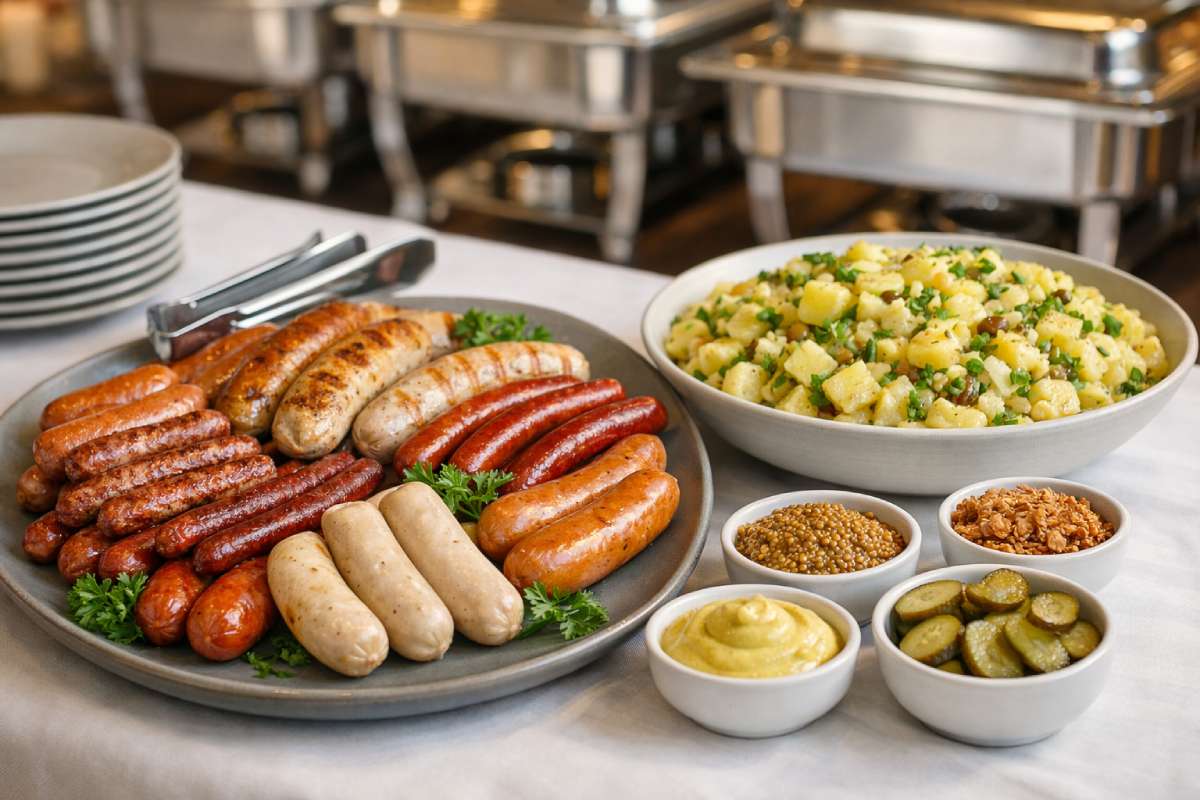
A catering-ready “sausages with potato salad” buffet: mixed German sausages with potato salad, mustards, gherkins and crispy onions.
Introduction
In UK foodservice, “simple” is only simple when it repeats well. Sausages with potato salad looks like an easy win—until Saturday service exposes the weak points: potatoes overcooked and collapsing, dressing separating, tubs weeping liquid in the fridge, or a buffet set-up that turns a tidy side into a risky, warm mess. That is why this article treats potato salad as a production item, not a picnic afterthought.
For chefs and pub kitchens, the job is consistency on the pass: a portion that holds shape, a flavour profile that suits the sausage, and a method that does not create extra stress during peak. For caterers, it is about scale, chilling discipline, and a salad that still eats well after transport and time. For buyers and retailers, it is about a spec that customers understand, plus a pairing story that sells without needing a long explanation.
We will cover three potato salad styles designed for three common service moments—BBQ speed, pub plates, and buffet holding—and tie them to sausage selection and plating logic. Where relevant, we’ll reference The Sausage Haüs range produced by Remagen (Germany) and distributed in the UK by Baird Foods, because the best side dish is the one that makes your main item easier to sell.
Key Takeaways
- Sausages with potato salad works in UK foodservice because it’s familiar, fast, and easy to portion—if the potato salad for catering is built to hold texture and stay tidy.
- Use three service-ready approaches: BBQ potato salad side dish (creamy and quick), pub potato salad side dish (balanced, pass-friendly), and buffet potato salad make ahead (stable, transport-safe).
- For consistency, choose the best potatoes for potato salad UK kitchens can rely on (waxy varieties, correct cut size, steam-dry before dressing) to avoid mushy results.
- When you need holding power, German potato salad for sausages (vinegar–mustard dressing, herbs, minimal mayo) is often the safest bet for buffets and events.
- Food safety is non-negotiable: potato salad food safety UK means rapid chilling, controlled cold holding, and clear “time out of fridge” discipline during service.
- Pair to the sausage, not the other way round: spicy or smoked sausages benefit from sharper, pickled notes; classic bratwurst suits mustard-herb styles—this is how sausages with potato salad becomes a sellable menu line.
- Standardise portions for margin: fixed sausage count + fixed scoop weight of potato salad reduces waste and gives buyers confidence when ordering potato salad for catering at scale.
Why “sausages with potato salad” works in UK foodservice
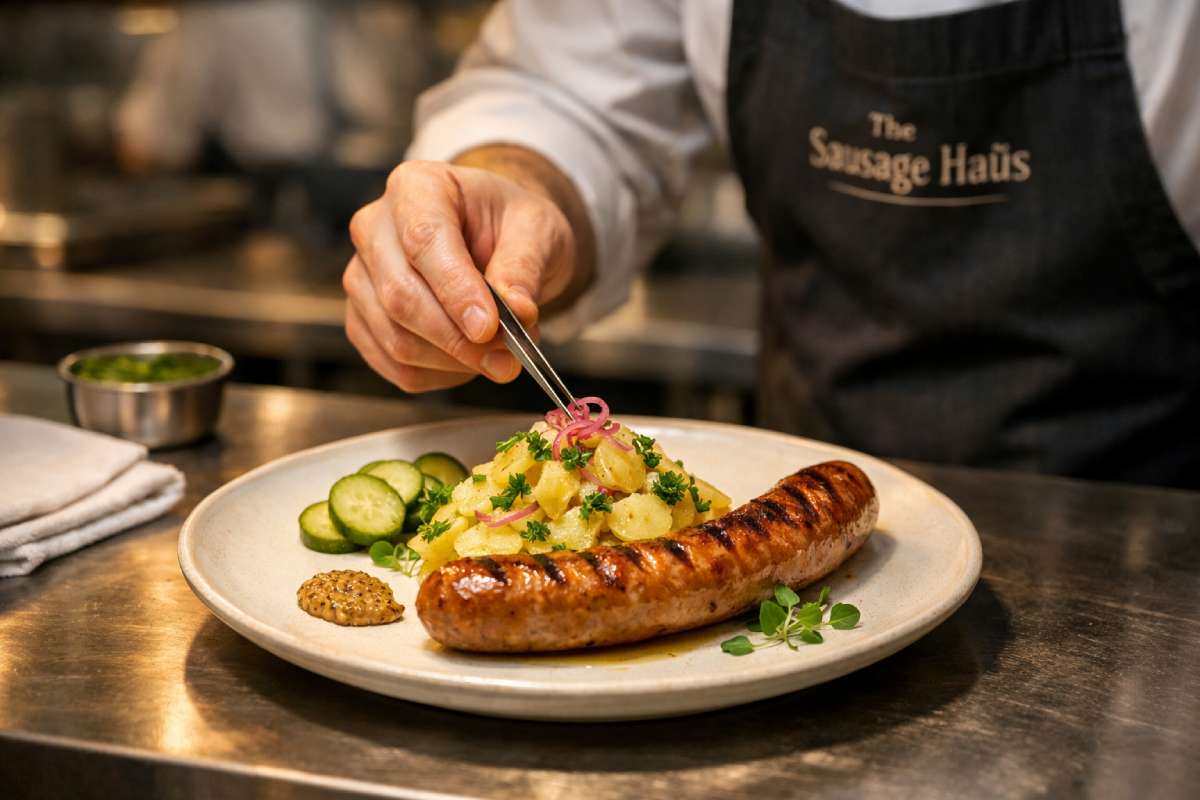
A chef adds the final garnish to a perfectly grilled bratwurst with classic Swabian potato salad at the kitchen pass.
One plate, three use-cases: BBQ speed, pub plates, buffet holding
In UK foodservice, the best-selling dishes are rarely the fanciest—they’re the ones that survive reality. Sausages with potato salad earns its place because it works across three very different operating modes with the same core mise en place and only minor tweaks to finishing. That matters when you’re juggling labour, fridge space, prep lists, and unpredictable covers. You can run it as a fast BBQ line item when the weather turns and you need throughput; you can plate it as a dependable pub meal with a clear spec and clean presentation; and you can serve it buffet-style where guests self-portion and you need the food to stay stable and safe over time.
Crucially, the components behave well in service. Sausages are portionable, cook consistently in batches, and hold hot without collapsing. Potato salad, when made with the right method, is a cold side you can portion fast, keep tidy, and scale without turning service into a mess. It’s one of the few combinations that can be “simple” and still operationally robust.
- BBQ speed: sausages are high-throughput and forgiving on grill or flat-top, while potato salad is a cold side you can portion fast. That means less faff on the line and fewer “where’s the garnish?” moments when the garden is full and the printer is screaming.
- Pub plates: it lands as a proper meal, not a snack. One strong protein + one starchy side = a plate customers understand instantly. You can keep it consistent across shifts because the portion is simple: fixed sausage count plus a standard scoop of potato salad.
- Buffet holding: for events, sausages hold well hot (in covered trays or chafers) and potato salad holds cold when you treat it as a chilled item with a defined time-out policy. The combination looks abundant on a buffet and serves quickly without sauces running everywhere.
In short: it is operationally flexible. You can run the same “sausages with potato salad” offer at a summer BBQ, as a pub special, and on a corporate buffet with only minor adjustments to the potato salad style and holding method.
Menu logic and margin: why buyers like it (predictable spec, low waste)
Buyers and operators tend to like the same things for the same reason: fewer surprises. Sausages with potato salad is easy to specify, easy to cost, and easy to repeat—so it protects GP and reduces waste without needing constant supervision from the head chef. It also sits in a sweet spot of perceived value: customers understand it immediately and feel they’re getting a “proper plate” (protein + side), which supports menu price points without adding complicated prep.
From a procurement perspective, it’s a clean brief: choose the sausage type, set the portion weight/count, define the potato salad style, and you have a repeatable standard that’s easy to communicate across shifts and sites. From a kitchen perspective, it’s a strong labour trade: most of the work happens in prep (cook potatoes, dress, chill), while service becomes controlled assembly. That’s exactly what time-poor teams want—speed and consistency, not more moving parts.
- Predictable spec: you can define it in numbers: sausage type + sausage count (or grams) + potato salad scoop size. That makes ordering, portion control, and staff training straightforward.
- Low waste profile: sausages are portionable and freezable; potato salad is batchable with controlled yield. Done properly, you are not trimming expensive proteins or binning delicate greens at the end of service.
- Fast prep-to-serve ratio: most labour is done earlier (cook potatoes, dress, chill). Service is then assembly, not cooking from scratch.
- A “sells itself” plate: customers understand it immediately, which reduces decision friction. That matters on pub menus and event buffets where speed of choice affects queue time and turnover.
This is also why it works for retailers and wholesalers: it is a recognisable combination with clear merchandising hooks (BBQ, Oktoberfest, “German-style”, party buffet), and it supports repeat purchase.
Product note: The Sausage Haüs range for this dish
The main reason this dish stays profitable is that it depends on consistency. If your sausage cooks unevenly, splits, or varies in size, your portioning and plating discipline goes out the window—and so does your margin. The advantage of building sausages with potato salad around a defined sausage range is that you can lock the spec: predictable weight, predictable cook, predictable eating experience. That makes it easier to train staff, easier to forecast yield, and easier for buyers to order with confidence.
For this post, the idea is not to list sausages for the sake of it, but to give you a practical set of “fits” depending on the potato salad style and service format—BBQ, pub plate, or buffet. The Sausage Haüs line-up below covers the core eating occasions you actually sell in the UK: classic bratwurst for broad appeal, frankfurters for faster service and smoky/spicy variants, bockwurst for mild crowd-pleasing, and Munich weisswurst for themed events.
- Bratwurst: the all-rounder for BBQs and pub plates; pairs cleanly with Swabian vinaigrette potato salad or roasted potato salad for a “proper meal” feel.
- Bacon Frankfurter: adds smoky depth; works especially well with creamy mayonnaise potato salad (comfort) or roasted potato salad (premium).
- Cheese Frankfurter: richer and more indulgent; best with brighter, vinegar-led salads (Swabian style) to keep the plate balanced.
- Chilli Beef Frankfurter: brings spice and colour; pairs best with creamy mayo style (to soften heat) or roasted potato salad with pickled elements.
- Bockwurst: mild, plump and broadly appealing; a safe choice for buffets and mixed audiences, particularly with classic mayo potato salad or Swabian style.
- Munich Weisswurst: gentle and traditional; pairs best with a lighter Swabian-style potato salad and mustards, especially for event menus with a German theme.
Choose the right potatoes and stop texture failures before they start
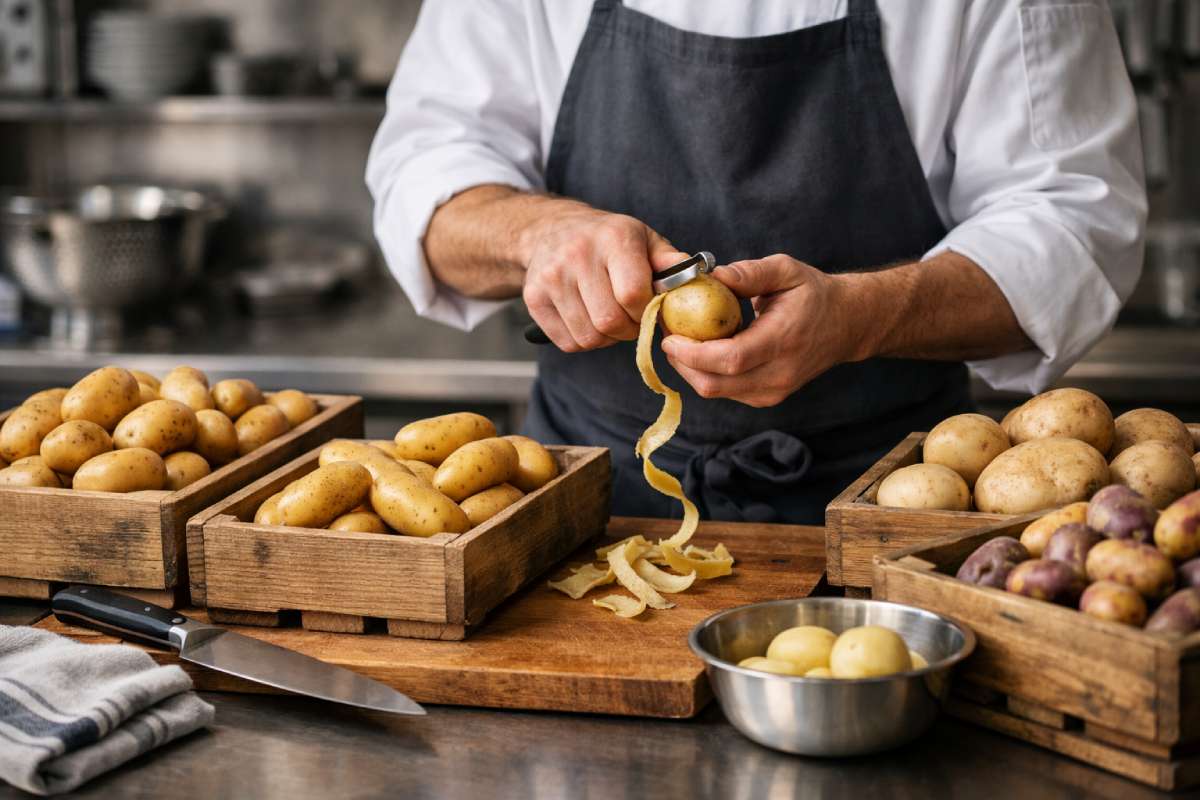
Choosing the right potatoes is the quickest way to improve sausages with potato salad—waxy varieties hold shape and portion cleanly in service.
Most potato salad problems are not “recipe issues”. They are process issues: the wrong potato type, the wrong cut, too much water left in the potato, dressing added at the wrong time, or tubs being moved and mixed one time too many. Get the fundamentals right and you stop 80% of complaints before service.
Best potatoes for potato salad in the UK (waxy vs floury, cut size, peel on/off)
For sausages with potato salad, you want potatoes that hold their shape, portion cleanly, and don’t collapse into paste after mixing and chilling. In UK terms, that usually means choosing a waxy potato over a floury one—because waxy potatoes keep their structure under the exact conditions that break potato salad in service: prep-ahead, cold storage, transport, and repeated scooping.
Waxy potatoes (preferred for potato salad):
They stay sliceable, keep tidy edges, and give you a salad that looks “intentional” on the plate rather than tired. Good UK favourites that usually perform well:
- Charlotte (a classic for potato salad; holds shape and absorbs dressing without falling apart)
- Jersey Royals (excellent when in season—firm, distinctive flavour, great for vinaigrette/Swabian style)
- Nicola (reliable, waxy texture; good for buffet holding)
- Anya (waxy, nutty; reads premium on pub plates, especially for roasted potato salad)
Floury potatoes (use with caution):
They can taste great, but they break down faster and release more starch—fine for mash, risky for a salad that has to survive chilling, folding, and service. Typical floury choices like:
- Maris Piper
- King Edward
…can work only if you’re extremely strict on cook point and mixing, but they’re much less forgiving. In practice, floury potatoes are where “mushy” and “gluey” potato salad usually starts—especially when staff are moving quickly.
If you want one simple buying rule: choose waxy for reliability, and only use floury if you’re deliberately chasing a softer texture and you can control process tightly.
Practical spec decisions:
- Cut size:
- Slices (Swabian/vinaigrette styles) look more “German” and absorb dressing evenly.
- Chunks (mayo style) feel generous and stand up to folding.
- Keep it consistent: mixed cuts lead to mixed texture, which reads as “inconsistent” even if the flavour is good.
- Peel on vs peel off:
- Peel on can look more rustic/premium (and saves labour) if the skins are clean and not too thick.
- Peel off gives a cleaner visual for pub plates and retail tubs and reduces the risk of tough skin pieces in the bite.
- If you go peel-on, keep skins intact (don’t half-peel) and avoid overcooking—the moment skins start slipping, you’re already heading towards mush.
Preventing mushy potatoes (cook method, steam-dry, cooling control)
Mushy potato salad is usually caused by one of two things: overcooking or aggressive mixing while hot. Once the starch structure collapses, no amount of “more dressing” fixes it—it just turns into glue.
Use a repeatable method that protects texture:
- Start in cold, salted water and bring up gently. This reduces the “outside disintegrates while the centre is firm” issue.
- Cook to just tender, not “fork falls through”. If the potato can’t hold a clean edge, it won’t survive mixing.
- Drain properly, then steam-dry: leave potatoes in the colander (or back in the warm pan off heat) for a few minutes so surface moisture evaporates. This is one of the biggest quality levers you have.
Cooling control (service-relevant):
- For mayo potato salad, let potatoes cool fully before dressing so the emulsion stays stable and the tub doesn’t turn greasy.
- For vinaigrette/Swabian style, dress while warm (not hot) so the potatoes absorb flavour—then chill.
- Minimise handling. Mix gently, then stop. Every extra fold damages edges and releases starch.
Quick red flags you can train staff on:
❌ Potatoes “feeling” soft in the pan = they will be mushy in the tub.
❌ Mixing hot potatoes hard = gluey texture by the time it’s chilled.
✔️ Clean edges + gentle fold + proper steam-dry = potato salad that portions like it should.
Preventing watery potato salad (seasoning timing, dressing absorption, drainage)
Watery potato salad is what happens when water escapes after you think you’re finished. That water comes from potatoes that weren’t dried, from salt pulling moisture out later, or from dressing added before the potatoes can absorb it.
To keep potato salad glossy, not wet:
- Steam-dry is non-negotiable. If you skip it, the tub will weep in the fridge.
- Season in stages:
- Lightly season warm potatoes first (especially for vinaigrette styles).
- Final seasoning happens after chilling, when flavours settle and you can judge acidity and salt properly.
- Let it rest before service: a short rest (even 20–30 minutes) allows dressing to absorb so you don’t see pooling liquid at the bottom of the gastro.
- Drain high-water add-ins: if you’re using onions, gherkins, or any pickled elements, make sure they’re well-drained. A “helpful splash” of pickle juice becomes a puddle later.
Practical rescue (when it’s already watery):
- Drain off excess liquid before service (don’t stir it back in).
- Fold through a small amount of cooked, cooled potato (best fix if you have it).
- For mayo style, tighten with a small amount of mayo + mustard, then re-check salt and acid.
If you control potato type, steam-dry, and the timing of dressing/seasoning, your potato salad stops being unpredictable—and becomes a reliable side you can confidently pair with any sausage on the menu.
The 3 potato salad styles that match different sausages
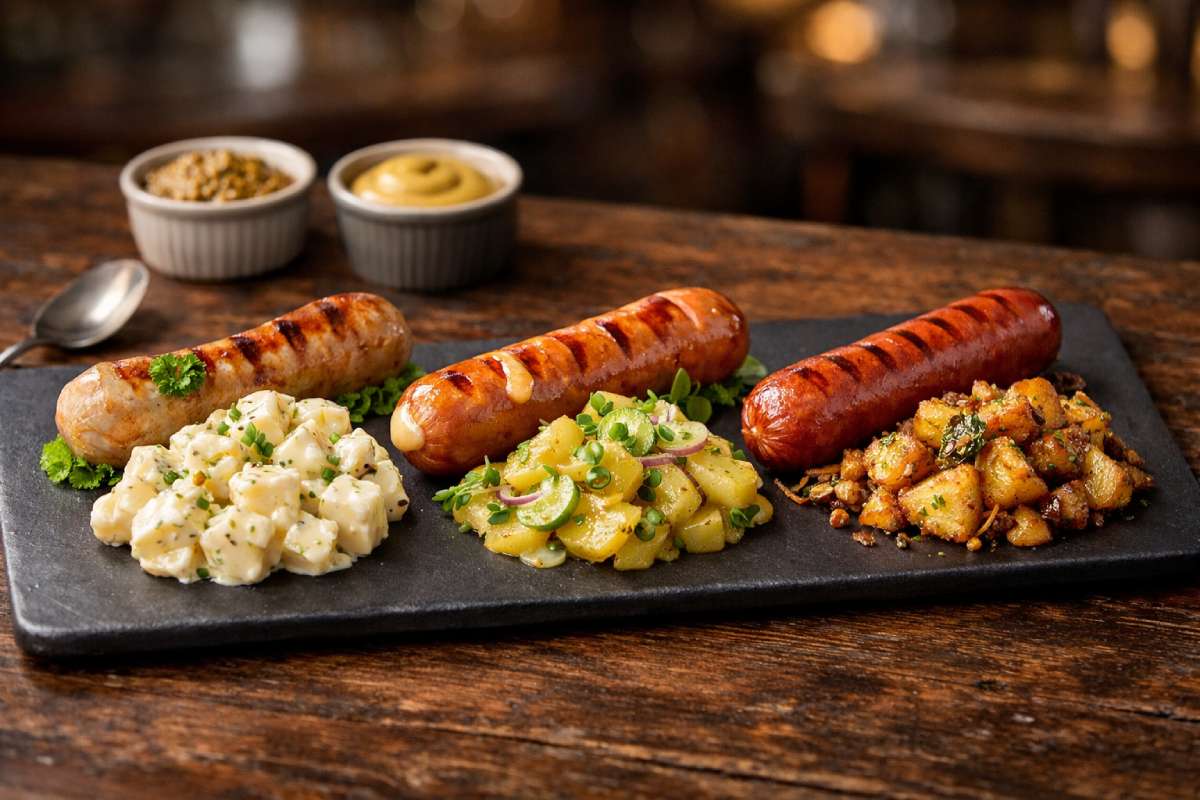
Sausages with potato salad, three service-ready options: creamy mayo, Swabian vinaigrette with vegetable stock, and roasted potato salad.
Below are three potato salad styles that work in real UK service. Each has a clear “job” (BBQ speed, pub-plate consistency, buffet holding) and each pairs better with certain sausage profiles. The goal is not culinary theatre. It is a potato salad spec you can repeat, portion, and hold without drama.
Style 1: Mayonnaise potato salad (classic creamy)
Best for: BBQ speed, family-facing menus, high familiarity.
What it does well: Mayo-based potato salad reads “generous” on the plate and is fast to finish once the potatoes are cooked and cooled. The texture is forgiving if your potatoes are slightly over, and it delivers instant comfort value.
Best sausage matches (practical pairing logic):
- Bacon Frankfurters / Chilli Beef Frankfurters: creamy mayo softens heat and smoke; add a pickled note (gherkin) to keep it bright.
- Bockwurst: mild, plump sausage + creamy potato salad is a straightforward crowd-pleaser.
- Big Bratwursts: works when you want a “BBQ classic” plate; keep acidity in the salad (a touch of mustard or pickle) so it doesn’t feel flat.
Service notes (avoid the usual failures):
- Keep potato chunks distinct and fully cooled before dressing (warm potatoes + mayo = greasy texture and short holding window).
- If it goes watery, it is usually under-steam-dried potatoes or overdressing. Fix by draining, folding through a small amount of cooked, cooled potato, or tightening with a little extra mayo and mustard—then re-season.
Style 2: Swabian-style potato salad (vinaigrette + vegetable stock)
Best for: pub plate consistency and “German credibility” without being niche.
What it does well: This is the workhorse style for sausages with potato salad because it stays glossy rather than claggy, cuts through rich sausages, and sits neatly on the pass. The vegetable stock element gives body and savouriness without needing mayo.
Best sausage matches (practical pairing logic):
- Big Bratwursts: the acidity and onion/herb profile does the heavy lifting; it makes a bratwurst plate feel lighter and more complete.
- Cheese Frankfurter: the Swabian-style vinaigrette + vegetable stock brings acidity and lift to balance the rich, creamy cheese notes, keeping the plate fresh rather than heavy.
- Weisswursts: gentle sausage needs gentle dressing—this style can be tuned mild while still adding balance.
Service notes (make it repeatable):
- Dress the potatoes while they are warm (not hot) so they absorb flavour, then chill. This reduces “bland centre” complaints.
- Do not flood it. You want a controlled gloss, not a puddle. If it looks wet in the tub, it will look worse on a plate.
Style 3: Roasted potato salad (golden, crisp-edged)
Best for: pub specials, premium plates, higher perceived value.
What it does well: Roasting gives texture you cannot fake in a cold salad. The crisp edges and caramelised notes hold up next to bold sausages and make the dish feel more “cooked” and premium—useful when you want sausages with potato salad to justify a higher menu price point.
Best sausage matches (practical pairing logic):
- Chilli Beef Frankfurters: roasted potato salad can carry spice-forward sausages; add herbs and a touch of mustard to connect the flavours.
- Bacon Frankfurters: roast + bacon notes = natural pairing; add a pickle element to prevent sweetness overload.
- Bockwurst / Big Bratwursts: turns a simple sausage into a pub-plate upgrade with minimal extra labour.
Service notes (keep it sharp in service):
- If you dress too heavily, you lose the roast texture. Use a light, oil-and-vinegar style dressing, fold gently, and finish with herbs at the end.
- For events, transport roasted potatoes separately and toss close to service to protect crispness.
Choosing quickly (if you only remember one line):
- Want maximum familiarity and speed? Mayonnaise potato salad.
- Want the most reliable all-round pub plate? Swabian vinaigrette + vegetable stock.
- Want premium texture and menu value? Roasted potato salad.
Make-ahead, storage and service safety for potato salad in professional kitchens
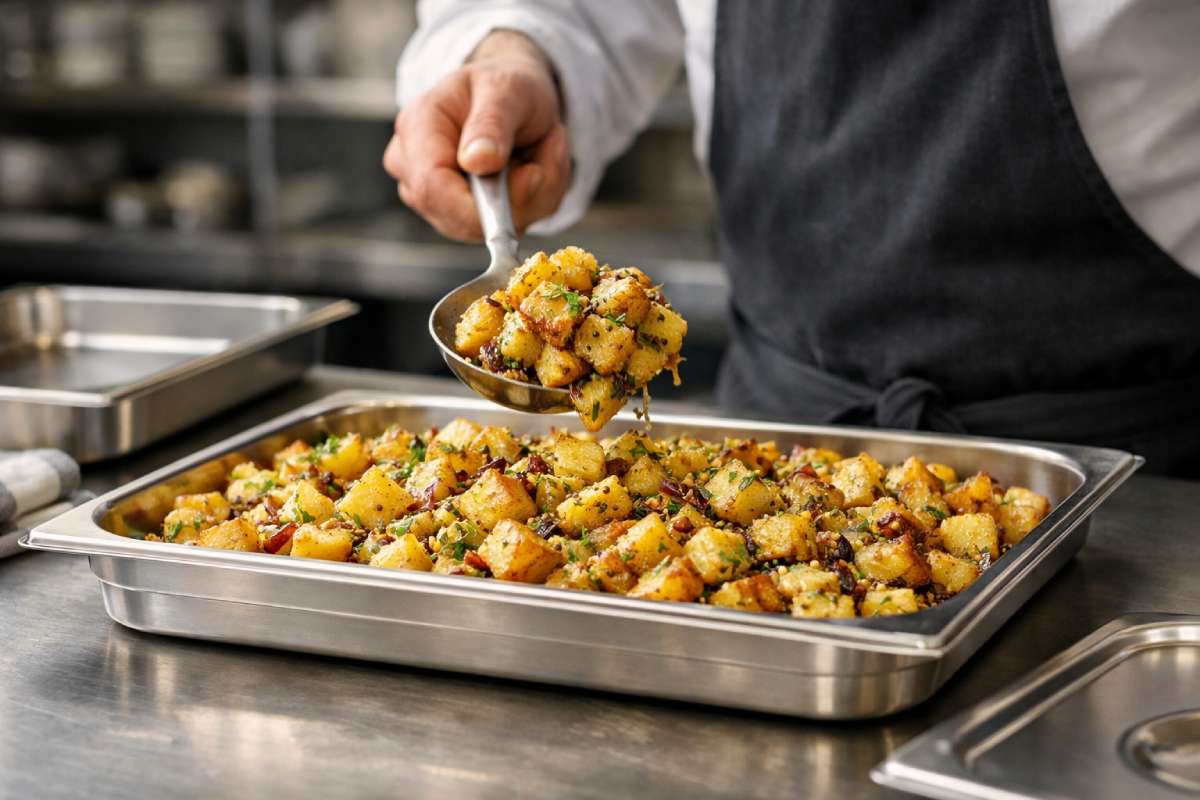
Roasted potato salad prepped in a shallow gastro tray for fast chilling and reliable make-ahead service.
Potato salad is one of those items that looks harmless right up until it isn’t. In a professional kitchen, you’re balancing three things at once: eating quality, speed of service, and cold-chain discipline. Get the workflow right and potato salad becomes an easy win for sausages with potato salad. Get it wrong and it turns into a tub that goes watery, tastes flat, or (worse) becomes a risk you don’t need.
Make-ahead timeline (prep today, serve tomorrow) without quality drop
A “prep today, serve tomorrow” potato salad is completely achievable—provided you treat it like a production item with a defined process, not an open-ended bowl that sits around.
A reliable make-ahead workflow:
- Cook potatoes to just tender (clean edges, no collapse). Drain and steam-dry properly.
- Choose dressing timing by style:
- Swabian vinaigrette + stock: dress warm so it absorbs flavour, then chill.
- Mayonnaise style: cool potatoes fully, then dress (keeps emulsion stable and texture clean).
- Roasted potato salad: roast and cool; toss lightly close to service to protect texture.
- Rest before chilling: give it 15–30 minutes to absorb dressing so you don’t get pooling liquid later.
- Chill, then final-season: salt and acidity often need a final tweak once cold. This step is what separates “fine” from “customers notice”.
Practical quality controls for tomorrow’s service:
✔️ Potatoes still defined; no broken edges in the tub
✔️ Dressing looks absorbed (glossy, not puddled)
✔️ Taste check cold: salt, acid, mustard, pepper
❌ If it’s already watery before it hits the fridge, it will be worse tomorrow—drain and tighten now.
Chilling and holding: keeping potato salad cold safely, fast
For potato salad food safety UK kitchens, the principle is simple: keep it cold, keep it covered, and minimise time out of refrigeration. What makes potato salad tricky is that it’s dense, often made in large batches, and gets handled repeatedly during service—exactly the conditions that reward sloppy chilling.
Operational best practice (without making it a lecture):
- Use shallow containers: spread the potato salad into shallow gastro trays rather than deep tubs. Surface area is your friend for fast chilling.
- Cover and label: lids on, date/time marked, and store in the coldest appropriate part of the fridge—not on a warm edge near the door.
- Batch for service: hold a master tray cold, and decant into a smaller service tray. Refill from the master rather than keeping one tray out for hours.
- Don’t “save it” by stirring: repeated mixing warms the salad and breaks texture. Portion, close, return.
- Separate wet add-ins until needed (where relevant): if you’re using juicy pickles/onions, keep them well-drained and add with restraint to avoid weeping in the service tray.
A simple service rule that staff follow:
✔️ Small tray out, big tray stays cold.
✔️ Lid back on immediately after portioning.
❌ No “it’ll be fine” on the pass.
Can potato salad be served warm? When it works and when it doesn’t
Yes—potato salad can be served warm, and when done properly it elevates the dish. But warm potato salad only works with the right style and the right service window.
When it works (recommended):
- Swabian-style vinaigrette + vegetable stock: this is the natural warm option. The dressing stays glossy, the flavour carries, and the salad pairs extremely well with a long Bratwurst on a pub plate.
- Roasted potato salad: also works warm, especially for specials. The crisp edges read premium, and the salad feels like a cooked side, not a fridge item.
When it usually doesn’t (avoid):
- Mayonnaise potato salad served warm: warm mayo-based salads quickly become heavy, greasy, and unappealing. They also create avoidable food-safety complexity. Keep mayo versions cold.
Warm service guidance (keep it practical):
- Warm potato salads are best treated as a cooked side, made in smaller batches and served within a defined window.
- Don’t try to run a “warm-ish” compromise. Either commit to warm service properly (with control), or keep it cold and stable.
If you build your make-ahead timeline around the salad style, and you respect chilling/holding discipline, potato salad becomes a reliable trade component—one that makes sausages with potato salad easy to sell and easy to run.
Scaling for catering, retail tubs and wholesale supply
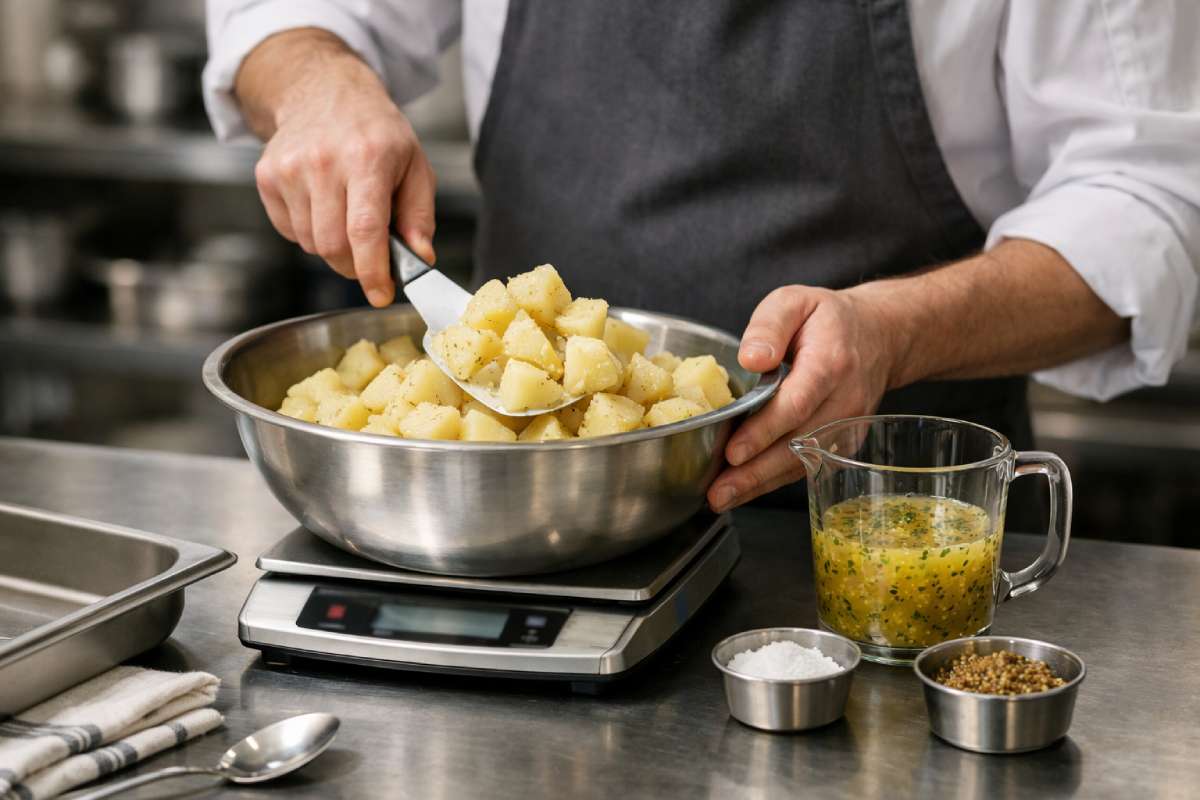
Scale potato salad by weight: cooked potatoes on the scales, dressing measured, then folded in gently to protect texture.
Scaling sausages with potato salad is rarely limited by cooking skill. It’s limited by how well you control yield, moisture, cold chain, and presentation once the batch size moves beyond “a bowl for tonight”. The good news: potato salad is very scalable—if you standardise the numbers and protect texture.
Batch maths: scaling dressings without breaking texture
The quickest way to ruin a big batch is to “dress by eye” and then keep correcting. Every correction means extra mixing, extra starch release, and a higher chance of watery tubs tomorrow.
A practical approach that holds up at scale:
- Weigh potatoes after cooking and steam-drying. That’s your true yield. If you scale on raw weight, you’ll chase consistency forever.
- Start with a conservative dressing ratio, then adjust once absorbed. In big batches, it’s easier to add than to rescue.
- Dress in stages: add ~70–80% of the dressing, rest, then add the remainder only if needed. This prevents pooling and protects structure.
- Use gentle folding tools (large spatula/paddle) rather than whipping the mix. The more you beat it, the more starch you release—hello glue.
Quick guide by style (how to think, not a rigid recipe):
- Mayonnaise potato salad: scale the mayo component carefully; it will “loosen” in the tub as it warms slightly during handling. Keep pickles/onions well-drained.
- Swabian (vinaigrette + stock): the potatoes absorb more when warm, so your dressing volume often looks “too little” at first. Let it rest before adding more.
- Roasted potato salad: dress lightly and close to service; the more liquid you add, the faster you lose the roasted texture.
Labelling and shelf-life thinking (practical, non-legalistic)
For trade operations, label discipline is less about paperwork and more about avoiding two expensive outcomes: waste from uncertainty (“bin it to be safe”) and risk from guesswork (“it’s probably fine”).
Keep labelling simple and consistent:
- Product name + style: “Potato salad – mayo” / “Potato salad – Swabian” / “Potato salad – roasted”
- Prep date/time and use-first guidance (e.g., “use first”, “open tray”, “service tray”)
- Allergen cue for the team: mayo versions commonly introduce egg; keep it obvious.
Shelf-life thinking in practice:
- Decide whether you are running one-day (prep today, serve today) or next-day (prep today, serve tomorrow) as your standard, and brief everyone on it.
- If you operate multiple sites or supply retail tubs, standardise a single internal rule for how long a tub can be used once opened/served from. The goal is consistency, not heroics.
This is deliberately non-legalistic: your local processes should follow your food safety management system. The operational point is that clear labelling prevents “mystery tub” decisions.
Packaging and transport: keeping it cold, neat and saleable
For catering drop-offs, retail tubs, or wholesale supply, the product is judged before it’s tasted. Potato salad that arrives separated, smeared on the lid, or warm at the edges is a commercial problem—even if the recipe is good.
Packaging and logistics that protect quality:
- Use the right fill level: overfilled tubs smear; underfilled tubs look mean. Aim for a clean headspace and a flat, tidy surface.
- Keep liquids under control: drain pickles/onions; avoid adding extra “helpful” dressing right before sealing. If it weeps, it will look like a fault.
- Cold chain discipline: transport in insulated boxes with sufficient cooling; load last, unload first. For events, decant into smaller service trays to reduce time out of refrigeration.
- Prevent movement damage: potato salad breaks down when it’s shaken. Pack tight to reduce slosh and avoid stacking in a way that squeezes lids.
- Separate where sensible: for roasted potato salad, consider transporting potatoes and dressing separately and tossing close to service—this keeps the “roasted” promise intact.
If you’re supplying the full dish concept (sausages plus side), the same logic applies: sausages travel and hold well when hot-held correctly; potato salad travels and sells well when it stays cold, neat, and clearly labelled. Scale the system, not just the recipe.
Frequently Asked Questions
Cook waxy potatoes until just tender, drain well, and dress while warm so the flavour absorbs. Fold gently (don’t mash), add your chosen extras (onion, pickles, herbs), then chill and adjust seasoning before service.
Mary Berry’s BBC Food potato salad method combines warm cooked new potatoes with a punchy dressing (oil, Dijon mustard, vinegar, a touch of sugar), then finishes with mayonnaise and crunchy add-ins like spring onions, celery and herbs (in her version, served with salmon and prawns).
A common Jamie-style approach is to cook new potatoes until tender, then dress them while still warm with a mustard–vinegar–olive oil dressing and fold through shallots and parsley (i.e., a brighter, vinaigrette-led potato salad rather than a heavy mayo version).
Make-ahead is encouraged, but the key is treating it like a production item: controlled chilling, minimal handling, and a defined “service window” so quality and safety don’t drift during peak.
The guide is built around three service moments: a BBQ-speed creamy style, a pub-plate balanced style, and a buffet-friendly holding style designed to stay stable and safe in real service conditions.
A simple “base” potato salad is usually just potatoes + a dressing + an acid + seasoning. In practice, that often looks like potatoes, mayonnaise (or oil), vinegar or pickle juice, plus salt/pepper—then you build variations from there.
For broad appeal and consistent service, start with classic Bratwurst as the all-rounder, then use Frankfurters (incl. smoky/spicy variants) for faster service and “bolder” plates, and Bockwurst/Weisswurst for mild crowd-pleasing or themed German menus.
Across most styles you’ll see potatoes, mayonnaise or oil, mustard, vinegar/pickle juice, onion, and herbs (often parsley or dill). Many versions also add egg, celery, or pickles for texture and bite.
German potato salad is commonly vinegar-forward rather than mayo-heavy, often using oil, vinegar, mustard, onions, and sometimes a warm dressing that soaks into the potatoes. It tastes brighter, holds well, and pairs naturally with sausages.
Don’t overcook the potatoes, don’t dress them while they’re dripping wet, don’t mash them with aggressive mixing, and don’t leave a mayo-based salad sitting warm for long periods. For best texture, drain well, steam-dry briefly, and fold gently.
Potato salad fails when chilling and cold-holding discipline slips. The guide stresses rapid chilling, controlled cold storage, and a clear “time out of fridge” rule during service—without turning it into a legal manual.
Sharper, mustard-forward salads are ideal when you want a cleaner, pass-friendly plate and better holding power—especially useful to balance richer sausages (e.g., cheese) and to keep buffets tidy.
Conclusion
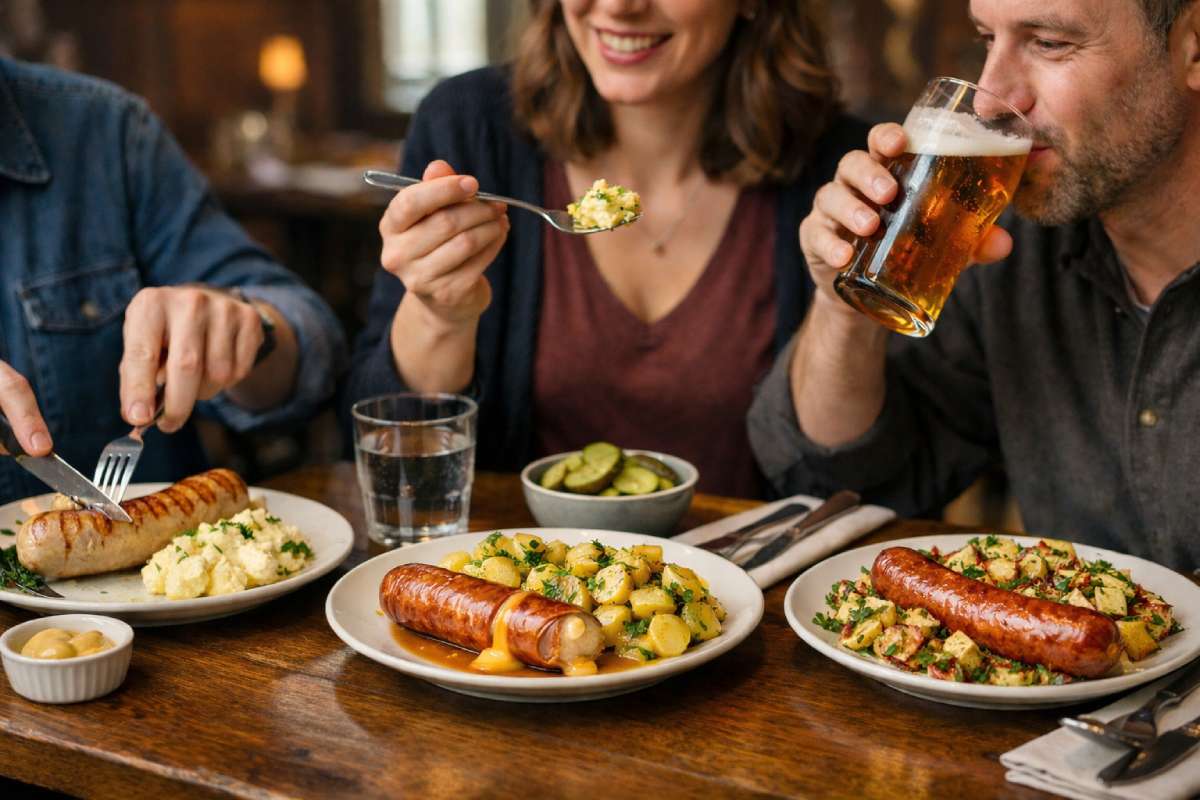
Sausages with potato salad as a pub-friendly trio: creamy mayo, Swabian vinaigrette with stock, and roasted potato salad—built for real service and real customers.
Sausages with potato salad is a dependable option for UK foodservice because it fits three realities at once: fast BBQ trade, consistent pub plates, and buffet-friendly catering. The difference between a plate that quietly sells and one that causes friction is rarely the sausage—it’s the potato salad spec. When you choose the right potato, control moisture, and match the style to the service moment, you avoid the usual failures (watery tubs, gluey texture, bland flavour, messy plating) and you gain something more valuable than novelty: repeatable quality.
The practical takeaway is straightforward. Use a creamy style when speed matters, a balanced mustard-forward style when you need a clean, reliable pub plate, and a vinegar-led German-style when you need holding power for events. Standardise portions, set a make-ahead timeline, and treat chilling and cold-holding as part of the method—not an afterthought.
If you’re planning a BBQ menu, a pub special, or a catering buffet, build your sausages with potato salad offer around one of these three styles, then brief your team on the portion and holding rules. It will run smoother, waste less, and sell more consistently.
About Sausage Haüs
The Sausage Haüs supplies premium German-style sausages built for UK foodservice and retail—designed to perform in real kitchens, not just in product photos. Our range is produced by Remagen (Germany) and distributed in the UK by Baird Foods, giving trade customers dependable supply, consistent specifications, and formats that suit pubs, caterers, wholesalers, and retailers.
Whether you’re building a BBQ line, a plated pub special, or a catering buffet, we focus on what matters operationally: sausages that cook evenly, portion predictably, and deliver a recognisable eating experience that customers come back for. The Sausage Haüs portfolio includes classic and modern options to support menu variety—without complicating procurement or prep. If you want help selecting the right sausages for your potato salad style, service format, and customer base, we can point you to the best fit for your operation.