Hotdog onions split opinion because they change everything: texture, sweetness, heat-hold performance, and portion cost. Crispy roasted onions deliver instant crunch and fast service; caramelised onions bring rich flavour but need time and careful holding. This guide ends the hotdog onions “war” with practical, UK-ready decision rules—so you can choose the right onion style for pubs, events, and home platters without slowing the pass.
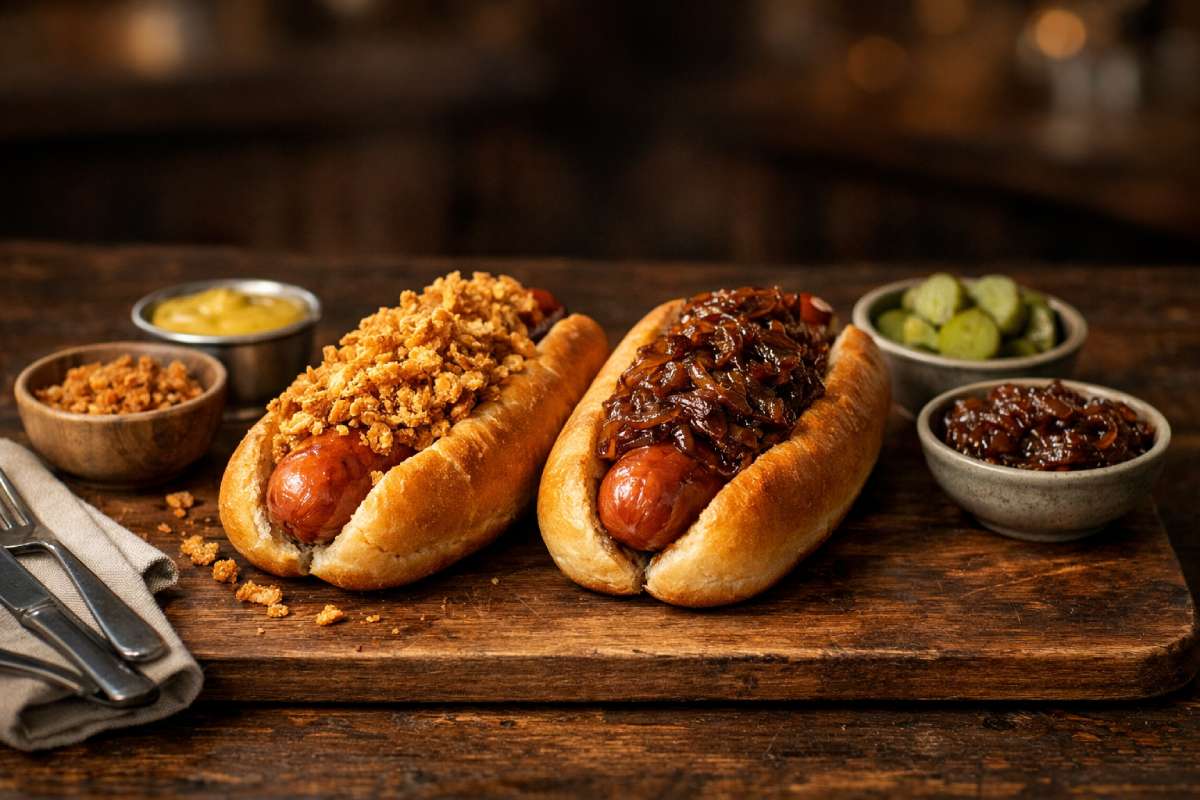
Crispy roasted or caramelised—two hotdogs, two onion styles, one delicious debate.
Introduction
Hotdog onions are not a small detail. In a bun, onions often decide whether a hotdog eats “clean” with crunch and lift—or turns soft, sweet, and messy. That’s why people argue about crispy roasted onions versus caramelised onions: they’re effectively two different products with two different service behaviours.
In the UK trade world—pub kitchens, street food traders, event caterers, and anyone buying through wholesalers or cash & carry—the onion decision is rarely just about taste. It’s about speed on the line, hot holding, wastage, and portion cost. Crispy onions are quick, consistent, and easy to portion, but can soften if they sit under sauce. Caramelised onions can feel more “premium” and help build a signature profile, but they typically require labour, pan space, and careful reheating to avoid a greasy or watery finish.
The good news: you don’t need a one-size-fits-all answer. You need a system—which onion style wins for your sausage type, sauce level (mustard vs cheese sauce), service format (platter vs wrapped to-go), and prep reality (fresh cook vs bought-in). That’s exactly what this post delivers.
Key Takeaways
- Choose by service format: crispy hotdog onions usually suit fast pass service and platters; caramelised onions can suit “premium” dine-in builds where you control assembly timing.
- Protect crunch: crispy onions can soften quickly under wet sauces—hold them dry and add at the last second.
- Manage holding risk: caramelised onions may split or turn watery if overheated or held poorly—test your reheat and hot-hold method before service.
- Portion cost matters: crispy onions are typically easy to portion consistently; caramelised onions can vary more (yield, water loss), affecting cost per serve.
- Match onion to sausage: smoked/frankfurter styles often pair well with tang (pickles, mustard, pickled onions), while richer bratwurst builds can carry sweetness (caramelised/onion jam).
- Offer a “two-onion” option: for menus and events, a default onion plus an upgrade (e.g., crispy standard + caramelised add-on) can lift perceived value without slowing the line.
- Verify allergen and ingredient specs: for bought-in crispy onions or onion relishes, confirm ingredients, allergens, and handling guidance with your supplier for consistent service.
Crispy vs caramelised: why people argue in the first place
Most debates about onions on a hotdog are not really about taste. They’re about performance: what happens after the sausage hits the bun, the sauce goes on, and the food sits for even two minutes on the pass—or gets carried to a table with a pint. Texture changes quickly in a warm, steamy bun, and onions are often the first topping to either elevate the bite or make it feel soft and muddled.
In UK pub and event service, the “right” option also depends on how you buy and prep. If you’re running a busy kitchen with a tight labour plan and you’re watching portion cost, the best-tasting topping is only useful if it’s consistent, easy to portion, and holds up through service. That’s why the crispy-versus-caramelised question keeps coming up: the two styles behave like completely different products.
Crispy onions: the line-speed favourite
Crispy onions win arguments because they deliver a clear, immediate payoff. One sprinkle and the hotdog tastes fresher, louder, more “snackable.” They also suit real-world operations: you can portion them quickly, train anyone to apply them consistently, and produce the same result whether you’re doing ten covers or a hundred.
Where they can let you down is predictable: moisture and steam. If crunchy onions go on too early and then get trapped under cheese sauce, relish, or even a heavy squeeze of ketchup, they can soften fast. That doesn’t make them “bad”; it just means they need a different build order and a little discipline around holding.
In practice, they work best when you treat them as a finisher, not a base layer. Keep them dry, keep them separate from wet toppings, and add them at the last possible moment. If you’re buying them in (common through wholesalers and cash & carry), do a quick spec check so you know what you’re serving—particularly ingredients and allergens—because products vary by supplier.
Caramelised onions: premium flavour, but only if you manage the prep
Caramelised onions make a hotdog feel more like a dish than a snack. They bring sweetness, savoury depth, and that “slow-cooked” character that pairs well with mustard, smoke, and rich pork. Done well, they can justify a higher price point because the flavour feels deliberate and house-made.
The trade-off is that they ask more from the kitchen. They take time, they occupy hob space, and their quality is sensitive to reheating and holding. If they’re not reduced properly, they can release water and turn the bun soggy. If they’re overworked or overheated, they can drift into greasy or flat tasting. None of this is catastrophic—but it does mean you should test your method in your own setup, with your own containers and hot-hold practice, before you commit to them as the default topping on a busy menu.
For portion cost control, caramelised onions also benefit from a simple discipline: weigh your batch, standardise the serving portion, and stick to it. Without that, the “premium topping” can quietly become a margin leak.
The scenario test: which one wins when service is real
If you’re serving at pace—busy lunch, match day, event service—crispy onions are usually the safer default because they’re fast and predictable. They also keep the hotdog visually appealing, especially on platters, because the topping looks “active” and textured even from a distance.
Caramelised onions tend to win when you control the timing: dine-in plates, slower service, or a signature build where the guest is eating immediately and you want depth more than crunch. They also work well as an upgrade rather than a default—because that lets you keep speed while still offering a premium option.
Cheese sauce is the special case. It’s delicious, but it’s also the fastest route to lost crunch. If cheese sauce is a key part of the build, the onion question becomes less ideological and more technical: do you want a crisp finish or a sweet base? The most reliable approach is to keep the sweet element under control and protect any crunchy element as a final layer.
A simple decision rule that holds up in most kitchens:
- If the hotdog is sauce-heavy, crunchy onions go on top, last second.
- If the hotdog is mustard-forward or drier, caramelised onions can sit under the sausage without collapsing the bun as quickly.
The option that ends most “arguments”: two textures, one build
If you want the crowd-pleasing result without picking sides, use a small amount of caramelised onions for flavour, then finish with a light sprinkle of crispy onions for texture. It reads as “chef-y” without complicating service too much, and it gives you a consistent sensory result: rich base, crisp top.
This is also commercially useful because it creates a clear menu story: the hotdog has a house topping that feels intentional, but the finishing step remains fast. If you’re cost-conscious, you can keep the caramelised portion modest and let the crisp topping do the heavy lifting on perceived value.
Third-party contenders: include them, but keep it tight
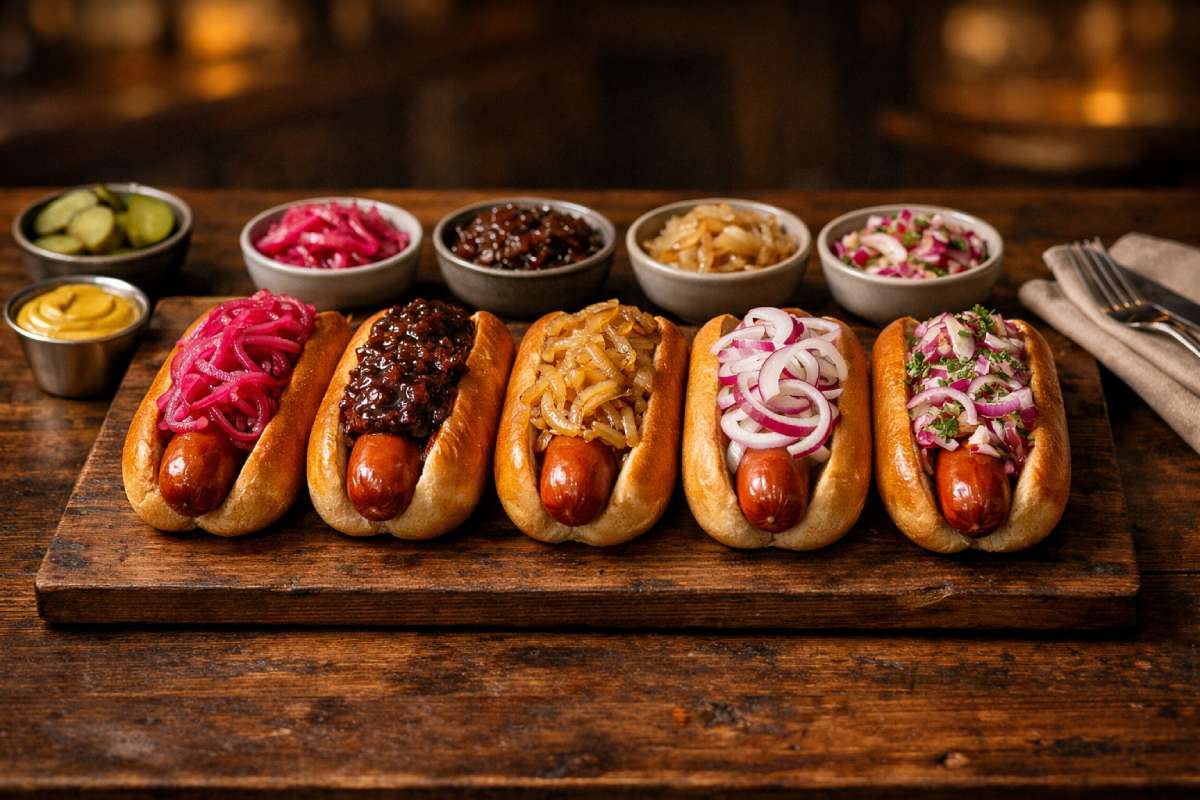
A hotdog onions tasting board: five onion styles, five very different bites.
Once you move beyond the two main camps (crispy versus caramelised), the onion conversation gets more useful—and more commercial. These “third-party” styles are not there to create endless choice. They’re there to solve specific problems that pubs, event traders, and anyone building a reliable hotdog offer will recognise: how to add freshness to a rich build, how to create a premium signature without slowing the line, how to keep the bun from collapsing, and how to give customers a sense of control without operational chaos.
The key is to treat these onions as role players. Each one should have a clear job description on your menu and in your kitchen: “adds tang”, “adds fragrance”, “adds bite”, “adds depth”. If an onion style doesn’t do a distinct job, it’s probably clutter.
1) Pickled onions: the “reset button” for rich hotdogs
Pickled onions are often the simplest way to make a hotdog taste brighter and more moreish. The acidity cuts through fat and dairy, so they work particularly well when you’re serving richer sausages, smoked styles, or anything with cheese sauce, mayo-based toppings, or heavy seasoning. In practice, they can make a hotdog feel less heavy without changing the core identity of the dish.
From a trade perspective, pickled onions also have a strong operational profile. They’re quick to prep in batches, they portion easily, and they can be used across multiple menu items (hotdogs, burgers, pulled pork, sandwiches). That means less “single-use prep” and better utilisation of your mise en place. The main risk is not safety claims—it’s flavour control. If they’re too sharp, too thick-cut, or too aggressively spiced, they dominate the bite and start fighting the sausage rather than supporting it.
A practical way to think about them is this: pickled onions are not meant to taste like “pickling vinegar”. They’re meant to taste like onion with a clean, crisp lift.
Where pickled onions win:
- Smoked sausages, frankfurters, and “cheese + smoke” builds
- Hotdogs with rich sauces (cheese sauce, burger sauce, garlic mayo)
- Menu items that need a “fresh” contrast without adding salad
How to keep them balanced (kitchen reality):
- Slice thin so the acidity hits quickly and doesn’t linger harshly.
- Avoid overloading: a small, measured portion usually reads more premium than a heap.
- If you buy in pickled onions, verify ingredient profile and consistency—products vary widely in sweetness, spice, and acidity.
Service tip: keep them well-drained. Excess pickling liquor can turn a bun wet faster than you expect.
2) Onion jam / marmalade: the premium “house signature” option
Onion jam (sometimes called onion marmalade) is what happens when caramelised onions are pushed further: more reduced, more concentrated, often sweeter, and usually more obviously “crafted”. In a pub context, it can signal premium positioning without needing a complicated build. One spoonful can make a hotdog feel intentional, like it belongs on a menu rather than being a quick snack.
Commercially, this is one of the easiest ways to justify an upgrade tier—because guests understand “jam” and “marmalade” as a made product. It also lends itself to a distinct naming convention (house onion jam, stout onion marmalade, smoky onion relish), which can help you stand out in listings and on printed menus.
The main caution is balance. Onion jam can overwhelm if it’s too sweet, too sticky, or too heavily spiced. It also changes the texture profile: it’s soft and concentrated, so if the rest of the build is also soft (soft bun + soft sausage + heavy sauce), you may end up with a “mushy” eating experience unless you add a crisp element elsewhere.
Where onion jam wins:
- Premium dine-in builds where you want “depth” more than crunch
- Hotdogs paired with mustard, smoked notes, or sharper toppings
- Menu lines where you want a signature that carries across multiple items
How to use it without making the build cloying:
- Keep the portion modest; let it read as a flavour accent, not a base layer.
- Pair with something that cuts through sweetness (mustard, pickles, a little acidity).
- Consider finishing with a light crisp topping (crispy onions, toasted breadcrumbs, or even a few sliced gherkins) to restore texture contrast.
Operational note: whether you make it or buy it, standardise the portion. It’s a high-flavour, high-perceived-value topping, but it can become a margin leak if it’s applied “by eye”.
3) Griddled onions: the fast-cooked compromise that feels fresh
Griddled onions sit in the sweet spot between raw and fully caramelised. They’re browned, fragrant, and satisfyingly “cooked”, but they don’t require the long reduction time of classic caramelisation. That makes them attractive for kitchens that want a cooked element with a fresher feel—especially when you’re doing smaller volumes or you want the theatre of something hot hitting the plate.
In flavour terms, griddled onions can deliver sweetness and savour without drifting into jammy territory. Texturally, they remain a little more present, which can help a hotdog feel less heavy than a fully caramelised layer. They also pair well with spicy toppings, because the light sweetness and browning round off heat without turning the whole build sugary.
The trade-off is service bandwidth. Griddled onions still need pan space and attention during a rush. If you’re already juggling sausage cooking, bun toasting, and sauce work, a griddle station can become a choke point. They can also swing from “nicely browned” to “oily and limp” if the pan is overloaded or the heat is wrong.
Where griddled onions win:
- Cook-to-order setups that want a “fresh cooked” narrative
- Builds that need savoury onion flavour without full sweetness
- Spicy hotdogs where you want rounding rather than extra sugar
How to keep them service-friendly:
- Work in controlled batches; overcrowding tends to steam them rather than brown them.
- Let them drain slightly before topping so you’re not adding oil to the bun.
- If you pre-cook and reheat, test the result—reheated griddled onions can lose their best qualities if held too long.
4) Raw onion: sharp, crunchy, low-labour—and surprisingly useful
Raw onion is the traditionalist option, and it remains relevant for a simple reason: it gives immediate bite and crunch with almost no labour. It also creates a strong “customisation” moment, which matters for family platters, pubs, and event service where taste preferences vary widely. Some guests love that clean, sharp onion hit; others avoid it entirely. That polarisation is not a problem if you position it correctly—as an optional topping rather than part of the default build.
From a kitchen perspective, raw onion is also an efficiency play. It’s inexpensive, quick to prep, and versatile across the menu. The risk is guest experience: thick slices can feel harsh, dominate the bite, and linger unpleasantly—especially when paired with rich sauces. The answer is simple technique: slice thin, present it neatly, and make it easy for guests to self-select.
Where raw onion wins:
- Mustard-forward builds and classic “street food” style hotdogs
- Situations where you want crunch but don’t want to rely on crispy onions
- Build-your-own setups (family boards, pub platters, event topping bars)
How to keep it guest-friendly:
- Slice thin (or finely dice) to reduce harshness.
- Consider red onion for colour and slightly softer flavour perception.
- Keep it optional and clearly separated from wet toppings so it stays crisp.
5) Shallots or red onion “salad”: refined bite, colour pop, clean freshness
If raw onion feels too harsh for some guests, but pickled onions feel too sharp or “vinegary,” a simple shallot or red onion “salad” sits neatly in the middle. It gives you freshness and crunch with a more refined flavour profile, plus a strong colour contrast that instantly upgrades the look of a hotdog—especially on platters and social-ready boards.
In UK pub and event settings, this option works well because it reads as prepared, not just “sliced onion on top.” It can help a hotdog feel more premium without requiring slow cooking or complicated holding. The texture stays lively, and the onion flavour remains present but typically less aggressive—particularly if you use shallots, which tend to be slightly sweeter and milder than standard white onion.
The key is to keep it bright and controlled. You’re not trying to turn it into a heavy slaw; you want a light, crisp onion topping that adds colour and lift, and that plays nicely with mustard, smoky sausages, and creamy sauces.
Where it wins:
- When you want a fresh, refined topping that looks premium on a platter
- With smoked sausages and frankfurters, where colour contrast and freshness help
- On builds with creamy sauces (cheese sauce, mayo-based sauces) where a crisp topping prevents “everything feels soft”
- For mixed crowds, because it’s usually less polarising than plain raw onion
How to keep it service-friendly:
- Slice very thin (half-moons) so it’s easy to eat and doesn’t overpower a bite.
- Dress lightly—just enough to soften the edge and add shine.
- Keep it in a dedicated container with tongs; it stays tidy and fast to apply.
- If you add herbs (parsley/dill/chives), use them sparingly so the onion stays the hero.
Holding and bun impact (practical):
Because it’s lightly dressed, it can sit on the line more comfortably than fully wet pickles, but it still shouldn’t be dripping. Excess liquid is what turns a great topping into a soggy bun problem. A quick drain before service (or a slotted spoon/tongs) keeps the texture crisp and the plating clean.
Simple menu positioning:
Call it something like “red onion salad” or “shallot salad” as an optional topping or a premium garnish. It signals quality, photographs well, and gives you a middle option between sharp raw onion and fully pickled acidity.
How to decide which “third-party” onions to include (without creating chaos)
You do not need all of these. In most UK pub and event contexts, the best-performing approach is to choose two from this group—each with a distinct purpose—then make sure your default build still works without requiring customers to “engineer” the hotdog themselves.
A simple selection logic:
- If your hotdogs skew rich (cheese sauce, mayo-based toppings, smoked sausages), include pickled onions for balance.
- If you want a premium signature and an upgrade story, include onion jam.
- If you want fresh-cooked theatre and can support it operationally, include griddled onions.
- If you want maximum flexibility with minimal labour, include raw onion as optional.
The practical goal is not to win an internet debate. It’s to give your kitchen a small set of onion tools that cover the most common needs: crunch, sweetness, tang, and speed—without slowing the pass or complicating ordering.
Best pairings by build type
Most topping decisions become easy once you decide what the hotdog is trying to be. Is it punchy and sharp (mustard, pickles, sauerkraut, snap), or rich and indulgent (cheese sauce, smoky sausage, sweet notes)? Is it being eaten immediately at the bar, or carried outside to a bench? The onion choice should support that intent, not fight it.
1) Smoked frankfurter / hotdog sausage builds (straight, smooth, smoky)
Smoked sausages already bring savoury depth. They usually perform best with onions that add contrast—either crunch or tang—because smoke + fat + soft bun can feel heavy without a “lift”.
Pickled onions are the natural partner here. They add brightness and keep the bite feeling clean, especially when the sausage is hot-held and the bun is soft. Crispy onions also work exceptionally well because they deliver texture that smoke alone cannot provide. Caramelised onions can still fit, but they tend to push the build into a sweeter, richer direction—great for some menus, less ideal if you want the smoked note to stay crisp and dominant.
Practical pairing logic for smoked builds:
- Best overall (balanced): pickled onions + a small crisp finish
- Best for speed + crunch: crispy onions (added last)
- Best for a “premium smokehouse” feel: onion jam in a small portion, cut with mustard or pickles
2) Bratwurst builds (richer pork profile, more “meal” than snack)
Bratwurst can carry sweetness better than a smoked frankfurter because the flavour is often rounder and less assertively smoky. That makes caramelised onions (or onion jam) a strong fit when you want the build to feel hearty and traditional.
That said, bratwurst also benefits from contrast. If you go caramelised, consider adding something that prevents the bite becoming too soft—either a crisp topping or a tang element. This is particularly important for platter service, where food can sit a little longer.
Practical pairing logic for bratwurst:
- Best for hearty, traditional flavour: caramelised onions as the base
- Best for a “house signature”: onion jam + mustard + a few pickles
- Best for platters: caramelised onions plus a light crispy onion finish
3) Cheese sauce builds (loaded, indulgent, visually “big”)
Cheese sauce changes everything because it adds weight, moisture, and heat retention. It also shortens the timeline in which anything crunchy stays crunchy. If you want a proper texture contrast, you need to design for it.
In cheese-heavy builds, caramelised onions can work underneath as long as you keep the portion controlled and properly reduced. But the most reliable route for “loaded” hotdogs is to treat crunchy toppings as a final garnish applied right before service. Pickled onions can be excellent here too, because acidity cuts through dairy richness and makes the whole thing feel less cloying.
Practical pairing logic for cheese builds:
- Best for balance: pickled onions (well-drained)
- Best for texture: crispy onions as the final layer
- Best for depth without extra mess: onion jam in a small measured dollop, not a smear
4) Mustard-forward builds (clean, sharp, classic pub profile)
Mustard loves onions. The question is whether you want the onion to be sharp, sweet, or crunchy.
Raw onion can be excellent here—especially finely sliced—because mustard’s tang and heat integrate with onion bite in a very “classic” way. Pickled onions also fit naturally, adding brightness without harshness. Crispy onions work too, particularly when the build is otherwise simple and you want to add texture without adding more sauce.
Practical pairing logic for mustard builds:
- Best classic bite: thin-sliced raw onion as optional
- Best clean balance: pickled onions
- Best for a simple menu upgrade: crispy onions
5) Spicy builds (chilli, jalapeños, hot sauce, peppery seasonings)
Spice can go two ways: you can amplify it with sharp toppings, or round it off with sweetness and savour.
Griddled onions are a strong “service-friendly” choice here because they add browned savour without turning sugary. Caramelised onions or onion jam can also work to soften heat, but you need restraint—too sweet and the build can feel sticky. Pickled onions are excellent if you want the spice to feel fresher and brighter, especially for street-food style presentations.
Practical pairing logic for spicy builds:
- Best rounded heat: griddled onions
- Best “sweet-heat” profile: caramelised onions in a modest portion
- Best fresh, punchy heat: pickled onions
Quick “if you want X, choose Y” decision rules
If you want the hotdog to feel:
- Crisp and snackable: crispy onions (add last)
- Rich and premium: caramelised onions or onion jam
- Lighter and more moreish: pickled onions
- Fresh-cooked without long prep: griddled onions
- Classic and punchy: raw onion (thin, optional)
Event and pub topping bar SOP
This is a practical setup that keeps speed, controls portion cost, and protects texture. Use it for a self-serve topping station, platter service, or a fast pass where you assemble to order.
A) Station layout (keep “wet” and “dry” separate)
Set the station up in two clear zones:
Dry zone (crunch and garnishes): crispy onions, any crunchy extras.
Wet zone (spoons not pinches): caramelised onions, onion jam, pickled onions, sauces.
That separation matters because it prevents steam and splashes from ruining crispy toppings, and it reduces cross-contamination risk.
B) Containers and tools (speed + consistency)
Use small gastronorm inserts or sturdy bowls that don’t tip easily. Give each topping a dedicated utensil so staff aren’t improvising mid-service.
- Crispy onions: a dry container with a clean scoop (not fingers)
- Caramelised onions / onion jam: portion spoon or ladle (standardise the scoop size)
- Pickled onions: slotted spoon to reduce excess liquid
- Raw onion: tongs or a small fork to keep it tidy
If you’re watching margin closely, the easiest win is to make “one scoop = one portion” the rule for any wet topping.
C) Holding and prep guidance (avoid the common failures)
Crispy onions: keep away from heat lamps and steam. If they soften, it’s usually because the container is too close to heat, or the lid traps moisture. Keep them dry and only open briefly.
Caramelised onions / onion jam: hold gently. Aggressive heating can push moisture out and create watery separation. If you’re holding for service, test the method during a real rush so you know how it behaves at the time and temperature you actually use.
Pickled onions: drain before service to protect buns. Keep the flavour clean and avoid over-soaking in liquid on the line.
Raw onion: prep thin, keep chilled, and present as optional. Thin slicing reduces harshness and makes it easier for customers to add “a little” rather than getting a mouthful.
D) Build order (the simplest way to protect eating quality)
Build order is the quiet secret behind “why this hotdog tastes better”:
- Bun
- Sausage
- Wet toppings (sauces, caramelised onions/jam) in controlled amounts
- Tang toppings (pickles/pickled onions, drained)
- Crunch last (crispy onions)
This order keeps the structure intact and gives you a repeatable result across staff, shifts, and service styles.
E) Menu design tip (commercially useful)
Offer a default topping that is operationally safe, plus one premium add-on. For example:
- Default: crispy onions (fast, consistent)
- Upgrade: caramelised onions or onion jam (premium flavour)
This approach reduces decision friction for customers, keeps service fast, and creates an easy upsell without redesigning the whole menu.
Frequently Asked Questions
It depends on what you’re optimising for. Crispy onions usually deliver the best crunch and speed in service, while caramelised onions typically give deeper flavour and a more “premium” feel.
You often can, but performance varies by batch and method. Hold them gently, avoid aggressive reheating, and test your process to make sure they don’t turn watery or greasy during a rush.
Keep them dry, store them away from steam, and add them at the last moment. If you’re using wet sauces (especially cheese sauce), treat crispy onions as a final garnish.
For most pubs and event setups, two onion options is plenty: one “default” plus one upgrade. If you run a topping bar, three options can work if they’re clearly separated into dry vs wet.
Pickled onions suit builds that need freshness and lift. Onion jam suits builds where you want richness, sweetness, and a signature feel—often as an upgrade or premium option.
Usually yes. Raw onion is fast and low cost, but it’s polarising. Offering it as an optional topping keeps customisation high without risking guest pushback.
Confirm ingredient list and allergens, consistency between batches, and any storage/handling guidance. If you’re serving across multiple sites or events, consistency matters as much as taste.
Start with bun and sausage, then wet toppings in controlled amounts, then tangy elements (drained), and finish with crunchy toppings last. This order usually protects texture and structure.
Smoked sausages often pair well with contrast: pickled onions for brightness or crispy onions for crunch. Onion jam can work as a premium accent if you balance it with mustard or pickles.
Pickled onions can add balance and cut through richness, while crispy onions work best for texture—added last. Caramelised onions can work underneath in a modest portion if they’re well reduced.
Conclusion
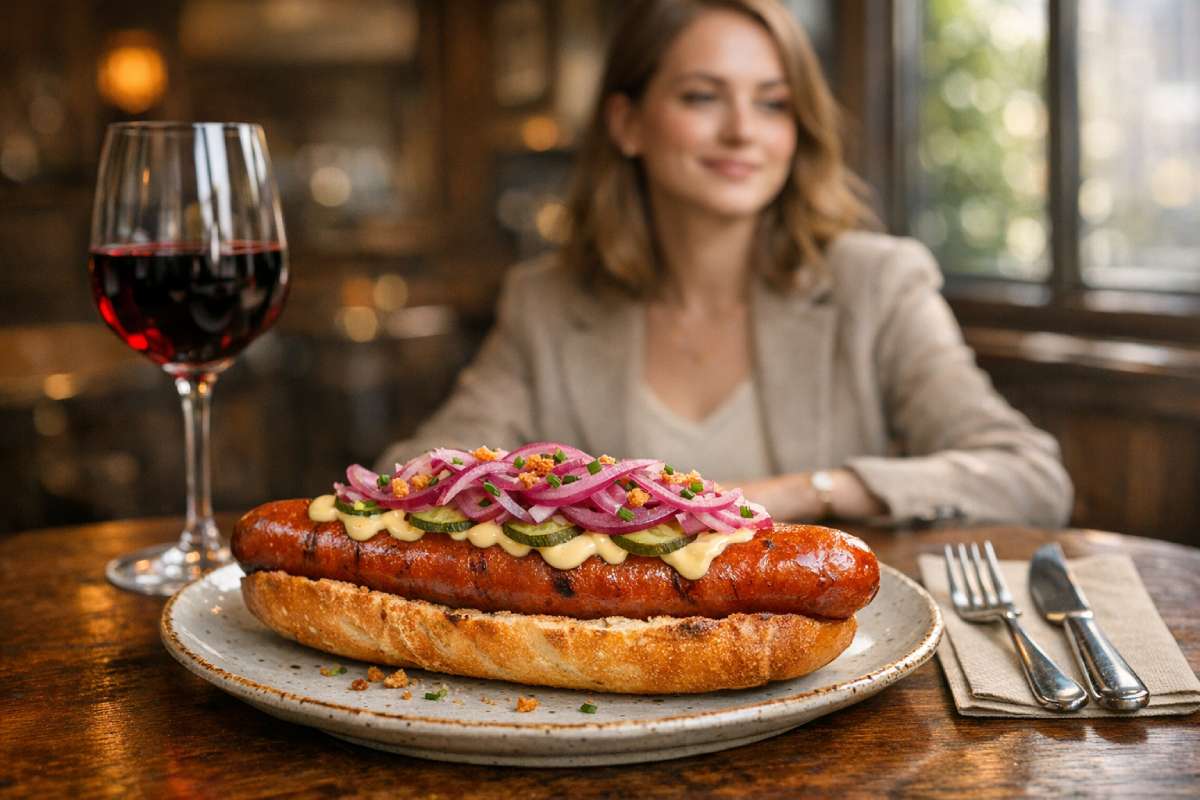
A gourmet hotdog topped with a refined red onion salad—served pub-style with a glass of red wine.
The “onion war” is less about right and wrong and more about choosing the topping that behaves best in your setup. Crispy onions bring fast, reliable crunch and are usually the simplest option for busy pub service, platters, and events—provided you add them at the last moment and keep them away from steam and wet sauces. Caramelised onions deliver deeper, sweeter flavour and can suit premium dine-in builds, but they typically need more prep discipline and careful holding to avoid a watery, bun-softening result.
Once you add the third options—pickled onions for brightness, onion jam for a signature feel, griddled onions for a cooked-to-order compromise, and thin-sliced raw onion for classic bite—you can build hotdogs that suit different guests and different service formats without overcomplicating the line.
If you take one practical approach from this guide, make it this: decide what you’re optimising for (speed, texture, premium flavour, or balance), then standardise the portion and build order so every serve lands the same. If you’d like, use the decision rules above to create a simple “default + upgrade” menu, and let customers pick a side—without slowing your service.
About Sausage Haüs
Sausage Haüs is a UK-focused foodservice brand built around properly made German-style sausages and practical service-ready formats for pubs, events, and catering. Our aim is straightforward: consistent products that cook well, plate well, and help operators deliver a great experience at pace—whether you’re building a quick lunchtime hotdog or a share platter for the evening trade.
We work with Remagen for authentic German sausage heritage and production standards, and our UK distribution is supported through Baird Foods, making it easy for kitchens to source reliably via trade channels. Beyond the sausages themselves, we focus on how the food is actually served—pairings, portion control, holding methods, and menu builds that make sense commercially.
If you’re developing a hotdog line, upgrading your toppings, or looking for a dependable German sausage range for your menu, Sausage Haüs is designed to fit real-world service from first prep to final pass.