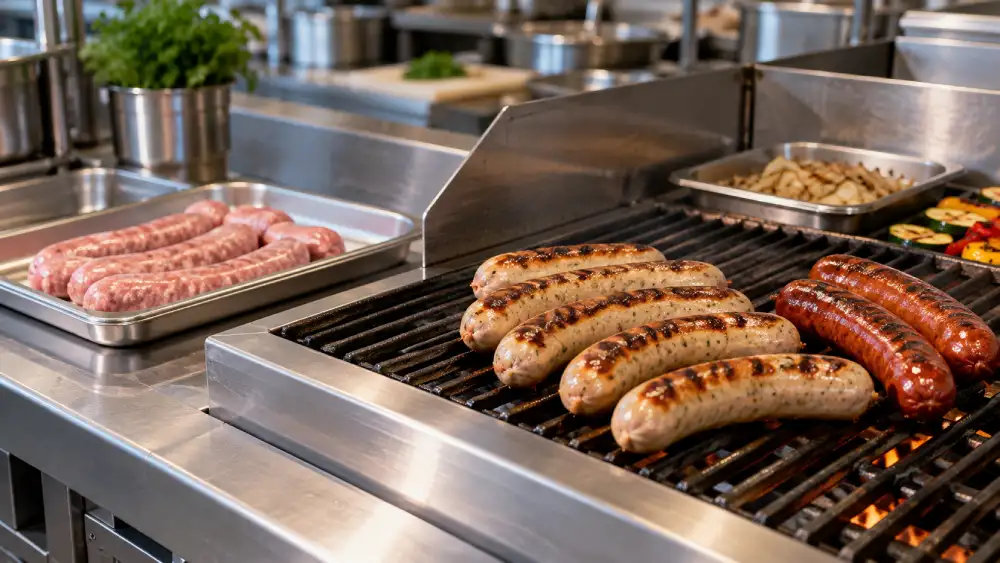
If you remember German Imbiss food from the 80s and 90s—especially around Bratwurst stalls—there is a good chance Schaschlik was on the menu. In Germany, Schaschlik (often also searched as Shashlik in English) is not just “skewers”; it is a whole Imbiss style of cooking: onions and peppers, a bold paprika-tomato sauce, and that unmistakable snack-bar comfort-food taste.
This version is designed for The Sausage Haüs audience and UK readers. It keeps the classic German Schaschlik sauce profile, but makes it easier, faster, and more consistent by using Chilli Beef Frankfurter as the hero ingredient. That gives you the satisfying bite and smoky spice you want from an Imbiss Schaschlik—without needing hours of slow-cooking or tricky meat timing.
Introduction
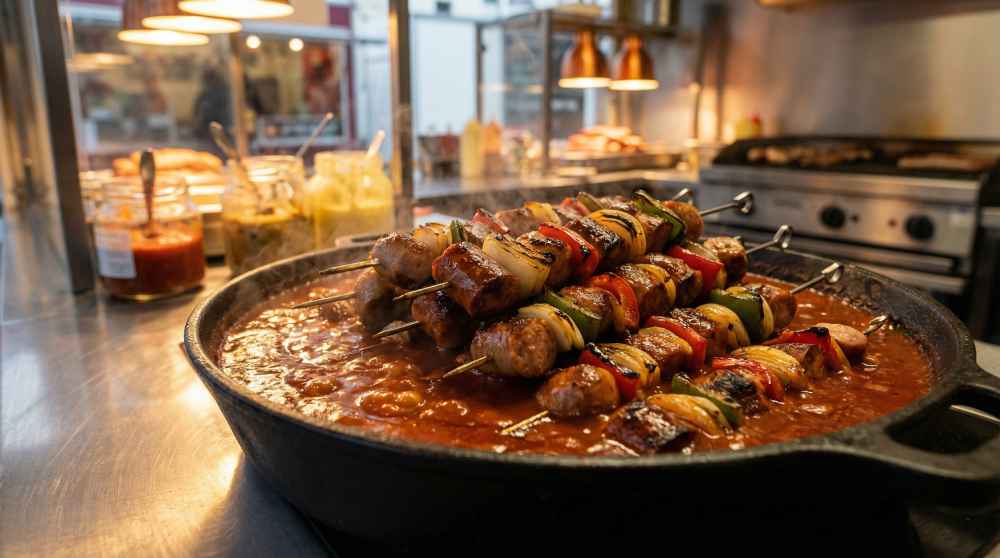
Imbiss-style Schaschlik skewers simmering in rich paprika-tomato sauce—hot, glossy and ready to serve.
If you ever spent time in Germany, you will remember how certain foods were simply everywhere—not because they were fashionable, but because they worked. Schaschlik was one of them: a big pot gently simmering behind the counter at the Imbiss, ready to be ladled over fries, served with bread, or handed across as a quick hot meal when the weather was cold and you wanted something filling. In English, some people search for Shashlik, but what many remember from Germany is this unmistakable German snack bar version—bold sauce, lots of onions and peppers, and that comforting, canteen-style satisfaction.
For many Brits who lived, worked, trained, or travelled in Germany—particularly during the decades when UK connections were common through postings and family life—this German Schaschlik is a genuine nostalgia dish. It brings back the atmosphere of snack-bar counters, festival weekends, roadside stops, and simple hot food that tasted far better than it had any right to. The flavours are intentionally direct: a paprika-tomato base with a slightly sweet-and-tangy edge, designed to pair perfectly with chips, crusty bread, or anything potato-based.
This article is written to recreate that Imbiss Schaschlik experience as authentically as possible, while still fitting modern UK kitchens and real cooking habits. The goal is not to turn it into a chef project. It is to show you how to get the same “German snack bar Schaschlik” depth of flavour at home using straightforward ingredients and a repeatable method—whether you are cooking for the family, meal-prepping for the week, or running a simple pub special.
There is also a deliberate Sausage Haüs twist: we use Chilli Beef Frankfurter as the core protein. That is not just a variation for the sake of it—it is a practical upgrade for consistency and taste. Chunks of pork can vary in cooking time and tenderness; a premium Frankfurter gives you reliable bite, reliable results, and a spicy profile that stands up to a rich sauce rather than disappearing into it. In other words, you get an Imbiss-style dish that is easier to repeat, faster to produce, and still feels completely at home in the world of German street food.
The result is the best of both worlds: an authentic-tasting Schaschlik sauce and that classic snack-bar feel, paired with the robust flavour and performance of Chilli Beef Frankfurter. It is hearty, practical, and built to become one of those recipes you come back to—especially when you want something warming, satisfying, and unmistakably “Germany on a plate.”
Key Takeaways
- Schaschlik is one of the most iconic German Imbiss classics, often remembered from Bratwurst stalls and festival food counters.
- In Germany, “Schaschlik” can mean skewers, but the biggest nostalgia trigger is usually the Schaschlik sauce (German Imbiss style): paprika-tomato, onions, peppers, and a tangy-sweet finish.
- Using Chilli Beef Frankfurter turns Schaschlik into a highly reliable Wurstschaschlik recipe concept: consistent texture, consistent cooking, and big flavour.
- You can refer to it as Schaschlik and include Shashlik once or twice for English searches—without losing the German authenticity.
- This post is written to support both search intents: “Schaschlik sauce” and “Imbiss Schaschlik” (snack-bar style).
What Is Schaschlik in Germany?
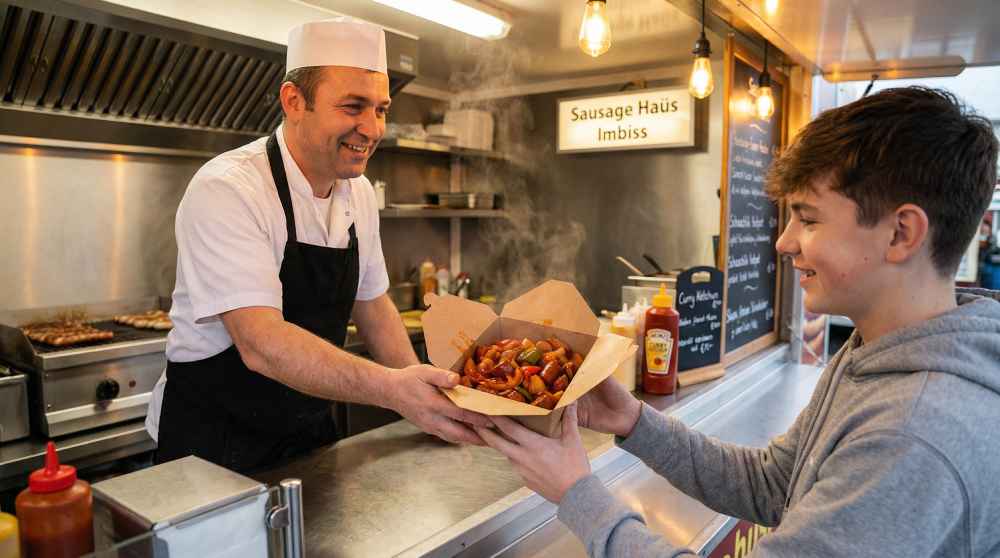
Classic Imbiss moment: a hot Schaschlik pot with Chilli Beef Frankfurter served in a takeaway box, ready to eat.
In the UK, many people hear “Shashlik” and think of skewers—chunks of meat grilled on sticks, often associated with Eastern Europe and Central Asia. In Germany, that skewer idea is absolutely central too. At festivals, grill stands, and classic Imbiss counters, the most recognisable format is Schaschlik on skewers: generous pieces of meat threaded with onion (and often pepper), grilled until browned, then served hot with a bold sauce and something starchy on the side.
That is the version this article focuses on. The recipe you’ll get here is the skewer-style German Imbiss Schaschlik—built to deliver the right “stall food” taste: smoky browning from the grill or pan, sweet onion edges, and a paprika-tomato sauce that feels exactly like something you’d order at a German snack bar. It is simple, high-impact, and designed for real-life UK cooking setups (BBQ, grill pan, or frying pan).
At the same time, it helps to know that in Germany the term is used more broadly than many Brits expect. Alongside the skewers, you will also see a pot-style version simmering behind the counter: the same flavour family—onions, peppers, a rich paprika-tomato base—served quickly over fries or with bread. That “pot” approach is popular because it is easy to hold hot and serve fast, and it is the reason people often search phrases like “Imbiss Schaschlik” when what they really mean is “that German snack bar taste”.
Even when the dish is sold as skewers, the sauce remains the identity. Many stalls use a signature paprika-tomato sauce—sometimes with a slight curry-ketchup edge—so what people are chasing is not just “meat on sticks”, but the full German street-food combination: grilled skewer flavour plus that unmistakable sweet-savoury tang.
For this skewer recipe, we also lean into practicality and repeatability by using Chilli Beef Frankfurter pieces as part of the build (or as a variation if you want to keep it more traditional). It works unusually well in a skewer format because it browns quickly, keeps a satisfying bite, and brings a gentle heat that matches the sauce profile rather than fighting it. The result is a skewer that tastes authentically Imbiss-style, but is easier to execute consistently—especially in a UK kitchen.
So, think of it this way: in Germany, the skewer version is the headline act, the pot version is the convenient counter classic, and both live under the same name because they share the same core flavour logic. This article honours that reality—but the instructions you’ll follow are for the skewer-style Schaschlik/Shashlik that most people picture first, with the pot version mentioned as a close cousin and an easy future variation.
Why Schaschlik Works So Well as an Imbiss or Pub Classic
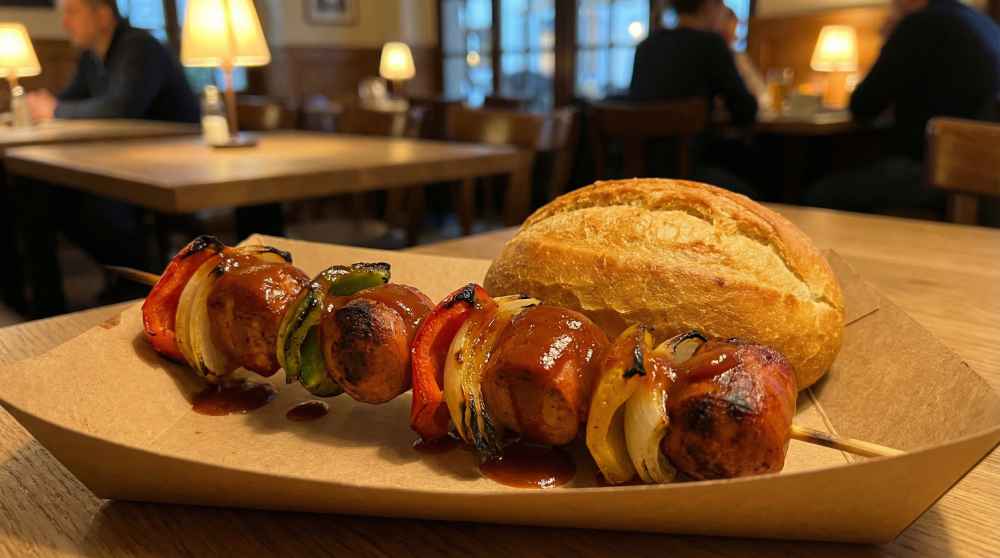
Imbiss-style Schaschlik skewers with Chilli Beef Frankfurter, onions and peppers—served with a crusty roll.
This dish is a textbook Imbiss or pub classic because it was essentially designed around snack-bar realities: speed, consistency, strong flavour, and simple serving formats that work whether you are feeding one person or a queue of twenty. It is not “delicate” food. It is practical, satisfying, and built to deliver the same experience every time.
1) It is made for hot-holding and fast serving
A proper Imbiss needs food that can be prepared in batches, held hot safely, and served in seconds without losing quality. That is exactly where this dish excels. Even when the headline item is skewers, the operation behind the counter often depends on a robust sauce base and components that can be kept ready. The pot-style approach—often referred to as Schaschliktopf—is perfect for that: you can simmer it gently, keep it hot, and portion it quickly.
The reason it works so well is simple: the sauce is forgiving and it improves with time. As it sits, the onions soften further, the peppers mellow, and the paprika-tomato base develops more depth. Instead of drying out or separating, it becomes more cohesive. In snack-bar terms, that means fewer problems during service and more consistent plates. In home-cooking terms, it means it tastes even better the next day, which is exactly what people want from comfort food.
2) The flavour profile is universal (and very “repeatable”)
The core profile—paprika, tomato, onion sweetness, a little tang, and optionally a subtle curry note—hits a sweet spot that works in Germany and the UK. It is bold without being complicated, and it tastes “familiar” even if someone has never eaten the dish before. That is why “German street food recipe” content performs so well: it gives readers something that feels exciting and authentic, but still lands inside flavour territory they already enjoy.
There is also a practical advantage: the flavour is easy to standardise. A snack bar needs a sauce that tastes the same every day. This is exactly that kind of build. Once you have your preferred balance—slightly sweeter, slightly tangier, more paprika-forward, or with a gentle curry edge—you can replicate it with very little variation. That is a huge part of why the dish became so widespread in Imbiss culture in the first place.
3) It pairs perfectly with the Imbiss “holy trinity” of sides
Imbiss food is not just about the main item—it is about what it is served with. This dish was made to sit alongside the classic side formats people expect from a German snack bar:
- Fries (the classic move, and arguably the most iconic pairing)
- Bread rolls / crusty bread (fast, practical, and perfect for mopping up sauce)
- Potato salad (especially in warmer months, or as a canteen-style plate)
- Or simply on its own as a bowl of proper “hot food” when you want something filling and warming
That flexibility is not accidental. It means the dish can move across seasons, budgets, and serving situations. It can be a quick lunch, a late-night comfort meal, a pub special, or a festival-style tray with chips. And because the sauce is the identity, it makes almost anything around it taste better—exactly the kind of value-add an Imbiss aims for.
4) It scales effortlessly from one portion to a big batch
Some recipes are fine at home but fall apart when you try to cook them for more people. This one scales cleanly. The ingredient list is straightforward, the method does not require precision timing, and the “holding” quality is excellent. That is why it works for casual foodservice and why it is such a strong candidate for pubs, pop-ups, and event catering. You can make a base batch, keep it hot, and finish skewers or serve sauce portions without stress.
5) It is visually satisfying and extremely “Discover-friendly”
From a content performance perspective, it ticks the boxes: glossy sauce, visible onions and peppers, browned meat, and a clear street-food identity. It photographs well, it looks hearty, and it communicates “comfort” instantly—even to someone scrolling quickly. That is a major reason it tends to perform strongly in Google Discover: it is both aspirational (“this feels like a German snack bar”) and practical (“I can actually cook this”).
In short: it’s an Imbiss classic because it was built for real service conditions—fast, repeatable, filling, and flavour-forward. That is exactly the combination that also makes it perform well online today.
Why Use Chilli Beef Frankfurter for Schaschlik?
Traditional versions are often pork-based—frequently using neck or shoulder, sometimes mixed cuts—because those pieces stay juicy and develop flavour with time. That approach is excellent, and it is part of the classic German stall identity. The downside is variability: different fat content from pack to pack, different cube sizes, different cooking times, and a higher chance of dry or chewy meat if the heat is too high or the simmer time is too short. For a home cook, that can mean “great one day, slightly disappointing the next.” For foodservice, it can mean inconsistent plates and wasted prep.
Using Chilli Beef Frankfurter solves those problems in a very “Imbiss practical” way. It does not replace the German spirit of the dish—it actually aligns with what snack bars prioritise: consistency, speed, and bold flavour that holds up in sauce.
1) Consistent texture and cooking
Frankfurters are designed to deliver predictable results. When you build a Wurstschaschlik recipe around a premium sausage like Chilli Beef Frankfurter, you get repeatable outcomes: the pieces brown reliably, they heat through quickly, and they stay juicy even if the sauce simmers a little longer than planned. That matters for weeknight cooking, and it matters even more if you want a dish that can be batch-cooked and served fast.
2) A flavour that genuinely belongs in an Imbiss context
A spicy Frankfurter is not a “random twist.” German stalls often carry multiple sausage styles—smoked, spiced, chilli, cheese—because customers like variety and strong flavour. A spicy Frankfurter in a paprika-tomato sauce tastes completely at home: the gentle heat lifts the sweetness of onions and peppers and gives the whole dish more depth without requiring extra ingredients or complicated seasoning.
3) Better sauce integration and a more “snack-bar” bite
Sliced sausage gives you more surface area than chunky pork cubes. In an Imbiss Schaschlik sauce, that means more sauce contact per bite—more paprika, more tang, more of that classic sweet-savoury balance. It also creates a very satisfying texture: a firm bite that contrasts with soft onions and peppers, exactly the kind of mouthfeel that makes people think “this tastes like it came from a German snack bar.”
4) Strong UK relevance and an easier click decision
UK audiences understand sausages immediately. A beef Frankfurter in sauce is familiar, approachable, and feels like comfort food, even to someone who is not sure what the dish name means. From a content perspective, that is valuable: if a reader is uncertain about the term, they will still click a Chilli Beef Frankfurter recipe—especially one positioned as German Imbiss food—because it signals “hearty, easy, and tasty.”
5) More flexibility for heat level and customer preferences
Finally, a Chilli Beef Frankfurter base makes it easy to control spice. You can keep the sauce mild and let the sausage provide the warmth, or add more heat for readers who want a stronger kick. That flexibility works for families at home and for pub service, where you often need a dish that can be “one recipe, two spice levels” without extra labour.
In short, Chilli Beef Frankfurter makes the dish more consistent, more repeatable, and more accessible—while still delivering the bold, satisfying flavour profile people expect from a proper German Imbiss-style meal.
Schaschlik Sauce: The Real Star
If you want this to taste like a proper German snack bar, the main thing to get right is the sauce. The skewers matter, the browning matters, and the onions matter—but the flavour memory people are actually chasing is that unmistakable Imbiss-style paprika-tomato sauce. It is the element that makes the whole dish feel “from Germany”, even when you cook it in a normal UK kitchen.
Snack bars build sauces with a very practical goal: it must taste great with fries, it must stay stable while holding hot, and it must deliver big flavour quickly. That is why the classic approach follows a simple logic:
- Onion-heavy base for sweetness and depth (it’s what makes the sauce taste rounded rather than sharp)
- Peppers for texture, colour, and aroma (and to keep the sauce from feeling one-dimensional)
- Tomato paste + ketchup for body and that unmistakable snack-bar taste (ketchup is part of the “Imbiss signature” in a way home cooks sometimes underestimate)
- Paprika as the smoky-sweet backbone (this is the flavour people identify immediately)
- Acid + sugar balance to keep it lively (a splash of vinegar plus a touch of sweetness stops it tasting flat or heavy)
- Optional: a curry note, which is why “German curry ketchup sauce” sometimes appears as a search term—some stalls add a subtle curry warmth to push the flavour into classic street-food territory
This combination is also the reason so many people search for very specific phrases like:
- Schaschlik sauce (German Imbiss style)
- ketchup and tomato paste sauce
- sweet and sour paprika sauce
They are not necessarily trying to recreate a chef-style reduction. They are trying to recreate the exact snack-bar flavour profile: bold, slightly sweet, slightly tangy, and intensely satisfying—especially when it hits something starchy like chips or bread.
It is worth saying plainly: this is not fine dining, and it is not supposed to be. A good Imbiss sauce is deliberately direct, comforting, and “moreish.” When you get the balance right—onion sweetness, paprika warmth, tomato richness, and that tangy lift—the dish becomes instantly recognisable, and it makes everything around it taste better. That is why, in practice, the sauce is the real star.
How to Serve It Like a Proper Imbiss
You do not need to overcomplicate the Schaschlik. The whole point of an Imbiss Shaschlik is that it is simple, fast, and satisfying—served in a way that makes sense for standing, sharing, or eating quickly without cutlery theatre. If you want the “German snack bar” feeling at home (or in a pub special), focus on two things: a hot, generous portion and a side that soaks up sauce properly.
1) Chips (the classic)
Serving it with chips is peak snack-bar logic. It is the most recognisable Imbiss pairing because it turns the dish into a complete meal with almost no extra work. You have crispy, salty chips and a rich, bold sauce that clings to them—exactly the contrast people remember from German street food counters.
Practical notes to make it feel authentic:
- Use medium-thick fries rather than ultra-thin ones. Thin fries go soggy too quickly once the sauce hits.
- Serve the fries first, then spoon the sauce over the top so you keep a mix of crisp edges and saucy bites.
- If you want the “stall tray” feel, finish with a small extra spoon of sauce right before serving, so it looks glossy and fresh.
From a content and marketing perspective, it also photographs brilliantly: the shine of the sauce, visible peppers and onions, and those chunky sausage pieces make the dish instantly readable in one image. That is one reason this serving style tends to perform well in scroll-based environments like Discover: it looks hearty and practical, not fussy.
2) Bread roll / crusty bread (the easy UK crossover)
This is the most natural bridge for UK readers. A bowl of this dish with a warm roll or thick slices of crusty bread is comfort food people understand instantly: rich sauce, savoury meat, soft onions, and bread to mop the plate. It is also the serving option that makes the dish feel like a cold-weather staple—quick dinner, late-night food, or “something proper” after a long day.
Practical notes:
- Choose bread with structure (a crusty roll, baguette, or sourdough). Soft sliced bread collapses fast.
- Serve the bread warmed if you can—ten minutes in the oven changes the whole experience.
- If you want a more “German” feel, go for a Brötchen-style roll (crusty outside, soft inside) and serve the sauce in a bowl on the side so people can dunk and mop.
Optional “Imbiss upgrade” touches (still simple)
If you want to lean into the snack-bar vibe without adding labour, these small additions do the job:
- A small dollop of mustard on the side (sharpness cuts the richness).
- A few raw onion rings or finely sliced onion as a topping for crunch (very common in stall food culture).
- Pickles or gherkins as a quick, acidic counterpoint.
The guiding principle stays the same: keep it bold, hot, and generous. That is how an Imbiss serves it—and that is how it tastes best.
Imbiss-Style Schaschlik Skewers With Chilli Beef Frankfurter
Ingredients
Method
- Heat oil in a large pot or rondeau on medium-high.
- Add sliced onions and cook 8–10 min until softened and lightly golden at edges.
- Add pepper strips, cook 4–5 min to soften slightly but keep some texture.
- Add tomato paste, cook out 2–3 min (important: remove raw taste).
- Add ketchup + passata, stir until homogeneous.
- Add stock, bring to a steady simmer.
- Season: paprika(s), pepper, curry (optional), Worcestershire, vinegar, sugar, salt (start lower).
- Simmer 15–20 min, stirring occasionally to prevent catching.
- Consistency target: thick enough to cling to skewers and fries, not watery.
- If too thin after simmering, add cornflour slurry gradually while simmering, until it nappes the back of a spoon.
- Cut Frankfurter into 4–5 cm chunks (bigger looks more “Imbiss” and holds better in sauce).
- Cut onions into petals and peppers into 2–3 cm squares for threading.
- Toss Frankfurter pieces lightly with oil, salt, pepper, smoked paprika (and optional garlic powder).
- Assemble skewers: Frankfurter → onion → pepper → repeat (4–5 sausage chunks per skewer).
- Use metal skewers for service; soaked bamboo works for home or events.
- Goal: browning + a little char. This creates the “stall” taste.
- Plancha / flat top: 2–3 min per side
- Chargrill: 3–5 min total, turning
- Heavy pan: 6–8 min total, in batches
- You are not “cooking from raw” here—Frankfurter is ready-to-eat—so you’re building colour and flavour.
- Lay seared skewers into the simmering sauce (single layer if possible, then stack).
- Simmer gently 6–10 min so the skewers are fully hot and sauce clings.
- Hold at ≥63°C for service.
- Fastest: hold skewers in sauce; plate/box to order.
- Best texture: hold sauce hot, keep skewers warm/dry, dip/finish 2–3 min in sauce to order.
Frequently Asked Questions
Yes—this is ideal. The sauce often tastes even better after resting because the onions and peppers soften further and the flavours blend. Reheat to piping hot and hold at safe hot-holding temperature during service.
Yes. You can cook it as a Schaschliktopf-style pot: brown the sausage pieces, simmer them in the sauce with onions and peppers, and serve in a box or bowl. It is excellent for hot-holding and batch service.
Use an onion-heavy base, sweet paprika, tomato paste plus ketchup for body, then balance with a little vinegar and sugar. The goal is bold, slightly sweet and slightly tangy—made to taste great with fries.
For best quality, rotate batches and avoid over-holding skewers until they go too soft. Many operators hold the sauce hot and finish skewers to order (or hold finished skewers for a shorter window). Consistency is best when you keep the sauce stable and refresh skewers regularly.
The heat is usually a warm background rather than aggressive. To make it milder, keep the sauce mild and avoid extra chilli. To increase heat, add chilli flakes, hot paprika, or a little hot sauce—without overpowering the Imbiss profile.
They are related, but not identical in how people use the term. “Shashlik” often implies grilled skewers more broadly, while the German Schaschlik memory for many people includes the distinctive Imbiss-style paprika-tomato sauce and the way it is served with fries or bread.
For the best result, grill or sear first. Browning adds that stall-style flavour and a light char note. After searing, finish the skewers in the sauce for a few minutes so they take on the Imbiss coating.
In Germany, Schaschlik usually refers to skewers of meat (often with onions and peppers) served with a bold paprika-tomato sauce—an Imbiss classic at snack bars, festivals and grill stands. Some places also serve a pot-style version in the same sauce.
The most classic serving is with fries, either with sauce ladled over or on the side. A close second is crusty bread or a bread roll for dipping and mopping up the sauce—both feel very “Imbiss”.
Chilli Beef Frankfurter gives consistent texture and fast service results. Because it is already cooked, you focus on browning for flavour and then finishing in sauce—perfect for an Imbiss workflow and repeatable quality.
Conclusion
Schaschlik is the kind of dish that proves why German Imbiss food has such lasting appeal. It is not complicated, it is not delicate, and it does not rely on perfect technique—yet it delivers a big, satisfying flavour hit that feels instantly familiar to anyone who has spent time in Germany. The Shashlik skewer format brings that classic grill-stand character, while the sauce does the heavy lifting: paprika warmth, tomato depth, onion sweetness, and that slightly tangy edge that makes you want “one more bite,” especially with fries.
Using Chilli Beef Frankfurter is the practical upgrade that makes this recipe easy to repeat. You get consistent texture, reliable cooking, and a flavour profile that genuinely belongs in the snack-bar world—robust enough to stand up to a rich sauce, with a gentle heat that lifts the whole dish. For UK readers, it also makes the recipe more approachable: the format is recognisable, the ingredients are straightforward, and the result feels like proper comfort food rather than an obscure niche dish.
Most importantly, this is a recipe that earns its place in your regular rotation. It works for casual family dinners, it scales well for guests, and it is ideal for pub or event service because it holds its quality and delivers fast, satisfying plates. Serve it like a proper Imbiss—hot, generous, and paired with fries or crusty bread—and you get a genuine taste of Germany without leaving the UK.
If you have been searching for that “German snack bar” flavour you remember, this is it.
About The Sausage Haüs
The Sausage Haüs supplies authentic German sausages for UK retail and foodservice—built for consistent quality, reliable handling, and strong customer appeal. Our range is produced using heritage German butchery expertise, including our long-established German partner Remagen (founded in 1718), and distributed in the UK through Baird Foods.
We focus on products that perform in real service conditions: excellent flavour, dependable cooking results, and formats that work just as well for pubs, festivals, street food counters and caterers as they do for home cooks. From classic Bratwurst and traditional Frankfurters to modern options like our Chilli Beef Frankfurter, The Sausage Haüs is designed to help you serve bold, memorable German food—without unnecessary complexity.
To explore the range, visit The Sausage Haüs website or speak to Baird Foods about UK supply and availability.